


Healthcare app development covers any mobile or web software that handles medical data, connects patients with providers, or supports clinical work. In the US, there’s a catch sitting on top of all of it.
If the app touches protected health information, HIPAA applies, and that one law ends up deciding things you’d never expect it to, like which database you can use or how a nurse logs in on a shared ward tablet.
We’ve watched founders treat compliance as paperwork to sort out before launch. It never plays out that way. So this guide walks through what actually falls under HIPAA, security work regulators look for, build process, honest cost figures, and one phase that blindsides almost everyone.
What Counts as a Healthcare App and Which Ones Fall Under HIPAA
People throw everything from step counters to hospital management systems into the same bucket and that gets messy the moment compliance questions show up.
Here’s the test that cuts through it. Does the app create or transmit protected health information on behalf of a covered entity? If it does, HIPAA applies. If it doesn’t, you’re probably in the clear.
Apps that must comply with HIPAA
The obvious ones are telemedicine platforms, patient portals and remote patient monitoring apps. Add appointment systems tied to a clinic and anything a doctor uses to pull up patient records.
Honestly, if a healthcare provider or insurer appears anywhere in your business model, work on the assumption that HIPAA applies until a lawyer tells you it doesn’t.
Apps that usually sit outside HIPAA
A fitness tracker you download yourself, a meditation app, a calorie counter. These handle health related data, but not on behalf of a covered entity, so HIPAA does not reach them. FTC rules and state privacy laws still do, though.
Washington’s My Health My Data Act and similar state laws have closed much of the old gap, so “we’re just a wellness app” is a weaker shield than it was five years ago.
Read More: How to Build HIPAA & GDPR Compliant Apps
The $86 Billion Reason Healthcare Apps Keep Getting Built
The money explains the crowded market. Grand View Research put the global mHealth apps market at $37.5 billion in 2024 and expects it to reach $86.37 billion by 2030, growing 14.8% a year.
The revenue split surprises people. Roughly three quarters of it comes from medical apps, not the fitness apps that dominate download charts, and North America takes the biggest regional cut.
A few things pushed it here. Telehealth outgrew its pandemic workaround phase and settled in as a normal way to see a doctor. Conditions like diabetes and heart disease demand daily attention, and phones happen to be very good at daily. Then wearables arrived and quietly moved continuous health monitoring out of the hospital and onto people’s wrists.
Providers now expect apps to plug into their workflow, and patients expect the same convenience they get from their banking app. That’s a high bar, and it’s why so many healthcare apps launch, stall, and quietly disappear.
HIPAA Compliance Explained Without the Legal Jargon
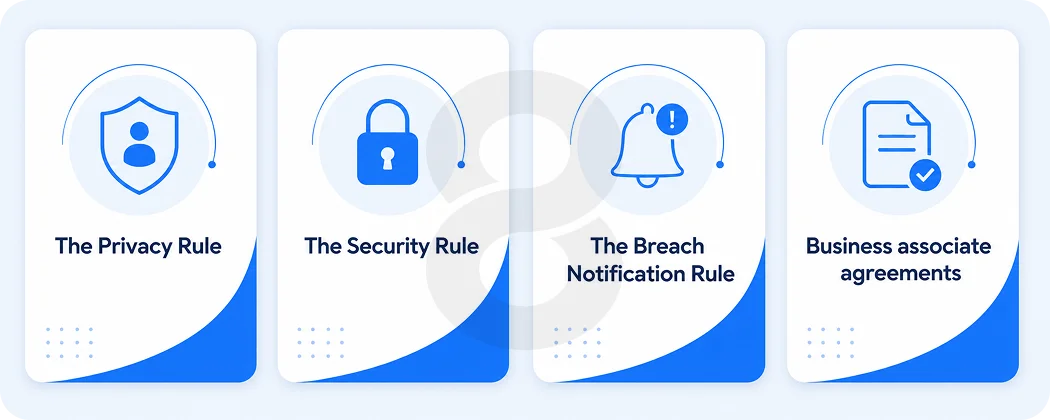
Strip away the legal language and HIPAA comes down to three rules an app builder needs to care about.
The Privacy Rule
This one decides who gets to see protected health information and under what circumstances. Inside an app, that becomes consent flows, role based access, and the restraint to collect only the data the product genuinely needs. A billing clerk has no business reading clinical notes. Your marketing team has no business seeing any of it.
The Security Rule
The HIPAA Security Rule, published by the US Department of Health and Human Services, asks for administrative, physical, and technical safeguards around electronic health data. It was written to be technology neutral, which sounds sensible until your engineers ask for a checklist and discover there isn’t one.
What it means in practice is encryption, access controls, audit trails, and a documented risk analysis. Pay attention to that last item. When federal regulators penalize companies, a missing or half done risk analysis is the failure they cite most often.
The Breach Notification Rule
When protected health information leaks, the people affected have to hear about it within 60 days. Breaches that hit 500 or more individuals also get reported to regulators, who publish them on a public portal for anyone to browse.
The 2024 Change Healthcare ransomware attack exposed data on roughly 193 million people, and after that, breach preparedness stopped being a legal formality and started coming up in board meetings.
Business associate agreements
Every vendor that touches your health data, from your cloud host to your SMS provider, needs a signed business associate agreement. AWS, Google Cloud, and Azure all offer them, but only for specific services. Twilio will sign one. Many analytics tools will not, and plenty of healthcare apps have leaked data through an SDK the founders forgot was even installed.
Read More: How Pregnancy Tracker Apps Handle HIPAA and GDPR
7 Security Measures Your Healthcare App Cannot Launch Without
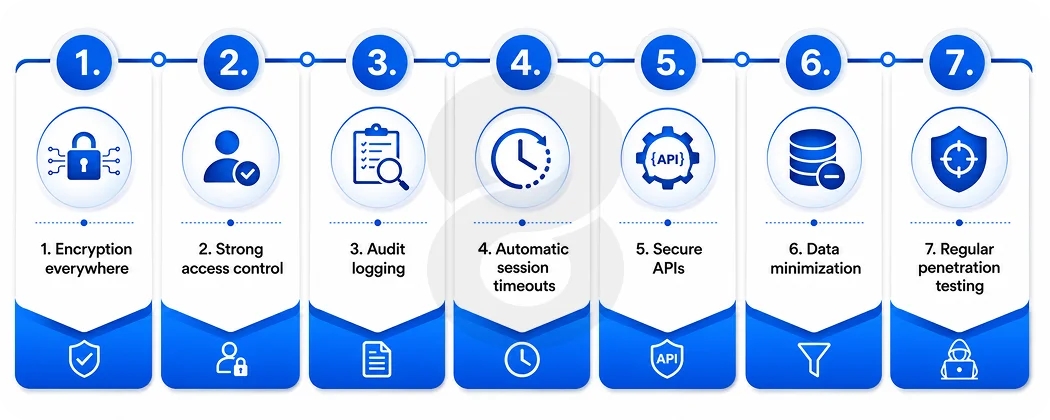
Healthcare data breaches cost an average of $7.42 million per incident, the most expensive of any industry for more than a decade running. These seven measures are where prevention actually happens.
1. Encryption everywhere
AES 256 for stored data and TLS 1.2 or higher for anything moving over a network. That covers the basics, but the details are where apps fail. Encryption keys need their own management plan, kept separate from the data they protect, and backups need the same treatment as production databases because attackers know they’re often forgotten.
There’s a practical payoff too. Properly encrypted data that gets stolen may qualify for a breach notification safe harbor, meaning you might not have to report the incident at all. That one clause has saved companies from headlines.
2. Strong access control
Every user gets a unique ID, multi factor authentication guards the door, and role based permissions decide what’s visible once inside. A front desk coordinator needs schedules, not lab results.
The part teams skip is offboarding. When a nurse leaves the clinic or a contractor rolls off the project, their access should die the same day, through a process that runs automatically rather than depending on someone remembering.
3. Audit logging
You need a tamper resistant record of who opened which patient record, when, and what they did with it. Regulators ask for these logs first in any investigation, and “we don’t have them” reads as guilt.
Good logging also protects your own staff. When a well known patient gets admitted and someone snoops, the log is how you find out, and hospitals fire people over exactly this more often than you’d think.
4. Automatic session timeouts
Clinical devices get shared, passed around, and left unattended on counters. A tablet still logged in at a nursing station is a breach waiting for a passerby. Short session windows with quick biometric re-entry solve this without driving staff crazy, and the re-entry part matters.
If logging back in takes thirty seconds and six taps, staff will find workarounds, usually sticky notes with passwords, and your timeout policy will have made things worse.
5. Secure APIs
Token based authentication, rate limiting, and strict input validation on every endpoint that touches patient data. APIs deserve extra paranoia because they’re invisible in a demo. Nobody notices a leaky endpoint until someone enumerates patient IDs through it.
Test for broken object level authorization specifically. It’s the most common API flaw in healthcare apps, and it’s exactly the kind of bug that turns one patient’s data into everyone’s.
6. Data minimization
Don’t collect what you don’t need, and don’t keep what you’re done with. Every field you add to a signup form is a liability you’ll carry for years, and data you never stored can never leak.
Retention deserves a written policy with actual deletion behind it, not an archive folder nobody audits. This is also the cheapest measure on the list. It costs nothing to not build a field.
7. Regular penetration testing
Your own team stops seeing its blind spots after a few months of staring at the same codebase. Independent software testing before launch and after every major release catches what familiarity hides.
Pair scheduled penetration tests with automated vulnerability scanning between them, and treat the findings report as a work queue, not a certificate. Plenty of breached companies had a clean pen test PDF sitting in a drawer.
How to Build a Healthcare App in 7 Steps
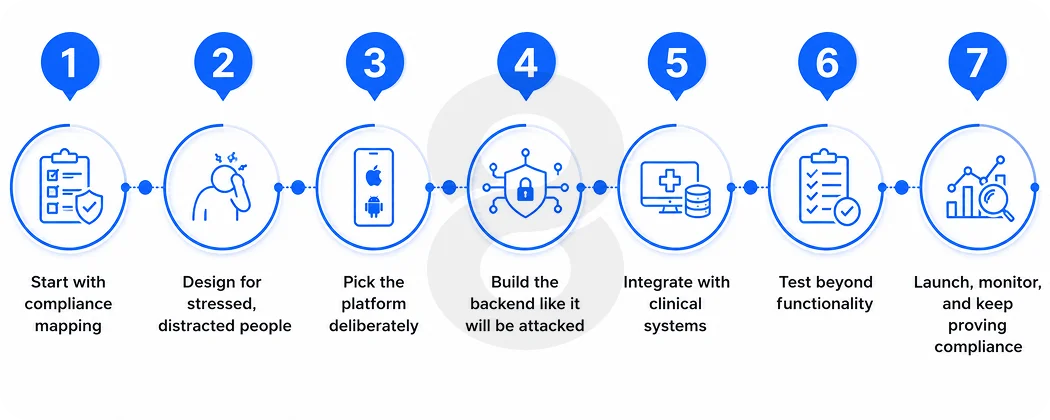
Every healthcare app project we’ve seen succeed followed roughly the same sequence, and every one that turned painful skipped a step near the front. The order below isn’t arbitrary. Compliance and data decisions come first because they’re brutally expensive to change once code exists, and the flashy parts come later because they’re the easy bit.
1. Start with compliance mapping
Before anyone designs a screen, sit down and document what data the app will handle, where that data will live, who gets to touch it, and which regulations reach it. You’ll need this risk analysis for legal reasons anyway. Doing it first just means you won’t tear out half the architecture six months in.
2. Design for stressed, distracted people
Picture a patient opening the app at 2 am to check a test result they’ve been dreading. Clever navigation means nothing to that person. Healthcare UX comes down to large touch targets, plain language and flows a 70 year old can finish without phoning their kids for help.
3. Pick the platform deliberately
Going native with iOS and Android development gets you the deepest access to HealthKit and device sensors. A cross platform approach with Flutter makes more sense when the budget has to cover both stores at once.
Either route can pass a HIPAA audit, and that’s the point worth remembering. Auditors care about how you handle data, not which framework draws the buttons.
4. Build the backend like it will be attacked
Because it will be. Ransomware crews go after healthcare more than any other industry, and being a small startup doesn’t take you off the list. If anything, it makes you the softer target.
Start with HIPAA eligible cloud infrastructure and get the business associate agreement signed before a single patient record lands on it. Then wall off patient data in its own environment, so a breach in one service stops there instead of handing over the whole system.
Logging and monitoring belong in the first sprint, since bolting observability onto a system after an incident is installing cameras after the robbery. Same thinking applies to backups and disaster recovery.
The teams that bounce back from ransomware in days made those decisions months earlier. The ones that take weeks are improvising.
5. Integrate with clinical systems
This is where the app earns its place in an actual care workflow. EHR connections let providers see app data inside the systems they already work in. Lab integration pulls results automatically instead of asking patients to upload PDFs. Pharmacy networks make e-prescriptions possible, and payment processing has to handle insurance logic, not just card charges.
Sequence matters here. Each integration partner has its own approval process and quirks, so run them in parallel rather than one after another. More on the EHR side below, because it deserves its own section.
6. Test beyond functionality
Standard QA confirms the buttons work. Healthcare needs more layers on top of that. Security testing probes authentication, session handling, and data exposure. Load testing earns its keep in healthcare because demand arrives in waves. Monday mornings hit clinics hard, and flu season can triple telehealth traffic overnight.
A platform that buckles right then has failed the only test that counted. Then comes compliance validation, which is really just checking your own homework. Your risk analysis made promises about consent flows, audit logs, and data handling. This is where you confirm the shipped product keeps them.
A bug in a food delivery app annoys someone. A bug in a medication dosage screen can hurt someone, which is why medical apps get tested against edge cases consumer apps would never bother with.
7. Launch, monitor, and keep proving compliance
HIPAA compliance is continuous, and launch day is when the ongoing work starts. Annual risk assessments are mandatory, not a nice to have. Dependencies need patching on a schedule, because most healthcare breaches exploit known vulnerabilities that already had fixes available.
Staff need training refreshers, since phishing remains the most common way attackers get in. Run breach response drills before you need one, so the first time your team practices notification procedures isn’t during an actual incident. And keep the documentation current, because when regulators come asking, the paper trail is your defense.
Read More: Telemedicine App Development Cost in 2026
Healthcare App Features That Earn Their Place
Pitch decks tend to list twenty features. Usage data usually vindicates about six of them. What follows are the ones patients and providers keep coming back for.
Appointment booking and reminders sit at the top, and it isn’t close. Secure messaging with the care team comes next, then access to test results. For telehealth products, video consultations carry the whole experience, and they need infrastructure built for HIPAA rather than whatever generic video SDK was easiest to drop in.
Medication reminders drive daily retention. E-prescriptions and bill payment reduce phone calls, which is what clinics actually pay for.
On the growth side, syncing with wearables through dedicated wearable app development turns passive users into daily ones, and connected medical devices built on IoT app development make remote patient monitoring possible at all.
AI symptom checkers and triage assistants, typically added as an AI chatbot layer, take real pressure off support teams. In a medical setting, though, they need guardrails and disclaimers written by someone who has thought hard about what happens when the bot gets it wrong.
Read More: Custom Pharmaceutical Software Solutions: A Guide for Growing Pharma Companies
Healthcare App Development Cost Overview
Budget 20 to 40 percent above what a comparable consumer app would run you. Compliance documentation, security engineering, and clinical integrations all bill real hours, and none of them show up in the feature list. The ranges below reflect where typical projects actually land.
| App Type | Typical Cost (USD) | Timeline | Complexity |
|---|---|---|---|
| Appointment Booking & Reminder App | $40,000–$80,000 | 3–4 Months | Simple |
| Patient Portal with EHR Access | $80,000–$150,000 | 4–7 Months | Medium |
| Telemedicine Platform with Video Visits | $100,000–$200,000 | 6–9 Months | Medium to High |
| Remote Patient Monitoring with Connected Devices | $120,000–$250,000 | 6–10 Months | High |
| Hospital-grade System with Multiple Integrations | $250,000+ | 9–12+ Months | Very High |
The variables that move these numbers most are the number of EHR integrations, whether you build native or cross platform, video infrastructure, and how much of the compliance documentation your team can produce internally. Ongoing maintenance typically runs 15 to 20 percent of the build cost per year, and in healthcare it is not optional.
Read More: Healthcare App Development Cost in 2026: A Detailed Guide
EHR Integration Is the Part Nobody Warns You About
Here’s the uncomfortable truth. The app itself is often the easy half of healthcare app development. Wiring it into electronic health record systems like Epic or Oracle Health is where the schedule quietly falls apart.
Modern integrations run on FHIR, standard API format, and anyone who suffered through the old HL7 v2 era will tell you how much better things are now. Better does not mean easy.
Every hospital configures its EHR its own way, hospital IT security reviews can drag on for weeks, and the sandbox you tested against has a habit of behaving differently from production.
A single Epic integration that looks like a two week task on paper regularly takes two months once approvals, testing, and edge cases are counted.
The practical advice is to start integration conversations with target health systems before development begins, not after. Experienced system integration work up front, including mapping which FHIR resources you actually need, saves painful surprises at the end of the project.
Where Healthcare App Development Goes From Here
Three shifts are worth building for right now. First, AI is moving from chatbot novelty to clinical workflow, with ambient documentation, triage support, and personalized care plans leading adoption.
Serious products treat AI development in healthcare as a regulated activity, with model documentation and human oversight built in, because the FDA is paying attention to software that behaves like a medical device.
Second, care keeps moving home. Remote monitoring, hospital at home programs, and connected devices keep pushing care into the living room, and the app is increasingly the first thing a patient touches before any human gets involved.
Third, interoperability rules keep tightening in patients’ favor. Federal information blocking regulations require providers to share records, which means apps that make patient data useful have regulatory wind at their backs for the first time.
Read More: Healthcare Automation Solutions Explained: From Scheduling to Claims Processing
How 8ration Approaches Healthcare App Development

8ration is a custom software agency that builds healthcare software alongside its fintech and consumer work, which shapes how the team treats patient data. The habits carry over from finance, where encryption, audit trails, and access discipline are assumed rather than argued for.
On the healthcare side, the team has shipped products like a cardiac fitness tracking app built around five clinical monitoring protocols and a patient access platform for pharma sponsored support programs.
Projects start with the compliance mapping described earlier in this guide, then move through design, mobile app development, integration, and testing with the same engineers throughout, so context does not get lost in handoffs.
The team works with US healthcare clients across time zones and provides post launch maintenance, which in this industry means keeping the compliance file current, not just fixing bugs.
Read More: Top Healthcare Software Development Companies Based on Clutch Reviews