




It’s 6:30 PM on a Tuesday. You’re still at your desk because of a denied claim, a miscoded entry, a patient scheduled with the wrong specialist. Again. The administrative side of healthcare is genuinely broken.
Trilliant Health’s 2025 analysis shows admin costs hit 66.5% of total hospital operating expenses, up 87.2% since 2011. Nearly two-thirds of physicians cite admin work as their top burnout driver.
Healthcare automation solutions have existed for years, but what’s being deployed in 2025 and 2026 is fundamentally different from the rule-based bots that came before.
How Healthcare Automation Solutions Actually Work Today
The term “healthcare automation” gets thrown around a lot, usually by vendors trying to sell something. So let’s strip it back to what it actually means in practice.
Healthcare automation is the use of software, AI, robotic process automation (RPA), and connected workflows to handle repetitive administrative and clinical tasks without someone manually doing them. The goal is simple: fewer errors, less time wasted, faster payments, and staff who aren’t completely burned out by Friday afternoon.
What has changed in the past 2–3 years is that these solutions started to go beyond simple task automation. Today’s platforms leverage artificial intelligence to identify different claim types that are more likely to be denied, NLP to extract structured data from unstructured clinical notes, and AI agents to automate “supply exception” routing, claim status checks and other tasks within payer portals.
The 2025 CAQH Index stated it simply: In 2024, the healthcare industry saved $258 billion from administrative expenses by adopting automation and electronic transactions. However, the same report identified that there’s still $21 billion in savings to be realized, as organizations are waiting for their processes that remain partially or fully manual to be completed.
Read More: Custom Pharmaceutical Software Solutions: A Guide for Growing Pharma Companies
The Four Areas Where Automation Delivers the Most
If you’re trying to figure out where to start, the answer from virtually every research study points to the same four areas: prior authorization, medical coding, patient scheduling and no-shows, and clinical documentation. These four account for the largest, most automatable cost centers in any health system of meaningful size.
Prior authorization alone costs practices $11,000 per clinician annually in staff time, according to Trilliant Health’s analysis. Denied claims average $118 per rework episode. A single no-show in primary care represents roughly $200 in lost revenue. And documentation time? Physicians spend between 34% and 55% of their workday on clinical documentation and reviewing electronic medical records, time that could be spent with patients.
Patient Scheduling Automation: Fixing the Leaky Front Door
Consider how many health care visits take place by appointment anyway. Callers are placed on hold, contacted with a calendar check by a front desk employee, approved, and sent home; and perhaps a reminder card is sent in the mail. This process hasn’t changed much since the 1980s.
According to Experian Health’s State of Patient Access survey, 63% of providers offered self-scheduling in 2024, up from just 40% in 2022. That’s real progress. But here’s the catch: MGMA polling shows that most practice leaders report only 25% or fewer patients actually use digital scheduling tools. The gap between offering it and patients actually using it is a product and UX problem as much as a technology one.
Automated scheduling platforms rectify the back end of this. Online booking systems can automatically verify insurance, send intake forms, deliver pre-visit instructions, and schedule text or email reminders. Staff won’t need to handle any of it until the patient comes in.
Read More: How to Build an Appointment Scheduling System Like Calendly
What Scheduling Automation Actually Recovers Financially
Tebra research estimates that no-shows cost practices between $3,200 and $6,800 per month. Automated reminders with confirmation requests reduce no-show rates by 25 to 45% according to KFF data. For a practice with 120 weekly appointments and a 30% no-show reduction, that recovery can reach $90,000 to $160,000 in annual revenue. The automation cost pays for itself within the first month.
The deeper value is for front desk staff. When a system handles routine booking, cancellations, rescheduling confirmations, and intake form collection automatically, your staff aren’t spending half their day on phone calls. They’re available for things that actually require a human: insurance escalations, complex patient questions, and situations where judgment matters.
| Scheduling Problem | Manual Process Cost | Automation Impact |
|---|---|---|
| No-show rate (avg 5%) at 400 weekly appointments | $156K–$364K annual revenue loss | 25–45% reduction via automated reminders |
| Staff time on scheduling calls | 700–870 hours per scheduler annually | 38–47% time savings (Deloitte) |
| Self-scheduling adoption (2022) | 40% of providers offered it | 63% offering it by 2024 (Experian Health) |
| Patient form completion | Manual, paper-based | Automated intake on booking confirmation |
Claims Processing Automation: Where the Real Money Is
Claims processing is the most painful part of the revenue cycle, and also the one where automation delivers the clearest financial return. So it’s worth spending real time here.
In 2024, insurers denied 19% of in-network claims according to KFF, and fewer than 1% of those denials were ever appealed. Think about that for a second. Nearly one in five claims gets denied, and the vast majority of the revenue that could be recovered through appeals just… disappears. Because no one has the time or staff to chase it.
The 2025 CAQH Index reported that the healthcare industry could save more than $20 billion each year through further automation of claims-related workflows. Aetna made news in May 2026 when it announced its Claims Assist Manager tool reduced processing time for complex claims requiring manual review by more than 20% using AI agents.
Read More: 10 Telehealth Mobile App Success Stories: What Worked and What Didn’t
How Automated Claims Processing Actually Works
The whole journey is covered by modern claims automation. At the end of a patient visit, AI scans the clinical notes, classifies them with the relevant ICD-10 code, checks for pre-submission requirements according to the payer’s rules, detects any potential denial triggers, and submits the claim. It is monitored in the system as it makes its way through adjudication and any problems are passed onto the appropriate person.
Once it took a trained coder to manually review notes, enter codes, check edit rules, and submit via a payer portal; this can now happen with minimal human contact. In real-time, AI-native coding solutions like RapidClaims incorporate NLP and analyze unstructured clinical notes and discharge summaries. They have deny predictor flags that will point out claims that may be a problem before you submit them, rather than chasing appeal deadlines 6 weeks later.
Experian Health’s 2025 research found that 56% of providers say patient information errors are the primary cause of claim denials. Those are errors that automated eligibility verification catches before a claim is ever submitted.
| Claims Metric | Industry Benchmark | With Automation |
|---|---|---|
| Initial denial rate | 19% (KFF, 2024) | Reducible via predictive denial tools |
| Clean claims rate target | 95%+ (HFMA, 2024) | Achievable with AI-assisted coding |
| Denial rework cost | $47.77–$63.76 per claim (HFMA) | Reduced through pre-submission scrubbing |
| Annual rework cost, industry-wide | $20 billion (HFMA) | $20B+ savings opportunity (CAQH, 2025) |
| Claims follow-up speed | Manual staff rate | AI agents work 4–5x faster, cut follow-up costs ~80% |
Prior Authorization: The Automation Most Practices Need Yesterday
Prior authorization is a topic that deserves a discussion all on its own due to its particular pain factors. According to the AMA, doctors submit an average of 39 prior authorization requests per week and spend about 13 hours on PA-related activities. And 94% of doctors believe that prior authorization negatively affects patient care.
Prior authorization (PA) automation involves submitting PA requests electronically, monitoring approvals and getting responses directly from the payers instead of via fax and hold music.
For example, HIMSS 2025 benchmarks show an average of 12.4 hours per week of staff time saved per five physicians with practices that fully automated their PA workflows, and that 87% of these practices had a full ROI within six months of deployment.
Clinical Documentation Automation: Giving Time Back to Clinicians
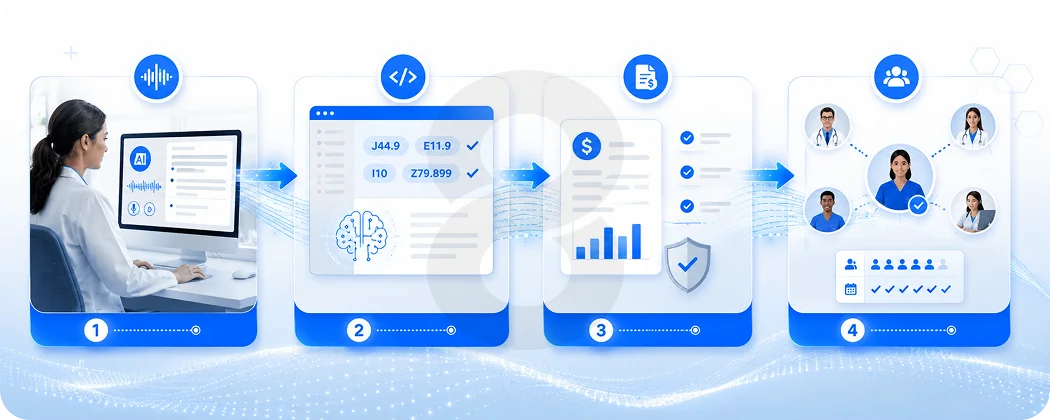
Clinician burnout exists in documentation. Physicians spend 34 to 55 percent of their work day on clinical notes and EHR review. Ambient documentation tools listen to the encounter and create a structured note in real time, and document it in the EHR.
How AI scribes are changing the math
In 2025, the revenue generated from ambient documentation tools was estimated at $600 million, representing a 2.4X year-over-year increase. They are already used extensively by Kaiser Permanente and the Cleveland Clinic. Research from Yale New Haven Health shows a 52% to 39% reduction in clinician burnout in 30 days after implementing an AI scribe. Not a slow-burn! That’s what’s measurable in just a month.
Read More: Artificial Intelligence in Medicine: Transforming Healthcare with Smart Technology
What it Means for Coding and Billing Accuracy
When AI handles documentation, the clinical notes become richer and more consistent. That directly improves downstream coding accuracy. For organizations building custom healthcare software development products, integrating documentation automation into the care workflow means cleaner data from the start, which reduces rework throughout the entire revenue cycle and cuts down on denial triggers caused by incomplete clinical records.
Read More: 10 Benefits of Artificial Intelligence in Healthcare: Key Insights
The Staffing Angle Most Organizations Miss
Deloitte estimates that automation frees up 13% to 21% of nurses’ time annually, translating to 240 to 400 additional hours per nurse per year. In a market where hospital vacancy rates regularly exceed 10%, that recovery isn’t a nice-to-have. It’s a staffing strategy. Giving clinical staff back their time is one of the most direct ways automation changes who stays and who walks out.
Revenue Cycle Management and the Automation Stack
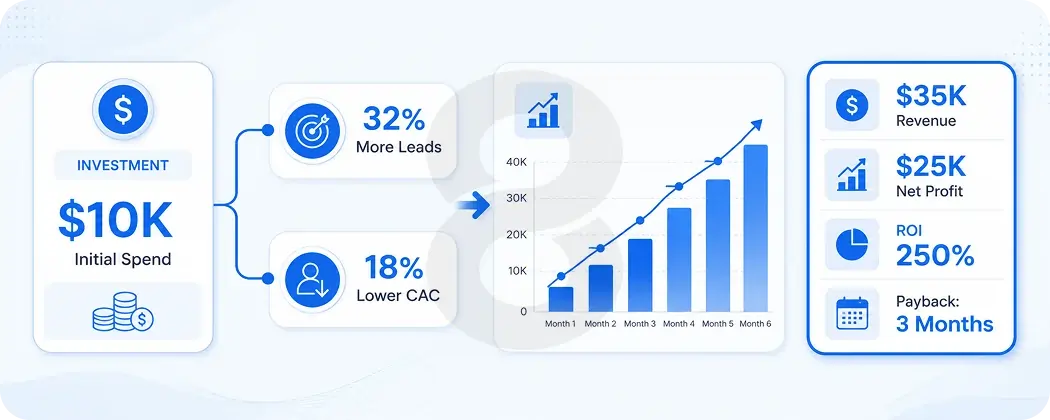
Revenue cycle management is where all these individual automation pieces come together. Scheduling, eligibility verification, prior authorization, coding, claims submission, denial management, payment posting. In most healthcare organizations, these steps are handled by different teams using different systems, which creates handoff errors, delays, and lost revenue at every junction.
Mature healthcare automation solutions in 2026 treat the revenue cycle as a single connected workflow rather than a series of siloed tasks. The 2025 CAQH Index notes that 63% of healthcare organizations have already integrated AI-powered automation into their revenue cycles, with coding and documentation as the leading applications. And 15% of those organizations report positive ROI already, which suggests the rest are still in implementation or early rollout phases.
What the ROI Actually Looks Like
The average ROI for a healthcare automation deployment over three years is 2.9x, according to HIMSS 2025 benchmarks. Others do better, some do better. Innobot’s ROI was shown to be 667%, 528% and 387% in various client deployments, and claims processing time was reduced by 97.9% and payment posting time was saved 99.8%.
Those are extreme numbers, but they reflect the potential of a highly effective and end-to-end use of automation instead of a piecemeal approach.
If a team is considering creating custom software solutions to link these revenue cycle phases, architecture is a huge deal. Eligibility verification needs to talk to scheduling, which needs to talk to documentation, coding, and claims submission. Errors reduce and reimbursement improves when that data moves seamlessly between systems and doesn’t need to be manually re-entered.
| Revenue Cycle Stage | Manual Pain Point | Automation Fix |
|---|---|---|
| Eligibility verification | Phone calls to insurers, 20–30 min per patient | Real-time electronic verification pre-visit |
| Medical coding | Manual chart review, 10–15 min per chart | AI coding with NLP from clinical notes |
| Claims submission | Manual entry, multiple portal logins | Automated clearinghouse submission |
| Denial management | Staff reviews denials after the fact | Predictive denial prevention pre-submission |
| Payment posting | Manual matching of EOBs to accounts | Automated ERA posting with exception routing |
Implementation Realities: What Nobody Puts in the Brochure
Here’s the part that often gets glossed over in vendor pitches. Healthcare automation doesn’t plug in and run. There are real implementation challenges, and organizations that ignore them pay for it later.
Integration and interoperability is the first wall most teams hit. Healthcare systems involve multiple legacy EHRs, clinical platforms, billing systems, and payer connections. Getting automation tools to talk to all of those consistently is genuinely hard. API integrations work cleanly for modern systems. Legacy systems often require middleware or RPA bots that navigate interfaces the way a human would, which is slower and more fragile.
Read More: Medicine Delivery App Development: Features, Cost & Benefits
Staff adoption is the second wall. Clinical and administrative teams are burned out. When you introduce a new tool, even a good one, the change management required to get genuine adoption is substantial. Moreover, organizations that treat this as a technology rollout rather than an organizational change project consistently underperform.
And then there’s data quality. Automation tools are only as good as the data feeding them. If patient records are messy, if coding data is inconsistent, if eligibility information is stale, the automation amplifies those problems rather than solving them.
None of this means automation isn’t worth it. The numbers are too clear. But the organizations that get the best outcomes are the ones that treat implementation as a serious project, not a software purchase. Teams that are serious about enterprise app development in healthcare know this and build compliance, data validation, and change management into the project scope from the start.
What the Next Wave of Healthcare Automation Looks Like
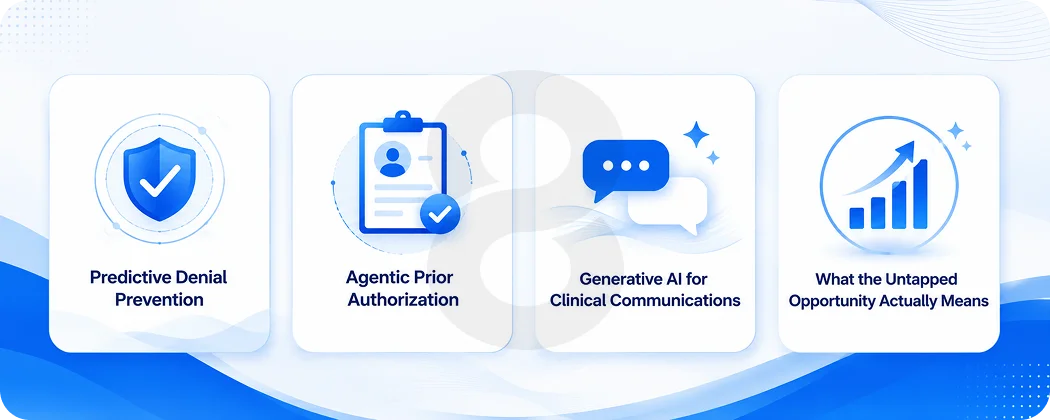
Healthcare automation is shifting from single-task bots to agentic AI that handles multi-step workflows, makes decisions at each junction, and escalates exceptions without human input. The agentic AI market in healthcare is forecast to grow from $538 million in 2024 to $4.96 billion by 2030.
Predictive Denial Prevention
AI models now analyze claims before submission, flagging patterns that match specific payer denial rules. The claim gets corrected before it leaves the practice, not after a 45-day appeals cycle. Organizations using predictive denial tools report significant drops in first-pass denial rates.
Agentic Prior Authorization
Instead of staff sitting on hold, AI agents submit PA requests electronically, track approvals in real time, and flag delays automatically. Furthermore, according to SS&C Blue Prism, 55% of healthcare organizations are already implementing AI into scheduling and waitlist management, with prior auth automation following fast.
Generative AI for Clinical Communications
Drafting prior authorization appeal letters, discharge summaries, and referral documentation used to take 20 to 30 minutes per document. Generative AI cuts that to minutes with a human review step. The quality often improves because the output pulls directly from structured clinical notes rather than memory.
What the Untapped Opportunity Actually Means
80% of the healthcare AI market remains untapped, per Menlo Ventures’ 2025 report, while buying cycles have already compressed from 18 months to under six. Organizations moving now build operational advantages that are genuinely hard to replicate once competitors have locked in vendor relationships and trained their teams.
Read More: Top Healthcare Software Development Companies Based on Clutch Reviews