


Who is not a fan of apps like Uber, DoorDash, Netflix, or Instacart? These on-demand structures have completely redefined how humans get access to services, from ordering meals and booking rides to consulting doctors and hiring home cleaners, all with a few taps on a telephone.
If you are a startup founder, entrepreneur, or commercial enterprise owner considering entering this area, the primary query that certainly comes to mind is, “How much does on-demand app development cost in 2026?”
It relies upon it. But that isn’t always exact enough while you are attempting to plan a budget, pitch traders, or decide whether or not that is even possible. So on this guide, we smash down each unmarried value element, from discovery to deployment, from regional pricing to hidden charges, and from MVP builds to organization-grade structures with actual numbers, tables, and practical insights to help you plan cleverly.
What Is an On-Demand App?
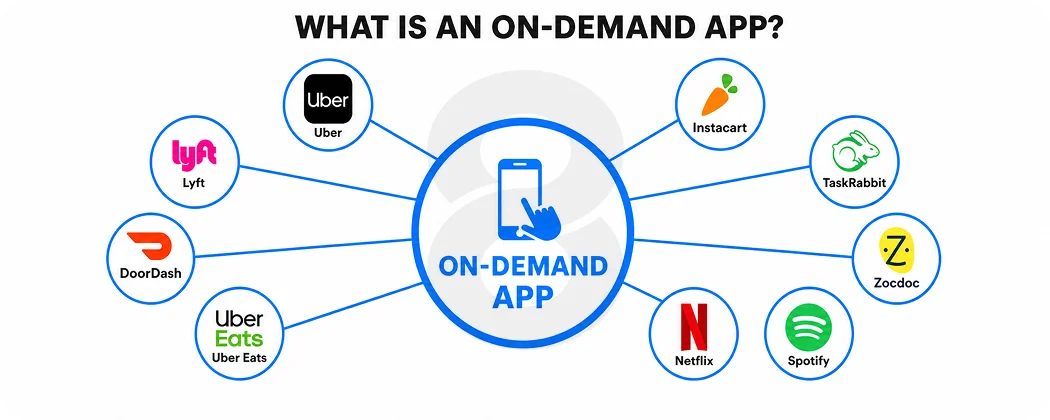
An on-demand app acts as a digital bridge between a provider/issuer and a client, permitting them to connect immediately via a cellular or internet platform. The app takes a request from the client, matches it with a to-be-had issuer, enables the transaction, and promises it to the provider, all in real time.
Classic examples include:
- Uber / Lyft: trip-hailing
- DoorDash / Uber Eats: meal transport
- Instacart: Grocery shipping
- TaskRabbit: Home offerings
- Zocdoc: Healthcare appointments
- Netflix / Spotify: Leisure on demand
Each of these systems serves a distinct area of interest exceptionally well, and this is the core philosophy behind the success of on-demand apps.
The on-demand delivery market is exploding in 2026, projected to surpass $430 billion globally by 2033 as consumer expectations for instant access reshape industries from groceries to healthcare. Yet, 62% of startups in this space struggle with launch delays due to custom development hurdles, according to 2025 data from McKinsey that analysts expect to persist into early 2026.
The On-Demand Economy by the Numbers (2026)
Before diving into expenses, here are some data points that underline why businesses are investing heavily in this space:
Metric |
Stat |
| Global on-demand economy value (2026) | $335 billion+ |
| Annual consumer spending on on-demand services | $57.6 billion |
| Global mobile app revenue projected (2026) | $600 billion+ |
| On-demand users in the US alone | 22.4 million+ |
| Food delivery market size (2026) | $200 billion+ |
| Healthcare app market size (2026) | $45 billion+ |
| Average app uninstall rate due to poor UX | 88% (9 out of 10 users) |
These numbers make it clean; this isn’t always a marketplace you want to disregard. But constructing the right product at the right value calls for clarity.
Read More: Local vs. Remote: Does it Matter Where Your App Development Firm is Based?
Categories of On-Demand Apps
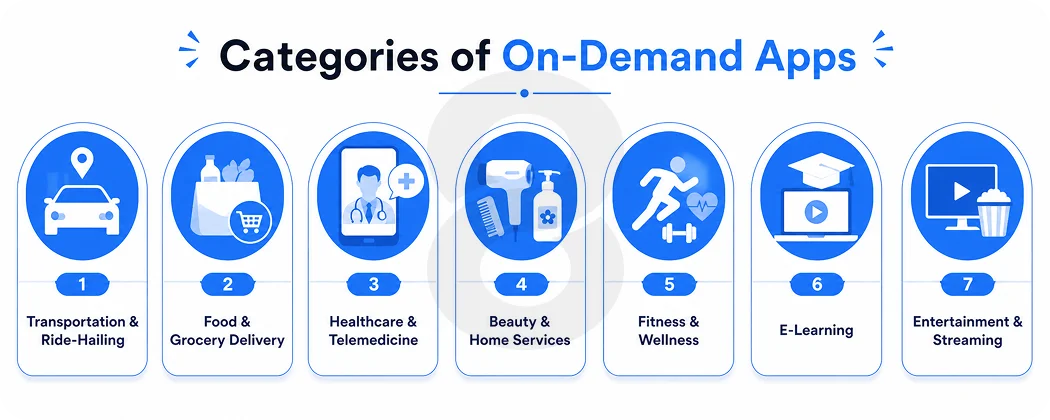
Understanding what kind of app you need to construct is step one in estimating your price range. Each category comes with its own complexity and variety of values.
1. Transportation & Ride-Hailing
Apps like Uber and Lyft fall right here. They require real-time GPS tracking, dynamic pricing, driver-matching algorithms, and a two-sided marketplace structure. Logistics apps for fleet and shipping control also belong to this class.
2. Food & Grocery Delivery
Apps like DoorDash, Instacart, and Zomato are popular food delivery apps that include restaurant/shop integrations, real-time order tracking, multiple payment options, and delivery/operations management. These are among the most complex on-demand apps to build.
3. Healthcare & Telemedicine
Post-pandemic, telemedicine apps like Zocdoc and HealthTap noticed an explosive increase. These require video consultation capabilities, prescription management, HIPAA/GDPR compliance, and stable data handling, all of which add substantially to the cost.
4. Beauty & Home Services
On-demand beauty and domestic-care apps connect customers with professionals for haircuts, massages, cleaning, maintenance, and more. They require reservation systems, company profiles, review mechanisms, and area-based matching.
5. Fitness & Wellness
Fitness apps including personal schooling apps, yoga platforms, and weight-reduction plan trackers connect users with certified professionals. Many now combine wearables and AI-pushed coaching.
6. E-Learning
Getting to know platforms allows students to connect to instructors, get admission to path content, and make progress. Features like live classes, recorded periods, quizzes, and certification add to the development scope.
7. Entertainment & Streaming
Streaming systems require strong CDN infrastructure, subscription control, content material recommendation engines (often AI-powered), and multi-tool compatibility.
Read More: How 8ration Cut App Load Time by 60% Without Rewriting Core Logic
Cost by Using App Complexity: The Core Breakdown
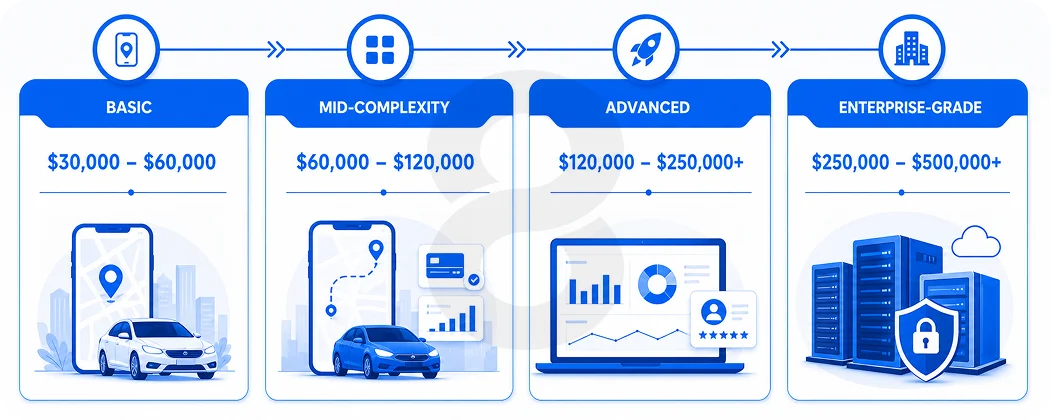
This is the quantity all and sundry desires. Here is a sensible 2026 fee breakdown by means of complexity:
App Complexity |
Estimated Cost |
Timeline |
Best For |
| Basic MVP | $30,000 – $60,000 | 2–4 months | Idea validation, startups |
| Mid-Complexity | $60,000 – $120,000 | 4–7 months | Growing businesses |
| Advanced / Feature-Rich | $120,000 – $250,000+ | 7–12+ months | Scalable platforms |
| Enterprise-Grade | $250,000 – $500,000+ | 12–18+ months | Large-scale operations |
Basic On-Demand App ($30,000 – $60,000)
A basic model specializes in core capability and is normally developed as an MVP to test the market. It consists of consumer registration and login, a primary carrier list, booking or order placement, easy fee integration, push notifications, and a primary admin dashboard. Many startups start here to reduce preliminary funding and improve the platform based on consumer comments.
Mid-Complexity On-Demand App ($60,000 – $120,000)
A mid-level application consists of extra advanced capabilities that beautify the personal experience and operational performance. This tier covers real-time order tracking, more than one fee gateway, in-app chat or messaging, scores and opinions, push notifications and alerts, an analytics dashboard, and a multi-panel structure (client, service provider, and admin). Costs boom here because of extra APIs, advanced UI/UX design, and backend infrastructure required to aid real-time operations.
Advanced On-Demand App ($120,000 – $250,000+)
Advanced programs include AI-powered guidelines, advanced analytics and reporting, real-time GPS monitoring with route optimization, dynamic pricing algorithms, multi-language and multi-forex assist, 1/3-birthday party CRM/ERP integrations, and high-degree safety and scalability. The value rises significantly as more technologies like AI, machine learning, and cloud infrastructure are included.
Enterprise-Grade Platform ($250,000 – $500,000+)
Enterprise answers are constructed for massive-scale operations with lots of daily transactions. These contain custom infrastructure, multi-region deployment, devoted DevOps groups, and ongoing engineering aid.
The AI Factor in 2026: A Game Changer for Costs
One of the biggest shifts in 2026 is the upward push of AI-augmented improvement. AI agent groups and AI-assisted coding gear have dramatically modified the economics of app improvement:
- Projects that cost $75,000–$150,000 in 2022–2023 now price $30,000–$75,000 in 2025–2026
- AI-first development teams can compress timelines from 6–nine months to 6–10 weeks in some instances
- Labor charges can be decreased with the aid of 40–60% via AI-assisted code technology, trying out, and documentation
- Pre-constructed boilerplate libraries for auth, bills, notifications, and dashboards put off the need to construct from scratch
However, AI does now not remove the want for skilled senior engineers. The first-class effects come from groups wherein experienced developers direct AI tools strategically, not replace engineering judgment altogether.
Hidden Costs Most People Miss
When budgeting to your on-demand app, most founders most effective account for improvement. Here are the fees that regularly get omitted:
Hidden Cost |
Estimated Amount |
Notes |
| App Store Fees | $99/year (Apple), $25 one-time (Google) | Required to publish |
| Legal & Compliance | $3,000 – $15,000 | Terms of service, privacy policy, GDPR/HIPAA |
| Marketing & ASO | $5,000 – $30,000+ | App store optimization, paid ads, influencers |
| Third-Party Subscriptions | $500 – $5,000/year | Maps, SMS, analytics, email services |
| Server & Cloud Hosting | $200 – $5,000+/month | Scales with user traffic |
| Security Audits | $3,000 – $10,000 | Critical for fintech and healthcare apps |
| Annual Maintenance | 15–25% of dev cost/year | Bug fixes, OS updates, feature additions |
| Project Management | Often excluded from estimates | Add 10–15% of total project cost |
Key Challenges in On-Demand App Development
Understanding demanding situations upfront allows you finances and plan extra as it should be:
1. Supply and Inventory Management
Maintaining constant supply whether or not drivers, transport executives, or carrier vendors — requires wise matching algorithms and actual-time statistics infrastructure that adds to development complexity.
2. Dynamic Consumer Behavior
User options shift continuously. Building for behavioral analytics and personalization from day one requires additional backend work, however will pay off in retention.
3. Rising Competition
The on-demand space is saturated in maximum categories. Differentiating through UX, pricing models, or niche concentration is important and best design is not reasonably priced.
4. UI/UX Design Complexity
Nearly 88% of users uninstall apps after encountering a negative experience. Investing in a minimalist, intuitive layout isn’t non-compulsory; it directly impacts your ROI.
5. Choosing the Wrong Development Partner
Inexperienced teams can reason price range overruns, missed time limits, and technical debt that prices far greater to repair than it would have needed to build the first time. Always evaluate portfolio, evaluations, and technical knowledge earlier than signing an agreement.
The global super apps market size was estimated at USD 121.10 billion in 2025 and is projected to reach USD 968.77 billion by 2033, growing at a CAGR of 30.1% from 2026 to 2033.
How to Reduce On-Demand App Development Costs Without Cutting Corners
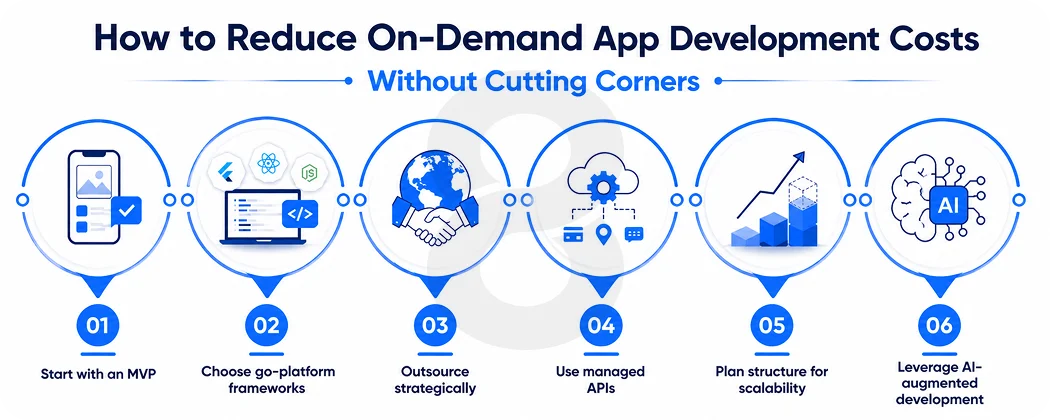
You do not need to overspend to construct a fine product. Here are verified strategies utilized by a hit founders in 2026:
Start with an MVP
Build best the core functions had to validate your concept. An MVP reduces preliminary investment by using 30–50% and generates early user statistics to manual future development.
Choose go-platform frameworks
React Native or Flutter offers you iOS and Android insurance from a unmarried codebase, reducing improvement time and value by way of 30–forty%.
Outsource strategically
Eastern European and Indian improvement teams provide high-quality first-rate at 40–60% decrease fees than US/UK teams, if selected cautiously.
Use managed APIs
Instead of building payment, maps, or notification systems from scratch, use mature APIs like Stripe, Google Maps, and Firebase. This alone can save weeks of development time.
Plan structure for scalability
Designing your app with a modular, scalable structure from day one approach, you can upload features later without rebuilding core structures, fending off highly priced rewrites.
Leverage AI-augmented development.
Work with groups that use AI equipment for boilerplate, documentation, trying out, and code evaluation. These teams continuously supply quicker and less expensive solutions without sacrificing exceptional quality.
Read More: How Much Does it Cost to Develop an App
Cost Comparison: Build vs. Buy vs. White-Label
Approach |
Cost Range |
Pros |
Cons |
| Custom Build | $30,000 – $250,000+ | Full control, unique product | Higher cost, longer timeline |
| White-Label Solution | $5,000 – $30,000 | Fast to market, low cost | Limited customization, generic |
| No-Code Platform | $500 – $5,000 | Cheapest, fastest | Not scalable, limited features |
| SaaS Platform | $200 – $2,000/month | Managed infrastructure | Ongoing costs, vendor lock-in |
For agencies serious about building a long-time period, competitive product, custom improvement stays the gold standard. White-label answers are splendid for short market tests but hardly ever scale properly.
Read More: The Real Cost of App Maintenance: What Budget Percentage Should You Allocate?
Maintenance: The Cost That Never Ends
Maintenance Activity |
Annual Cost |
| OS updates (iOS/Android new versions) | Included in maintenance |
| Bug fixes and patches | $3,000 – $8,000/year |
| Security updates | $2,000 – $5,000/year |
| New feature additions | $5,000 – $20,000/year |
| Server/cloud scaling | $200 – $5,000+/month |
| Total Annual Maintenance | ~15–25% of original dev cost |
How to Choose the Right On-Demand App Development Company
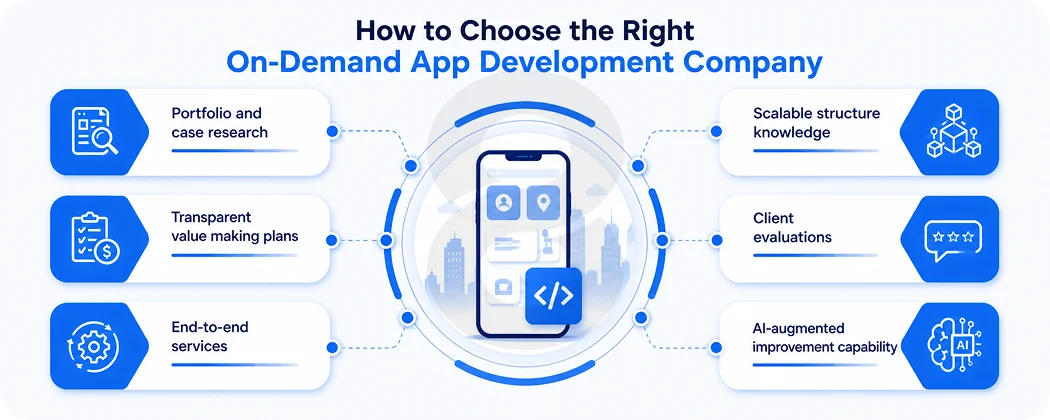
Not all development companions are equal. Here is what to look for in 2026:
- Portfolio and case research: Has the business enterprise built on-demand apps before? Ask for live examples on your class.
- Transparent value making plans: A fantastic associate facilitates you apprehend prices earlier than improvement begins, now not after.
- End-to-end services: Look for agencies that handle discovery, layout, improvement, testing, deployment, and submit-release help under one roof.
- Scalable structure knowledge: Your app will develop. Ensure your accomplice builds with scalability baked in, not bolted on.
- Client evaluations: Check systems like Clutch, GoodFirms, and G2 for confirmed customer testimonials.
- AI-augmented improvement capability: In 2026, companies that use AI tools correctly will deliver faster, less expensive, and higher exceptional results than conventional groups.
Quick Summary: Total Cost at a Glance
App Type |
Estimated Budget |
Timeline |
| Basic MVP On-Demand App | $30,000 – $60,000 | 2–4 months |
| Mid-Complexity On-Demand App | $60,000 – $120,000 | 4–7 months |
| Advanced On-Demand Platform | $120,000 – $250,000 | 7–12 months |
| Enterprise On-Demand System | $250,000 – $500,000+ | 12–18+ months |
| Annual Maintenance (all tiers) | 15–25% of build cost | Ongoing |
Conclusion
Building an on-call app in 2026 is one of the most rewarding investments a business can make, provided you move in with clear eyes about what it in reality costs and what drives the ones’ fees.
The bottom line: on-call app improvement fees vary from $30,000 for a lean MVP to $250,000+ for a complete-scale, feature-rich platform. The variety that applies to you relies upon your app category, feature set, platform choice, crew place, and generation stack.
The smartest technique is constantly to start lean, validate early, and scale based totally on actual consumer feedback. Do not try and construct the whole lot in version one. Focus on the features that directly create value for your users, release fast, and iterate primarily based on statistics.
Partnering with an experienced development organization that knows both the technical and enterprise dimensions of on-call for systems and one that leverages cutting-edge AI-augmented development will come up with the fine shot at building a product that competes, scales, and grants ROI.