


Hiring a software development company in New York sounds clean on paper.
You search a few agencies, check portfolios, or book calls. Everyone says they build scalable products, work with startups and enterprises, and care about quality.
Then the proposals arrive.
One team says your product will cost $18,000. Another says $90,000. A third says they need two weeks of discovery before they can even guess.
And honestly, after enough calls, all the decks start sounding the same. Same words and screenshots of dashboards nobody has used since 2021.
That is why this decision needs more than a list of “top companies.”
A good software development company in New York should help you make fewer expensive mistakes. That is the real job.
Code matters, of course. But code without product thinking, user testing, clean architecture and honest cost control becomes another internal system people avoid until it breaks on a Monday morning.
New York is not a small software market where you can casually wing it and hope nobody notices. The city has real tech weight behind it. NYC has been the second strongest tech hub in the world for years.
And the spending is still there, even if every meeting now starts with someone saying the budget is tight. Gartner projected worldwide IT spending to hit $5.43 trillion in 2025, and a big chunk of that money is still going into software and IT services.
What Does a Software Development Company in New York Actually Do?
A software development company in New York helps businesses turn messy ideas into working digital products. That sounds neat. It usually isn’t.
In real life, the call usually starts with someone saying, “We just need a simple app.” Then the simple app turns out to need user accounts, payments, dashboards, admin controls, email alerts, CRM integration, analytics and a backend that can talk to three old systems nobody has opened with confidence in years.
So the job is not just writing code. A software development company has to plan the product, design the flow, build the system, test what breaks, launch it properly and keep it alive after launch.
That last part matters more than people admit, because software has a habit of behaving nicely in demos and badly the moment real users arrive. But the real job is making sure the product does not collapse under its own ambition.
That can mean a customer facing app, an internal platform, a SaaS product, an AI tool, a marketplace, a booking system, a logistics dashboard or a backend replacement everyone has been delaying because the current system still “kind of works.”
And “kind of works” is usually where the trouble starts. The useful companies do more than write code. They ask painful questions early.
- Who will use this?
- What are they doing now?
- What data needs to move?
- What happens if payment fails?
- Who owns the admin panel?
- What does success look like after launch?
That last one matters. A lot of software dies because nobody defined success beyond “build the thing.”
If your product needs custom workflows, different user roles, dashboards, backend logic or approvals, stop trying to force random tools to behave like custom software.
Common Services Offered by New York Software Development Companies
Service |
What it usually includes |
Best for |
| Custom software development | Product planning, backend, frontend, database, testing and launch | Businesses with workflows that off the shelf tools can’t handle |
| Web app development | Browser based apps, portals, dashboards, APIs and admin panels | SaaS products, internal tools and customer platforms |
| Mobile app development | iOS, Android, cross platform apps, app store launch and updates | Consumer apps, service apps, booking apps and field teams |
| AI development | AI features, chatbots, automation, recommendations and data workflows | Companies with repetitive processes or large data sets |
| UI and UX design | User research, wireframes, prototypes, design systems and usability checks | Products that need better adoption or conversion |
| Software testing | Manual QA, automated testing, performance testing and bug tracking | Any product that cannot afford public embarrassment |
| System integration | APIs, CRM, ERP, payment gateways, third party tools and data sync | Companies tired of copying data between tools |
| Maintenance and support | Bug fixes, security updates, feature improvements and monitoring | Products that need to survive after launch |
A serious team will explain what you actually need and what can wait. A weak team will happily build everything on your wish list, then act surprised when the budget catches fire.
What Buyers Usually Look for Before Choosing a Software Development Company
People searching for the best software development company in New York are usually not looking for a random list of agencies.
They are trying to avoid a bad decision.
That is the honest version.
Because once you hire the wrong development team, the damage is not small. You lose money, yes. But you also lose time, momentum, confidence and sometimes the product itself.
Anyone who has watched a software project drag for six months knows the feeling. The demo looks fine but the real product keeps breaking and nobody wants to own the mess.
So buyers usually compare a few things before they reach out.
Reviews come first because nobody wants to be the experiment. Past projects matter too, because clients want to see whether the team has built something close to what they need.
Then they check hourly rates and minimum budgets because going into a sales call with no price context is exhausting. Team size, services, industries and delivery process matter as well, because software development is already confusing enough without companies hiding behind broad promises and polished words.
- What they really want to know is simple.
- Can this team understand my idea?
- Can they build it without turning the budget into a crime scene?
- Have they worked with businesses like mine?
- Will they explain technical choices in plain English?
- Will they stay involved after launch?
That is the real search intent behind “best software development company in New York.” People are not just shopping for code. They are shopping for lower risk.
And fair enough. Bad software vendors do not just waste money. They waste months. Sometimes they waste the whole idea.
Read More: Best B2B Software Solutions for Small Businesses (2026 Guide)
How Much Does Software Development Cost in New York?
Software development in New York costs real money. The US Bureau of Labor Statistics reported that software developers earned a median annual wage of $133,080 in May 2024.
That does not include project managers, QA testers, designers, DevOps engineers, benefits, overhead, sales, office costs or the hidden cost of smart people sitting in meetings trying to understand why your checkout flow has seven exceptions.
That is why a software development company in New York often charges more than offshore firms.
Read More: Pricing Models for Software Services: Fixed vs. Hourly Rates Explained
Hourly Rates You May See
Team Type |
Common Hourly Range |
Notes |
|---|---|---|
| Freelance Developer | $40 to $120 | Lower cost, but limited coverage if design, QA or DevOps are needed |
| Offshore Development Team | $25 to $75 | Useful for budget control, but management quality matters |
| Nearshore Team | $50 to $120 | Better time zone overlap for US companies |
| New York Based Agency | $100 to $250 plus | Higher cost, stronger local strategy and communication in many cases |
| Specialist AI or Enterprise Team | $150 to $300 plus | Usually for complex, regulated or high risk systems |
The cheapest quote is rarely the cheapest outcome. I know that sounds like something agencies say to justify their pricing, but it is also painfully true.
A cheap build with no documentation, no tests and no proper handover becomes expensive the moment someone else has to fix it.
Read More: What is a Proof of Concept in Software Development
What Affects the Cost of Hiring a Software Development Company in New York?
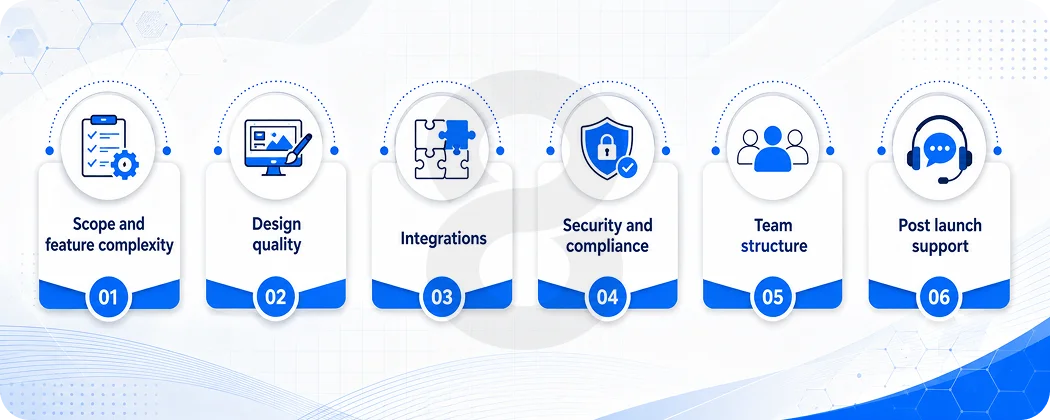
Cost depends on scope, speed, complexity and how many unknowns you bring into the project.
If you already have wireframes, user stories, clear workflows, brand guidelines and a realistic feature list, the team can estimate better. If your brief is “Uber but for something else,” everyone is guessing. And guesses become change requests.
Scope and Feature Complexity
A login screen is simple until you add social login, enterprise SSO, role based access, two factor authentication and account recovery. A dashboard is simple until five departments need different reports.
Software gets expensive through details.
Design Quality
Good UI and UX design costs money, but bad design quietly taxes the product every day. Users get confused. Support tickets increase. Sales demos feel awkward. Onboarding drags.
If your product depends on adoption, do not treat design like decoration.
Integrations
APIs look harmless in planning docs. Then you discover one vendor has bad documentation, another has rate limits, and the old CRM stores phone numbers in three different formats because apparently chaos is a business model.
Integrations need budget.
Security and Compliance
Healthcare, fintech, insurance, education, real estate, and enterprise software usually need stronger security planning. That can include encryption, audit logs, access controls, data privacy rules and compliance support.
Skipping security early feels fast. Until it isn’t.
Team Structure
A complete team may include:
- Product manager
- UI and UX designer
- Frontend developer
- Backend developer
- Mobile developer
- QA engineer
- DevOps engineer
- Project manager
You do not always need all of them full time. But someone needs to cover those responsibilities.
Post Launch Support
Launch is not the finish line. It is the first time real users show you what you missed.
You need monitoring, bug fixes, app updates, server maintenance, feature improvements and security patches. A software development company in New York that talks about launch but not maintenance is leaving out the part where products actually survive.
Best Services to Look for Before You Hire
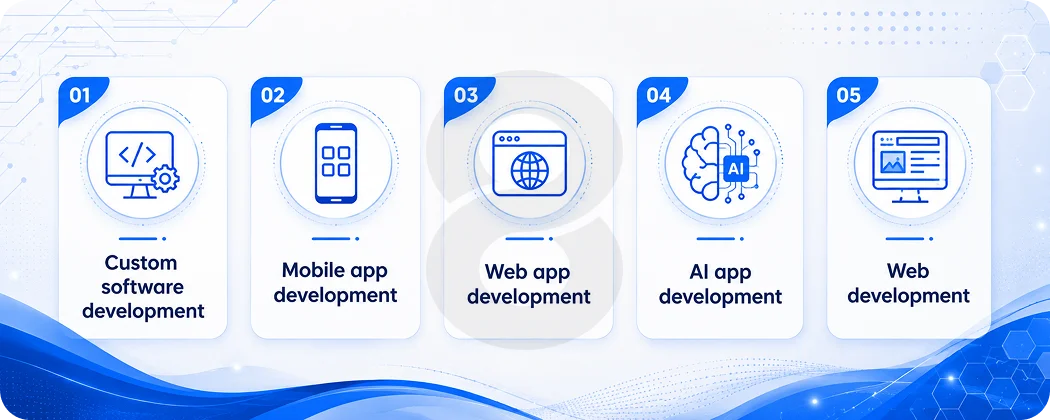
You do not need every service under the sun. You need the right mix for your product.
A startup building an MVP needs speed, product clarity and a tight feature set. An enterprise replacing old internal software needs architecture, integration planning, change management and documentation. A consumer app needs strong mobile UX, retention thinking and analytics.
Custom Software Development
Custom software development makes sense when your business process is too specific for ready made tools. This could be an internal operations platform, quote management system, booking engine, workflow tool, CRM extension or SaaS product.
The value is control. The risk is overbuilding. A good team keeps the first version focused.
Mobile App Development
Mobile apps are useful when users need frequent access, location features, push notifications, offline mode, camera access or device level functionality.
For iOS and Android products, ask whether the team recommends native development or cross platform development. Flutter, React Native and other frameworks can save cost in some cases, but they are not magic. Nothing is. Annoying, but true.
You can explore mobile app development if your product needs iOS, Android or cross platform delivery.
Web App Development
Web apps are often the smarter first move for business platforms. They are easier to update, easier to access and usually cheaper to maintain than separate mobile apps.
A web app can support customers, staff, vendors, admins and managers from one central product. A browser based product can often do the job before you spend money on separate iOS and Android apps. That is where web app development makes more sense.
AI App Development
AI is useful when it has a job. Automating support triage, summarising documents, recommending products, detecting fraud patterns, analysing user behaviour or speeding up internal workflows.
AI is not useful when it gets added because someone in a board meeting panicked. If AI is part of the roadmap, look at AI app development with a real use case, not a buzzword wish list.
Web Development
Some businesses do not need a full app yet. They need a fast website, a customer portal, landing pages, a CMS or a better conversion path.
Some companies do not need a heavy platform yet. They just need better web development so the site loads fast, explains the offer clearly and sends clean leads to the sales team.
Read More: Intellectual Property in Software: How to Protect Your App Idea Before You Build
How to Choose the Best Software Development Company in New York
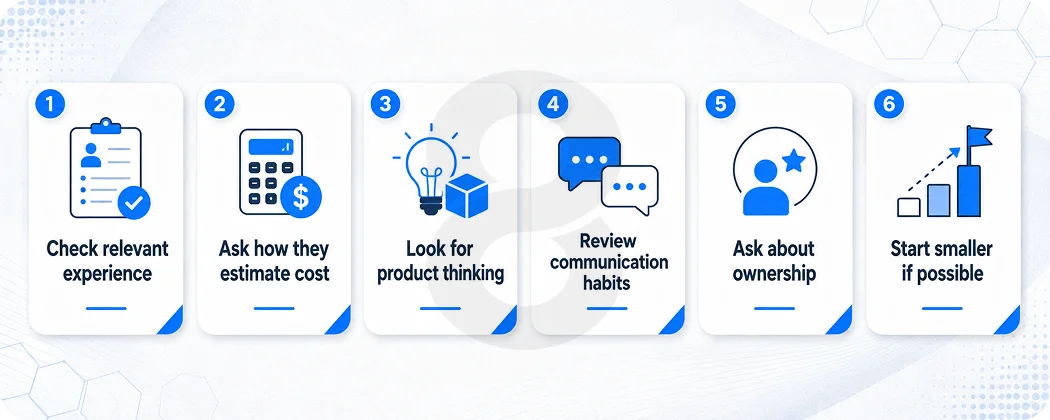
The right software development company in New York should not only ask what you want to build. They should ask why you want to build it, who will use it, what can go wrong and what should wait for later. That is where you start seeing the difference between a vendor and a real product partner.
Check Relevant Experience, Not Just Famous Logos
A portfolio with big names can make a company look safer than it really is. Everyone sees familiar logos and relaxes a little, which is understandable, but logos alone do not explain the work behind them.
Ask what the team actually owned. In one project, they may have built the backend and handled the hard parts. In another, their role may have been limited to redesigning two screens. Sometimes a team joins late to fix a product someone else has already dragged through the mud. Integration work, testing and post launch support often tell you more about real capability than the logo itself.
What you want is relevant experience. If you are building a booking platform, look for teams that understand scheduling, payments, cancellations, admin roles and notifications.
If you are building internal software, look for workflow experience, permissions, reporting and messy system integrations. Similar work matters because it means the team has already made some of the mistakes you are trying to avoid.
Ask How They Estimate Cost
A good team explains assumptions. A bad team gives a number with confidence and no detail.
That confidence feels nice for about five minutes. Then the project starts, the scope moves, and suddenly everyone is arguing about what was “included.” Nobody needs that headache.
Ask how they reached the estimate. You should be able to see the thinking behind the price.
Ask for:
- Feature breakdown
- Timeline by phase
- Team roles
- Hourly or fixed pricing logic
- Change request process
- Post launch support cost
- Payment schedule
You want boring clarity here. Boring is good. Boring means fewer surprises. If a team cannot explain the cost in plain English before the project starts, they probably will not explain delays clearly once the project gets stressful.
Look for Product Thinking
A vendor that only asks what to build may miss what should be built.
That is dangerous because most first product ideas are too big. Everyone wants user accounts, dashboards, payments, reports, automations, notifications, admin controls and three future features that nobody has validated yet. It all sounds useful in a meeting. Then the budget starts bleeding.
You want a team that challenges weak ideas politely but firmly. If every answer is “yes, we can do that,” be careful. Some yeses are expensive.
Good product thinking means the team helps you decide what belongs in version one and what can wait. They should care about user behaviour, business goals, technical risk and launch speed. The goal is not to build the biggest possible product. The goal is to build the right first version without burying yourself under features.
Review Communication Habits
Communication problems kill projects slowly.
Before signing, pay attention to how the team behaves during sales calls. Clear answers matter. So do useful follow ups, honest tradeoff discussions and questions about your users, business goals and technical limits. A good team will also admit when something needs more discovery instead of pretending every answer is obvious.
The sales process usually gives you a preview of delivery. If communication already feels vague, delayed or messy before you pay, it probably will not become clean later.
Good communication does not mean endless meetings. Nobody wants that either. It means regular updates, clear next steps, honest blockers and demos that show real progress. You should never have to chase a development team just to find out what happened last week.
Ask About Ownership
You should own your code, accounts, design files, documentation and deployment access. Make this clear in the contract.
This sounds basic, but it gets ignored more often than it should. Then the company wants to switch vendors, hire an internal developer or raise funding, and suddenly nobody knows where the source code is, who controls the hosting account or whether the design files are even available.
Do not leave ownership vague.
You are paying for the product. You should not feel trapped inside someone else’s setup after launch. Ask what you will receive, where the code will live, how documentation will be shared and who controls third party accounts.
Start Smaller If Possible
A discovery phase, prototype or MVP can protect your budget. It gives both sides a chance to work together before you commit to the full build.
This model works best when the product still has unknowns. The workflow may need more clarity, users may need to test the concept, one integration may carry risk, or the business team may still be changing priorities, which happens more often than anyone likes to admit.
Starting smaller does not mean thinking small. It means spending less money on assumptions before real users prove what actually matters.
Red Flags That Should Make You Pause
Some red flags are obvious. Others look normal until you have already paid the deposit.
The biggest one is fake certainty. Software has unknowns. Timelines shift. Integrations behave badly. Users do strange things. A serious team will talk about risk early. A weak team will pretend everything is simple because they want the contract signed.
Watch closely if a company does any of these things:
- They promise a complex app in a few weeks without asking detailed questions.
- They avoid talking about testing.
- They do not explain who will work on your project.
- They refuse to discuss code ownership.
- They push every feature into phase one.
- They have no clear maintenance plan.
- They use AI as a selling point without naming the actual workflow.
- They cannot explain past work beyond pretty screenshots.
- They give a fixed price before understanding integrations.
A few of these may look harmless at first. They are not. If a team skips discovery, ignores testing or refuses to explain ownership, the project may still start smoothly. The problem comes later, when bugs appear, users complain or you need another team to continue the work.
Honest teams manage uncertainty. Weak teams hide it until it becomes your problem.
Read More: How to Hire a Software Engineer: The 2026 Checklist
What Should You Prepare Before Contacting a Software Development Company in New York?
You do not need a perfect brief. But you need enough clarity to avoid wasting calls.
Bring these:
- A short description of the product
- The business problem
- Target users
- Must have features
- Nice to have features
- Current tools or systems
- Competitor examples
- Budget range
- Target launch timeline
- Any compliance needs
- A rough success metric
Your first version should not try to become the final dream. That is how teams spend six months building features nobody uses.
How 8ration Can Help with Software Development Projects
A business looking for a software development company in New York usually needs two things at once.
Local market understanding and practical execution.
8ration works across software development, mobile apps, web apps, AI development, web development and digital services. That matters because most real products do not fit neatly into one box.
A mobile app may need a web admin panel. A SaaS product may need AI features later. A web app may need third party integrations, testing and ongoing support.
That mix is useful when you do not want to manage five separate vendors just to ship one product.
The better reason to consider 8ration is this: software projects need honest scope control. You need a team that can say, “Build this now, leave that for later, and do not waste money pretending phase one needs everything.”
That is the kind of thinking buyers should look for.
You can also review the broader digital services if your project touches mobile, web, AI, integration or long term product support.
Software Development Company Comparison Checklist
Use this before signing anything.
Question |
Strong Answer |
Weak Answer |
|---|---|---|
| Have you built something similar? | Shows relevant examples and explains the work done | Sends random portfolio links |
| How do you estimate cost? | Breaks down scope, roles, timeline and assumptions | Gives one number with no detail |
| Who owns the code? | You own code, files, accounts and documentation | Ownership is vague |
| How do you handle changes? | Clear change request process | “We’ll figure it out later” |
| What happens after launch? | Maintenance, monitoring and support plan | Launch is treated as the end |
| How do you test? | QA process, bug tracking, test cases and release checks | Testing is barely mentioned |
| How often will we communicate? | Weekly updates, demos and project tools | Random calls and unclear reporting |
Print this if you have to. Or paste it into your vendor sheet. It will save you from at least one bad call.
Final Advice Before You Choose
Do not hire a software development company in New York because their website looks expensive.
Hire them because they understand the messy middle of building software.
The messy middle is where things get real. The API does not behave. Users hate the flow you loved. The payment provider rejects something. The founder wants five extra features. The launch date moves. The budget gets tight. Everyone is tired.
That is where the right team matters.
A good software partner brings structure when the project starts getting messy. Tradeoffs are explained before they become problems, the core product stays protected, decisions get documented, testing is taken seriously, and weak ideas are challenged before they eat the budget.
That is the work you are really paying for. The code matters, of course, but judgment is the part that costs more because it saves you from rebuilding the same mistake twice.