


A proof of concept in software development is a small, focused prototype built to verify that an idea or feature is technically feasible before full-scale development. The phrase proof of concept has become familiar to you because you have sold software ideas to stakeholders and collaborated with product teams and conducted technical path tests before starting major development projects. Proof of concept exists as a fundamental software development element because it establishes operational software system functionality and demonstrates its use in actual environments.
The first step will involve us enhancing our comprehension of proof of concept software development. The next step will show us actual proof of concept testing from which we will learn. The proof of concept and MVP comparison study will show us their most important differences. The training will show you when to use each strategy, which will help you achieve time savings while decreasing risks and delivering superior software results.
What Is a Proof of Concept in Software Development?
Evidence of concept is a small, narrow project intended to confirm the viability of a specific idea, technology, or technical approach. It is not a finished product or a polished demo. It is a mere fact that it is already proven to work before your team spends much time and resources to develop it. The thesis question that a proof of concept in software development answers is: Is this technically possible?
To use the example of integrating a machine learning model into an old-fashioned banking system, the proof of concept would be used to test whether the integration can even happen, not by writing production-grade code or creating a user interface. The only idea is to approve the technical assumption in as short and as cost-effective way as possible.
An example of a software development is usually:
- Very small in scale: it experimentalizes one hypothesis or technical question
- Time-boxed: normally finished in a few days or weeks
- Internal-facing: seldom visible to the final users or paying customers
- Disposable: code written in a proof of concept is usually thrown away
It is not aimed at creating something great. The objective is to acquire something in a hurry.
Why Is a Proof of Concept in Software Development Important?
When teas do not go through the proof of concept phase, they tend to be six months into a six-month build when they realize that one of their fundamental technical assumptions was incorrect. That costly error is avoided with a proof of concept in software development.
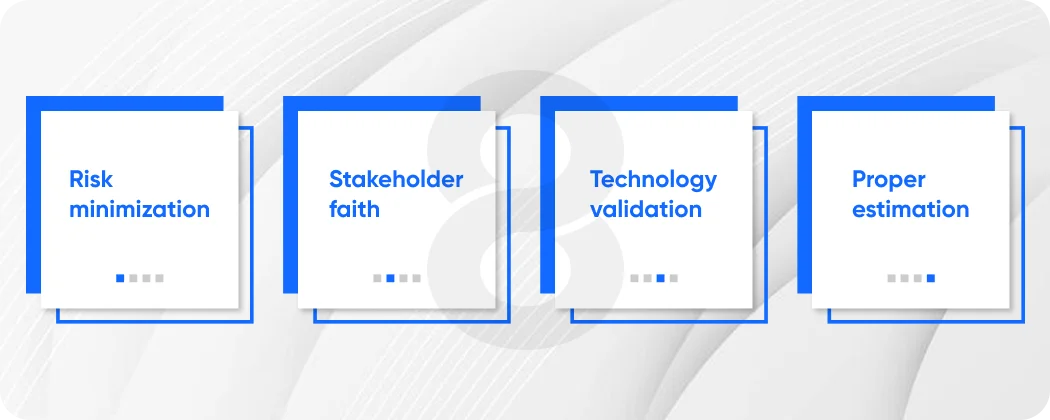
Here is why a PoC matters:
- Risk minimization: This reduces the amount of time wasted in months of effort in engineering an incorrect assumption. A proof of concept surfaces, detects blockers and becomes project killer.
- Stakeholder faith: A proof of concept provides the leadership with something tangible to test. As opposed to passing a concept on paper, the stakeholders will be able to view that the fundamental technical problem is indeed solvable.
- Technology validation: Proof of concept is used when assessing new frameworks, third-party APIs, or cloud services to ensure that engineers can put the technology into stress in a real-world context before investing in it.
- Proper estimation: Once a proof of concept is developed in software development, teams are in a far better position to know what is going to be needed to complete the entire build, resulting in more accurate timelines and budgets.
Proof of Concept Examples in Software Development
Concrete proof of concept examples would help a person understand better proof of concept in software development. The following are four real-world situations in which development teams have used a PoC.
Proof of Concept Example 1: AI-Powered Search Integration
A SaaS business would like to substitute its simple keyword search with a semantic search engine that can be optimized by a big language model. The engineering team develops a proof of concept before rebuilding the entire search infrastructure, indexing a small data sample, making test queries to an LLM API, and evaluating the accuracy of responses and latency.
This proof of concept example provides an answer to at least one of the key questions: Does semantic search result in even meaningfully better results on their particular data, and can they accept the response time in a production setting?
Proof of Concept Example 2: Real Time Collaborative Editing
One of the project management tools would like to introduce live collaborative editing to its system. The group develops a demonstration of principle that is based on WebSocket affairs on an abbreviated editor: no form, no coding, and no fault tolerance. Only the basic synchronization system.
Such a demonstration of concept illustrates the soundness of the technical approach prior to investing in the full-fleet build that may require several months and a large budget.
Proof of Concept Example 3: Moving to Microservices Legacy System
A company that uses enterprise software must replace a 15-year-old monolithic application with a microservices architecture. Instead of trying to completely migrate, the team constructs a proof of concept by extracting only one of the modules, the billing service, and turning it into a standalone microservice and verifying that it can communicate reliably with the monolith.
This proof of concept example exposes issues in architecture, challenges in data consistency, and complexity in integrating information early, wasting years of wasted refactor work.
Proof of Concept Example 4: Supply Chain Transparency with Blockchain
One of the logistics companies would like to understand whether blockchain technology can enhance transparency in its supply chain. A prototype uses a minimal smart contract on a test network, logs a few shipment events, and makes sure that the information is incorruptible and verifiable.
This example of proof of concept does not create a product; it is a response to the question of whether blockchain was even the correct tool for the issue in the first place. What all of these proof of concept examples have in common is that the most difficult assumption should be tested first and with the least effort required.
Read more: 10 Web Application Frameworks – Selecting the Best Tech for Your ROI
Proof of Concept vs Prototype: What Is the Difference?
Many people in software development mistakenly confuse a proof of concept with a prototype. They often use the two terms interchangeably, even though each serves a completely different purpose.
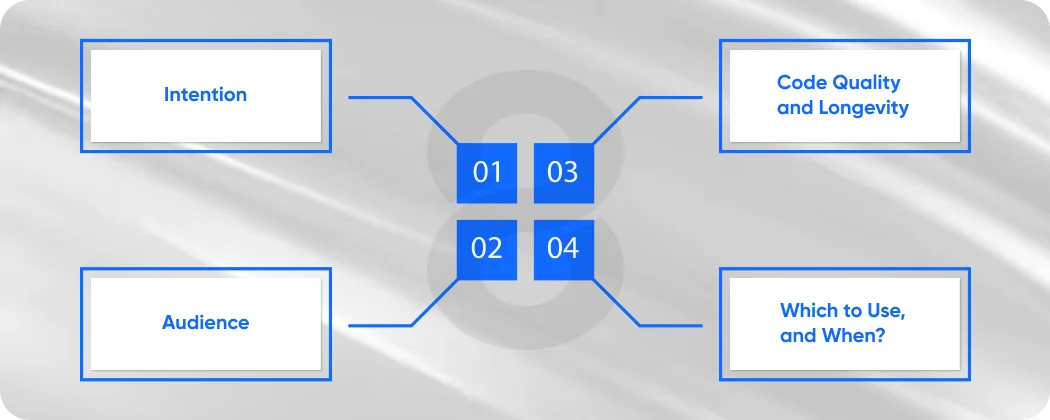
Intention
A proof of concept is concerned with practicability. It asks: Can we build this? A prototype is regarding shape and experience. It questions, “What do you want this to be like?”
The PoC is internal and technical in the debate of proof of concept vs prototype. The prototype is usually graphical and interface-based. A prototype may also include a refined UX with clickable flows but without actual back-end functionality. A proof of concept may contain the functionality of the backend with no user interface at all.
Audience
In a comparison of proof of concept and prototype based on the eyes of the audience, the contrast is quite pronounced. A proof of concept is constructed to help engineers and technical decision-makers. The spectators are all internal. It is to respond to a technical question, not to impress anybody with aestheticism.
Designers, product managers, investors, or end users may often have a prototype constructed. It aims at conveying a product vision, getting user feedback, or testing a UX hypothesis with real users.
Code Quality and Longevity
In a proof of concept, the deliverable is a technical discovery a successful code spike, a benchmark result, or a feasibility report. After the question is answered the code is normally discarded. In a prototype, the product is physically modeled, wireframes, mockups or an interactive prototype. It can or can be real code and in other instances, prototype code can also turn into production code.
Which to Use, and When?
Use a proof of concept when:
- You are testing a new technology or architecture that you never tested before
- You are not certain that a certain technical integration can be attained
- You have to de-risk a significant engineering choice prior to investing in it
Use a prototype when:
- You need to test a concept of a user experience or interface design
- You should be able to share a product vision with the stakeholders or investors
- You are willing to get actual user reviews on the experience of using the product
Most software development processes include a proof of concept preceding a prototype. The initial part is to verify that the technology can work (proof of concept), and the next is to refine what it should look like (prototype), and the final step is moving to production of the actual product.
Read More: How to Hire a Software Development Team – A Step-by-Step Guide
Proof of Concept Vs MVP: The Critical Differences
In case the proof of concept vs prototype comparison should be confused with that, the proof of concept vs MVP difference is even more misconstrued, which makes sense since, in the startup and product circles, speed is a valuable currency.
What Is an MVP?
A Minimum Viable Product (MVP) represents the smallest version of a product that delivers real value to real users. Unlike a proof of concept, an MVP is a real product. Teams launch it to end users, use it to solve a real problem, and design it to gather user feedback and generate business traction.
The Lean Startup by Eric Ries popularized the MVP concept as a way to test business hypotheses in real-world conditions. An MVP primarily answers one key question: Will people use it and pay for it?
PoC vs MVP: 5 Major Differences
-
Audience
A proof of concept has an internal audience engineers, architects and product leads. It is never sent to the customers or displayed to the audience. A real user or a paying customer is an external audience of an MVP. It is a prototype of a real working product.
-
Goal
Technical feasibility is proved by a proof of concept. It provides the answer to the question of something being constructed based on the available technology and constraints. MVP contains product-market fit and business viability. It provides the answer to the question whether it should be constructed or not and whether real individuals will take it into use.
-
Quality Standard
An proof of concept is purposely crude. There is no emphasis on code quality, user experience, or performance. The proof of concept is normally abandoned once it has been used to learn. MVP, though minimum, should be sufficient to be of real value. Users will judge it. It must be reliable even though it may lack features.
-
Scope
A proof of concept is extraordinarily thin it may only cover one feature, one technical query, or even a one-line function call. It is aimed at isolating a single variable.
MVP is a whole, but bare-bones product experience. It contains just enough functionality to be actually helpful and enough polish to send it to the people with a high degree of confidence.
-
Outcome
Once there is a sign of a working prototype, your team will either continue with the technical courage, change strategy, or drop a poor technical concept before wasting more resources. What should follow an MVP is an iterative process based on actual user feedback, a pivot of your product strategy, or starting to scale what has been working in the market.
Read More: What Is QA Testing in Software – Our Experts Insights
How to Run a Successful Proof of Concept in Software Development
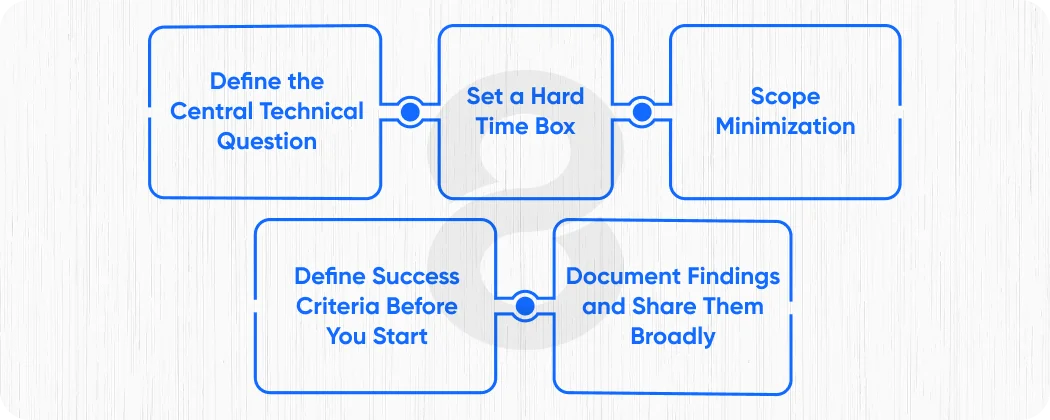
Having known what the concept of a proof of concept is in software development and how it is different to both prototypes and MVPs, how can one run a successful proof of concept, then?
Step 1: Define the Central Technical Question
The main question of software development is a life or death of a proof of concept. You need to define in writing what technical hypothesis you are testing before dropping one line of code. Would the current database infrastructure be able to handle 10,000 events per second? is a good demonstrating question. “Can we build a great product?” is not.
Step 2: Set a Hard Time Box
A proof of concept must never be a long-running process. Establish an absolute limit not the question, of one or three weeks usually, and assume it is a deadline. In case the technical question cannot be answered within the time box, the technical question should likely be narrowed down.
Step 3: Scope Minimization
Eliminate all the non-technical matters of the technical question in the test. No verification of identities, no recording, no failure modes, no UI. Take all your attention on the single thing you should learn from your proof of concept.
Step 4: Define Success Criteria Before You Start
Get an agreement on what is considered success at the beginning. A response time under 200ms? An effective third-party API handshake? A machine learning model with 80% accuracy on the test data? The clarity of the success criteria will eliminate scope creep and guarantee that the proof of concept will have clear and actionable results.
Step 5: Document Findings and Share Them Broadly
Regardless of the success or failure of your proof of concept on software development, write on what you have learned. A failed PoC is not a wasted effort you should take it as a good indication that will divert your team before spending much more resources. Communicate with all the concerned parties with the aim of making timely decisions without any form of hesitation.
Read More: Intellectual Property in Software – How to Protect Your App Idea Before You Build
Common Mistakes to Avoid with a Proof of Concept in Software Development
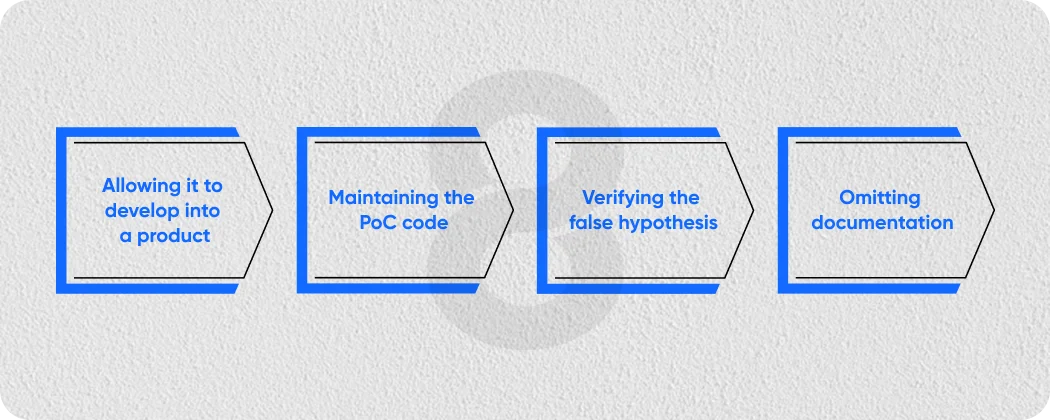
- Allowing it to develop into a product: The most prevalent error is to allow a proof of concept to develop into a prototype or an MVP. Make it brutally point-blank at the one technical question.
- Maintaining the PoC code: Teams are usually hesitant to abandon code that they have developed in a proof of concept. PoC code is not production-ready, however. Almost always, the right step to take is to start afresh once the feasibility is established.
- Verifying the false hypothesis: Test your riskiest technical hypothesis, not what you already know to be possible. Anywhere you are not testing something that is truly in doubt, you are not actually running a proof of concept.
- Omitting documentation: Since PoC code is discarded, what is left is the findings. Lack of documentation implies that the team misses out on knowledge and wisdom that the proof of concept intended to create.
Conclusion: Proof of Concept in Software Development Is a Strategic Advantage
Awareness of what a proof of concept is in software development and how to use it together with prototypes and MVPs is one of the most important skills a product or engineering team can acquire.
A proof of concept de-risks technical decisions. A prototype enhances user experience. An MVP is a market fit test with actual users. Both of them have a specific and essential role, and their confusion results in the loss of time, inappropriate expectations, and products based on weak grounds.
Even the best software teams do not go directly to building. They pose difficult technical questions initially, exercise some of their most hazardous assumptions early in the form of a proof of concept. And to fill out their own validation program, they rely on the examples of proof of concepts. It is that practice, transitioning between demonstration and prototype to MVP with a conscious effort to do so, which makes the difference between a team that always delivers great software and a team that has spent six months developing the wrong product as a whole.
A proof of concept in software development serves as your initial and most powerful barrier against costly and preventable errors. Whether you are a startup founder testing a new idea, a product manager evaluating an untested technology, or an engineering lead validating a complex system migration. You use a proof of concept to confirm that the idea works before committing significant resources. 8ration helps teams validate ideas early with a proof of concept, reducing risks and preventing costly mistakes before full-scale software development.