




Code is not the starting point of innovation. It begins with ownership. The software concepts in the current digital economy are evolving at an unprecedented rate. A mobile application built with architecture, an AI-based platform, a SaaS product, or an enterprise system can transform markets in a few months. Before development teams write code, founders and enterprises must answer a critical strategic question: who owns the innovation, and how will they safeguard it?
This is something that technology leaders know. Amazon has also established a conducive environment all around the world with patents on its technological systems, logistics, and proprietary platforms. Apple has one of the strongest intellectual property portfolios in the globe, with thousands of patents, trademarks, and copyrights that it uses to strengthen its brand dominance. Their development does not occur by chance. It is protected.
Your idea of an app needs to be promoted to a product that is a secured intellectual property.
The Strategic Importance of Intellectual Property in Software
Software is not tangible, but it can be most of the value of a company. In the contemporary business, intellectual resources are more valuable than the physical infrastructure in terms of money. Competitive differentiation is brought about by codebases, algorithms and data models, UI/UX frameworks, and proprietary processes.
Companies that do not protect intellectual property in software at an early stage put themselves at risk of several things. Functionality can be imitated by competitors. The contractors can challenge ownership. The vendors can limit their use with the help of licensing arrangements. Investors can raise the question of defensibility.
The possession of your intellectual property eliminates these weaknesses. It provides you with complete usage, development, distribution, and monetization control. You establish the direction your product follows and its growth as opposed to the restrictions of a license.
The investment in intellectual property is on the rise as global innovation is on the rise. Technology-driven economies concentrate heavily on patent filings, and IP-based sectors consistently generate stronger economic performance and higher wage returns. This strengthens a single fact: innovation is not an unprotected principle that creates value.
Learning the Principles of Intellectual Property in Software
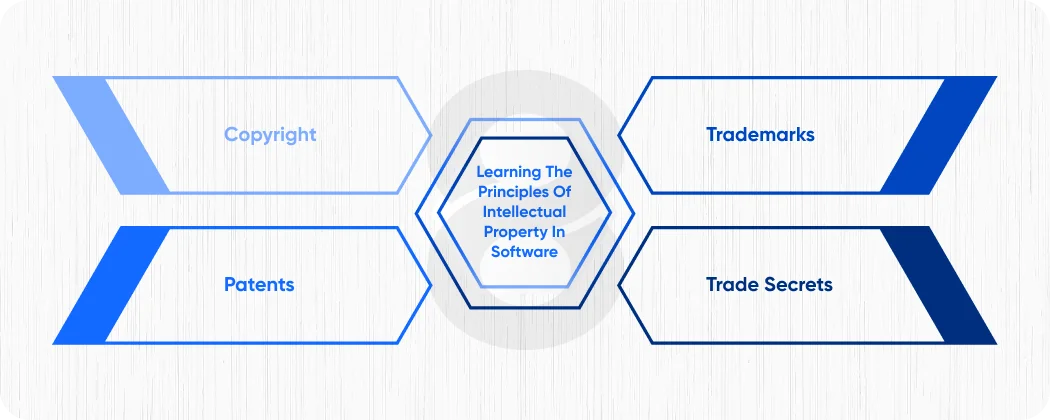
In order to defend an app idea, it is important to know what the most common types of protection are. There are four categories of intellectual property in software, which are mostly interdependent, namely, copyright, trademarks, patents, and trade secrets. They secure two distinct levels of your computer product.
Copyright: Code and Creative Structure
Copyright protects the initial expression of your software. Its protection automatically takes place the moment you produce source code, create interfaces, or prepare documentation or organization databases. Nevertheless, registration enhances enforcement and makes a governmental record of ownership.
Copyright does not safeguard an idea but only safeguards the expression of code. When the same logic is developed by a different developer, then it becomes a complex case in a legal sense. Thus, registration and documentation is a strategic reinforcement.
In software development, copyright is granted to the source code, object code, layouts of the UI design, and written materials. Copyright notices placed in documentation and application interfaces also strengthen the ownership.
Trademarks: Guarding Brand Name and Marketplace
Whereas the code is safeguarded by copyright and recognition by trademarks. Your market identity is your app name, logo, tagline, and branding aspects. The protection of the trademark will ensure that the new entrants do not produce branding that is confusingly similar and misleads consumers.
Brand clarity is crucial to other companies that develop digital products on a scalable basis. The trademarks alone of Apple add value to the global brand value. Establish trademark rights through commercial use, and strengthen geographic protection and enforcement power through formal registration.
Registration of trademarks before rollout will eliminate the expensive rebranding efforts down the line.
Patents: Securing Technical Innovation
Patents are used to safeguard new inventions and technical processes. They are in the field of software can be claims over algorithms, security protocols, AI procedures, or unusual system designs.
Patent protection involves the public disclosure of the invention traded off against exclusive rights over a specific time period, which is usually twenty years (utility patents). This monopoly will discourage competition and increase investor confidence.
Intellectual property in software, however, has to be thought over. The invention should be novel, non-obvious, and useful. Necessitating the financial investment and time, patent applications may become a powerful tool in the intellectual property of software in the case of strategic use.
Trade Secrets: Guarding Competitive Advantage
Not every innovation is to be patented. Certain factors do well as trade secrets. This is usually the case with proprietary algorithms, training data, internal procedures, and pricing logic.
The protection of trade secrets is based on confidentiality. Firms have to employ stringent access controls, non-disclosure agreements, and security structures to uphold secrecy. Trade secrets are not subject to expiry, unlike patents, so long as they are kept secret.
A large number of technology firms have been relying on trade secret plans to serve as safeguards to core engines without any publicity.
According to a report:
The intellectual property management software market, which assists management in organizing, automating, and enforcing IP strategies, is estimated to grow from approximately 12.3 billion to 24.8 billion by 2030 at a 12.9% CAGR. This expansion is directly related to the implementation of an IP strategy in product and app development by companies.
Read More: Why 80% of Apps Fail in the First Year (And How to Ensure Yours Doesn’t)
Why Protection Must Begin Before Development
Several founders feel that protection commences after the launch. As a matter of fact, it has to start before development.
In the earliest stages of an app concept, co-founders, designers, developers, consultants, and agencies actively collaborate to shape the idea and propose solutions. Lack of written ownership agreements may lead to confusion on ownership of what.
The companies must define before writing any code:
- Ownership of core concepts
- Future developments to be assigned
- Licensing boundaries
- Confidentiality obligations
- Post-termination IP rights
Outsourcing complexifies the situation. The third-party developers should explicitly transfer the ownership of your product through properly formulated intellectual property clauses. The developer can preserve rights without being formally assigned. Remarkable savings will keep your idea with you.
This is where product engineering services and dedicated development team (staff augmentation) services become critical, as they establish clear IP ownership frameworks, secure development environments, and legally binding transfer terms from day one. By aligning technical delivery with contractual clarity, you protect your innovation while still benefiting from outsourcing efficiency and cost optimization.
Read More: The Billion-Dollar Blueprint – How the Most Downloaded Apps Monetize in 2026
Aligning Intellectual Property with Commercial Objectives
Software IP must be in line with the business strategy. The revenue model, partnership model, licensing model, and international expansion model should be supported by protection mechanisms.
Vendor lock-in is removed by companies that own their IP. They have complete authority over scaling decisions, integrations, and market adaptations. They do not rely on proprietary systems of licenses that limit customization.
Access to data is also guaranteed by the ownership of software IP. Numerous licensed sites do not allow the extraction of data or store information in a proprietary format. Architecture is the control of your data. Such a coincidence between the ownership of IP and commercial goals brings about resilience.
Implementing Protection Mechanisms Throughout the Development Lifecycle
Protection is not an isolated event. It is a continuous process that is incorporated in the software lifecycle.
All external partners should be included in non-disclosure agreements. The employment contracts are to have an IP assignment. Contracts with vendors should specify transfer of ownership after they receive payment.
Restrict code block repositories to authorized staff only. Maintain trade secrets with role-based access controls, strong authentication tools, and continuous monitoring.
Code escrow agreements add extra security in case of dealing with outside vendors. In case of a conflict, escrow agreements provide access to the source code.
Conduct frequent audits to ensure teams follow licensing guidelines and avoid adding unlicensed open-source components that create legal liability.
At completion of the project, there should be documentation of ownership of source code, documentation, designs, and other associated assets.
There has to be some protection.
The Role of Intellectual Property Management Software
With the growth in portfolios, manual tracking is no longer adequate. This is where the intellectual property management software is critical.
Intellectual property management software is centralized, and documentation, filings, renewal deadlines, inventor data, and license agreements are centralized. It gives visibility of patents, trademarks, copyrights, and trade secrets.
Companies that are operated on spreadsheets are likely to miss the deadline or lose documentation. The intellectual property management software lowers this exposure by automating the tracking procedures.
In the case of scaling technology companies, intellectual property management software is a base infrastructure. It helps in maintaining uniformity in jurisdictions as well as facilitating sustainable governance.
In the absence of the intellectual property management software, sophisticated IP portfolios will be torn apart and exposed.
The Critical Importance of Intellectual Property Docketing Software
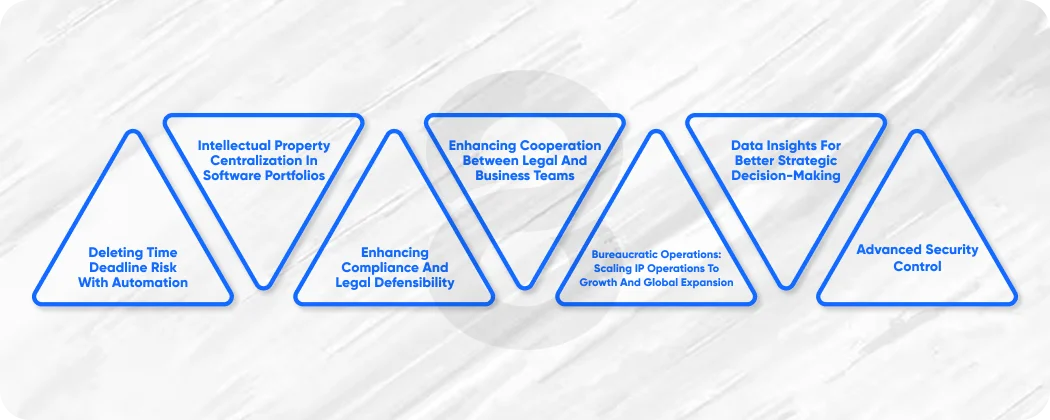
Innovation moves fast. Filing deadlines, renewal dates, jurisdictional rules, and compliance requirements move even faster. As companies expand their patent, trademark, and copyright portfolios, managing them manually becomes inefficient and risky. Intellectual property docketing software provides the structure, automation, and oversight businesses need to protect their assets with precision.
1. Deleting Time Deadline Risk with Automation
The loss of deadlines may be irreversible in respect to IP rights. There are patent maintenance fees, trademark renewals and office action responding with rigid time limits.
Intellectual property docketing software uses automatic calculation of the due date in various jurisdictions, Generation of reminders, and creation of escalation warnings. Although, this automation reduces the error of human beings and ensures that no organization ever loses any worthwhile rights due to negligence.
2. Intellectual Property Centralization in Software Portfolios
Software Intellectual Property spread sheets filings within regions are common in companies that handle Intellectual Property. This data cannot be tracked in spreadsheets or disconnected systems which leads to fragmentation.
The management of intellectual property has been centralized and is structured around:
- Patent applications
- Copyright registrations
- Trademark filings
- Licensing agreements
- Legal correspondence
This approach of centralization enhances visibility, accountability, and accuracy of reporting.
3. Enhancing Compliance and Legal Defensibility
The regulatory environment varies in countries. The processes of filing, documentation and statutory deadlines are manifold.
Docketing software Intellectual property complies with the docketing software in a standardized way. It records all activities, has audit logs and records communications. Organizations may also prove the accuracy of procedures and good governance in case of disagreements or audits.
4. Enhancing Cooperation between Legal and Business Teams
IP strategy ceases to be the preserve of the legal departments. Innovation management is done by product managers, R&D, executives, and even out-of-house counsel.
Modern intellectual property management solutions combine collaborative capabilities through which one can share documents, assign tasks, and track workflow. This orientation will make sure that the innovation strategy is aligned with more comprehensive business goals.
5. Bureaucratic Operations: Scaling IP Operations to Growth and Global Expansion
The complexity of IP is increasing as startups turn into global organizations. International filing involves dealing with several languages, legal systems, and filing organizations.
Intellectual property docketing software helps in scalable operations by:
- Supervising inter-jurisdictional filings
- Following up on foreign associates and agents
- Currency and fee calculation automation
- Unification of global reporting
Such scalability safeguards innovation and allows growth.
6. Data Insights for Better Strategic Decision-Making
In addition to monitoring deadlines, docketing systems create useful analytics. Reporting dashboards assist with reporting, leaders use them to:
- Assess portfolio strength
- Identify high-value assets
- Evaluate filing trends
- Optimize R&D investment
The software will help take IP management beyond administrative tracking to strategic planning in that it converts raw data into actionable insights.
7. Protecting Sensitive Innovation with Advanced Security Controls
The IP assets are usually the most important intellectual capital of the company. Financial and reputation damage can be brought about by exposure or unauthorized access.
An intellectual property management system in place has:
- Role-based access controls
- Multi-factor authentication
- Encrypted cloud storage
- Monitoring and logs of activities
These security measures protect the secret software algorithms, trade secrets, and legal documents.
According to Future Market Insights:
The world intellectual property software market tools that assist businesses in registering and handling of IP, such as patents, trademarks, and copyrights, are expanding fast. It is projected to increase by approximately 12.7 percent (CAGR) to about 21.3 billion dollars in 2035, compared to its current estimate of about 6.4 billion dollars in 2025. This is indicative of the companies that are increasingly investing in software to ensure the safeguarding of innovation and the facilitation of IP processes.
Building a Comprehensive Intellectual Property Management System
A good intellectual property management system incorporates legal, technical, and operational elements. It brings together documentation practices, contractual protections, access controls, intellectual property management software, and intellectual property docketing software under a single structure.
An intellectual property management system that is created well will ensure that:
- Ownership has also been very clear
- Deadlines remain monitored
- Assets remain documented
- Confidentiality is maintained
- Business strategy is the same
If companies fail to implement an intellectual property management system in a structured way at an early stage, they create chaos later.
This system can support sustainable governance as your platform becomes an ecosystem and your app becomes a platform.
Read More: How to Promote Your App in 2026
Software and Emerging Technologies Intellectual Property
The use of artificial intelligence, blockchain systems, and machine learning platforms causes an addition of complexity in the field of IP strategy. The rights to AI-generated outputs, safeguarding of training data, and eligibility to patent algorithms will take further planning.
Model architecture and data pipelines are common components of trade secrets in AI-controlled environments. Technical breakthroughs can be defended by patent strategies. Copyright protects source code. Brand positioning is maintained by trademark protection.
When these protections are incorporated into an intellectual property management system, coherence occurs.
Protected Innovation: The Long-Term Value
The possession of the intellectual property in the software enhances the negotiation power. It maximizes funding round valuation and endorses mergers and purchases and develops licensing opportunities.
The investors are always examining IP defensibility prior to investing in it. Low leverage is produced by weak protection.
By securing your app idea prior to development, you transform an idea into a safe asset. You develop trust with stakeholders. You generate a competitive advantage in the market.
Conclusion: Protect Before You Build
Most successful technology companies know that innovation is not permanent without protection. Like Amazon and Apple, they did not create companies on code. They established them on value-added intellectual property platforms.
Get the ownership safe before development commences. Establish agreements. Register protection. Institute management systems. Implement intellectual property management software. Digest intellectual property docketing software. Develop a complex intellectual property management system.
Intellectual Property in Software: It is Strategy, not Paperwork.
Protect your idea first. Then go and make it up.