


Blockchain gaming isn’t a bet anymore. It’s a legit production sector, with institutional funding and a serious technical standard, and the player base actually cares about investing in what they are buying in-game. To keep up, NFT game development companies have had to evolve quickly.
The figures confirm this. Fortune Business Insights projects that the global NFT gaming market will reach $7.63 billion in 2026 and $45.88 billion by 2034 with a CAGR of 25.14%. It’s not a niche experiment. This is an entire industry in motion. At the heart of all that growth is one fundamental question any gaming founder, studio, or investor will need to ask themselves: Who will actually build the thing?
This guide provides a walkthrough of the best NFT game development firms to consider in 2026, the ranking process, each firm’s strengths, and how to make the right decision for your project.
What Are NFT Game Development Companies?
These are the studios and agencies that specialize in creating games in which in-game assets are NFTs on a blockchain. They don’t just write game code, they build entire digital economies.
A serious NFT game development company takes care of everything: from designing the smart contract architecture and tokenomics to developing a multiplayer backend system, building the marketplace, and integrating cross-chain wallet solutions. Consider them to be the crossroads between a game studio and a blockchain consultancy and product agency.
Core Services They Offer
Where an NFT game dev shop differs from a regular game studio is the blockchain layer behind it all:
- NFT Integration: Making on-chain assets, such as in-game items, skins, land and characters, verifiable and rare assets that can be traded.
- Smart Contract Development: Creating and reviewing the independent code that manages the mint, transfers, royalties, staking and marketplace regulations.
- Wallet Integration: Non-custodial wallet experiences that allow players to handle their assets without the hassle, frequently with multi-chain backing.
- NFT Marketplace Development: Development of in-game or stand-alone marketplaces for players to purchase, sell and trade items.
- Tokenomics Design: Establishing sustainable in-game economies with dual-token models, inflationary controls and rewards.
- Multiplayer Architecture: Multiplayer support on the back end without degrading the integrity of the on-chain platform.
- Web3 Backend: APIs, Indexers and oracles that will bridge the gap between game clients and the blockchain in real-time.
- Cross-Platform Deployment: Delivering the game across PC, mobile and browser without compromising wallet capabilities.
- Security Auditing: Identifying and patching vulnerabilities in smart contracts before they get exploited.
Read More: How to Make a Multiplayer Game: A Complete Guide (2026)
Why Businesses Are Investing in NFT Games in 2026
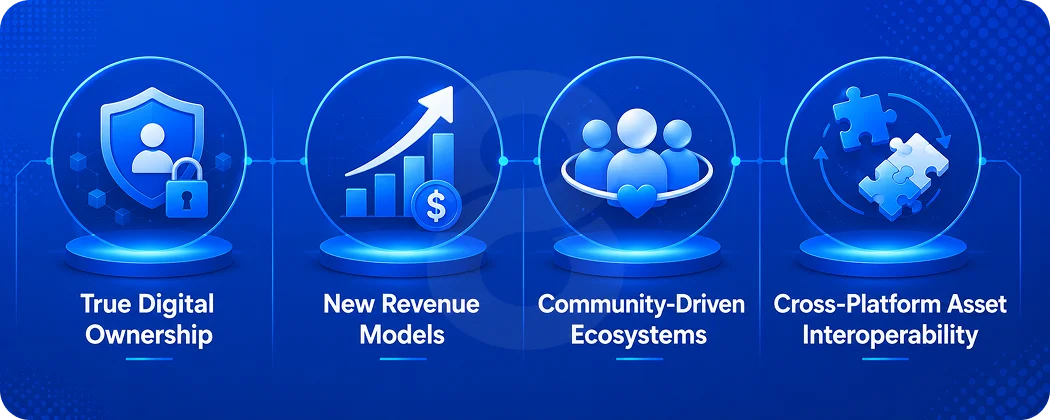
The “let’s add NFTs to our current game” mentality has largely passed. The firms that invest now have the basic knowledge of how it works.
True Digital Ownership
Players have always been spending money on games. The direction of the flow of value is what NFTs change. An “on-chain” in-game item is truly owned by the player who has earned or purchased it. They can sell it, hold it or trade it. It’s a very different relationship between the game and the player, and it’s one that traditional games are not able to replicate in order to retain players.
New Revenue Models
The revenue stack for an NFT game is significantly richer than a traditional title. Studios can earn from:
- Primary NFT sales on mint
- Secondary royalties on every resale
- Marketplace transaction fees
- Staking rewards programs
- Token offerings
- Subscription access to premium areas or features
No single stream dominates, which means diversified, longer-lived revenue.
Community-Driven Ecosystems
Due to the game being skin in the game, NFT games generally create more cohesive communities. If your character or land has real world value you are concerned about the direction and governance votes of the game and the economic health of the game. That’s a community energy that can only be captured through a green budget.
Cross-Platform Asset Interoperability
This is still early, but it’s moving. Items from one game being usable in another, assets that travel with the player regardless of where they play. The infrastructure is being built, and the NFT game development companies who are thinking about this now will be the ones whose clients win later.
Read More: Ideas for Game Development: How Businesses Can Enter the Gaming Market
How We Ranked the Best NFT Game Development Companies
This list isn’t based on who spends the most on their own marketing. Rankings were evaluated across:
- Years of verifiable blockchain and game development experience
- Quality and scale of NFT game portfolio
- Depth of blockchain expertise (chains supported, auditing practices)
- Tech stack range and modern framework adoption
- Client satisfaction data from platforms like Clutch, GoodFirms, and G2
- Smart contract security practices
- UI/UX quality across shipped games
- Scalability of backend architecture
- Post-launch support quality
- Innovation signals like AI integration, L2 adoption, and cross-chain capabilities
- Global presence and delivery track record
Top 10 NFT Game Development Companies in 2026
The rankings here are based on expertise, client happiness, breadth of blockchain ability, and the capacity to provide games that don’t fall apart upon release.
 8ration
8ration is a full-stack Web3 game development company capable of developing NFT-integrated gaming ecosystems from ideation to product launch. Their expertise spans Ethereum, Polygon, and BSC and they are involved in scalable multiplayer infrastructure, smart contract security and player owned economies.
Key NFT Game Development Services:
- Custom NFT game architecture and loop design
- Gas-optimized smart contracts (ERC-721, ERC-1155, custom)
- NFT marketplace development with auction and royalty systems
- DeFi staking integration for in-game asset rewards
- Non-custodial wallet creation with multi-chain support
- Multiplayer architecture for concurrent player ecosystems
- NFT avatar and character development with rarity attributes
- Tokenomics design and in-game economy modeling
- Metaverse environment development using Unity and Unreal Engine
Industries Served: Gaming, Entertainment, DeFi, Metaverse, Fintech
Technology Expertise: Solidity, Rust, Unity, Unreal Engine, Polygon, Ethereum, BSC, Web3.js, Hardhat, IPFS
Why Choose Them: 8ration sees NFT games as a technical and product challenge. Their blockchain app development team performs a full security audit before deployment, and their Web3 backend architecture is designed to be scalable for live gameplay, not MVP scale.
 Antier Solutions
Antier Solutions is one of the most experienced blockchain game development companies operating globally. With 600+ professionals and offices across the US, UK, and Europe, they’ve delivered over 50 NFT game projects in the past five years.
Key NFT Game Development Services:
- End-to-end NFT game development
- Cross-chain compatible blockchain gaming solutions
- Play-to-earn feature implementation
- In-game token and NFT creation
- NFT marketplace and avatar development
- 2D/3D art services
Industries Served: Gaming, Fintech, Real Estate, Healthcare
Technology Expertise: Ethereum, Solana, Polygon, Binance Smart Chain, Unity, Unreal Engine
Why Choose Them: Their fintech and crypto expertise provides an advantage in developing token economies that need to be treated like a real financial system, not just a card program with a blockchain facade.
 Juego Studios
Juego Studios is recognized as one of the most production-mature NFT game development companies globally. Founded in Bengaluru with a strong US presence, their 300+ person team has delivered 500+ projects. Their client list includes Disney, Sony, Warner Bros., and Tencent.
Key NFT Game Development Services:
- Full-cycle NFT game co-development
- Blockchain integration and asset tokenization
- Traditional game porting to blockchain
- Game tokenomics design
- NFT integration across game genres
Industries Served: Entertainment, Gaming, Media, Education
Technology Expertise: Unity, Unreal Engine, Ethereum, Polygon, Solana, AR/VR
Why Choose Them: They act as real co-development partners, not simply as units completing sequential tasks. This greatly decreases the risk of execution with complex, long-term projects.
 RisingMax Inc.
RisingMax Inc. is a New York-based blockchain and Web3 development firm with strong capabilities in NFT game development and decentralized application architecture. They serve startups and enterprises across North America.
Key NFT Game Development Services:
- Custom NFT game development
- Smart contract development and auditing
- NFT marketplace with P2E mechanics
- Token development and wallet integration
- Web3 backend development
Industries Served: Gaming, Finance, Retail, Healthcare
Technology Expertise: Ethereum, Solana, BSC, Unity, React, Node.js
Why Choose Them: A solid pick for North American businesses seeking a development partner that’s close by and has a solid track record of delivering enterprise services.
 Suffescom Solutions
Suffescom Solutions is an India-based company with a research presence in Japan and branch office in Singapore. They specialize in metaverse NFT-based games and have deep experience with blockchain, AR/VR, and IoT-integrated gaming.
Key NFT Game Development Services:
- Metaverse NFT game development
- AR/VR integrated gaming experiences
- Custom NFT game design and development
- NFT marketplace development
- P2E game architecture
Industries Served: Gaming, Metaverse, Retail, Real Estate
Technology Expertise: Unity, Unreal Engine, AR/VR frameworks, Ethereum, BSC
Why Choose Them: Suffescom has a cross-disciplinary team familiar with the intersection of games and games in the metaverse with AR/VR components.
 Peiko
Peiko
Peiko is a blockchain-native development studio with strong delivery credentials in DeFi and NFT gaming. They build with a focus on product quality and clean smart contract architecture.
Key NFT Game Development Services:
- NFT game development
- Smart contract development and security auditing
- Marketplace development
- Wallet and DeFi integration
- Token economy design
Industries Served: Gaming, DeFi, Fintech
Technology Expertise: Solidity, Ethereum, Polygon, React, Node.js
Why Choose Them: Peiko’s forte is his technical precision. They are a good option for games that rely on the economy layer with high pressure, as their auditing rigor and clean contract patterns make them a good choice.
 Kevuru Games
Kevuru Games is a specialized blockchain and NFT game development studio operating in the US market. They combine blockchain integration with deep game design expertise, focusing on building experiences that work as games first and NFT ecosystems second.
Key NFT Game Development Services:
- Full-cycle NFT game development
- Blockchain integration (Ethereum, Solana, Polygon, BSC)
- Smart contract development
- NFT asset creation and integration
- Multiplayer architecture
- Marketplace and wallet integration
Industries Served: Gaming, Entertainment, Collectibles
Technology Expertise: Unity, Unreal Engine, Ethereum, Solana, Polygon
Why Choose Them: Kevuru’s mentality is that gameplay is first, tokenomics is second. Their alignment with quality player experience is becoming rarer in the space, and it’s reflected in their released games.
 Cubix
Cubix
Cubix is a US-based studio with global delivery capabilities. They have significant experience across mobile game development and blockchain integration, with a portfolio that spans multiple game genres and chains.
Key NFT Game Development Services:
- Custom blockchain game development
- NFT integration and marketplace development
- Smart contract development
- Cross-platform deployment (iOS, Android, PC)
- Multiplayer game architecture
- Token development
Industries Served: Gaming, Entertainment, Fintech, Retail
Technology Expertise: Unity, Unreal Engine, Ethereum, Solana, BSC, Swift, Kotlin
Why Choose Them: The good thing about Cubix is that it does a good job of deploying NFT games to mobile devices, which is important since mobile accounted for 46.19% of the NFT gaming market in 2025.
 Whimsy Games
Whimsy Games is a creative blockchain gaming studio with presence across the US and Europe. With 50 to 250 professionals and 7+ years in gaming and blockchain, they’ve built a reputation for combining strong gameplay design with clean Web3 mechanics.
Key NFT Game Development Services:
- Play-and-Earn (P&E) model implementation
- NFT integration with gameplay-first design
- Smart contract development
- Blockchain game UI/UX
- Marketplace development
Industries Served: Gaming, Entertainment, Web3
Technology Expertise: Unity, Unreal Engine, Ethereum, Polygon, Solana
Why Choose Them: When it comes to playing, they are a game-first company, and as such, the NFTs play a supporting role to the game itself. That is consistent with the direction the market is heading in 2026 towards desirable games to play.
 Solulab
Solulab is a US-based Web3 and blockchain development company offering a full range of NFT game development services. They serve everything from NFT racing games and card games to PVP battle platforms and casino games, with a strong enterprise client base.
Key NFT Game Development Services:
- NFT game development across multiple genres
- Smart contract development and auditing
- NFT marketplace development
- Blockchain integration (Ethereum, Solana, Polygon, BSC, Avalanche)
- Token development and wallet integration
- Web3 backend infrastructure
Industries Served: Gaming, Entertainment, Finance, Healthcare, Retail
Technology Expertise: Unity, Unreal Engine, Ethereum, Solana, Polygon, Avalanche, BNB Chain
Why Choose Them: With their cross-industry experience, Solulab is also aware of how to create gaming platforms that must connect with financial and enterprise systems, which is valuable for projects that have intricate compliance or integration demands.
Comparison Table of the Top NFT Game Development Companies
| Company | Founded | Headquarters | Blockchain Expertise | NFT Marketplace | Smart Contracts | Best For |
|---|---|---|---|---|---|---|
| 8ration | 2020 | San Diego, USA | Ethereum, Polygon, BSC | Yes | Yes | Full-stack Web3 games, DeFi staking integration |
| Antier Solutions | 2016 | Chandigarh, India | Multi-chain | Yes | Yes | Large-scale NFT ecosystems |
| Juego Studios | 2013 | Bengaluru, India | Ethereum, Polygon, Solana | Yes | Yes | Co-development, AAA-grade projects |
| RisingMax Inc. | 2011 | New York, USA | Ethereum, Solana, BSC | Yes | Yes | North American enterprise clients |
| Suffescom Solutions | 2013 | Punjab, India | Ethereum, BSC | Yes | Yes | Metaverse and AR/VR-heavy games |
| Peiko | 2015 | Ukraine | Ethereum, Polygon | Yes | Yes | DeFi-integrated games, auditing |
| Kevuru Games | 2011 | USA | Ethereum, Solana, Polygon, BSC | Yes | Yes | Gameplay-first NFT development |
| Cubix | 2008 | USA | Ethereum, Solana, BSC | Yes | Yes | Mobile NFT game development |
| Whimsy Games | 2016 | USA/Europe | Ethereum, Polygon, Solana | Yes | Yes | P&E model, creative blockchain games |
| Solulab | 2014 | USA | Multi-chain | Yes | Yes | Genre-diverse, enterprise-grade games |
How to Choose the Right NFT Game Development Company
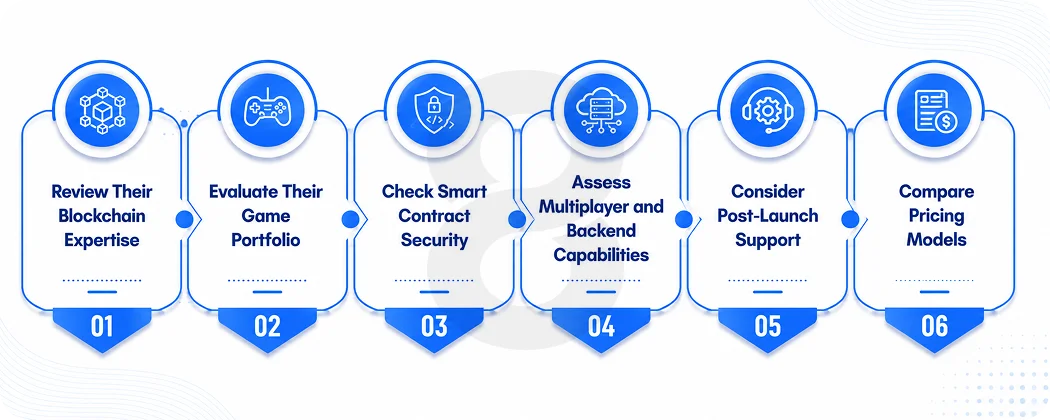
This decision doesn’t have to be guesswork. A few structured checks will surface the right partner quickly.
Review Their Blockchain Expertise
Not every blockchain fits every game. A card game on Ethereum with $30 gas fees is a dead product. A studio should be able to explain the trade-offs between Ethereum, Polygon, Immutable, Solana, and BNB Chain and make a recommendation based on your game’s specific transaction volume and audience geography.
Evaluate Their Game Portfolio
Smart contract work alone doesn’t qualify a company to build a full game. Look for shipped titles with active player bases. Watch the gameplay, not just the marketing site.
Check Smart Contract Security
Ask directly about their audit process. Who audits their contracts? Do they use external firms like CertiK or Hacken, or is it all internal review? Smart contract exploits have cost the gaming industry hundreds of millions. This isn’t optional due diligence.
Assess Multiplayer and Backend Capabilities
Most NFT games require real-time multiplayer infrastructure that can handle thousands of concurrent users while keeping on-chain state consistent. This is genuinely hard. A studio that’s only built single-player NFT experiences doesn’t have the same capability.
Consider Post-Launch Support
A blockchain game’s live economy needs active management. Token prices shift, exploits get discovered, player behavior creates unexpected edge cases. The best NFT game development companies offer real post-launch operational support, not just a handoff document.
Compare Pricing Models
Some studios quote fixed-price for defined scope. Others work on time-and-materials. For complex Web3 games, a discovery phase before full engagement is usually worth the upfront investment.
Read More: Top Mobile Game Development Companies Worldwide
Essential Features Every NFT Game Should Include
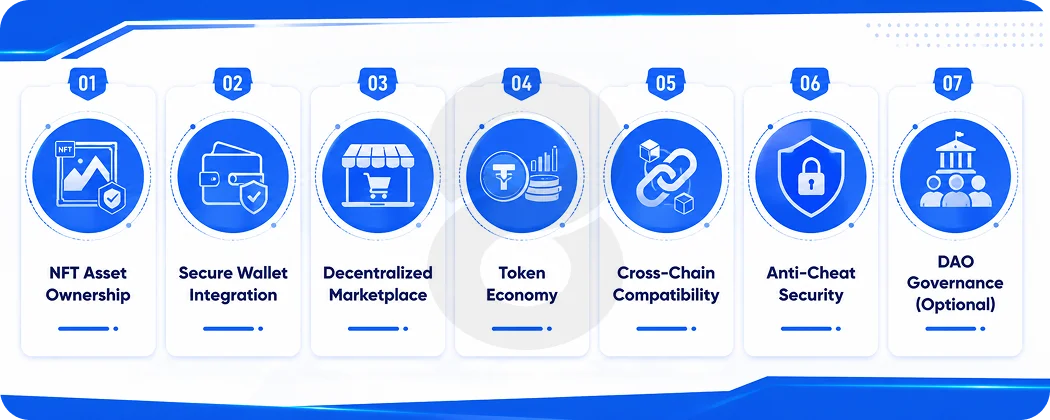
NFT Asset Ownership
Each in-game item should be a verifiable on-chain asset with unique metadata, rarity attributes, and a transferable ownership record.
Secure Wallet Integration
Non-custodial wallets with multi-chain support, social login options, and frictionless in-game authentication. Players shouldn’t need a crypto background to get started.
Decentralized Marketplace
An in-game or integrated marketplace where players can list, bid on, and purchase assets. Smart contract-enforced royalties should trigger automatically on secondary sales.
Token Economy
A well-designed dual-token system (governance + utility) with controlled supply, clear utility sinks, and inflation management. The economy has to work when 100 people are playing and when 100,000 are.
Cross-Chain Compatibility
Players shouldn’t be locked into one chain. The best games allow asset bridging across Ethereum, Polygon, Solana, and others.
Anti-Cheat Security
On-chain logic should be the source of truth. Off-chain game actions that affect NFT state need validation layers to prevent manipulation.
DAO Governance (Optional)
For games with active communities, a decentralized governance system lets token holders vote on game direction, economic changes, and treasury allocation.
Read More: What Are the Main Stages of Video Game Development
NFT Game Development Cost in 2026
Cost depends on game complexity, blockchain choice, NFT mechanics depth, multiplayer infrastructure requirements, and the number of custom smart contract systems involved. Here’s a realistic breakdown:
| Project Type | Estimated Cost |
|---|---|
| Simple NFT Game | $20,000 – $50,000 |
| Mid-Level Multiplayer NFT Game | $50,000 – $120,000 |
| AAA NFT Game | $150,000 – $500,000+ |
| NFT Marketplace Integration | $10,000 – $40,000 |
| Smart Contract Development | $8,000 – $30,000 |
Factors that push costs higher:
- Multi-chain deployment vs. single-chain
- Real-time multiplayer vs. turn-based or single-player
- Custom tokenomics with complex reward curves
- NFT avatar systems with generative rarity attributes
- Full marketplace vs. basic transfer functionality
- External security audits (recommended for anything going to mainnet)
- Backend infrastructure for high concurrency
- Ongoing maintenance and live-ops support contracts
Future Trends in NFT Game Development
AI-Powered NPCs
AI-driven non-player characters that adapt, learn, and generate dynamic in-game dialogue. According to CoinLaw, AI agents are a focus area for 39% of blockchain gaming companies in 2026.
Cross-Chain Gaming
Players moving assets across chains without friction. Bridges and cross-chain protocols are maturing fast, and games built with this in mind will have a significant interoperability advantage within two to three years.
Interoperable Digital Assets
An NFT earned in one game showing up as a usable item in another is still mostly theoretical, but the standards work is happening. ERC-6551 and similar specs are laying the groundwork.
Layer-2 Blockchain Adoption
Polygon, Immutable X, Arbitrum, and Base are absorbing gaming transaction volume because they make microtransactions economically viable. Most new NFT game launches in 2026 are defaulting to L2 rather than Ethereum mainnet.
Soulbound Tokens
Non-transferable tokens tied to a specific wallet address are being used for achievements, reputation, and identity within game ecosystems. They add dimension to player profiles without creating additional trade volume.
Metaverse Expansion
Persistent virtual worlds where NFT land, items, and identities carry long-term value. The metaverse gaming sector was valued at $0.28 billion in 2024 and is projected to hit $9.68 billion by 2033.
Real-World Asset (RWA) Integration
Physical goods, event tickets, and real-world collectibles being mirrored as NFTs within gaming ecosystems. This blurs the line between digital gameplay and physical ownership in interesting ways.
Read More: How to Hire the Best Game Development Team for Your Project
8ration’s Approach to NFT Game Development
8ration is a San Diego-based technology company that builds end-to-end Web3 gaming solutions. Their blockchain development team handles everything from initial tokenomics architecture through to smart contract auditing, NFT minting systems, and live-game backend infrastructure.
Their hire NFT developers service lets studios augment their teams with dedicated NFT and smart contract specialists without committing to full agency engagements. For teams building from scratch, their Web3 game development service covers the complete lifecycle: game design, blockchain integration, marketplace development, wallet creation, and post-launch support.
What distinguishes their work is the security-first approach to smart contracts. Before any contract goes to mainnet, it goes through penetration testing, vulnerability scanning, and functional validation across testnet environments. Their staking platform work, including multi-asset reward systems and NFT booster integrations, has helped projects achieve TVL milestones within months of launch.
For studios or founders entering the NFT gaming space, 8ration offers the combination of game product thinking and blockchain technical depth that most projects need but rarely find in a single partner.
Read More: How Long Does it Take to Make a Video Game
Final Thoughts!
The NFT gaming market is no longer asking whether blockchain games can work. The question now is which companies can actually build them well enough to hold a player base long-term.
The 10 companies on this list represent different strengths, different scales, and different philosophies. Some excel at enterprise-grade, multi-chain ecosystems. Others bring creative gameplay depth that makes their blockchain layer feel earned rather than bolted on.
If you’re at the early stage of planning an NFT game, start with your game’s core loop before you design the token economy. Find a development partner who asks hard questions about retention, not just architecture. And budget for security audits before mainnet, not after.
The infrastructure is here. The player appetite is real. What the space needs now is games people actually want to come back to.