


The mobile app economy is no longer a luxury, but rather a minimum standard to which all businesses, big and small, should adhere. However, when it comes to digital agencies, it is neither viable nor lucrative to create a new application each time a client requests. Enter white-label app development to agencies: a model enabling you to develop branded, production-ready mobile applications much faster, at reduced costs, and much more consistently than custom development could ever have done.
This guide contains everything you need to know, both what white-label mobile app development is all about and how agencies select the most appropriate platform, prevent typical pitfalls, and grow their offering into a stable source of revenue. Whether a small-scale boutique creative agency or a larger-scale digital consultancy, knowing this model could have a fundamental impact on your service delivery to your clients.
What Is White Label App Development?
White label app development is the process of licensing a ready-to-use application framework or product by a third-party developer and rebranding the product as your own. The technology behind it is developed once by the original developer and then resold under different names and logos to various buyers, usually agencies or end businesses.
Consider it as store-brand products at a grocery store. The cereal is also made in the same factory; the packaging is the only thing that is different. The codebase is shared in the app world, where dozens of client apps share the same codebase, but each wears a different logo, color scheme, and name.
In the case of agencies in particular, white label app development to agencies would imply you can provide mobile app services to your clients without having a full in-house development team. You take the technology, make it fit the brand of individual clients, and sell it as your own digital product. The client receives a smooth mobile application. You get the margin. The developer who developed it in the first place receives a licensing fee. Everyone wins.
Read More: 20 Best Mobile App Development Companies in the USA
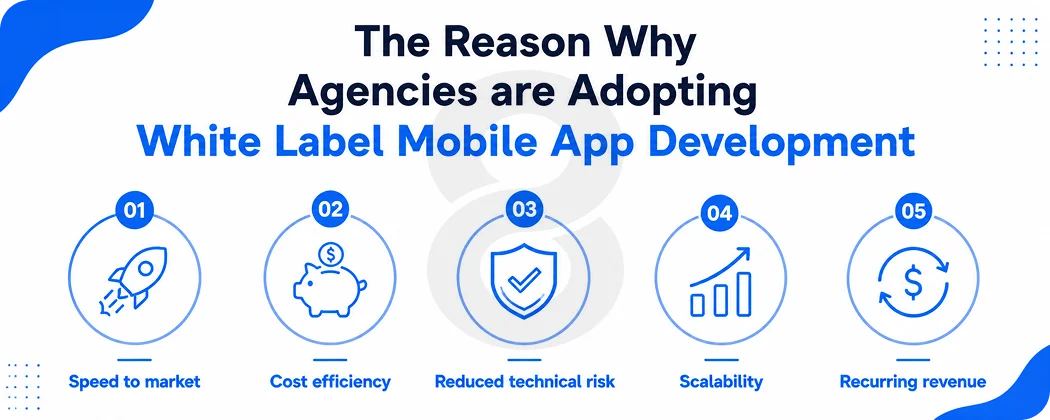
The Reason Why Agencies are Adopting White Label Mobile App Development
The figures reveal a very interesting tale. It is estimated that the mobile app market will increase to over $935 billion by 2027. All businesses, whether in retail, hospitality, healthcare, fitness, or real estate, are all busy in trying to find mobile solutions. To agencies, this is a gigantically large upsell and cross-sell opportunity, but only when you can effectively deliver apps.
This is the reason why white label mobile app development is increasingly becoming the choice of many agencies:
Speed to market
The development of custom apps normally requires six or twelve months between idea and release. White label solutions are able to be configured, branded, and deployed within a few weeks. White label is sometimes the only possible solution when a client requires a loyalty app prior to their summer campaign.
Cost efficiency
A native app is created by writing code that costs between $50,000 and $500,000, depending on complexity. White label platforms radically lower that investment and allow agencies to produce quality apps at price points that would appeal to mid-market clients and still achieve healthy margins.
Reduced technical risk
When you develop tailored software, you get all the bugs, all the security holes, and all the features that fail. Using a white-label platform, the underlying technology is already proven in numerous deployments. You get a product that has been battle-tested instead of having to start at the beginning.
Scalability
When your team has learnt a white-label platform, the onboarding of new clients will be able to be repeated and predicted. The same operating overhead that previously served two clients is now able to serve ten clients.
Recurring revenue
The majority of white-label mobile app development platforms have monthly or annual licensing fees. These are generally billed up by the agencies and charged to the clients as a regular recurring revenue stream and a one-time setup fee.
The global application development software market size was estimated at USD 257.94 billion in 2024 and is projected to reach USD 862.67 billion by 2030, growing at a CAGR of 22.8% from 2025 to 2030.
The Practicalities of White Label App Development to an Agency
This model is simple, yet its implementation needs clarity in each of the steps.
The first step is to choose a white-label platform that can fit into the niche and client base of your agency. Some platforms focus on restaurant ordering apps, fitness tracking, e-commerce, appointment booking, or loyalty programs. The right platform will all be based on the industries you are serving.
When you get your platform, you set up and brand the app to each client. This usually implies uploading logos, implementing brand color schemes, setting up navigation menus, configuring third-party integrations, such as payment gateways or CRM, and deploying the completed app to the Apple App Store and Google Play Store under the developer account of the client.
At that point, your agency can handle continuous updates, or push notifications, analytics reporting, and feature additions on a retainer basis. The client enjoys a unified, fully branded mobile product. They do not even see the platform behind the scenes nor do they really need to.
Read More: Top Custom Enterprise App Development Companies
Choosing the Right White Label Mobile App Development Platform
Not all white label platforms are created equal. A wrong decision here, can cause severe problems in the future, both in terms of poor performance and the lock-in of a platform that can limit what you can offer the clients. The following is what should be assessed:
Industry Fit
Is the platform relevant to the kind of businesses your clients operate? A restaurant platform will be built with table booking, menu management, and loyalty points built in. The platform created based on fitness studios will include a schedule of classes, management of memberships, and tracking of workouts. The time saved by choosing a platform that has out-of-the-box features that are applicable to your niche is phenomenal.
Customization Depth
To what extent can you really change? Other platforms do provide true white labeling, all branding removed, custom domain name support, and extensive UI customization. Others provide superficial modifications such as a change of logo. Learn how far you can go before making a commitment.
Hybrid vs. Native Technology
Apps that are native to iOS and Android provide the best performance and user experience. Cross-platform or hybrid apps made using frameworks such as React Native or Flutter provide a decent tradeoff between performance and development efficiency. Be frank with your customers on what they are receiving.
App Store Compliance
There are also stringent policies on white label and template-powered apps at both Apple and Google. Make sure that your platform is compliant and has a history of successfully publishing apps to both stores. The fact that apps are rejected over and over again is a liability.
Reseller Program Structure
Know the pricing model in and out. Do you charge per application, per customer, or a fixed monthly payment to allow unlimited deployments? Does it have an agency-specific reseller plan with volume discounts? Will you white-label the back end of the company itself, or will your clients see the branding of the original company in their back end?
Support and Documentation
You must have responsive support when something breaks at 9pm before a client launch. Before signing any contract, assess the quality of documentation of the platform, community and forums, and direct support.
Read More: How to Hire a Full Stack Developer in 2026 – The Complete Guide for Tech Founders
White Label App Development Process: Step by Step
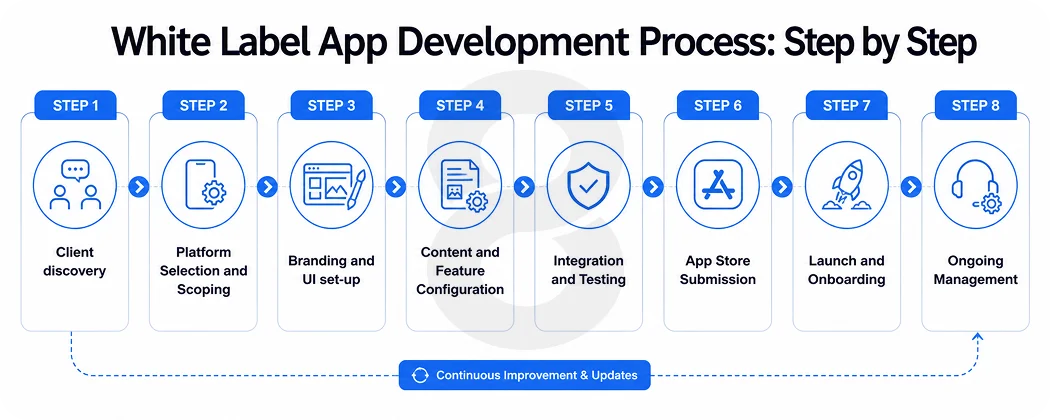
To agencies that are new to this model, a practical walkthrough of how a typical white label mobile app project unfolds and how its processes work together is presented as follows:
Step 1: Client discovery
No matter which technology you are working with, you need to know what the client really needs. What is the issue that the app is addressing? Who are your end-users? What integrations are needed? What does success in six months look like? The comprehensive discovery process helps to avoid scope creep and establish realistic expectations.
Step 2: Platform Selection and Scoping
Find a fit between the needs of the client and the possibilities of your platform. Record what it will contain, what it will need written, and what it just will not be able to do within the limits of the platform. Early disclosure constraints.
Step 3: Branding and UI set-up
Collect all brand resources: logos, brand guidelines, fonts, color codes, and photography. Improve these on the theming system of the platform. This is quite a quick process, and the level of detail here is what will make the final product look polished.
Step 4: Content and Feature Configuration
Fill in the app with the real content of the client product listings, service menus, location details, staff profiles, or anything the app needs. Enable such features as push notifications, loyalty programs, booking flows, or processing payments.
Step 5: Integration and Testing
Integrate all third-party services and test on both iOS and Android devices. Run on actual equipment, not only simulators. Particular attention should be paid to payment flows, authentication of a login, and any data that are synchronized with external systems.
Step 6: App Store Submission
Submit the app. This is not quick, Apple has a lengthy process to go through with its review process, requiring several days. Consider this as part of your project schedule and explain this to clients.
Step 7: Launch and Onboarding
Upon approval, assist the client with the launch by creating a plan – it may involve optimizing the App Store, launch announcement strategy, or training the staff on how to use the app in the role of an app administrator.
Step 8: Ongoing Management
Implement a retainer for the continuous maintenance, updates, analytics reporting, and support. This is the place where your recurring revenue resides.
Common Mistakes Agencies Make With White Label App Development
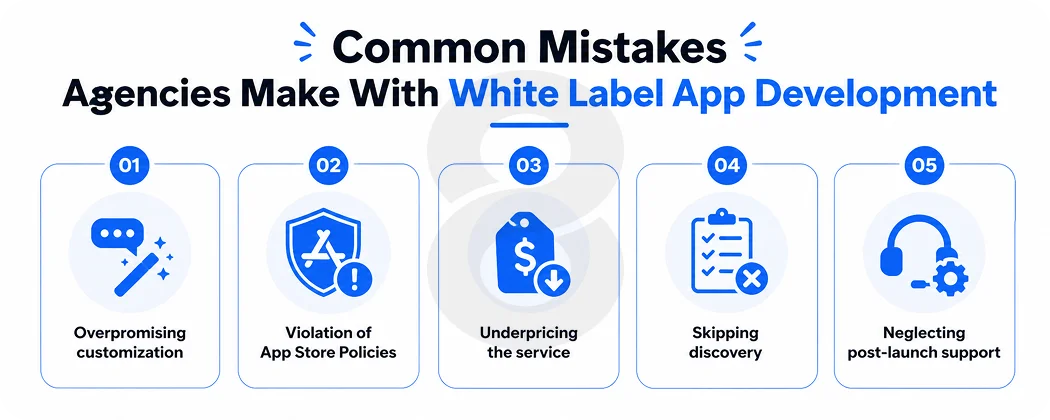
Agencies can falter even when on the right platform. The most common errors and ways to prevent them are as follows:
Overpromising Customization
It is also very tempting to inform a customer that it is possible to construct anything he or she desires. There are boundaries to white-label platforms. Be frank about what is and is not possible before the signing of contracts. It is much more destructive to find out during a project that one of its crucial aspects is misplaced.
Violation of App Store Policies
Apple has been getting very firm regarding template-based and white-label applications. Applications that are too close in functionality to other applications available on the platform, or that do not offer any real value, run the risk of rejection. Vendors with platforms with excellent compliance records know how to make each client app meaningfully different.
Underpricing the Service
Since white label helps to lower your development expenses, some agencies even pass all of the savings onto the client. This is a mistake. It is not the technology that makes you valuable but it is the strategy, project management, branding, and the continuing expertise that you bring.
Skipping Discovery
Making sales and rushing through the setup process without a proper discovery process results in scope creep, incorrect feature specifications, and a dissatisfied client. A fairly basic white-label app project should have a well-organized discovery phase.
Neglecting Post-launch Support
Apps require continuous care, OS updates, the addition of features, monitoring performance, and the strategy of push notifications. The agencies that consider app delivery a one-time project fail to realize the most valuable aspect of the model: long-term client relationships and recurring revenue.
Read more: 9 Steps for Startups to Hire the Right App Development Agency
White Label vs. Custom App Development: Which Is the Right Fit to Your Agency?
This is the question that all agencies will have to confront at some point. The simple truth is that it is a matter of the client and the application.
When the needs of the client can be mapped to existing platform features and when the speed to market is a key factor. When the budget is a major constraint, or when you are serving many clients with similar needs. And want to develop a process that can be repeated, white label mobile app development is the correct choice.
Tailor development is a viable option in cases where the client requires highly specialized functionality that is not available on any platform, when there are complex enterprise integrations involved, when the application is a core proprietary product to the business of the client, or when the long-term ownership and control of the codebase is a strategic priority.
There are several mature agencies which run both models. Most of the work they do with clients is white label mobile app development, with complex flagship projects being reserved to custom development. This provides them with the same level of efficiency as white label at scale but with the ability to win larger, more complex engagements.
How to develop a profitable White Label App Practice
After you have made your first few white label apps, the next thing to do is to systematize and scale. This is the way successful agencies develop a sustainable practice based on this model:
Create Service Packages
Instead of pricing out each project individually, create tiered packages, such as a starter app package, a growth package and an enterprise package, each having a defined scope, schedule and cost. It simplifies and accelerates sales conversations and establishes clear expectations.
Develop a Niche
Agencies that specialize in a particular industry say, white-label apps on behalf of independent restaurants, or fitness studios, or boutique retailers develop deep expertise that is priced at a premium and generates referrals in communities in which they operate.
Invest in Marketing Yourself
Case studies, before-and-after measures on client apps, and thought leadership content about white label app development to agencies will create inbound leads and make you the expert in your field.
Establish a Process of Client Success
The agencies that keep the apps clients on year-long contracts are the agencies that actively bring ideas, exchange analytic insights and assist the clients grow their user base. Use each app, client as a long-time collaborator, rather than a project.
Measure and Communicate Metrics
The number of app installs, active users, length of session, open rates of push notifications, in-app purchase conversion these figures that narrate the story of the value of your work. Give reports on them on a regular basis and attach them to the business performance of the client.
The Future of White Labels Mobile App Development
The white-label application industry is fast-changing. Many trends are defining what agencies can look forward to in the coming years.
White label platforms are being integrated with artificial intelligence, allowing features such as personalized content recommendations, predictive inventory management, and AI-powered customer service without the need to be custom-developed. Agencies that learn to structure and locate such capabilities will charge higher fees.
No-code and low-code tools are further reducing the barrier to entry, which means that more agencies can develop apps without extensive knowledge in technical areas. This enhances competition, yet broadens the overall market of clients in need of app solutions.
Progressive web applications (PWAs) are closing the gap between mobile applications and mobile websites, providing another delivery platform to agencies in need of faster and cheaper deployments to their clients who do not require full native functionality.
AI software spending will grow to $297.9 billion by 2027. Over the next five years, market growth will accelerate from 17.8% to 20.4% in 2027, with a 19.1% CAGR. Government has the largest spend of over $70 million by 2027, but oil and gas is growing fastest with a 25.2% CAGR.
Conclusion
White label agency app development is not a quick fix, but a more intelligent approach to work. By using existing ready-made technology, agencies can create real value to clients more quickly and consistently than it would have been built through custom development, and the process of building a scalable, recurring-revenue practice.
The secrets of success include finding the proper platform to fit your niche, being open and honest with clients about what white label means. Investing in discovery and after-sales services, and pricing your expertise, not just the technology, properly.
The mobile app opportunity is vast and continues to expand. Agencies that develop a viable white label mobile app development capability today will be delivering apps more efficiently, and more profitably, as well as at higher scale than those who wait. It is not whether you should provide the service of app development, the question is whether you develop such an opportunity now or whether you wait until your competitors develop this opportunity.