



The speed at which technology is changing is greater than ever before, and in 2026, businesses will not only be developing applications but also scalable and secure digital ecosystems.
That is why the knowledge of how to hire a software engineer is not only a hiring activity but also a strategic decision. Having a strong engineer will also speed up the product market fit, enhance the system architecture, enhance software integration, and minimize the risks encountered during software testing.
Statista records that the worldwide IT expenditure is over 5 trillion US dollars, and the number of developers is greater than 27 million across the globe. Competition is intense.
So, how do you hire right? Establish your business objectives, test technical skills, evaluate real-world problem-solving, and focus on scalability, security, and long-term value over short-term cost.
Why Hiring the Right Engineer Matters More Than Ever
Before going into the checklist, we should have an idea of what is at stake.
Contemporary software creation is no longer linear. It involves:
- Distributed systems
- Microservices architecture
- DevOps and CI/CD pipelines
- Infrastructure cloud providers such as AWS, Azure, and GCP
- Data compliance and security
- Agile and Scrum techniques
Moreover, it is essential to have software integration among the third-party APIs, CRMs, ERPs, and payment gateways. A competent engineer will give smooth interoperability and minimize vulnerability in the systems.
That is why, when you are asking yourself how to recruit a software developer in 2026, the first step is to communicate well.
The 2026 Checklist: How to Hire a Software Engineer Successfully
To hire the appropriate engineer, technical screening is not all that is needed. It requires strategic clarity, systematic assessment and alignment with long-term product, scalability and business growth objectives.
- Start with Strategic Clarity
- Define the Role Precisely
- Choose the Right Hiring Model
- Evaluate Technical Depth, Not Just Resume Buzzwords
- Assess Real-World Engineering Skills
- Prioritize Communication and Collaboration
- Verify Experience with Scalable Systems
- Validate Security and Compliance Awareness
- Check Portfolio and Case Studies
- Understand Cultural Alignment
- Consider AI Literacy in 2026
- Run a Structured Hiring Funnel
- Do Not Ignore Post-Hiring Onboarding
Using this methodical 2026 checklist, you will minimize the risks of hiring, enhance the quality of engineering, and create a scalable technology platform, which creates sustainable innovation and quantifiable outcomes.

Start with Strategic Clarity
Define your technical roadmap before you hire anybody.
Ask yourself:
- Is it a greenfield project or a modernization of a legacy?
- Does it require front-end, back-end, or full-stack expertise?
- Is it AI, blockchain, or cloud architecture?
- To what degree does the software testing need to be automated?
When you are attempting to know how to get a software developer to work on an idea, then it is even more crucial to be clear. The engineers must have product vision, user personas, and business objectives to create effectively.
Action step: Before you start to hire, write down your technical needs, system design expectations, scalability of the system, and adherence to standards.
 Define the Role Precisely
Writing inadequately defined job descriptions is one of the largest errors in hiring.
Rather than stating that they are seeking a developer, indicate:
- Python, Java, Kotlin, Swift, or TypeScript programming languages
- Such frameworks as React, Node.js, Django, or Spring Boot
- Cloud infrastructure experience
- Experience with containerization platforms like Docker and Kubernetes
- Background in the integration of software with APIs
- Experience in automated software test tools
Transparency will weed out the wrong applicants and select the serious ones.
 Choose the Right Hiring Model
In 2026, the appropriate model of hiring is paramount in ensuring the cost and scalability against long-term product performance. The organization that you select influences the effectiveness with which you recruit a software engineer.
In House Engineer
A full-time engineer is the best choice when you require complete ownership of product architecture, long-term roadmap alignment, and high expertise in the domain. In the case that you intend to recruit a software engineer into core systems, this model will provide stability and continuity.
Freelance Developer
A freelance developer is effective in short-term engagements, MVP features, or test builds. In case you have a small scope of work that you wish to find a software developer for within a short period, this flexible model can be used to control expenses and does not require long-term commitment.
Dedicated Remote Team
A special remote team enables you to recruit excellent software engineers without increasing internal facilities. This model promotes scalable software development and ongoing software testing, and facilitates smooth collaboration and minimized overheads of operation, as well as the complexities involved in recruitment.
Technology Partner
Some of the finest software developers are delivered to a project through a technology partner, as well as advice on the architecture, project management, and quality assurance. In case you desire to employ the most skilled developers at a lower risk, then this model provides a formal delivery and a scalable long term.
Hiring is also risky because partnering with a well-known software development company raises the chance of hiring great software engineers at a reduced cost in a short time.
 Evaluate Technical Depth, Not Just Resume Buzzwords
 Evaluate Technical Depth, Not Just Resume Buzzwords
Resumes are sometimes very impressive. Nevertheless, the assessment should be more profound.
During interviews:
- Ask the candidates to justify system architecture decisions
- Talk about scalability trade-offs
- Review GitHub repositories
- Test the ability to solve problems in real time
- Test the knowledge of their code of clean and design patterns
Also, complete a feasible coding task in line with your project.
Keep in mind that when searching to employ the most qualified developers, technical profundity and architectural intelligence are more important than stacking keywords on a resume.
 Assess Real-World Engineering Skills
Codes are not all about engineering.
An effective candidate must be able to show:
- Experience in version control with Git
- CI/CD pipeline principles
- Practices of API documentation
- Methods of database optimization
- Skills in performance profiling
- Secure coding standards
In addition to this, they ought to be familiar with software testing methodologies such as unit testing, integration testing, regression testing, and automated test coverage.
In case a candidate is unable to answer how they deal with production bugs or rollback deployments, think twice.
 Prioritize Communication and Collaboration
Practically, the finest engineers cannot be successful without communication skills.
The contemporary teams are dispersed. Engineers must:
- Write clear documentation
- Take part in sprint planning
- Communicate blockers early
- Cooperate with UI/UX designers
- Work with QA teams
To get a good software developer, consider how the party explains technical concepts in simple language.
Effective communication minimizes the deviation and enhances the speed of production.
 Verify Experience with Scalable Systems
Scalability will not be compromised in 2026.
Ask about:
- Load balancing experience
- Horizontal scaling policies
- Database sharding
- Redis caching systems
- Cloud auto-scaling
Statista points out that revenue in the cloud computing sector is steadily increasing across the globe, which speaks to the significance of cloud-native expertise.
A good engineer is expected to be conversant with the basics of distributed architecture.
 Validate Security and Compliance Awareness
The issue of security is not optional anymore.
Make sure the engineer realizes:
- OAuth authentication
- JWT tokens
- Encryption standards
- Secure API design
- The basics of GDPR and data protection
Millions can be spent by companies on security vulnerabilities. One of the aspects precludes long-term risk by hiring an engineer who is sensitive to security.
 Check Portfolio and Case Studies
Experience builds trust. Nonetheless, evidence generates trust.
Ask candidates or agencies:
- What was the size of the system?
- Which performance measures were better?
- What were the architectural problems resolved?
To illustrate this, during one of our projects for an enterprise, a client experienced serious API latency problems following the migration to microservices. The response time was above 4 seconds, and this influenced the retention of users.
Our engineering unit re-architected service orchestration, added Redis caching, improved indexing of the database, and added asynchronous message queues.
As a result:
- The response time of the API was reduced to less than 800 milliseconds.
- The cost of the servers went down by 22 percent.
- There was a greater uptime in the system.
This is not just an expertise in software development and scalability architecture. It also enhances EEAT signals since results can be measured.
 Understand Cultural Alignment
Skill in technical matters is important. Nevertheless, cultural fit guarantees partnership in the long run.
Assess:
- Work ethic
- Openness to feedback
- Adaptability
- Ownership mindset
- Attitude towards continual learning
The art of engineering is a changing field. Thus, one of the success factors is flexibility.
 Consider AI Literacy in 2026
The development tools aided by AI are transforming work processes.
Contemporary engineers need to realize:
- Artificial intelligence code helpers
- Prompt engineering basics
- Automated test generation
- Intelligent debugging
Statista reports that the AI software market in the world is growing at an accelerating rate, with the focus on AI integration skills as a competitive advantage.
In case you are interested in hiring a software engineer who is future-ready, AI literacy is a factor.
 Run a Structured Hiring Funnel
This is an optimized procedure of recruitment:
- Requirement analysis
- Resume screening
- Technical assessment
- Interview on live system design
- Culture fit interview
- Reference check
- Final offer
An organization enhances uniformity and minimizes favoritism when recruiting.
 Do Not Ignore Post-Hiring Onboarding
Hiring is only the beginning.
Develop a systematized orientation strategy:
- Access to documentation
- Overview of architecture meetings
- Codebase walkthrough
- Defined KPIs
- Initial sprint roadmap
Effective onboarding saves on ramp-up time and ensures high initial productivity.
Common Hiring Mistakes to Avoid Before Hiring a Software Engineer
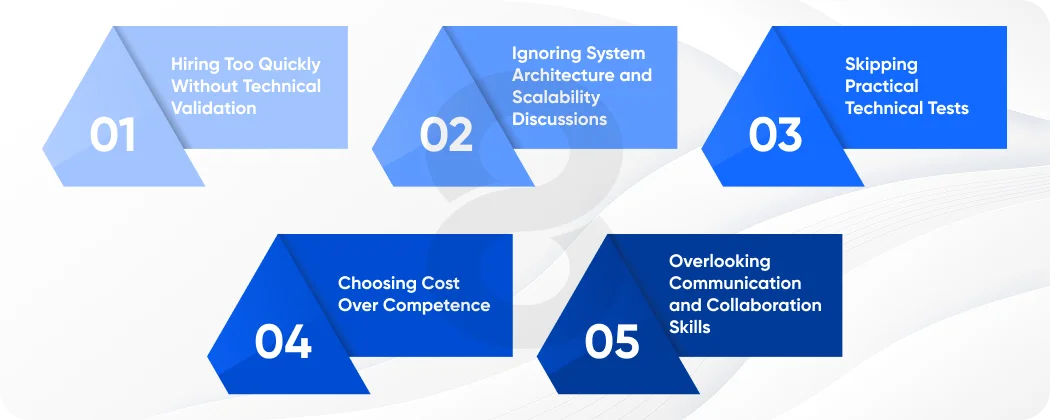
Software recruitment errors are costly, disastrous, and in many cases irreversible. Hence, in the event that you really want to know how to hire a software engineer, you should not take shortcuts that weaken product scalability and ROI in the long run.
1. Hiring Too Quickly Without Technical Validation
Hasty decisions are usually associated with the inappropriateness of the skills and the inadequate architecture. In understanding how to recruit a software developer, you have to put emphasis on structured interviews, technical tests, and system design consultations before you can reach out to any software engineer candidate.
2. Ignoring System Architecture and Scalability Discussions
A developer who is unable to articulate architectural tradeoffs will have a problem with complicated software integration in the future.
In order to find superb software engineers, test their knowledge of distributed systems and patterns of scalability and performance optimization in technical interviews.
3. Skipping Practical Technical Tests
The presence of resumes does not mean the ability to execute. You would like to recruit the most skilled developers, and you would like to carry out coding challenges, real-world simulations, and peer review of code. The good software testing knowledge must also be tested off before being finalized.
4. Choosing Cost Over Competence
Although budgets play a role, the issue of choosing the lowest cost may augment technical debt. Short-term savings are not prioritized by businesses that aim to hire a good software developer, as long-term value is created, clean architecture is used, and maintainable software development practices are taken into consideration.
5. Overlooking Communication and Collaboration Skills
There is no other way that even very strong candidates, who have all the technical skills, fail because they lack teamwork skills.
When you are hiring a software engineer, you need to evaluate the clarity of communication, documentation practice, and cross-team teamwork because the modern software development process requires team-based cooperation among the engineers, the quality assurance team, and the product stakeholders.
Cost Considerations in 2026
The cost of software engineering differs across regions and experience.
Factors affecting cost:
- Seniority level
- Tech stack complexity
- Cloud infrastructure knowledge
- Security specialization
- AI capabilities
Nevertheless, rather than asking how cheap I can hire, it should be how much value this engineer provides.
Quality engineering eliminates the technical debt and avoids costly refactoring.
When to Partner with a Software Development Company
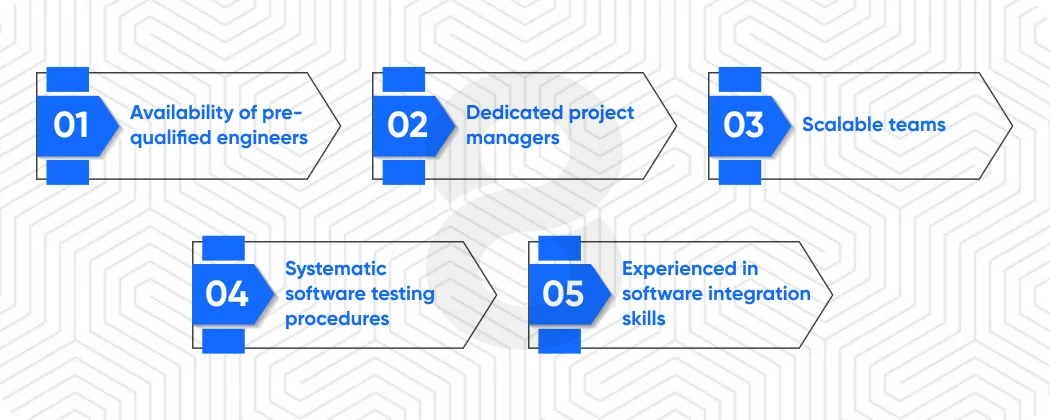
In other cases, rather than employing in-house, collaborating with an organization that specializes in software development offers
- Availability of pre-qualified engineers
- Dedicated project managers
- Scalable teams
- Systematic software testing procedures
- Experienced in software integration skills
When you need your project to be very fast, scalable, and reliable for an enterprise, outsourcing can assist you in getting the best developers without having to go through a lengthy recruitment process.
Read More: 20 Popular Software Development Life Cycle Models You Should Know
Engineering Talent That Transforms Vision Into Scalable Digital Reality
We do not just assist you in hiring a software engineer at 8ration. We match engineering talent to your business goals, product roadmap, and expansion vision.
Our experienced engineers assess architecture, scalability, security and performance at the outset of the project life cycle to make sure that every solution is future-proofed.
We do not merely provide code but create robust digital environments that enable innovation, well-integrated software and sustainable competitive advantage.
Final Thoughts!
Competitive advantage in 2026 is determined by technology and therefore, how to recruit a software engineer will be a very important strategic choice. Regardless of whether you are either proving an idea or digitalizing scaling, you should concentrate on architecture, scalability, security, and quantifiable outcomes.
It is not enough to find a software developer and create long-term value. By being precise and technical, you become risk-averse and fast-tracked, and build a robust technology base that maintains the innovation.