


Computer vision is no longer an experimental technology inside research labs. It now operates inside real production systems everywhere. Cameras became sensors. Images became data. Video became a measurable input. That shift changed how industries make decisions daily. Real-world computer vision applications now influence outcomes faster than human observation ever could.
Companies once treated visual AI as an optional innovation. That mindset is disappearing quickly. Vision models now monitor factories, diagnose patients, inspect crops, and guide vehicles. When machines can see, they can measure. When they measure, they optimize. That optimization is why Real-world computer vision applications are becoming infrastructure rather than features.
Executives used to ask whether vision AI was useful. Now they ask how soon they can deploy it. Competitive pressure plays a role here. So does cost efficiency. Automated perception reduces labor intensity and increases consistency. Those two forces together accelerate adoption across sectors.
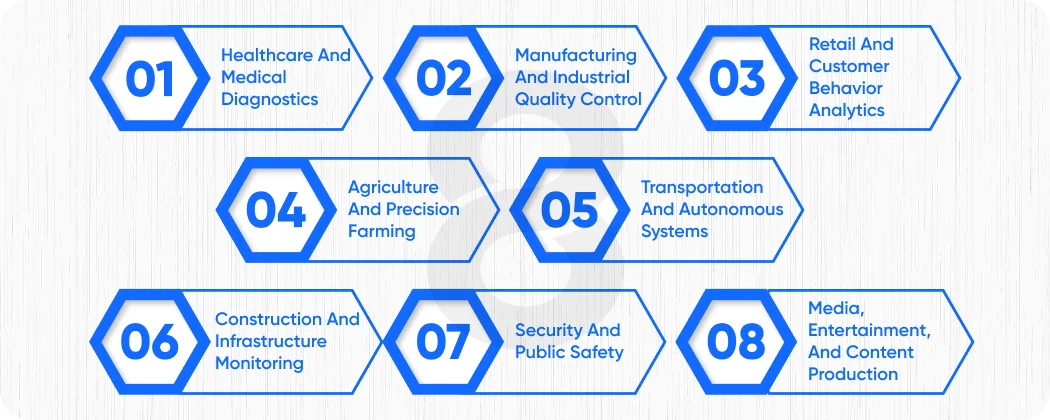
Let us examine where transformation is happening fastest.
Healthcare and Medical Diagnostics
Hospitals generate massive imaging data every single day. Radiology scans. Ultrasounds. MRIs. Pathology slides. Reviewing them manually takes time and attention. AI integration with vision models assists specialists by highlighting anomalies instantly.
Systems detect tumors, fractures, and retinal damage earlier than traditional review workflows. Earlier detection improves survival rates and reduces treatment costs. This is why Real-world computer vision applications are now integrated into diagnostic pipelines globally.
Hospitals also use vision monitoring for patient safety. Cameras detect falls, track movement, and alert staff automatically. These tools do not replace clinicians. They extend awareness across wards continuously and often integrate with mobile app development platforms for real-time staff alerts.
Read More: Artificial Intelligence in Medicine
Manufacturing and Industrial Quality Control
Factories rely on precision. Even small defects can cause recalls or safety issues. Human inspectors miss tiny irregularities after long shifts. Vision systems never lose focus or consistency.
Production lines now use cameras that inspect products frame by frame. They detect scratches, misalignment, or structural flaws instantly. That allows defective items to be removed before shipping. Real-world computer vision applications reduce waste and protect brand reputation simultaneously.
Predictive maintenance is another shift. Vision sensors monitor equipment wear patterns. They identify cracks, overheating signs, or alignment drift. Maintenance teams fix problems before failures occur.
Read More: Artificial Intelligence for Manufacturing
Retail and Customer Behavior Analytics
Retail stores once depended on sales data alone. Now they analyze visual behavior patterns too. Cameras track foot traffic, shelf interaction, and movement flow. These insights reveal how shoppers actually behave inside stores.
Retailers use Real-world computer vision applications to optimize layout placement. Products placed in high attention zones sell faster. Checkout monitoring also reduces theft and improves queue management.
Some stores deploy frictionless checkout systems. Customers walk out with items while cameras track purchases automatically with no scanning or no manual billing.
Agriculture and Precision Farming
Farmers face unpredictable weather, pests, and soil variability. Vision technology helps reduce uncertainty across all those variables. Drones capture aerial imagery of fields daily. Algorithms analyze plant health pixel by pixel.
Farmers identify disease spread early and treat only affected areas. That reduces pesticide usage and protects yield quality. Real-world computer vision applications also measure crop maturity. Harvest timing becomes data driven rather than guesswork.
Livestock monitoring uses similar tools. Cameras track animal movement, feeding behavior, and physical condition. Farmers receive alerts if patterns change suddenly.
Transportation and Autonomous Systems
Transportation relies heavily on perception accuracy. Vehicles must interpret surroundings instantly to operate safely. Vision models allow machines to detect lanes, pedestrians, signals, and obstacles simultaneously.
Autonomous vehicles depend directly on real-world computer vision applications for navigation. Without visual interpretation, automation would fail immediately. Traffic monitoring systems also use vision analysis. They measure congestion, detect accidents, and adjust signals dynamically.
Airports use visual AI for security screening. Systems identify suspicious items faster than manual inspection. This improves safety while reducing delays.
Construction and Infrastructure Monitoring
Construction sites change daily. Monitoring progress manually is slow and error prone. Vision systems track site activity continuously. They compare real progress with digital plans.
Managers detect delays early and adjust schedules. Real-world computer vision applications also improve safety compliance. Cameras detect whether workers wear protective gear properly.
Infrastructure maintenance benefits too. Bridges, roads, and tunnels require inspection regularly. Vision drones scan surfaces for cracks or corrosion. Engineers review reports rather than climbing structures manually.
Security and Public Safety
Security operations demand constant vigilance. Human monitoring cannot scale indefinitely. Vision AI augments surveillance teams with automated detection.
Systems identify unusual movement patterns or restricted area access. They alert personnel immediately. Real-world computer vision applications also support forensic analysis. Investigators search video archives using visual attributes instead of manual review.
Crowd monitoring is another application. Authorities track density levels and detect potential hazards before incidents escalate. Early detection prevents panic and improves emergency response coordination.
Media, Entertainment, and Content Production
Creative industries also rely on vision intelligence now. Editing software automatically tags scenes, faces, and objects. This speeds post-production workflows dramatically.
Studios use Real-world computer vision applications for visual effects tracking. Cameras capture motion data and map it onto digital characters. Sports broadcasting uses similar systems. They track player movement and generate real-time analytics overlays.
Content platforms use vision moderation tools. These systems detect harmful or restricted imagery automatically. That protects audiences and reduces manual review load.
Cross Industry Cost Impact Overview
# |
Industry |
Primary Benefit |
Cost Advantage |
Adoption Driver |
| 1 | Healthcare | Faster diagnosis | Reduced manual review | Patient outcomes |
| 2 | Manufacturing | Defect detection | Lower waste | Quality standards |
| 3 | Retail | Behavior analytics | Higher conversions | Competition |
| 4 | Agriculture | Crop monitoring | Lower chemical usage | Yield stability |
| 5 | Transport | Navigation accuracy | Fewer accidents | Safety laws |
| 6 | Construction | Progress tracking | Delay prevention | Project deadlines |
| 7 | Security | Threat detection | Staff efficiency | Risk reduction |
| 8 | Media | Automated tagging | Faster production | Content volume |
This comparison reveals a pattern. Vision technology does not just automate tasks. It reshapes decision speed itself. Faster decisions create measurable competitive advantage.
Implementation Reality Layer
Deploying vision systems requires more than cameras and models. Organizations must handle storage, bandwidth, and processing infrastructure. Video data grows rapidly and requires structured pipelines.
Teams implementing Real-world computer vision applications must also manage model retraining. Environments change. Lighting shifts. Objects evolve. Models must adapt to maintain accuracy.
Adoption Barriers Still Slowing Some Organizations
Despite benefits, adoption is not universal yet. Several factors slow deployment.
Common obstacles include
- Integration with legacy systems
- Data privacy regulations
- Hardware cost at scale
- Lack of internal expertise
Companies that address these early deploy faster. Those that delay planning face longer timelines and higher budgets. Real-world computer vision applications reward preparation more than experimentation.
Strategic Implementation Practices
Organizations seeing the strongest results follow consistent patterns.
Key practices include
- Designing data pipelines before model training
- Testing models in controlled environments first
- Monitoring accuracy metrics continuously
- Scaling infrastructure gradually
- Training staff alongside deployment
These steps reduce operational surprises. They also shorten optimization cycles. When optimization cycles shorten, value appears faster.
Strategic Closing Perspective
Computer vision is becoming a foundational business capability. Not a novelty feature. Not a temporary trend. Organizations adopting it now build operational intelligence layers competitors cannot easily replicate. Real-world computer vision applications transform observation into measurable insight. Measurable insight drives smarter decisions.
Industries that rely on visual interpretation will continue evolving fastest. Those ignoring visual data will operate with partial awareness. Partial awareness limits optimization potential. Full awareness enables precision.
The question is no longer whether computer vision matters. The real question is how quickly organizations can integrate it responsibly. Because in modern markets, the fastest learners usually win.