
A single missed contract deadline can cost a law firm thousands, damage client trust, or even trigger legal disputes. Yet many firms still manage critical agreements through cluttered inboxes, spreadsheets, and disconnected folders.
As legal operations become more complex, outdated processes are turning into serious business risks. The contract management market is projected to reach $5.29 billion by 2035, proving that firms are rapidly investing in smarter legal infrastructure.
This guide explores how to build a contract management system for law firms that streamlines workflows, strengthens compliance, reduces risk, and supports modern legal practice with AI, automation, and secure mobile access.
Why Law Firms Need a Dedicated Contract Management System
Generic business tools are not built for the complexity of legal workflows. Law firms need contract management systems that support jurisdiction-specific compliance, attorney-client confidentiality, multi-party approvals, and detailed audit trails.
The legal technology market was valued at $26.7 billion in 2024 and is projected to reach $46.8 billion by 2030, growing at a CAGR of 10.2%. Within this market, contract lifecycle management holds the largest revenue share, showing how quickly firms are modernizing their operations.
Poor contract handling also creates operational friction: attorneys waste billable hours searching for documents, paralegals manually follow up on approvals, and firms risk missing critical deadlines. A well-designed system eliminates these inefficiencies and improves overall legal operations.
Read More: How to Build a Dealer Management System for Modern Businesses
Step 1: Define Your Contract Lifecycle Requirements
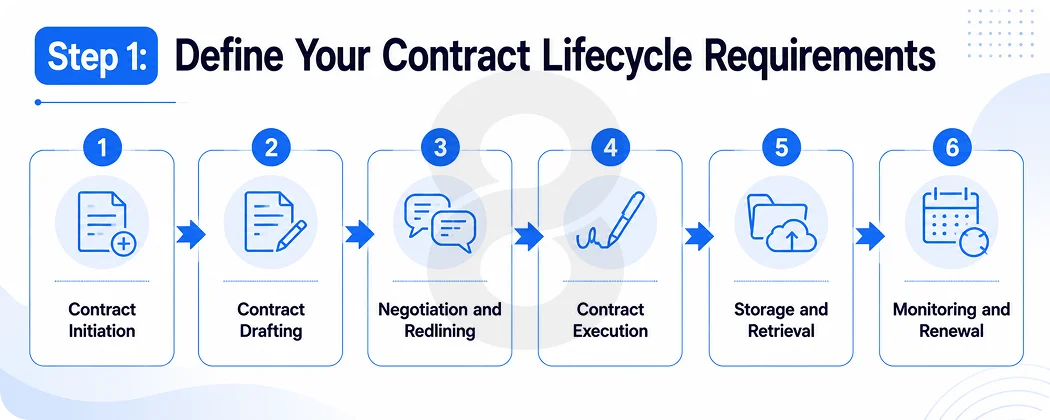
A successful contract management system starts with a clear understanding of how contracts move through your law firm. Identifying each stage of the lifecycle helps uncover operational gaps, approval delays, and compliance risks before development begins.
Contract Initiation
This stage begins when a need for a contract arises, such as onboarding a new client, hiring vendors, or creating partnership agreements. Your system should capture requests efficiently and route them to the right stakeholders.
Contract Drafting
Drafting involves creating agreements using standardized templates, clause libraries, and attorney input. A structured drafting process improves consistency and reduces manual work.
Negotiation and Redlining
During negotiations, multiple parties review, edit, and approve contract terms. Your platform should support tracked changes, version control, and collaborative workflows.
Contract Execution
Once approved, contracts move to execution. This includes collecting e-signatures, locking final versions, and securely storing signed documents.
Storage and Retrieval
Executed contracts should be stored in a centralized repository with advanced search, metadata tagging, and permission-based access for easy retrieval.
Monitoring and Renewal
The final stage involves tracking renewal dates, compliance obligations, and key milestones. Automated reminders help firms avoid missed deadlines and reduce legal risk.
Carefully mapping these stages ensures your contract management system aligns with your firm’s real workflows and operational needs.
Step 2: Choose the Right Architecture
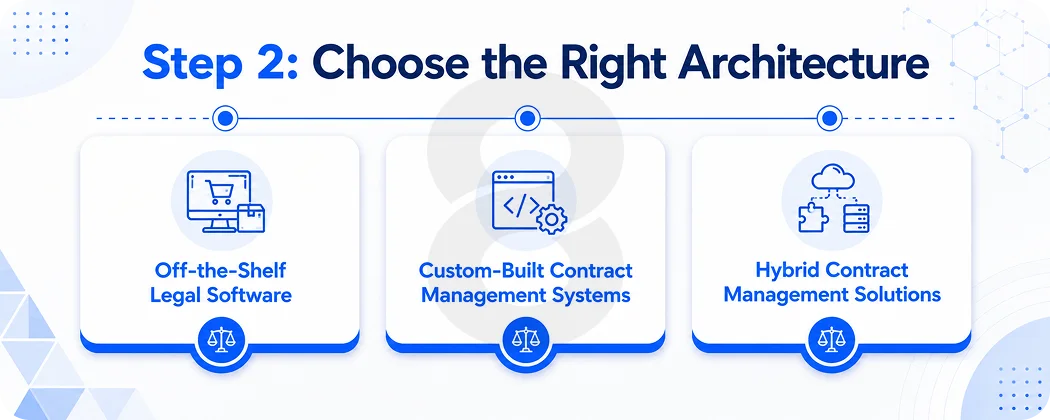
Once your lifecycle is mapped, the next major decision is architecture. You have three primary paths:
Off-the-Shelf Legal Software
Off-the-shelf legal software offers faster deployment and lower initial costs, but customization is often limited. For law firms with complex workflows, strict compliance requirements, or advanced integration needs, these platforms can eventually create operational bottlenecks instead of solving them.
Custom-Built Contract Management Systems
Custom-built platforms provide complete control over features, integrations, security, and data handling. By partnering with a custom software development company, law firms can build solutions tailored specifically to attorney workflows, approval processes, and operational requirements without unnecessary features or limitations.
Hybrid Contract Management Solutions
Hybrid approaches combine a commercial platform with custom-built modules or integrations. This model offers a practical balance between speed and flexibility, helping firms reduce development time while still supporting unique legal workflows and scalability needs.
Your architecture should be cloud-first, as cloud deployment in contract management is projected to reach $3.15 billion by 2035, offering scalability, remote access, disaster recovery, and automatic updates over on-premises systems.
Read More: What Does an App Development Agency Actually Do
Step 3: Build Core Features That Law Firms Actually Need
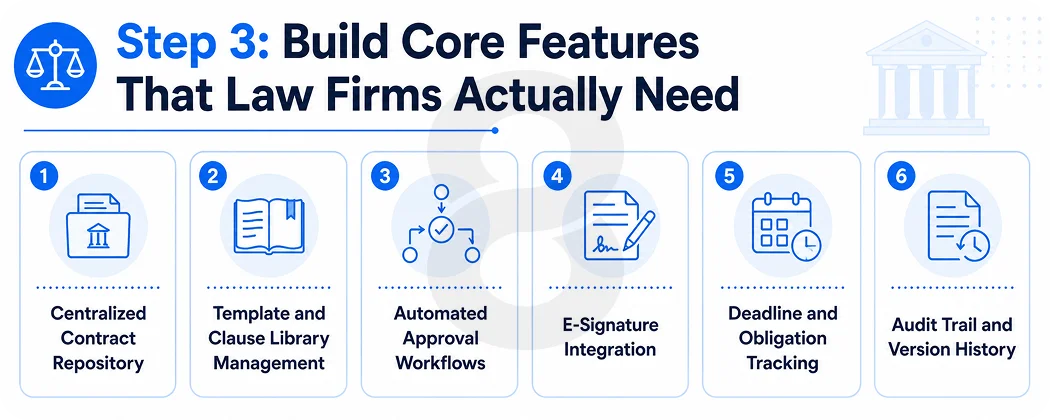
A bloated feature set is as dangerous as a sparse one. Focus your initial build on the core capabilities that generate the most value for attorneys’ day-to-day.
Centralized Contract Repository
A centralized contract repository is the most critical feature. Every contract across all matters should be stored in a single, searchable, permission-controlled system with full-text search, metadata tagging, matter linking, and structured folder hierarchies.
Template and Clause Library Management
Template and clause libraries enable attorneys to draft agreements using pre-approved legal language. This speeds up drafting, ensures consistency, and should include version control and role-based editing permissions.
Automated Approval Workflows
Automated workflows ensure contracts are routed to the correct reviewers based on type, value, and matter classification. This reduces manual coordination and ensures proper oversight before execution.
E-Signature Integration
E-signature integration with tools like DocuSign or Adobe Sign should be fully native. A seamless signing experience is essential for clients and counterparties unfamiliar with internal systems.
Deadline and Obligation Tracking
Automated tracking of deadlines and obligations helps prevent missed renewals and compliance failures. Features should include calendar sync, escalation rules, and multi-channel reminders.
Audit Trail and Version History
An immutable audit trail is essential for compliance. Every change, approval, rejection, and signature must be timestamped and tied to a user identity to ensure full transparency and accountability.
Read More: How to Hire a Full Stack Developer in 2026
Step 4: Integrate AI and Automation Into the Workflow
This is where a good contract management system becomes a great one. Artificial intelligence is no longer optional; it is becoming a baseline expectation in legal software. In 2024, legal AI adoption among law firms jumped from 11% to 30% in a single year, with large firms reaching 46% adoption.
AI-powered contract analysis can extract clauses, flag risks, and compare agreements with precedent libraries, significantly reducing review time. NLP enables intelligent search using plain English, while machine learning supports obligation classification, party identification, and risk scoring. The key is deep integration into workflows, not standalone tools.
Step 5: Ensure Security and Compliance Are Non-Negotiable
Legal data is among the most sensitive information any organization handles, with attorney-client privilege, court seal requirements, and strict confidentiality at stake. A single breach can severely damage a firm’s reputation and legal standing.
Security must be built into the architecture, not added later. Role-based access control (RBAC) should ensure matter-level restrictions, while end-to-end encryption protects data in transit and at rest. Multi-factor authentication (MFA) must be mandatory.
Compliance should align with HIPAA, SOC 2, and state bar rules in the U.S., and GDPR for international clients. GDPR alone drives over 45% of software enhancements in European legal markets
Step 6: Design for Integration Across Your Firm’s Ecosystem
No contract management system operates in isolation. To deliver genuine value, it must connect seamlessly with the other tools your firm already relies on.
This is where thinking like a B2B workflow systems architect becomes essential. Your contract platform should integrate with your practice management software (Clio, MyCase, or similar), your billing and time-tracking system, your document management platform (iManage, NetDocuments), your CRM for client relationship context, and your email environment for in-context contract sharing.
API-first architecture is the right approach here. Building your system with a robust REST API layer enables both current integrations and future connectivity as your firm’s technology stack evolves. Webhooks and event-driven architecture further ensure that changes in one system propagate instantly to connected tools without manual synchronization.
Step 7: Add Mobile Capabilities for Attorneys on the Go
Attorneys are not desk-bound. They are in court, at client meetings, traveling between offices, and reviewing documents from home. A contract management system that is not accessible and functional on mobile devices will simply not be used consistently.
A purpose-built mobile app for contract management gives attorneys the ability to review, annotate, approve, and execute contracts from anywhere without compromising security. Push notifications for approval requests, deadline alerts, and counterparty actions help keep workflows moving even when attorneys are away from their desks.
Mobile UX must be designed specifically for small screens, not just scaled down from a desktop interface. Touch-friendly document annotation, biometric authentication, and offline access to recently opened contracts are all features that elevate the mobile experience from usable to genuinely productive.
Read More: How to Hire a Software Development Team – A Step-by-Step Guide
Step 8: Plan for Onboarding, Training, and Adoption
Technology only delivers value when people actually use it. This is a lesson that many firms learn the hard way. Investing in sophisticated platforms that attorneys avoid because they are too complex or feel like extra work leads to wasted budgets and stalled transformation.
An adoption strategy must be built into the project plan from the beginning.
This means involving attorneys, paralegals, and administrative staff in the design process so that the system reflects how they actually work. It means designing intuitive UIs that reduce cognitive load rather than adding to it. And it means delivering role-specific training that focuses on practical daily workflows rather than feature-exhaustive walkthroughs.
Change management support, especially for senior partners who may be resistant to new tools, is often the difference between a system that transforms a firm’s operations and one that collects digital dust.
The Role of a Legal Software Development Partner
Building a contract management system is a significant investment of time, capital, and strategic attention. The firms that get it right typically do so with a focused development partner rather than attempting to build in-house or purchase a generic platform.
A partner experienced in legal software solutions brings three things that are difficult to replicate internally: deep knowledge of legal workflow specifics, proven technology infrastructure, and the ability to move fast without sacrificing quality.
The legal practice management software market is expected to grow from $2.84 billion in 2025 to $5.96 billion by 2032. Every year a firm delays building the right infrastructure, the competitive gap widens. The right development partner compresses that timeline significantly.
Final Thoughts!
Building a contract management system for a law firm requires deep understanding of legal workflows, strong security and compliance design, intelligent AI integration, and a focus on user experience for attorneys and staff.
When done right, it reduces missed deadlines, shortens contract cycles, lowers risk, and frees attorneys for high-value work. Successful firms rely on strong operational infrastructure, not just talent.
A well-built system is a high-leverage investment. With the right development partner, firms can move from manual chaos to scalable, efficient contract operations built for long-term growth.