




Many companies tend to overlook Malta as a location for software developers when considering expansion plans in Europe, preferring to go for more established tech hubs. That’s a wrongdoing, and shrewd companies are starting to understand it.
Malta has been quietly making its way to becoming one of the most exciting IT locations in Europe. A steady economy, a business-friendly tax regime, a young and well-educated workforce, and a booming tech industry are all contributing to Malta’s reputation as a destination for companies looking to hire a Malta developer without compromising on quality or budget.
From startups to mid-sized businesses and enterprises exploring nearshore opportunities in Europe, Malta provides an attractive proposition. Here we’ll cover all you need to know, including the current state of the local IT industry, salary ranges, top recruitment regions, and how to hire the perfect developers in Malta.
The State of Malta’s IT Industry
It’s important to understand the landscape you’re entering before you hire developers in Malta.
Malta’s application development software market is projected to reach US$31 million in 2025 and grow at a 6.45% CAGR through 2030, reaching approximately US$42.37 million by 2030. Currently, there are around 2,100 IT firms in Malta, from local businesses to subsidiaries of multinational companies.
Malta’s top data fact about the tech industry is that it is a young industry. Malta is the European country that has the largest proportion of under 35-year-old IT workers, at 63%. These are not only those on junior jobs, but the percentage of IT graduates in Malta is the highest in the EU: almost 9% of tertiary education graduates are involved in studying IT.
Around 16,000 people in Malta are currently on the IT market, which is about 3.7% of the total workforce of the island. For the size of the country, that’s a considerable talent pool.
Top programming languages used by the developers of Malta include JavaScript, PHP, Node.js, Angular.js and React.js. Both skill sets are well-suited for the demands of contemporary web and software development and it is relatively easy for international businesses to add developers from Malta to their current tech stacks.
Read More: 40 Best Technology Stacks for Mobile App Development in 2026
Key IT Hubs: Where to Find the Best Developers in Malta
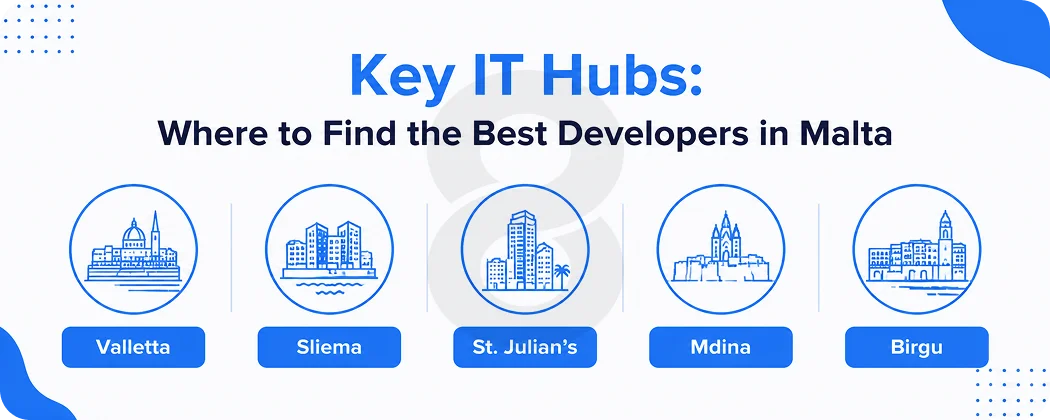
Like all tech ecosystems, the skillset of developers in Malta is not distributed uniformly across the country. Some cities have become places where technology firms and qualified personnel have naturally flocked. When making the decision to hire software developers in Malta, it is crucial to grasp these geographic differences, such as salary variations between different cities.
Valletta
As Malta’s capital city, Valletta is the epicenter of the country’s business and tech activity. It is a UNESCO World Heritage Site where the highest number of IT companies are based on the island as well as boasting the world’s best baroque architecture.
If you hire Malta developers in Valletta, you are likely to be getting the best and most varied pool of developers in the entire country. So, on average, a software developer in Valletta earns around a bit more than €4,575 a month, partly because of the high cost of living and partly because of the greater concentration of opportunities.
Sliema
The vibrant commercial, retail, and residential life on the seafront in Sliema makes it Malta’s bustling coastal business district. It’s steadily becoming a secondary tech and business services centre, and there is a good community of tech professionals here.
Sliema developers make an average of approximately €4,117 monthly. Sliema is a better choice for companies looking to hire software developers in Malta at a marginal cost gain over Valletta without compromising on quality or talent.
St. Julian’s
St. Julian’s is perhaps best known to anyone who has visited internationally for its nightlife or for tourism, but it has also gained a large population of tech professionals because of its vibrant way of life and the ease at which it’s close to the major business centres of Malta.
The salary of a software developer in St. Julian’s is roughly €4209 per month. For businesses seeking to recruit developers from Malta to a place where professional prospects are high, and quality of life is superb, St. Julian’s can be a very inviting place for recruitment.
Mdina
Despite its name, “Silent City”, Mdina is a medieval walled town, which has a distinct nature from the costal centres of Malta. By no means a primary tech centre, developers working from here generate an average of around €3,083 per month, usually from a distance or from home.
If your company is willing to recruit talent outside of the bustling metropolises, you can find experienced employees at affordable prices in Mdina and the neighboring areas.
Birgu
The city of Birgu is one of the historically important “Three Cities” of Malta, steeped in maritime history and showcasing beautiful architecture. Developers employed in and around Birgu make an average monthly income of €3,333, although it is not a tech hub like it is in some other cities.
This makes it another potential choice for businesses seeking to hire developers in Malta at a more moderate rate, especially for remote work.
What’s the Difference Between Malta and Other Near Shore Destinations?
In assessing the need to hire developers from Malta in particular, one should compare other nearshore and offshore development solutions offered to European and international businesses.
According to market research, Ukrainian developers are quite a popular touch to offshore, with an average yearly salary of about $30,000, which is approximately half as much in Malta. Eastern Europe provides substantial price reductions for projects where price is a critical factor. The EU, however, has its benefits in Malta, the shared time zone with western Europe, English being the official language (along with Maltese) and its nearness to European business culture.
Malta vs. Western Europe: Malta is also significantly cheaper than other cities in the West, such as London, Berlin, and Amsterdam. A senior developer will cost you 2 to 3 times as much in London as in Malta and you can pay a software developer for the same quality of developer in Malta.
Malta is a competitor to other countries in the Mediterranean region for nearshore IT workers, such as Portugal, Spain and Greece. It is a unique asset when it comes to English language, EU legal and policy frameworks and a young graduate stream.
For most businesses, the answer is that whilst less expensive than Western Europe, culturally and legally EU compliant, Malta boasts access to English-speaking talent and a time zone that dovetails into European business practices.
Read More: How to Hire a Full Stack Developer in 2026
Challenges When Hiring Developers in Malta
As with any talent market, there are always some hot-button issues and it is essential to come in with reasonable expectations for hiring software developers in Malta.
The biggest hurdle is that of not having enough talent to meet the demand. Malta’s IT outsourcing market is hampered by the quantity of demand and supply of IT graduates. Industry reporting indicates that about 46% of Maltese companies looking to hire for IT positions have found a problem in recruiting employees that possess the right skills and qualifications for the job.
In real terms, it means that there is competition for the best developers in Malta. High performing talent is already offered, or is in more than one contract. Therefore, speed to hire, employer branding and the total package (compensation and more) are very critical components of your recruitment strategy.
It also means that companies that only rely on passive jobs posting may have trouble. Approaches like sourcing proactively, leveraging recruiter networks, and having established partnerships can be more effective with staffing firms who have local pipelines.
Best Ways to Hire a Developer in Malta
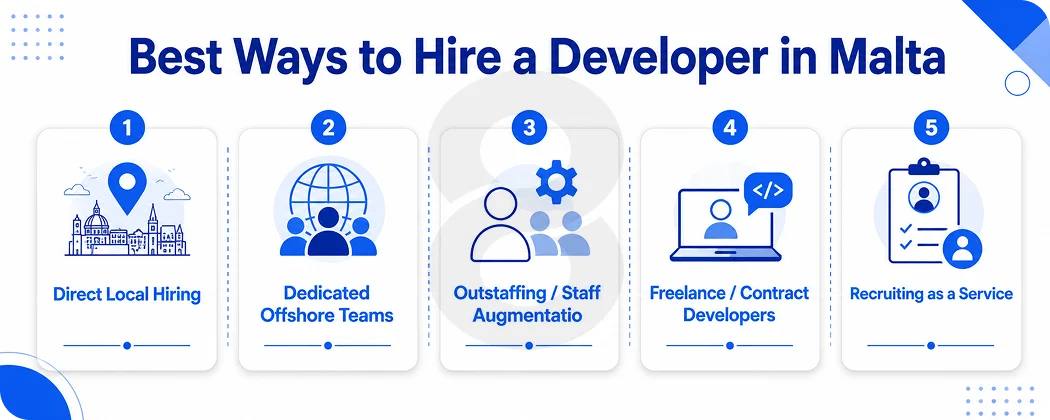
Several different options exist to develop talent in Malta, and each has a different cost structure, degree of control, and administrative burden.
Direct Local Hiring
You create a legal entity in Malta and employ developers as full-time employees in Malta. This provides you with ultimate control, and also ultimate administrative complexity, in terms of compliance with local employment law, benefits, tax matters and HR affairs.
Dedicated Offshore Teams
Team formation by a third-party offshore provider in Malta or related to the Maltese market for your project through a business technology partner in Malta. You do the work, they handle HR, accounting, compliance, and office setup. It is one of the most favored models for businesses looking to invest in software developers in Malta without having to establish a local company.
Outstaffing / Staff Augmentation
You add individual Malta developers to your current team in a flexible manner. This is good if you have a need for filling in holes in a team, not creating an entire one. It is a fantastic option for specialty technical jobs.
Freelance / Contract Developers
If you’re looking for a more short-term or project-based development, having freelance / contract developers from Malta can offer flexibility. The downside is that there’s usually less integration, less reliability when it comes to long-term work and more work managing contracts separately.
Recruiting as a Service
Some providers will take care of the entire recruitment process including sourcing, vetting and presenting candidates, and you would be responsible for the actual hiring of the candidate. Perfect for companies looking for the top developers in Malta without having the local knowledge or networks.
Businesses in Malta are rapidly integrating AI into customer support, analytics, personalization, and automation. AI-enabled apps are expected to become standard across fintech, travel, and eCommerce platforms by 2030.
Read More: How to Hire a Software Development Team – A Step-by-Step Guide
Tips for Hiring the Best Developers in Malta
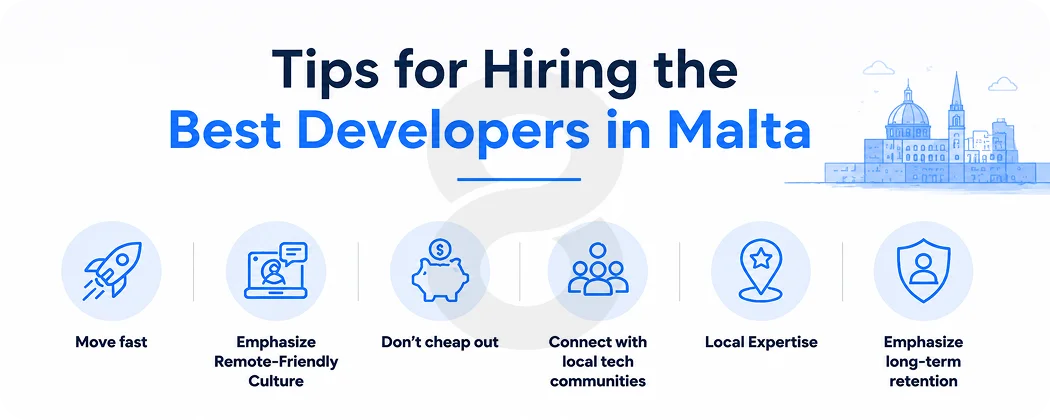
Here are some tips and tricks for hiring the best developers in Malta.
It’s one thing to locate great developers and it’s a completely different ballgame to be able to on board and keep them. The following are some of the best practices to help businesses leverage the talent market in Malta.
Move fast
With talent competition, a slow hiring process is among the speediest means to shed great prospects. Make your interview process as efficient as you can and also attempt to go from initial contact to offer in 2-3 weeks, if you can.
Emphasize Remote-Friendly Culture
Many of Malta’s developers, particularly younger professionals, value flexibility. If your company allows remote or hybrid working, make it a key component of your employer brand.
Don’t cheap out
In a competitive market, it’s hard to convince developers to take a job if you’re essentially offering them less than they can get elsewhere. When you hire developers or an app development company in Malta, research the market rates and try to offer at or above the median for the relevant experience level and position.
Connect with local tech communities
Malta has a tight-knit tech community. Candidates that job boards may never find can be identified through tech meetups, local LinkedIn groups, university programs, and word of mouth.
Local Expertise
Engaging IT recruitment firms with local connections and familiarity will significantly cut down your hiring time and enhance the quality of candidates you’ve seen.
Emphasize long-term retention
With a talent shortage, it is an expensive endeavor to lose a developer you’ve recruited and onboarded. Your best tools for retention are competitive salaries, career development opportunities and a positive team culture.
Malta offers a unique mix of factors that make it an ideal location for IT Outsourcing and Nearshoring Malta is often mentioned as a good nearshore IT destination for European companies. This is far from coincidence; it’s the result of a distinctive combination of structural benefits.
Language barriers, which can cause communication problems in offshore solutions in non-English-speaking markets, are not a problem. Malta is an EU member state, so its legal systems, data protection (GDPR compliance) and business practices are in line with those of other EU countries. Its location in the middle of the Mediterranean helps to facilitate the logistics of teams working with Western and Southern European partners.
Conclusion: Is Malta the Correct Talent Market for your Company?
Malta is not an option for every company. If the absolute cost minimization is your first and foremost objective, then you can find lower rates in Eastern European markets. Larger markets will provide more room to grow a larger team rapidly if you need one.
However, for companies looking for top-tier developers who are EU-aligned, will speak English, have a cultural understanding of European business norms, and are young and technically educated, Malta is indeed a very attractive choice.
The main thing is to enter the market informed, move quickly, and take advantage of local knowledge to see it through when there’s always more demand than supply. Do this, and you will discover that the top developers in Malta are not only there for you, they can help you bring the most ambitious technical projects to fruition.
From a short-term project to a long-term dedicated software team, it’s a reality you can take advantage of in Malta. The island is but a speck, but its tech dreams and its talent are no small things.