


Logistics is a global industry in a digital revolution. Companies that used to operate their fleets, shipments and warehouses from spreadsheets and on the phone are calling for intelligent, real-time, mobile solutions. However, every time one sits down at a board table or walks through the startup pitch deck, there’s always one question that comes on the table: How much does it really cost to build a logistics app?
There’s never a simple answer, but it doesn’t have to be a mystery, either. This guide explains all of the factors that affect the cost of mobile app logistics development, provides a practical estimation model and takes you through a 5-minute estimation exercise in your mind so you can enter any vendor conversation with the knowledge of what you are getting into.
Cost estimation is crucial to the success of logistics apps.
By 2030, it is expected that the logistics technology market will cross the $77 billion threshold globally, as it is anticipated that people will demand technologies that track last mile deliveries as well as fleet, warehouse automation, and supply chain visibility. Amazon, FedEx, and DHL have set the standard and midsize logistics firms are trying to meet it.
Prior to any code is written, decision makers require a believable budget. Oversimplifying the cost of app development for the logistics industry results in incomplete products, scope reductions, and lost market opportunities. Overstating is enough to put potential investors off, and will also push the launch date further back by several months. The proper logistics software project begins with a calibrated estimate, which is based on real variables.
The 5-Minute Cost Estimation Framework
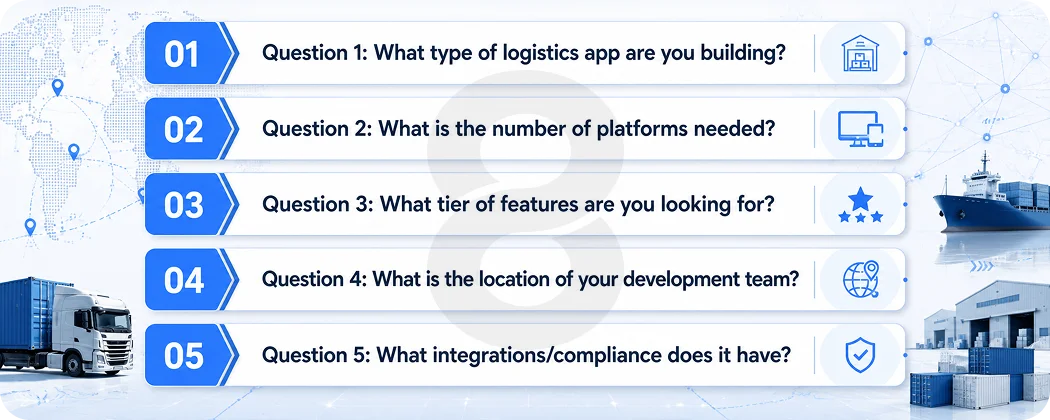
This is your structured logistics app cost calculator. You’ll have a range of working before you’ve spoken with one developer when answering 5 questions.
- Question 1: What type of logistics app are you building?
- Question 2: What is the number of platforms needed?
- Question 3: What tier of features are you looking for?
- Question 4: What is the location of your development team?
- Question 5: What integrations/compliance does it have?
You will have one cost multiplier for each question. Let’s explain each of the five in detail.
Step 1: App Type Defining Your Logistics Product
In Step 1, App Type, you describe your product that you want to market in your logistics.
The first and most crucial factor affecting logistics app development expenses is the sort of application. Logistics is not a single entity; it’s an ecosystem consisting of digital tools with varying complexity levels and development time.
App Type |
Primary Users |
Core Functionality |
Estimated Cost Range |
| Fleet Management App | Dispatchers, drivers | GPS tracking, route optimization, fuel logs | $30,000 – $90,000 |
| Last-Mile Delivery App | Delivery agents, customers | Real-time tracking, proof of delivery, notifications | $25,000 – $75,000 |
| Warehouse Management System (WMS) | Warehouse staff, managers | Inventory tracking, barcode/RFID scanning, pick-pack | $50,000 – $150,000 |
| Freight Brokerage Platform | Shippers, carriers | Load boards, bidding, carrier matching | $60,000 – $200,000 |
| Supply Chain Visibility Platform | Enterprise clients | Multi-tier tracking, analytics, ERP integration | $100,000 – $350,000 |
| On-Demand Courier App | End consumers, couriers | Booking, live tracking, payments | $35,000 – $120,000 |
The most typical first app for expanding logistics companies is a fleet management or last-mile delivery app. At the highest end of the spectrum of complexity and therefore, logistics mobile app development expense, supply chain visibility platforms are those that demand a significant degree of integration with enterprise infrastructure and real-time data pipelines between multiple parties.
Step 2: Platform Strategy iOS, Android, or Both?
The number of development hours will be directly multiplied by your platform decision. If it is an iOS-only app, it will have to be developed with a separate codebase and tested with its own testing cycles, and maintained separately from other Android apps. If it is an Android-only app, it will have to be developed with a separate codebase, tested with its own testing cycles, and maintained separately from other iOS apps. This is minimized in cross-platform solutions such as React Native or Flutter but comes with its own set of performance and device-specific feature limitations.
Platform Strategy |
Relative Cost |
Best For |
| iOS Only (Native Swift) | Baseline | Premium B2C markets, Apple enterprise environments |
| Android Only (Native Kotlin) | Baseline | Emerging markets, driver-heavy fleets |
| Both Native (iOS + Android) | 1.8x – 2x baseline | Maximum performance, large engineering teams |
| Cross-Platform (React Native / Flutter) | 1.3x – 1.5x baseline | Startups, MVP launches, budget-conscious builds |
| Progressive Web App (PWA) | 0.7x – 0.9x baseline | Internal tools, desktop-heavy workflows |
If you’re developing an app for your drivers or a consumer-focused delivery tracking app, cross-platform development using React Native or Flutter is the most cost-effective and feature-rich app. If real-time response is essential, as it is in mission-critical dispatch systems, and access to hardware is important, then native development is worth the higher logistics app development cost.
Step 3: Feature Tiers What Your App Actually Does
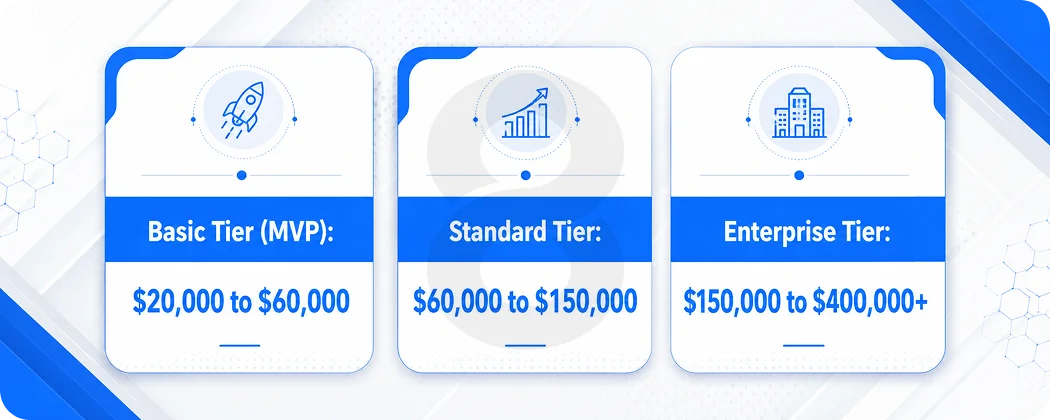
This is where granularity in estimation comes in. The main drivers of logistics app development cost are features, and the difference between a simple, minimum viable product and an enterprise-level product is vast.
Basic Tier (MVP): $20,000 to $60,000
This tier is appropriate for validation or early deployments or internal pilots. It contains the minimum viable functionality to test the concept and solicit feedback from the user before going into a bigger build.
- Users can be registered and log-in according to their roles (driver, dispatcher, admin)
- Simple GPS tracking, Static Map View
- Manual shipment status updates
- Simple push notifications
- A built-in reporting dashboard to export to CSV
Standard Tier: $60,000 to $150,000
The standard tier is ready for production use of logistics operations. It extends the MVP in real-time and with features that offer customers that boost retention and improve ops efficiency.
- Real-time GPS tracking, live rewind and geofencing notifications
- Automated ETA calculations and proactive customer notifications
- Proof of delivery with photo capture and digital signature
- Performance scoring of drivers and complete trip data
- Communication between the driver and the dispatcher within the app
- Collection and payment integration for COD or digital collections
- Clean, simple analytics dashboard with trend reports and KPI cards
Enterprise Tier: $150,000 to $400,000+
Enterprise logistics platforms are engineered to be scalable, compliant to regulations, and very well integrated with the existing business system. They encompass all the standard features and more, making logistics a strategic asset rather than a cost center.
- AI-powered route optimization and dynamic load planning
- Multi-modal freight management, air, sea, and road
- Integrating temperature, humidity, and tamper sensors with IoT
- Full integration with ERP and TMS systems, such as SAP, Oracle, or JDA
- Sophisticated predictive analytics and forecasting systems
- Custom SLA monitoring and automation breach alerts
- White-label multi-tenant software solutions for 3PLers
Feature Category |
Basic MVP |
Standard |
Enterprise |
| User Authentication & Roles | ✅ | ✅ | ✅ |
| GPS & Real-Time Tracking | Basic | Real-Time | Advanced + IoT |
| Route Optimization | ❌ | Manual | AI-Powered |
| Proof of Delivery | ❌ | ✅ | ✅ + Biometrics |
| In-App Communication | ❌ | ✅ | ✅ + Video |
| Analytics & Reporting | Basic | Standard | Predictive AI |
| ERP/TMS Integration | ❌ | Partial | Full |
| White-Label / Multi-Tenant | ❌ | ❌ | ✅ |
| Estimated Dev Hours | 400–800 hrs | 800–2,000 hrs | 2,000–6,000 hrs |
Step 4 Team Location: The Biggest Cost Lever
Where your development team is placed has a bigger effect on the bottom line than almost any other single piece or driver. Hourly rates shift dramatically by geography, and a 2,000-hour project can look totally different depending on who builds it and how they’re organized internally.
Region |
Average Hourly Rate |
1,000-Hour Project Cost |
| North America (US/Canada) | $100 – $200/hr | $100,000 – $200,000 |
| Western Europe (UK, Germany) | $80 – $150/hr | $80,000 – $150,000 |
| Eastern Europe (Ukraine, Poland) | $40 – $80/hr | $40,000 – $80,000 |
| Latin America (Brazil, Mexico) | $35 – $70/hr | $35,000 – $70,000 |
| South Asia (India, Pakistan) | $20 – $50/hr | $20,000 – $50,000 |
| Southeast Asia (Philippines, Vietnam) | $25 – $55/hr | $25,000 – $55,000 |
These figures provide an explanation for why many agencies pursue a hybrid version: a small senior team in North America or Western Europe for architecture and purchaser-going through work, paired with a larger implementation group in Eastern Europe or South Asia. This technique can reduce the logistics mobile app improvement cost via 30–50% with out sacrificing high-quality, provided the engagement is controlled with clean processes, overlap hours, and rigorous code assessment requirements.
Step 5: Integrations and Compliance Costs
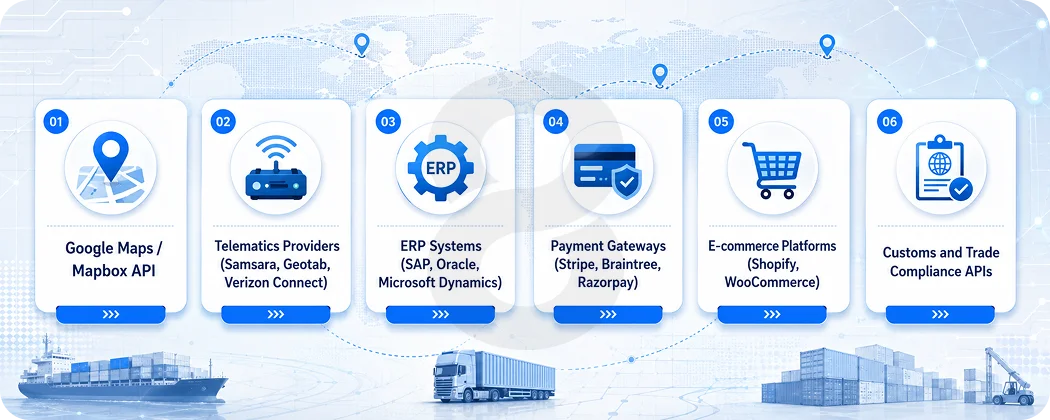
Integrations are consistently underestimated in early budgets, yet they account for 20–35% of general development time on enterprise logistics tasks. Every external machine your app wishes to talk with provides design complexity, testing overhead, and ongoing maintenance liability.
Common 1/3-birthday party integrations and their value impact:
- Google Maps / Mapbox API: Route visualization, geocoding, and ETA calculation. Adds $3,000–$8,000 in improvement plus ongoing API utilization fees scaled to request quantity.
- Telematics Providers (Samsara, Geotab, Verizon Connect): Vehicle statistics, engine diagnostics, and motive force conduct feeds. Adds $ 8,000–$25,000 depending on the issuer’s API maturity.
- ERP Systems (SAP, Oracle, Microsoft Dynamics): Custom middleware, records transformation, and sync good judgment. Adds $15,000–$60,000 in line with integration, which is regularly the single largest hidden cost within the assignment.
- Payment Gateways (Stripe, Braintree, Razorpay): Adds $5,000–$15,000 in improvement plus PCI-DSS compliance work.
- E-commerce Platforms (Shopify, WooCommerce): Order ingestion and success triggers. Adds $6,000–$20,000 depending on customization requirements.
- Customs and Trade Compliance APIs: Critical for cross-border freight operations. Adds $10,000–$40,000 for global deployments.
Regulatory compliance layers similarly value these integrations and should by no means be handled as an afterthought:
- GDPR compliance for EU-going through operations adds $5,000–$15,000 in audit, consent management, and facts structure paintings.
- HIPAA compliance for pharmaceutical or medical logistics provides $15,000–$40,000.
- FMCSA ELD compliance for US business trucking provides $10,000–$30,000 in licensed hardware integration and audit logging.
The Full Cost Breakdown: A Realistic Budget Model
Here is how a typical standard tier logistics mobile app development cost may be spread across a $100,000 project.
Development Phase |
Share of Budget |
Estimated Cost on $100,000 Project |
| Discovery and Planning | 8% | $8,000 |
| UI and UX Design | 12% | $12,000 |
| Backend Development | 25% | $25,000 |
| Mobile App Development | 22% | $22,000 |
| Admin and Web Panel | 12% | $12,000 |
| Integrations | 10% | $10,000 |
| QA and Testing | 8% | $8,000 |
| Deployment and Launch Support | 3% | $3,000 |
This is not a perfect formula. Nothing in logistics software is that clean.
A driver app with heavy location tracking may spend more on mobile development. A platform with ERP or telematics integration may burn through the integration budget much faster. A product with complex reporting will need more backend and analytics work.
But this table gives you a realistic starting point.
The common mistake is thinking the mobile app is the whole product. It is not. The app is what people see. The real work is behind it.
Shipment status has to update correctly. Driver location has to stay accurate. Routes need to change when something goes wrong. Customers need the right notification at the right time. Dispatchers need to see what is happening without calling five people. Managers need reports they can trust.
That backend work is boring to talk about in a sales meeting, but it is where most logistics apps either survive or fall apart.
Hidden Costs That Push the Budget Up
The first estimate almost never includes everything.
Sometimes that is because the vendor is being vague. Sometimes the client is being vague. Usually, it is both.
Logistics software has a way of exposing details nobody mentioned in the first call. A dispatcher says one thing. A warehouse manager says another. Drivers have their own reality. Customers expect clean tracking. Finance wants proof for every payment and delivery exception.
That is where hidden costs start showing up.
Cloud Infrastructure and Hosting
A logistics app needs reliable hosting because data is moving all day.
Location updates, shipment records, driver activity, route changes, proof of delivery files, notifications, and reports all need somewhere to live.
For a small app, cloud hosting may be manageable. For a busy delivery operation with real time tracking, storage, analytics, and high API traffic, monthly infrastructure costs can grow quickly.
Map and Location API Usage
Maps look simple until the bill arrives.
Google Maps, Mapbox, HERE, and similar tools charge based on usage. Geocoding, route calculation, live tracking, ETA updates, and distance matrix requests can all add cost.
If your app tracks hundreds or thousands of deliveries every day, you need to plan API usage properly. Otherwise, the app may work fine technically while quietly becoming expensive to run.
Admin Panel Complexity
A lot of teams obsess over the mobile app and treat the admin panel like an afterthought.
Bad idea.
In logistics, the admin panel is where operations usually live. Dispatchers assign routes there. Managers check delays there. Support teams look up customer issues there. Finance may need delivery or payment records from there.
A serious admin panel can include shipment control, driver status, route assignment, exception handling, customer records, delivery proof, reporting, payment status, and access control.
That is not a small side screen. It is a product of its own.
Offline Mode
Drivers do not always have perfect internet. Warehouses have dead zones. Long haul routes lose signal. Rural areas can make a beautiful app feel useless in five minutes.
Offline mode sounds like a simple feature until you build it.
The app has to save actions locally, sync them later, avoid duplicate updates, and handle conflicts when server data changes while the device is offline. It takes planning, testing, and patience. Usually more patience than anyone has left by that point.
Real World Testing
Testing a logistics app is not like testing a landing page.
You have to test weak networks, moving vehicles, wrong addresses, cancelled orders, late deliveries, battery drain, location delays, failed payment updates, photo uploads, digital signatures, and notification timing.
Skipping QA makes the first quote look nicer. Then the app launches, drivers complain, customers get wrong updates, and your team starts fixing issues in production.
Nobody enjoys that week.
Read More: How to Choose the Right Supply Chain Management Software Solutions
How Long Does Logistics App Development Take?
Cost and timeline usually move together.
A basic logistics app may take 10 to 16 weeks. A standard app can take 4 to 7 months. An enterprise logistics platform can take 8 to 14 months or more.
App Complexity |
Estimated Timeline |
Typical Scope |
| Basic MVP | 10 to 16 weeks | Driver login, shipment list, status updates, simple GPS, basic admin panel |
| Standard Logistics App | 4 to 7 months | Live tracking, proof of delivery, dashboards, notifications, payments, integrations |
| Enterprise Logistics Platform | 8 to 14 months plus | ERP, IoT, predictive analytics, multi tenant setup, compliance, advanced reporting |
You can rush the timeline. People do it all the time.
But logistics apps punish shortcuts.
A phased launch usually works better.
Build the core workflow first. Test it with real users. Fix what breaks. Then add automation, analytics, integrations, and the more advanced features that looked so impressive in the pitch deck.
How to Reduce Logistics Mobile App Development Cost
You can reduce cost without damaging the product, but you need to cut the right things.
Do not cut backend planning, testing and security. Those savings usually come back as expensive problems later.
Cut the features that do not need to exist in version one.
Start With One Core Workflow
Pick the workflow that matters most.
For a last mile delivery company, that might be order assignment, driver tracking, proof of delivery, and customer notifications.
That is enough for a strong first version.
Fleet maintenance, advanced analytics, loyalty features, predictive routing, and deep reporting can wait if they are not needed on day one.
Use Cross Platform Development When It Makes Sense
React Native and Flutter can reduce logistics app development cost because one codebase can serve both iOS and Android.
This works well for many driver apps, courier apps, customer tracking apps, and internal tools.
Native development still makes sense when the app depends heavily on background tracking, device hardware, performance, or strict platform level control.
Use Existing APIs Where Possible
You do not need to build everything from scratch.
Maps, payments, SMS, email, barcode scanning, and analytics can often be handled through trusted third party services.
The smart move is to build your core logistics logic properly and use existing tools for the parts that do not make your business unique.
Keep the First Admin Panel Practical
The first admin panel does not need every chart, filter, and export option someone mentioned in a meeting.
It needs to help the operations team do the work.
Focus on shipment control, driver visibility, exceptions, customer updates, and basic reporting. Add advanced analytics after your team knows which numbers they actually use.
Plan Integrations in Phases
ERP, TMS, WMS, telematics, ecommerce, payments, and customs integrations can all add cost.
If the budget is tight, connect the systems that matter to daily operations first. The rest can come later.
A phased integration plan keeps the first release realistic and makes the project less painful for everyone involved.
When Paying More Makes Sense
Cheaper development is not always the win.
In logistics, bad software can damage real operations. This is not a small app where a user closes the screen and comes back later. Deliveries get delayed. Customers call. Drivers get confused. Managers lose visibility. Finance asks for proof that nobody can find.
Pay more when the app controls time sensitive deliveries, high value shipments, medical logistics, cold chain tracking, international freight, or large fleet operations.
In these cases, reliability matters more than shaving a little off the estimate.
That is the part many budgets ignore.
A logistics app should reduce operational noise. If it creates more confusion, it has failed, even if the invoice looked reasonable.
Read More: On-Demand App Strategy: MVP vs Full Product Approach
Build From Scratch or Use Existing Logistics Software?
Not every company needs a custom logistics app.
Sometimes existing logistics software is enough, especially if your workflows are standard and your team needs something quickly.
Use existing software when you need a faster launch, lower upfront cost, and basic tracking or dispatch features.
Build custom when your workflows are specific, your clients expect branded tracking, your operations rely on custom rules, or your app needs deep integration with internal systems.
The hybrid approach often makes the most sense.
Start with the part of the workflow causing the most pain. Maybe that is delivery tracking, dispatch management, or proof of delivery. Build that properly, get adoption, then expand.
Trying to build everything at once sounds efficient in planning meetings. It usually becomes slow, expensive, and exhausting once real users get involved.
Final Logistics App Development Cost Estimate
The final Logistics app development cost depends on the product type, platform strategy, feature depth, team location, integrations, and compliance requirements.
A basic MVP can cost $20,000 to $60,000.
A standard logistics app with live tracking, proof of delivery, notifications, payments, and an admin dashboard can cost $60,000 to $150,000.
An enterprise logistics platform with ERP, TMS, IoT, predictive analytics, and compliance work can cost $150,000 to $400,000 or more.
The best way to estimate logistics mobile app development cost is to build the budget in layers. First, define the app type. Next, decide on the platform. Then factor in the feature tier. After that, consider the team location. Finally, account for integrations, compliance, infrastructure, and ongoing support.
If the budget still feels unclear, the scope is probably unclear too.
And that is fine. Better to admit that early than pretend everything is clear and discover the truth halfway through development.