


Here’s the thing nobody tells you when you’re first evaluating logistics software: the spreadsheet you’re using right now, the one with color-coded tabs for routes and a separate column someone added “just temporarily” three years ago, that spreadsheet is costing you money every single day.
Maybe not in a way you can put on a slide. But the missed handoffs, the dispatcher making ten phone calls to figure out where a truck is, the customer emailing “where is my order” for the fourth time, all of that compounds. And at some point, usually after a bad quarter or a scaled-up operation that your current system simply can’t handle, you end up here: researching logistics app development.
This guide is for anyone who’s been burned by a system that wasn’t built for how they actually work. It covers the full picture: types of logistics software, what features matter, what they cost, what the build process looks like, and how to avoid the mistakes that push projects over budget and past deadline.
What Logistics App Development Actually Covers
Logistics app development is the process of designing and building software that manages the movement of goods, vehicles, inventory, and information across a supply chain. That’s a broad definition on purpose, because logistics software isn’t one thing.
Fleet operators need something completely different from warehouse managers. A last-mile delivery startup has different requirements than a freight forwarding company handling international cargo. The term covers a wide range of platforms, and the type you build shapes everything from the feature list to the tech stack to the development timeline.
According to Precedence Research, the logistics software market is going to roughly double from $16.3 billion in 2025 to $34.68 billion by 2035. That growth isn’t coming from one category. It’s spread across every layer of supply chain software, from simple tracking tools to AI-powered transportation management platforms.
Before jumping into a build, it helps to know which category actually fits your operation.
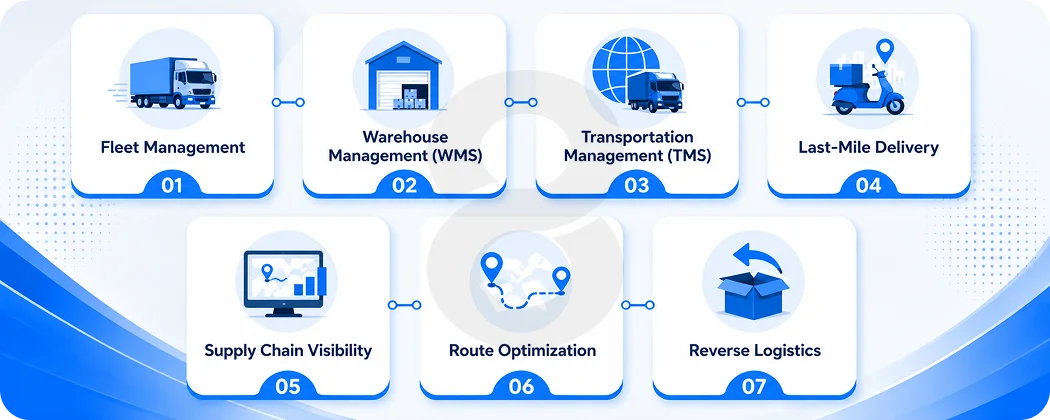
The main types of logistics software
Here’s a breakdown of the most common types, what they do, and who they’re actually for:
| App Type | Core Function | Best For |
|---|---|---|
| Fleet Management | Vehicle Tracking, Driver Scheduling & Maintenance Alerts | Transport Companies with Owned Vehicles |
| Warehouse Management (WMS) | Inventory Tracking, Picking, Packing & Fulfillment | Distribution Centers & 3PL Operators |
| Transportation Management (TMS) | Multi-carrier Coordination, Freight Auditing & Rate Comparison | Shippers & Freight Forwarders |
| Last-Mile Delivery | Route Assignment, Real-time Tracking & Proof of Delivery | E-commerce & On-demand Delivery Services |
| Supply Chain Visibility | End-to-end Shipment Tracking Across Suppliers & Carriers | Enterprises with Complex Supply Chains |
| Route Optimization | Multi-stop Routing with Traffic & Load Constraints | Businesses Operating Delivery Routes |
| Reverse Logistics | Returns Authorization, Restocking & Disposal Routing | Retailers with High Return Volumes |
Returns management has become a logistics priority in its own right. Around 20% of online sales were returned in 2025, and without systems that automate this process, returns quickly become an operational black hole that drains both time and margin.
Most companies end up needing two or three of these in combination. A fleet management app without warehouse integration leaves you with a gap between dispatch and fulfillment. A TMS without route optimization still relies on manual planning. The question isn’t just which type you need, it’s which combination of capabilities covers your actual bottlenecks.
Read More: How to Choose the Right Supply Chain Management Software Solutions (Complete Guide)
Core Features Every Logistics App Needs
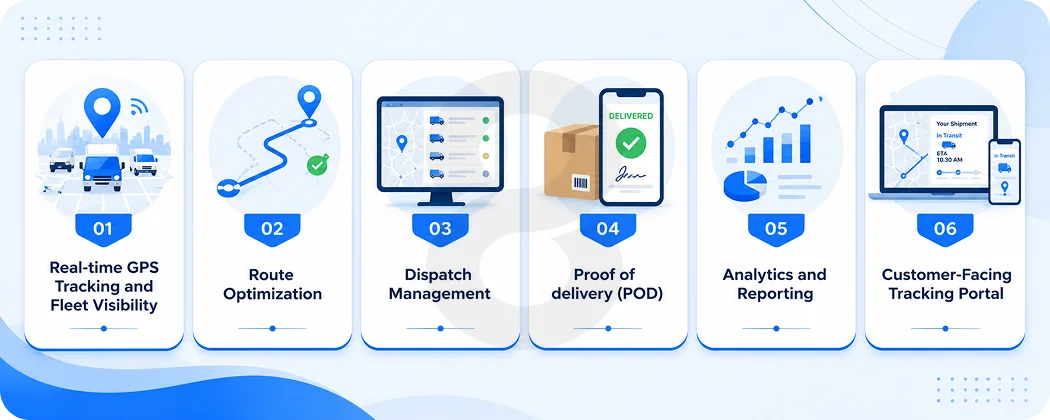
Getting the feature list right is probably the single most important decision in the entire project. Too few features and the app doesn’t solve the real problem. Too many features packed into version one and you’re six months behind schedule with a bloated system nobody has learned to use.
Here’s what logistics app development teams consistently identify as the non-negotiable core:
Real-time GPS Tracking and Fleet Visibility
A GPS tracking system gives fleet operators real-time connection with vehicles, drivers, and even hardware-level components like fuel tanks and cargo sensors. When a vehicle goes off-route, dispatchers see it immediately and can reroute.
But the longer-term value is in the data. Over time, tracking tells you which routes consistently underperform, which drivers idle too long, and where maintenance costs concentrate. That visibility compounds into real savings.
Route Optimization
Basic routing finds the shortest path between two points. That’s table stakes. What you actually need is something that considers delivery windows, vehicle load capacity, driver hours, real-time traffic, and fuel efficiency simultaneously.
Building a dynamic optimization engine that recalculates routes as conditions change is a significantly larger undertaking. It often requires machine learning expertise and can represent $20,000 to $60,000 of your development budget, depending on how sophisticated the logic needs to be.
Dispatch Management
The dispatcher’s interface is where operations either flow or break down. A well-designed dispatch and fleet management module handles driver assignment, load matching, order prioritization, and real-time communication between all parties. It should reduce the number of phone calls a dispatcher makes per shift, not add another screen to manage on top of everything else.
Proof of delivery (POD)
Digital POD through photo capture and e-signature replaces paper-based confirmation entirely. It eliminates delivery disputes, speeds up invoicing cycles, and gives both parties a timestamped record that holds up. This is one of those features that seems minor right up until you’ve spent two weeks trying to resolve a missing delivery claim that nobody can verify.
Analytics and Reporting
The analytics and reporting segment is expected to expand at the fastest growth rate of any logistics software category between 2026 and 2035. Companies that built platforms without robust reporting are rebuilding them now. On-time delivery rates, cost per mile, driver utilization, route efficiency, these metrics are what actually tell you whether the platform is working.
Customer-Facing Tracking Portal
Customers want to know where their delivery is without calling anyone. A real-time tracking link or self-service portal reduces inbound inquiries significantly, which means your team spends less time answering status update emails and more time on actual operations.
Read More: Location-Based App Development for Startups: Improve Efficiency & Reduce Costs
Feature comparison: MVP vs full platform
| Feature | MVP Build | Full Platform |
|---|---|---|
| Real-time GPS Tracking | Yes | Yes + IoT Integration |
| Route Optimization | Basic (Static) | AI-powered (Dynamic) |
| Dispatch Management | Manual Assignment | Automated with Priority Logic |
| Proof of Delivery | Photo + Signature | Photo, Signature + Barcode Scan & Geofence Trigger |
| Analytics | Basic Delivery Reports | Predictive Analytics & Custom KPIs |
| Customer Portal | Live Tracking Link | Full Self-service Portal with Notifications |
| ERP/WMS Integration | Optional | Required |
| Offline Functionality | Limited | Full Offline Mode |
How Logistics App Development Actually Gets Built
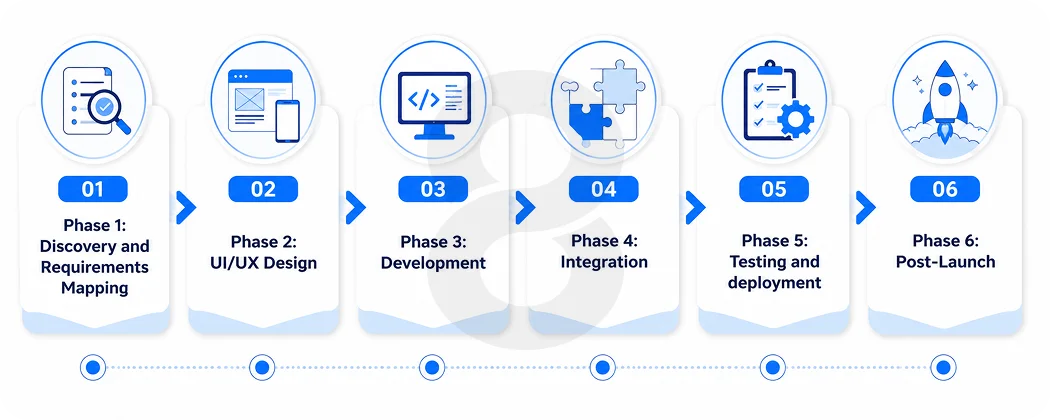
Most failed logistics software projects don’t fail because of bad code. They fail because the discovery phase was rushed, requirements were vague, and the team started building before they understood the actual operational workflow.
Here’s a realistic view of how the process unfolds:
Phase 1: Discovery and Requirements Mapping
This is the phase most companies want to skip. Don’t. Two to four weeks spent mapping actual workflows, interviewing dispatchers and drivers, documenting integration requirements, and defining success metrics will save months later.
Understanding compliance requirements early saves significant rework: GDPR protects user data for European customers, DOT compliance is critical for fleet management in the US, and state-level privacy laws like CCPA may apply depending on your operating regions.
Phase 2: UI/UX Design
Logistics software design is used under pressure. Dispatchers are managing multiple deliveries simultaneously. Drivers check their screens while making time-sensitive decisions. Warehouse staff are scanning and moving at the same time. Good UX isn’t a nice-to-have, it directly affects whether the app gets used or abandoned within the first month.
Design should produce high-fidelity prototypes of all user roles: admin panel, driver app, customer portal, and dispatcher view. Usability testing with real users before any code is written catches expensive problems early.
Phase 3: Development
Most teams in 2026 are choosing React Native or Flutter for mobile development, with Node.js on the backend and AWS or Google Cloud for infrastructure.
Cross-platform tools help teams move faster by sharing most of the codebase. For logistics apps that depend on live updates and GPS data, this approach often delivers the right balance between performance and build efficiency.
Development is typically structured in two-week sprints following Agile methodology. Core features ship first, integrations and advanced capabilities come in later phases. This allows real-world testing of the critical path before resources are committed to secondary features.
Phase 4: Integration
Logistics apps rarely operate in isolation. They connect to mapping APIs like Google Maps, HERE, and Mapbox, plus payment processors, warehouse management systems, and ERP platforms like SAP and Oracle.
IoT hardware integration, covering vehicle telematics, temperature sensors, and RFID scanners, adds meaningful scope. Depending on the number and variety of devices, IoT integration alone can add $15,000 to $60,000 to a project.
Phase 5: Testing and deployment
Simulation testing under realistic load conditions matters more for logistics apps than almost any other software category. A platform that works fine during testing but slows under peak-hour GPS pings across a 200-vehicle fleet is a real failure mode. Stress testing with realistic data volumes should happen before any live deployment.
Phase 6: Post-Launch
Logistics app maintenance typically costs 15 to 20 percent of the initial development budget annually, covering bug fixes, performance updates, compatibility upgrades, and ongoing support. Factor this into the total cost of ownership, not just the initial build number.
What Logistics App Development Costs in 2026
This is the question everyone asks first and budgets for last. Here’s an honest breakdown. Development costs in 2026 range from $40,000 to $90,000 for a mid-complexity custom app.
A basic MVP covering shipment tracking and driver assignment sits at $40,000 to $55,000, while a full-featured platform with real-time fleet visibility, route optimization, and a customer-facing portal runs $70,000 to $90,000 and up. Enterprise systems with deep ERP integration and AI-driven dispatch typically exceed $120,000.
Cost by Complexity Tier
| Tier | What’s Included | Estimated Cost |
|---|---|---|
| Basic MVP | GPS Tracking, Driver App & Basic Dispatch | $20,000 – $55,000 |
| Mid-complexity | Route Optimization, Analytics, Customer Portal & Proof of Delivery (POD) | $55,000 – $120,000 |
| Enterprise | AI Routing, IoT Integration, ERP Synchronization & Multi-region Support | $120,000 – $300,000+ |
What Drives Cost Up
Several variables push a project toward the higher end:
- AI and machine learning: Predictive route optimization, demand forecasting, and automated dispatch recommendations all require specialized development and ongoing model tuning. Expect this to add $15,000 to $50,000 depending on scope.
- Number of user roles: A platform serving drivers, dispatchers, warehouse managers, customers, and finance teams is a significantly larger build than a two-role system.
- Third-party integrations: Each external system, whether ERP, WMS, payment processor, mapping API, or telematics hardware, adds development and testing time that’s often underestimated at the start.
- Regulatory compliance: DOT compliance, GDPR data handling, and electronic logging device requirements add scope that isn’t always visible in early estimates.
- Ongoing maintenance: Costs continue after launch with maintenance at 15 to 20 percent per year, plus hosting, data storage, and licensing. A $100,000 build carries approximately $15,000 to $20,000 in annual upkeep.
How to Control Costs Without Cutting What Matters
Start with an MVP that covers the highest-priority workflow and expands from there. Use cross-platform frameworks to avoid building separate iOS and Android codebases. Prioritize integration with your most critical existing system first, typically the WMS or ERP, and save secondary integrations for later phases.
Budget a contingency of 15 to 20 percent from the beginning, because scope always expands once real users start working with the system.
Read More: Logistics App Development Cost Calculator: Estimate Your Project in 5 Minutes
Emerging Technologies Reshaping Logistics Software Development
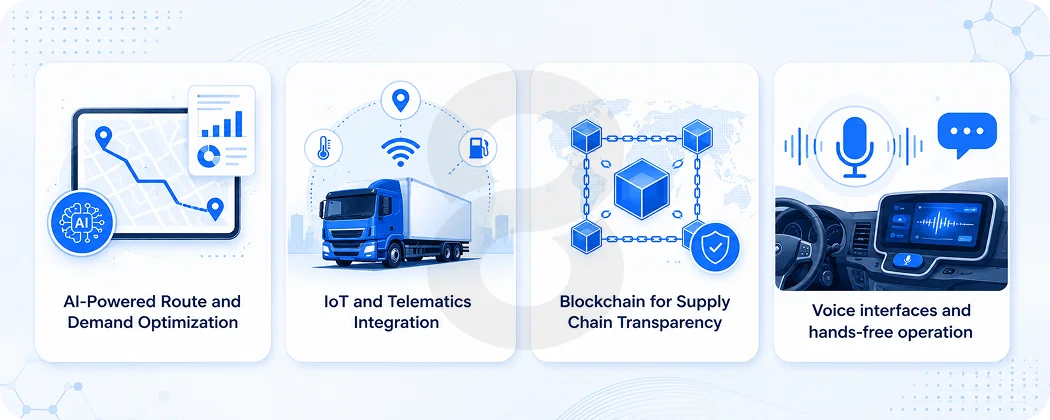
The technology roadmap for logistics app development has shifted dramatically in the past two years. What were considered advanced features in 2023 are now expected baseline capabilities for any serious platform.
AI-Powered Route and Demand Optimization
Businesses applying sophisticated AI-powered planning tools have reported a 15 percent increase in vehicle utilization and up to 25 percent fewer empty miles, thanks to algorithms that generate efficient routes and cut wasted mileage. These aren’t theoretical gains. They’re numbers logistics companies are reporting from live deployments.
AI is also being applied to demand forecasting. Knowing that a particular region will see higher order volume on Friday afternoon lets you pre-position vehicles rather than react to the surge. That shift from reactive to proactive is where the real operational savings come from.
IoT and Telematics Integration
IoT devices in logistics go well beyond standard GPS. Temperature sensors in refrigerated trucks, tire pressure monitors, engine diagnostics, fuel consumption tracking, and cargo weight sensors all feed into a central platform.
When a refrigerated unit shows temperature variance at 2am, the system flags it before product is lost. With 5G connectivity becoming more widely available, the latency and reliability of these real-time feeds is improving significantly.
Blockchain for Supply Chain Transparency
The immutable ledger concept fits well in high-value freight and pharmaceutical logistics, where chain of custody documentation needs to be unimpeachable. Blockchain functionality reinforces data protection while smart contracts enable more transparent supply chain operations, reducing disputes between carriers, shippers, and receivers.
Voice interfaces and hands-free operation
Voice interfaces powered by AI are playing a growing role in fleet management. Drivers and logistics managers interact with their systems hands-free while driving or operating machinery.
Voice-enabled features include status updates, route confirmation, and exception reporting without anyone taking their hands off a wheel or a pallet jack. Warehouse workers using voice-guided picking already exist in major distribution centers, and the extension to driver apps is the next step.
Where Logistics App Builds Go Wrong
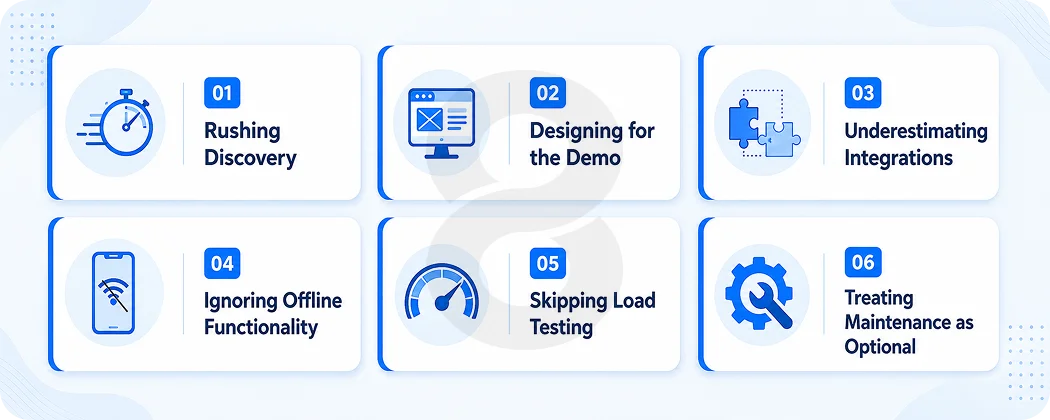
Real logistics software projects fail in predictable ways. These aren’t edge cases. These are patterns that show up across builds of every size, and most of them were avoidable.
Rushing Discovery
The irony is that rushing the discovery phase adds months to the project later when requirements change mid-build. Spending four weeks mapping actual operational workflows, interviewing dispatchers, and documenting edge cases is cheaper than rebuilding three features that missed the mark entirely.
Designing for the Demo
A platform that looks great in a pitch but requires three taps to do something a dispatcher does 200 times a day is a failed product. Prioritize the highest-frequency actions in every interface. The demo audience and the daily user are almost never the same person.
Underestimating Integrations
“We’ll connect it to our existing WMS later” is the most common phrase that turns a six-month project into a fourteen-month one. Integration scope, whether ERP, WMS, payment processors, or telematics hardware, needs to be defined and estimated in phase one, not treated as an afterthought that will sort itself out.
Ignoring Offline Functionality
Drivers in rural areas, warehouse workers in concrete buildings, and field teams at ports frequently lose connectivity. A logistics mobile app that requires a stable internet connection to function simply isn’t ready for real-world use. Offline mode isn’t optional in a serious logistics build.
Skipping Load Testing
A platform that works fine in testing can fall apart under peak-hour GPS pings across a 200-vehicle fleet. That failure mode is avoidable with proper stress testing before deployment, but it’s one of the first things dropped when timelines compress and budgets tighten.
Treating Maintenance as Optional
Software that isn’t maintained degrades. APIs change, operating systems update, security vulnerabilities emerge. The 15 to 20 percent annual maintenance budget isn’t overhead; it’s what keeps the platform functioning reliably after launch.
What to Look for in a Logistics App Development Partner
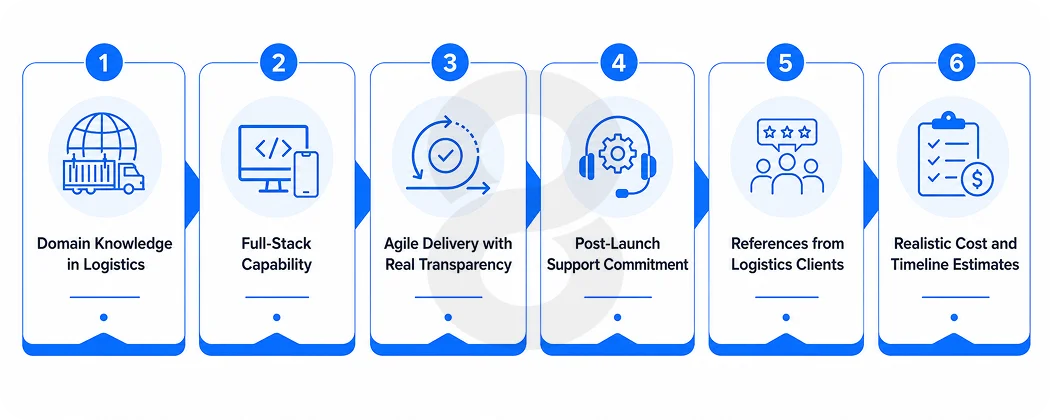
Choosing who builds your logistics platform matters as much as what gets built. The wrong partner can produce technically functional software that doesn’t solve the actual operational problem, and that’s a failure even if the code passes every test.
Here’s what separates a capable partner from one that will cost you more in the long run:
Domain Knowledge in Logistics
A team that has built logistics and supply chain software before will ask different questions in discovery. They’ll know to ask about driver offline behavior, peak-hour GPS load, compliance requirements, and ERP integration complexity before the first prototype. Teams without that background discover these requirements mid-build.
Full-Stack Capability
Logistics platforms need mobile development, backend architecture, cloud infrastructure, API integration, and often AI or IoT components. A partner that covers the full development stack in-house reduces handoff risk and keeps the architecture coherent across layers, rather than stitching together work from multiple vendors.
Agile Delivery with Real Transparency
Two-week sprints, working demos, and honest status reporting matter in a complex build. Any team that can’t show you a working version of the core feature set within the first six weeks of development is carrying risk they haven’t surfaced yet.
Post-Launch Support Commitment
The platform will need updates. Mapping APIs change pricing. New OS versions break things. Compliance rules shift. A partner that disappears after deployment is a liability. Confirm that maintenance and support terms are written into the contract before work begins.
References from Logistics Clients
Ask for references specifically from logistics or supply chain clients, not just general app development portfolios. The operational requirements of a fleet management platform are fundamentally different from those of a consumer app or an e-commerce storefront. Domain experience is not transferable.
Realistic Cost and Timeline Estimates
Any partner who gives you a fixed price on a complex logistics build in the first conversation without a thorough discovery phase is either underscoped or overconfident. Realistic estimates come from real discovery, not from matching a budget number to make the sale.
How 8ration Handles Logistics App Development
8ration builds custom software for logistics and supply chain teams that need platforms built around how they actually operate, not around a template. Discovery comes first: operational workflows get mapped, compliance requirements get documented, and integration scope gets defined before any design or development work starts.
The mobile and web development teams collaborate closely with operations stakeholders to build platforms that hold up under real fleet conditions, meaning proper offline handling, stress-tested GPS tracking at scale, and dispatch interfaces designed around peak-shift reality.
AI integration for route optimization and demand forecasting is architectured into the system from the beginning, not bolted on later. UI/UX design for multi-role interfaces, backend architecture for high-volume GPS data, cloud infrastructure, and ERP or WMS integrations round out the full-stack capability.