


The Real Money Problem Behind On-demand App Development
You know that moment when a founder says, “We need an app like Uber, but for our industry”? That sentence sounds simple. Then the cost starts growing. Customer app. Provider app. Admin dashboard. Live tracking. Payments. Ratings. Push notifications. Chat. Promo codes. Wallet. Route management. Reports. Support tools. Suddenly, the first version is no longer small. It becomes a heavy product before a single real customer has used it. That’s why the MVP vs full product on-demand decision matters so much. It is not a technical debate. It is a money decision.
The global mobile application market was valued at $252.89 billion in 2023 and is expected to reach $626.39 billion by 2030, according to Grand View Research. That tells us one thing clearly. Apps are still a huge business channel, but the market is crowded and users have choices.
On demand categories are also expanding. The online food delivery market alone was valued at $288.84 billion in 2024 and is projected to reach $505.50 billion by 2030. But growth does not mean every app wins. The retention data by Adjust shows that app retention often falls to 26 percent on day 1, 13 percent by day 7, and about 7 percent by day 30. So yes, demand is there. But users leave fast when the app does not solve a real problem. That is where minimum viable product, full product development, on demand app development, mobile app development cost, and product market fit become part of the same question. How much should you build before the market gives you proof?
What MVP Means for On-demand App
An MVP is the smallest working version of your app that lets real users complete the main task. For an on-demand food app, that task might be placing an order and getting it delivered. For a taxi app, it might be booking a ride and completing payment. A home services app might involve requesting a cleaner, plumber, or technician and tracking the booking. A good MVP is not a rough demo. It must work. A functional MVP is a product with key features that let real users experience its value on their own. That means your MVP should include the basic flow, not every possible feature. For most on-demand apps, a practical MVP includes:
- Customer registration
- Service listing
- Booking or order placement
- Basic provider management
- Payment gateway integration
- Order status updates
- Admin panel
- Ratings and feedback
- Basic notifications
That’s enough to test whether people use the app, pay through it, and come back. It is also enough to expose problems early. Customers may want faster booking. Provider dissatisfaction with the workflow could be a key issue. Payment failure might be the real issue. Demand might exist, but only in one area of the city. An MVP gives you those answers before you spend six figures on extras.
For on demand apps, the first version must prove the transaction. If users can request, pay, track, and rate the service, you already have enough data to make better investment decisions.
Read More: Why Your On-Demand App Failed and How to Fix It Before Launch
What a Full Product Means for On-Demand App
A full product is the complete version of the platform. It has richer design, stronger infrastructure, more integrations, deeper analytics, and features built for scale.
Experts describe a full product as a version with expanded features, polished design, scalability, and long term support based on proven demand.
For an on demand business, a full product may include:
- Advanced user onboarding
- Multiple service categories
- Smart matching
- Real time location tracking
- Provider availability management
- In app chat
- Digital wallet
- Subscription plans
- Promo engine
- Loyalty system
- AI based recommendations
- Advanced analytics
- Automated dispatch
- Fraud prevention
- Customer support dashboard
- Multi city operations
- Scalable cloud architecture
A full product makes sense when you already know the market. It also makes sense if users will not tolerate a limited first version. Think healthcare, logistics, fintech, enterprise delivery, or regulated transportation. In these cases, weak security, poor performance, missing compliance, or broken workflows can damage trust from the start. But for many startups, building the full product too early creates waste. You pay for features before you know if users care.
Read More: On-demand App Development: The Complete Guide for Startups and Enterprises
MVP Vs Full Product Cost Comparison
A mobile app MVP usually costs between $20,000 and $80,000, depending on features and complexity, while a full scale mobile app can range from $40,000 to over $400,000. In terms of timeline, MVP development typically takes around 2 to 6 months, whereas a full product can take 6 to 18 months or more based on scope, integrations, and scalability requirements.
At 8ration, mobile app development comes at a similar range, with simple apps starting from $20,000 to $50,000 and complex apps reaching $160,000 to $400,000 plus.
Cost Area |
MVP On Demand App |
Full Product On Demand App |
| Typical budget | $20,000 to $80,000 | $40,000 to $400,000 plus |
| Build time | 2 to 6 months | 6 to 18 months |
| Feature scope | Core user flow only | Complete product with advanced features |
| Risk level | Lower early risk | Higher upfront risk |
| Best use case | Testing demand and user behaviour | Scaling a proven business model |
The MVP saves money because you delay nonessential spending. You are not paying for a loyalty system before users place repeat orders. Payment behavior is not yet clear enough to justify building a complex wallet. You are not creating provider gamification before providers even agree to use the app. That delay is not weakness. It is discipline.
Read More: How Much Does It Cost to Build an On-Demand App in 2026?
Where Founders Waste Money in Full Product Builds
Full product development often looks safer because everything is included. But here’s what happens in real life. The team spends months building features based on assumptions. Then users behave differently. They ignore some features, complain about basic flows, and ask for things nobody planned. Now the business pays twice. First, it paid to build the wrong thing. Then it pays again to fix it. The common money leaks include:
- Building too many user roles before demand is clear
- Adding advanced filters that users do not need
- Creating complex dashboards nobody checks
- Integrating tools before the workflow is proven
- Designing loyalty systems before repeat usage exists
- Building for multiple cities before one location works
- Spending heavily on custom design before onboarding is tested
This is why feature prioritization matters. Every feature should answer a business question. Does it increase bookings? Does it improve fulfillment? Reducing cancellations is another key consideration. User retention improves only if it brings users back. Does it reduce manual support? If not, it can wait.
When an MVP Saves More Money
An MVP is the better money saving strategy when your idea still has open questions. That includes questions like:
- Will customers pay for this service through an app?
- Will providers accept the commission model?
- Can we fulfill orders fast enough?
- Which features increase repeat usage?
- What is the real cost per booking?
- How much support does each transaction need?
For a new on demand startup, these questions matter more than visual polish.
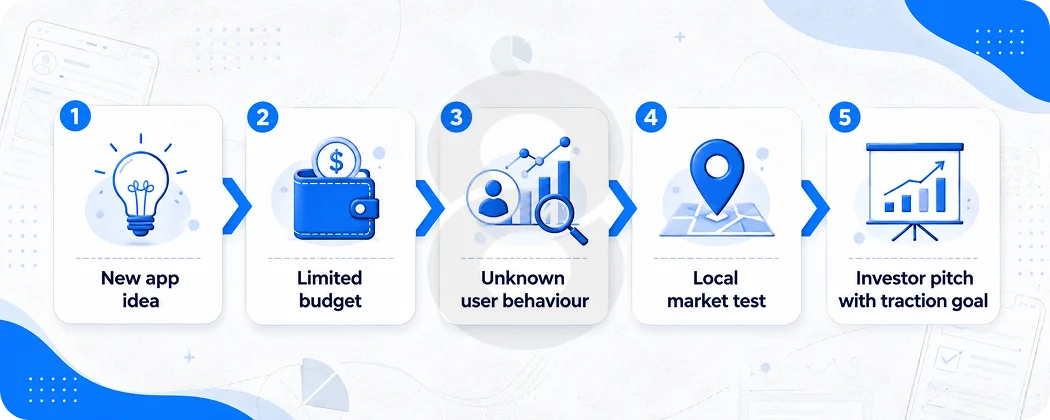
Business Situation |
Better Choice |
Why It Saves Money |
| New app idea | MVP | You test demand before heavy spending |
| Limited budget | MVP | You protect your cash and avoid unnecessary features |
| Unknown user behaviour | MVP | You learn from real users before scaling |
| Local market test | MVP | You can validate one city or area first |
| Existing customer base | Full Product | You already know what users need |
| Regulated or high trust market | Full Product | You avoid trust, compliance, and support problems |
A strong MVP also helps with fundraising. Investors do not only want a beautiful idea. They want proof. Downloads are nice. Repeat usage is better. Paid transactions are even better. And for on demand apps, operations matter as much as software. You need to know whether drivers arrive on time, restaurants update menus, technicians accept jobs, or customers cancel when prices change. A full product cannot answer these questions in a meeting room. Users answer them after launch.
Read More: MVP Development Cost in 2026: $10k – $100k
When a Full Product Can Save More Money
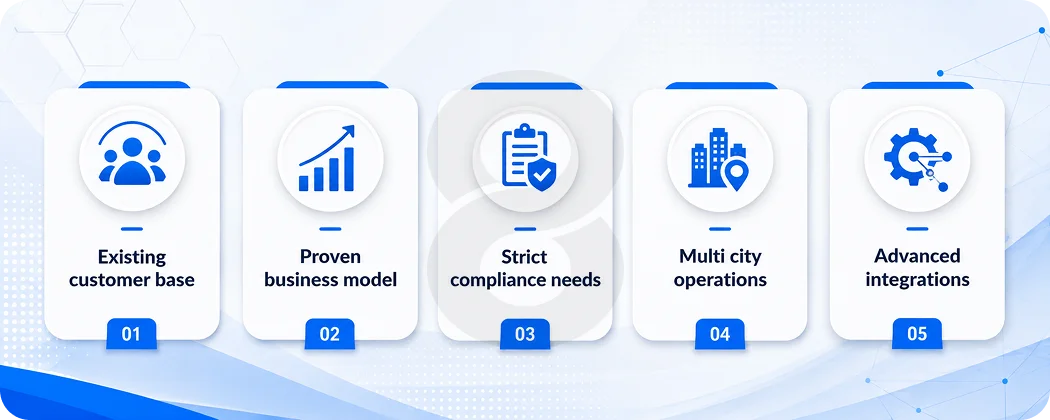
A full product can save money when the business already has proof.
You may already be running a delivery business and considering how to digitize operations. Orders might already be coming through WhatsApp, while your team handles a growing volume of manual bookings. Meanwhile, competitors may have set new standards in customer experience, including live tracking, wallet payments, refunds, and instant support.
In that case, an MVP that feels too limited may create friction.
A full product is the better option when:
- The business model is already validated
- You have an existing customer base
- You know the main user journeys
- The market has strong competitors
- Compliance and security are required
- Failed transactions can cause serious losses
- You need integrations with CRM, ERP, POS, or fleet systems
- Your operations cover multiple branches or cities
For example, an on demand healthcare app cannot skip privacy and security. A logistics platform cannot launch with weak tracking. A taxi booking app cannot ignore driver allocation, route logic, and payment settlement. This is where full product spending becomes protection. You are paying to avoid operational failure. Our Android app development shows how industry apps often need secure payments, Google Pay, inventory sync, GPS tracking, fleet monitoring, route optimisation, and compliance ready architecture depending on the category. So the answer is not always “build an MVP.” The answer is build the smallest version that is safe, useful, and credible for your market.
The On-Demand App Features You Should Build First
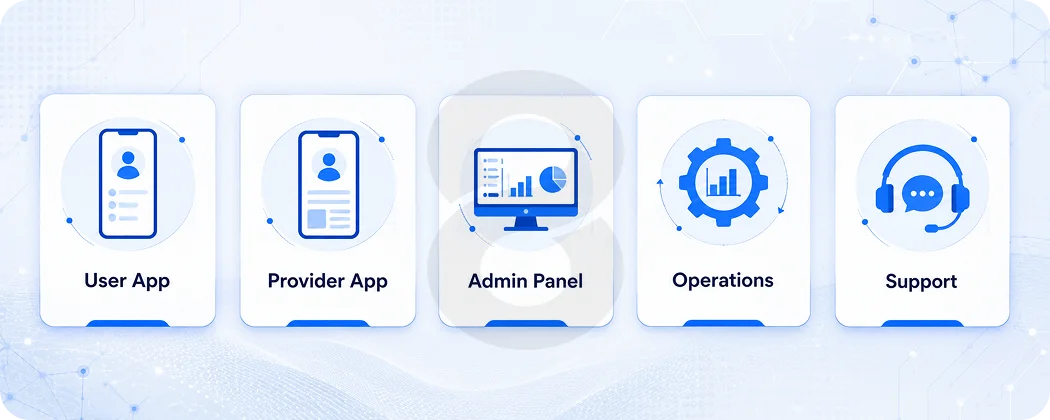
The first version of an on demand app should focus on the transaction. That means the customer should be able to request something, the provider should be able to accept it, and the business should be able to manage it. Everything else comes after that.
Feature Group |
MVP Version |
Full Product Version |
| User app | Signup, service search, booking, payment, rating | Wallet, loyalty program, subscriptions, smart suggestions |
| Provider app | Job alerts, accept or reject option, status updates | Earnings dashboard, schedule tools, performance reports |
| Admin panel | User management, bookings, payments, complaints | Advanced reports, fraud checks, campaign tools |
| Operations | Manual dispatch or basic matching | Automated dispatch, route logic, multi city control |
| Support | Email support or basic ticket handling | Live chat, refund tools, call center support, escalation rules |
This is also where scalable architecture matters. You do not need a massive system on day one, but you need clean architecture so your MVP can grow without being rebuilt from scratch. That is the balance. Build lean. But do not build cheap in a way that creates technical debt. Cheap code becomes expensive when every new feature breaks something old.
How to Decide Between MVP and Full Product
The decision becomes easier when you stop asking, “Which one is cheaper?” Ask, “Which one reduces waste for our current stage?” Use this simple framework. Choose MVP if your biggest risk is market uncertainty. Choose a full product if your biggest risk is operational failure. That’s the cleanest way to think about it. If you are still proving demand, build an MVP. If demand is proven and failure would hurt trust, build the full product or at least a stronger first version.
Choose MVP when
- You are testing a new category, new city, new pricing model, or new user behaviour.
- You have limited capital and need to show traction before raising more money.
- You want real feedback before investing in advanced features.
- You can handle some operations manually in the early stage.
Choose full product when
- You already have active customers.
- You already know which features users need.
- You operate in a category where trust, security, speed, and support cannot be weak.
- You need multiple integrations from the start.
- You are replacing an existing offline or manual operation with a digital system.
Read More: Digital Asset Management System Powered by Blockchain
The Hidden Cost of Launching Too Late
There is another cost founders often miss. Waiting too long. A full product can take many months. During that time, your market can change. Competitors can move. Customer behaviour can shift. Your own idea can lose momentum. MVPs offer faster launch and lower initial investment, while full scale apps take longer because of broader features, integrations, security, infrastructure, and testing. That delay has a cost. You spend more before learning anything. You also lose the chance to collect user data early.
In on demand apps, this is serious because operations improve through repetition. The first 100 bookings teach you things no planning document can. What area has the most demand right now? Which provider type cancels most? Which payment method fails? What time slot leads to delays? Which customer complaint repeats? A smaller launch can answer all of that.
Read More: The Real Cost of App Maintenance: What Budget Percentage Should You Allocate?
The Better Money Saving Strategy
For most new on demand businesses, the MVP saves more money. But not because it is cheaper on paper. It saves money because it protects you from building the wrong product. That matters more. A full product becomes a smarter investment after the core model is proven. After users begin returning consistently, bookings start repeating, unit economics become viable, and the team gains clarity on what should be automated versus what can remain manual, the best strategy is usually a phased approach.
So the best strategy is usually phased. Start with MVP app development that proves the main transaction. Measure usage, retention, fulfilment, support load, and repeat orders. Then move toward full scale mobile app development with the features users have already demanded through behaviour. That is how you save money without building something weak. And that is the real answer to MVP vs Full Product On-Demand App planning. Build less at the beginning, but build it properly. Then spend more only when the data gives you permission.
How 8ration Helps You Build the Right On-Demand App Strategy
The hard part is not choosing between an MVP and a full product on paper. The real challenge is knowing what your app should include in the first version, what can wait, and what needs proper development from day one. That is where 8ration helps.
8ration works with businesses that want to build on demand apps, mobile apps, cross platform apps, and custom digital products without spending money on features users may never use. The process starts with your idea, users, market, and budget. After that, the team helps you decide whether your business needs a lean MVP, a stronger first release, or a full product built for scale.
For a new startup, this often means building a focused MVP with booking, payment, provider, and admin flows. These features help you test demand without making the first version too heavy. For an existing business, the approach is different. 8ration can help turn manual operations into a digital platform with customer apps, provider apps, dashboards, analytics, integrations, and long term scaling support. This makes the MVP vs Full Product On-Demand App decision easier because the strategy comes from your real business stage, not guesswork.
If you want to test a new idea, 8ration can help you plan MVP app development with only the features needed to prove demand. If you already have customers and operations in place, the team can help you build a stronger product with better performance, smoother workflows, and room to grow. You can also explore 8ration’s on demand app development services, mobile app development services, and cross platform app development services to choose the right path for your project.