



Every founder who Googles how to make idle game sees the same thing. A wall of tutorials promising you can build a clicker in a weekend. And technically, you can. A button, a counter, a number that goes up. Done.
Then you play Idle Miner Tycoon or AdVenture Capitalist for ten minutes and realize the gap between your weekend project and a game that made millions is not a gap. It’s a canyon.
This article covers what actually goes into idle game development, where DIY projects fall apart, and why founders who are serious about revenue end up hiring experts anyway. Usually after burning six months finding out the hard way.
Why Idle Games are Smart Investment for Mobile Game Founders
Call them incremental games, clicker games, idlers, whatever. The genre runs on one promise. The game keeps playing when the player stops. Tap for coins, buy an upgrade, set up some automation, close the app, go live your life. Come back tomorrow and the pile got bigger overnight.
That overnight pile is the entire psychology of the genre. Waking up to progress you didn’t work for feels weirdly great, and players build a morning habit around it the same way people check their phones before their feet hit the floor.
The numbers back the habit up too. Idle games post a stickiness rate of around 18% compared to 10.5% for hyper casual titles, which means players return day after day instead of deleting after one session.
The best performing idle tycoons have hit 50% day one retention and 10% day thirty retention, numbers most mobile genres can only dream about.
Read More: Casual Game Development: A Complete Guide for Business Owners
Why players stick with idle games longer
The genre rewards checking in, not grinding. Players open the app, collect what accumulated, make one or two smart decisions about upgrades, and leave satisfied.
There’s no energy bar punishing them for being busy. No skill ceiling locking out casual players. The passive gameplay loop respects people’s time, and people repay that with loyalty.
Why developers keep entering the genre
Compared to a midcore RPG, an idle game is faster and cheaper to build. Shorter core loops mean less content to produce and test. Monetization slots in naturally through rewarded video ads and purchases that speed up time.
And hybrid formats like idle RPGs and idle tycoons keep pulling in new audiences who never touched a pure clicker. Cheaper to build does not mean easy to build well, though. That distinction is the whole point of this article.
How to Make Idle Game: Step by Step
Anyone teaching you how to make an idle game will walk you through roughly the same stages. The stages are simple to list. Executing them is where projects live or die.
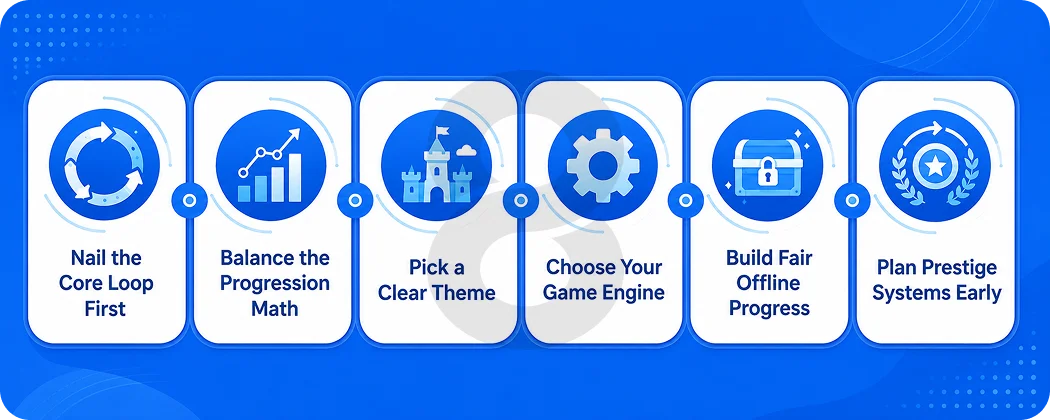
Nail the core loop first
The core loop is the repeating cycle of action, reward, and upgrade. Tap to earn coins, spend coins on a generator, generator earns coins for you, buy a better generator. Every successful idle game gets this loop feeling good within the first sixty seconds of play. If the loop is boring at minute one, no amount of content fixes it later. Games like Cookie Clicker and Cats & Soup built empires on loops that feel satisfying before the player even understands the strategy underneath.
Read More: Ideas for Game Development: How Businesses Can Enter the Gaming Market
Balance the progression math
This is the part tutorials skip and the part that kills most DIY projects. Idle games run on exponential curves. Upgrade costs, income rates, and time gates all have to scale together so the player always feels slightly behind but never stuck.
Get the curve wrong in one direction and players max out in two days and leave. Get it wrong in the other direction and progress feels dead, so they leave anyway. Balancing an idle game economy is closer to actuarial work than game design, and studios employ dedicated economy designers for exactly this reason.
Pick a theme players understand in five seconds
Mining. Restaurants. Zoos. Capitalism. The best idle game themes explain themselves in the app icon. Players should know the fantasy before they finish reading the title.
A strong theme also shapes your art style, your upgrade names, and your ad creatives, so choosing it carefully saves money everywhere downstream.
Choose the right game engine and stack
Unity remains the default choice for cross platform idle game development, with strong 2D tooling and every ad network SDK you’ll ever need. Unreal Engine works for visually heavier projects. Some studios build lighter clickers in Godot or even native code.
Most idle games run fully on device, but leaderboards, cloud saves, and live events need a backend, which is a genuine software architecture decision rather than an afterthought.
Read More: Unity Game Engine: A Game Development Guide for Businesses
Build offline progress that feels fair
Offline earnings are the genre’s signature feature and one of its trickiest systems. Calculate offline income too generously and you break the economy. Too stingy and players feel cheated for having jobs.
Most successful games cap offline earnings and then sell or ad gate extensions to that cap, which turns a technical system into a revenue stream.
Plan the prestige system early
Prestige lets players reset their progress in exchange for permanent multipliers, and it’s what turns a two week game into a two year game.
Retrofitting prestige into an economy that wasn’t designed for it usually means rebuilding the entire progression curve. Teams that know how to make idle game economies plan the reset loop from the first spreadsheet.
Read More: What Are AAA Games? Breaking Down the Biggest Titles in Gaming
The Hidden Problems With Making an Idle Game Yourself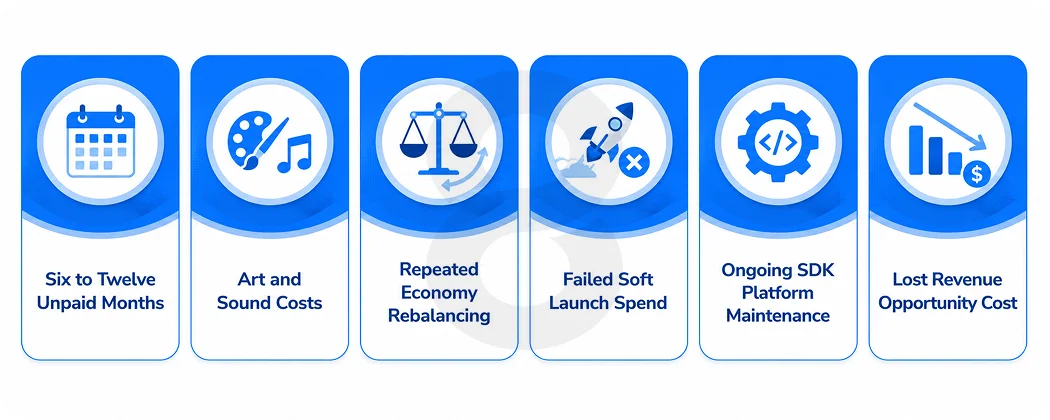
Here’s the honest version nobody puts in tutorials. Building the first 70% of an idle game is genuinely fun. The button works, the numbers go up, friends say nice things. The last 30% is where the project turns into a second job that pays nothing.
The tutorial trap
Tutorials teach mechanics in isolation. A clicker here, an auto generator there. What they never teach is how systems interact at scale. How does your prestige multiplier interact with your rewarded ad boost during a limited time event?
Nobody on YouTube covers that, because the answer depends entirely on your specific economy. Solo developers on incremental game forums say the same thing over and over. The coding was the easy part. The balancing broke them.
The economy is a math problem most beginners lose
An idle game is a spreadsheet wearing a costume. Every upgrade cost, income rate, and time gate is a variable in a system of exponential equations.
Professional studios simulate their economies before writing a line of game code, running thousands of virtual play sessions to find the dead zones where progress stalls. A DIY developer finds those dead zones through one star reviews.
Monetization gets bolted on too late
Rewarded video ads, purchase placement, ad frequency, and pricing all affect retention, and retention is the entire business model. DIY projects typically add monetization after the game is built, which is backwards.
Ad placements need natural pauses in the gameplay loop. Purchases need to solve real player frustrations rather than manufacture them. That design work has to happen at the start.
| Hidden DIY Cost | What It Actually Looks Like |
|---|---|
| Your time | 6 to 12 months of nights and weekends, unpaid |
| Art and sound | $3,000 to $15,000 outsourced, or amateur assets that hurt conversion |
| Economy rebalancing | 2 to 3 full reworks after players find the dead zones |
| Failed soft launch | Ad spend burned testing a game that wasn’t ready |
| SDK and platform maintenance | Ongoing updates for ad networks, iOS and Android changes |
| Opportunity cost | The revenue a properly built game would have earned in that year |
Add it up and the free option starts looking expensive.
Read More: Character Design Ideas: 30 Visions for the Next Evolution of Player Interaction
Hiring Idle Game Developers vs DIY Development
Nobody’s saying a founder can’t figure this stuff out. Unity is learnable. So is economy design, and ASO, and the mess that is ad mediation. Give a determined person enough time and they’ll get competent at all four.
Time is exactly the problem. Each of those skills takes months to pick up properly, and they stack one after another. Meanwhile, the genre keeps moving, the store gets more crowded, and user acquisition gets pricier every quarter. By the time a self taught founder is ready to ship, the window they spotted two years ago has usually closed.
Here’s how the two paths actually compare.
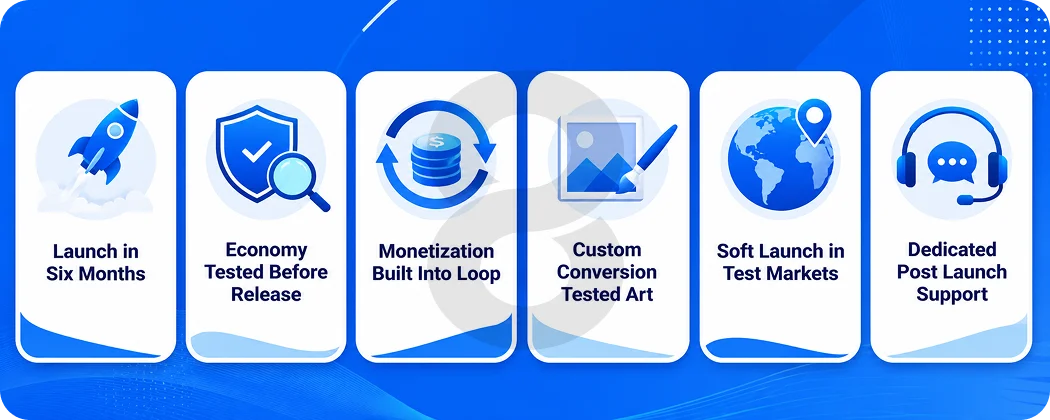
| Factor | DIY Development | Expert Team |
|---|---|---|
| Time to launch | 8 to 18 months | 2 to 6 months |
| Economy balancing | Trial and error with live players | Simulated and tested pre launch |
| Monetization setup | Added after build, often clumsy | Designed into the core loop |
| Art and UX quality | Asset store or amateur | Custom, conversion tested |
| Soft launch strategy | Rarely happens | Standard practice in test markets |
| Post launch support | You, at midnight | Dedicated maintenance team |
| Total cost | “Free” plus a year of your life | $20,000 to $150,000, predictable |
Read More: How Long Does it Take to Make a Video Game
What a professional team handles that tutorials skip
A real studio brings economy designers who model your progression curves, UI designers who know why the upgrade button sits where it sits, and engineers who have already fought with every ad mediation SDK on the market.
They run soft launches in test markets before the global release, so pricing and ad frequency get tuned on cheap installs instead of your main marketing budget. Increasingly, they also apply AI driven difficulty balancing to personalize reward pacing per player, something the biggest idle publishers now treat as standard.
There’s also a middle path. Keep the vision and the game design in house, and bring in vetted engineers to fill the gaps. Founders who already have a sharp designer on the team but nobody senior enough in Unity tend to get the most out of this setup, since the missing piece is execution speed rather than direction.
Idle Game Development Cost Breakdown
Of all the genres a first time founder could pick, idle games are among the kindest to a budget, and that’s no small part of why so many start here. Where the money lands depends on ambition. At the entry level, a clean clicker with one solid loop, decent art, and ads wired in costs somewhere between $20,000 and $40,000, with a two to three month build.
Step up to an idle tycoon, the kind with several production chains, a prestige reset, seasonal events, and cloud saves, and the budget moves to $50,000 to $90,000 across four to six months. Idle RPGs are the expensive tier. Characters, gacha collection, live ops. Those projects clear $100,000 and keep costing money after launch, by design.
Three variables move the price more than anything else. Art complexity, because 3D and heavy animation multiply production hours. Backend requirements, since live events and cross device sync need real server infrastructure and custom software architecture behind the game client.
And platform count, because shipping iOS and Android together adds testing overhead even with a cross platform engine.
Worth remembering what that budget is buying. It is not just code. It’s the accumulated scar tissue of teams who have watched games fail for reasons a first timer cannot see coming. In a market where over 95% of players abandon a new title within thirty days, that experience is the product.
Read More: How Much Does It Cost to Make a Mobile Game?
How 8ration Handles Idle Game Development for Founders
8ration builds games and apps for founders who want a product, not a science project. The game team handles the full cycle. Concept validation, economy modeling, art production, Unity development, monetization integration, soft launch testing, and post launch live ops.
Art comes second at 8ration. Math comes first. Every project opens with an economy model, where the team maps progression curves and runs simulated player journeys to find the spots where the game will stall. Catching a dead zone in a spreadsheet costs an afternoon. Catching it in a live game costs reviews, refunds, and a patch under pressure.
Monetization gets the same early treatment. Rewarded ads and purchase offers are placed while the core loop is still being shaped, so they land at moments where a player actually wants the boost rather than moments where the game is begging for attention.
And because most idle games live inside a larger product strategy, 8ration’s mobile app engineers handle everything around the game too, from analytics and attribution to push notification flows that pull lapsed players back.
After launch, the team stays on. Balance patches, seasonal events, new content drops, and ad revenue optimization all continue, because idle games earn their money in months two through twenty four, not week one.