



Everyone who has spent time around mobile products has watched this happen at least once. A founder plays Candy Crush on a flight, lands, and tells the team the company should make a game. Six months later there is a half finished prototype, burned budget, and quiet agreement to never bring it up again.
That outcome is common. It is also avoidable. Casual games are a real business with real economics and the companies that treat them that way do fine. The ones that treat them like a side quest do not.
This guide covers what casual game development involves from a business owner’s seat. Not the coding tutorials. The decisions, costs, monetization math, and traps that eat budgets alive.
What is a Casual Game
A casual game is one that anybody can pick up in seconds. No tutorial worth mentioning, no learning curve, no controller with seventeen buttons. Think match 3 puzzles, endless runners, word games, merge games, and solitaire variants. The player taps, swipes, or drags. That is the whole control scheme.
The audience is the point here. Casual titles are built for people who would never call themselves gamers. Someone waiting for coffee or travelling on a train. It can also be a person who has ninety seconds and wants those ninety seconds to feel good.
That design constraint shapes everything downstream, from the art style to the session length to how the game makes money.
The label matters because it determines your business model before a single line of code exists. A casual game lives or dies on volume and repeat sessions. A hardcore game can survive on a small audience paying a lot. Confuse the two and the budget math falls apart fast.
Casual, hyper casual, and hybrid casual
These three terms get thrown around like they mean the same thing. They do not, and picking the wrong lane is an expensive mistake.
| Factor | Hyper Casual | Casual | Hybrid Casual |
|---|---|---|---|
| Core gameplay | One mechanic, instant | Simple, level based | Simple core with deeper layers |
| Session length | Under 2 minutes | 3 to 10 minutes | 5 to 15 minutes |
| Main revenue | Ads almost entirely | Purchases plus ads | Balanced mix of both |
| Retention focus | Day 1 | Day 7 | Day 30 and beyond |
| Development time | 2 to 8 weeks | 3 to 6 months | 4 to 9 months |
| Typical budget | $5,000 to $30,000 | $30,000 to $150,000 | $80,000 to $250,000+ |
Hyper casual games are the disposable lighters of gaming. Cheap to make, played hard for a week, then deleted. The model peaked a few years back when user acquisition was cheap. Ad privacy changes made cheap installs expensive, and the pure hyper casual play got much harder to profit from.
Hybrid casual is where the industry moved. Take the instant accessibility of hyper casual, then bolt on progression systems, collections, and meta layers that give players a reason to come back for months.
The numbers back the shift. Sensor Tower data showed purchase revenue inside hybrid casual titles jumped 37% year over year, which is the kind of growth the rest of mobile gaming would kill for.
Read More: How Much Does It Cost to Make a Mobile Game?
For most business owners entering the space today, hybrid casual is the honest recommendation. It costs more upfront and takes longer, but it is the model with a future.
Casual Games Market Size and Why Businesses Are Investing in 2026
The online casual games market is valued at $22.68 billion in 2026 and is projected to keep climbing through 2031. That growth is happening while other entertainment categories fight over shrinking attention.
The audience case is even stronger. Casual games pull in the broadest player base of any genre, around 63% of everyone who plays games worldwide. That includes the demographics traditional gaming never reached.
Women over 35 are one of the highest spending segments in casual puzzle titles. Retirees play daily. Teenagers play between classes. There is no other game category where the target audience is basically everyone with a phone.
Then there is the operational case, which matters more to a business owner than either of the above. Compared to midcore or console projects, casual games have shorter development cycles, smaller teams, and faster feedback loops.
A studio can test whether a core mechanic works within weeks. A failed concept costs tens of thousands instead of millions. In an industry famous for burning money, casual is the corner where discipline actually gets rewarded.
One thing worth saying plainly, because most agency blogs will not. The casual games market is crowded. Hundreds of titles launch every week and most of them make close to nothing.
The market rewards teams who validate ideas before building them and punishes everyone else. That is not a reason to stay out. It is a reason to enter with a process instead of a hunch.
The Casual Game Development Process: Step by Step
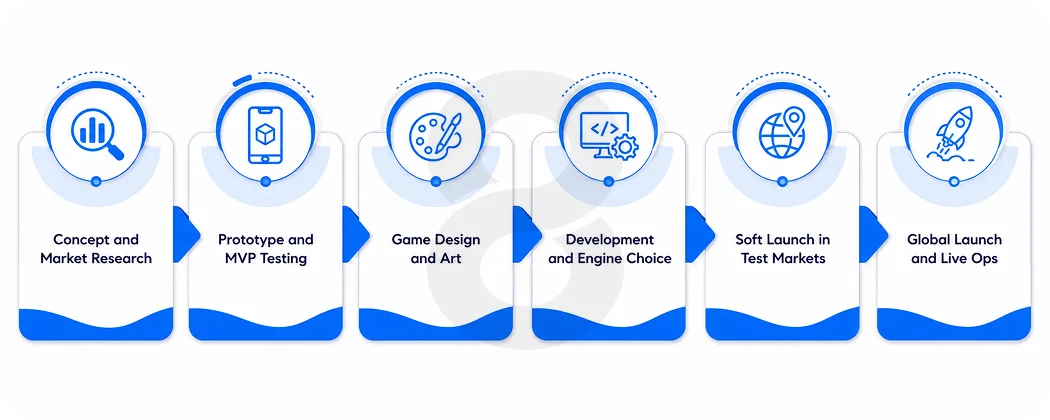
Every studio dresses this up differently, but casual game development follows the same skeleton everywhere. Here is what actually happens, and where projects usually go sideways.
Concept and market research
This phase looks like a slide deck and feels skippable. It is the most important month of the entire project. The work here is studying what already ranks in your target category, what mechanics are trending in top charts, what the download and revenue estimates look like for comparable titles, and where the gaps are.
The goal is a one page concept. One core mechanic, one target audience, one monetization hypothesis. If the concept needs three paragraphs to explain, it is not a casual game yet.
Prototype and MVP
Speed matters more than polish here. A playable prototype of the core loop should exist within two to four weeks. Gray boxes, placeholder art, no menus. Just the mechanic.
Then people who are not on the team play it. Watch them. Do they replay without being asked? Do they understand it in under ten seconds? A prototype that needs explaining has already failed the casual test.
Game design and art production
Once the loop is validated, the real design work starts. Level progression, difficulty curves, reward pacing, and the meta systems that keep players returning. In casual games the visuals do double duty.
They are the tutorial. Bright color coding, pulsing buttons, and satisfying feedback animations teach the player without a single line of instruction text.
Art direction has a bigger effect on the budget than most owners assume going in. Stylized 2D work costs less per asset and reads clearly on a five inch screen, and it scales without pain when the content team has to ship another 500 levels a year from now.
Development and engine choice
Unity remains the default engine for casual titles, and for good reason. Fast iteration, a massive asset store, mature ad network integrations, and one codebase that ships to both stores. Unity powers the majority of top grossing casual games for exactly these reasons.
Read More: Unity Game Engine: A Game Development Guide for Businesses
Godot has become a credible free alternative for lighter 2D projects and Unreal only enters the conversation when a title needs heavy 3D visuals, which casual games rarely do.
Platform strategy belongs in this phase too. Most casual titles launch on both stores simultaneously, though the two audiences behave differently. iOS players spend more per user, so iOS builds tend to carry purchase focused monetization.
Android delivers volume, so Android versions usually lean harder on ad revenue. A good studio tunes for both rather than shipping one build twice.
There is also a whole layer of the project that players never interact with directly. Accounts, cloud saves, leaderboards, and the analytics pipeline all depend on custom software built to handle sudden load.
Plenty of games have gone viral over a weekend and spent that same weekend offline, usually because someone cut corners on the backend months earlier to save a few thousand dollars.
Soft launch and testing
Before global release, the game goes live in one or two small markets. The Philippines, Canada, and New Zealand are the usual picks. The point is to collect real retention and monetization data from real players while the stakes are still low.
The metrics that matter at this stage are few and brutal:
- Day 1 retention. Below 35% means the first session is broken.
- Day 7 retention. Below 12% means the progression is broken.
- Session count per day. Casual players should return multiple times daily.
- Cost per install versus revenue per user. If acquiring a player costs more than that player generates, the business model does not exist yet.
Games iterate through soft launch for anywhere from one to six months. Painful, yes. Cheaper than a failed global launch, also yes.
Read More: How Long Does it Take to Make a Video Game
Launch and live operations
Global launch is not the finish line. It is the point where the work changes shape. Successful casual games run on live ops, meaning weekly events, seasonal content, new level drops, A/B tested offers, and constant tuning based on player data.
Studios that treat launch day as the end typically watch their game die within a quarter. The ones that budget 30% to 40% of resources for post launch are the ones still charting a year later.
How Much Does Casual Game Development Cost in 2026
The honest answer is that cost tracks complexity, and complexity is a choice. Here is where budgets actually land in 2026.
| Project Tier | What You Get | Timeline | Budget Range |
|---|---|---|---|
| Prototype / MVP | Core loop, placeholder art, test build | 3 to 8 weeks | $10,000 to $30,000 |
| Simple casual game | Polished single mechanic, 100+ levels, ads integrated | 3 to 5 months | $30,000 to $80,000 |
| Full casual title | Multiple modes, meta progression, hybrid monetization, backend | 5 to 8 months | $80,000 to $180,000 |
| Hybrid casual with live ops | Everything above plus events pipeline, analytics, ongoing content | 8 to 12+ months | $150,000 to $250,000+ |
A few things move these numbers more than owners expect. Art style is the big one, since custom animation and character work can double an art budget overnight. Multiplayer features add backend cost that never really stops. And every third party integration, from ad networks to attribution tools, adds testing time that compounds.
Read More: Character Design Ideas: 30 Visions for the Next Evolution of Player Interaction
The cheapest project is rarely the least expensive one. A $25,000 build that retains nobody costs $25,000 plus the marketing spent discovering that nobody stays. A $90,000 build that soft launched properly and hit its retention marks is the one that actually returns money.
How Casual Games Make Money

Casual games are free to download almost without exception. The money comes from three places, and the mix between them is the most consequential business decision in the whole project.
Rewarded ads
Most of the ad money in casual gaming flows through this format now. The player runs out of moves, the game offers an extra life in exchange for a 30 second video, and the player takes the trade willingly. Nobody forced anything, which is exactly why the format works.
Completion rates on rewarded video sit above 90%, and the data keeps showing that players who use these ads stick around longer than players who ignore them. Forced interstitials between levels have not disappeared, but each one chips away at retention a little, so experienced studios treat them like a spice rather than a main ingredient.
Purchases inside the app
Boosters, extra moves, cosmetic items, and battle passes. The catch that surprises every first time game owner is how few players ever pay. Roughly 3% of casual players make a purchase.
The design job is making the game generous enough that the other 97% stay and watch ads, while giving the paying minority things genuinely worth buying.
The hybrid model
The industry settled this debate. Games designed from day one to blend ads and purchases outperform single model games on nearly every metric, and retrofitting hybrid monetization into a game built for one model is far harder than designing for it natively. A sensible starting split is roughly 40% purchase revenue to 60% ad revenue, then tune from real data
One design principle ties all three together. Monetization should sit at emotional peaks. Offer the booster right after a near miss. Show the rewarded ad right when the player wants one more try. Money asks that arrive at the right moment feel like part of the game. The same asks at the wrong moment feel like a shakedown, and players uninstall shakedowns.
Why Most Casual Games Fail and How to Avoid It
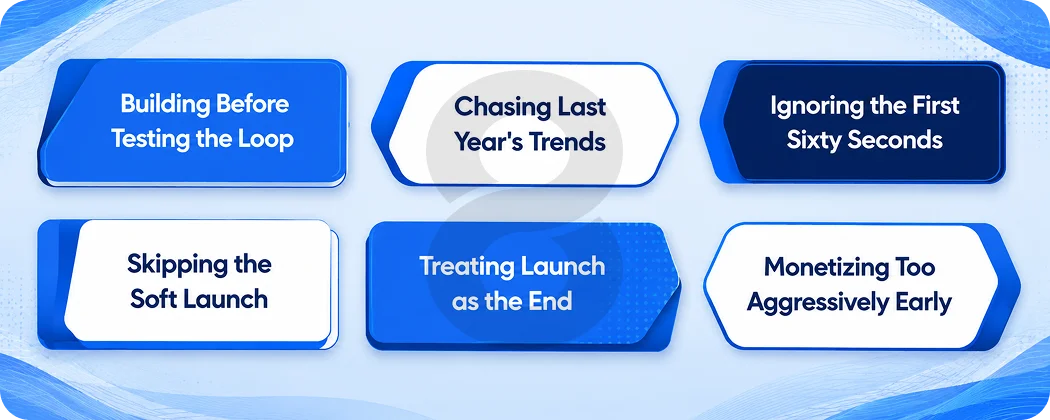
The failure patterns in this market are so consistent they could be printed on a warning label.
Building the full game before testing the loop
The single most expensive mistake. Months of art and content stacked on a mechanic nobody validated. The fix costs two weeks and a gray box prototype.
Chasing last year’s trend
By the time a mechanic is visible in the top charts, hundreds of clones are already in production. Fast followers with big user acquisition budgets win that race. Everyone else funds it.
Ignoring the first sixty seconds
Casual players give a new game about a minute. If the fun has not landed by then, the game is deleted and the install spend is gone. The opening session deserves more design attention than any other part of the game.
Skipping soft launch
Going global without test market data means discovering retention problems at full marketing spend. Nobody who has done it once does it twice.
Treating launch as the end
No events, no updates, no fresh content. The game charts for two weeks, then bleeds users to titles that ship something new every Friday.
Monetizing like it is 2019
Aggressive forced ads and paywalls torch retention. Modern players have infinite alternatives one tap away, and they use them.
None of these are technology problems. They are process problems, which is good news, because process problems are fixable before they get expensive.
How 8ration Handles Casual Game Development From Idea to Live Ops
8ration is a studio that handles the entire arc described above, from the first concept workshop to the live ops calendar running a year after launch.
The full cycle game development team covers design, 2D and 3D art, Unity and Unreal engineering, backend infrastructure, QA, and store deployment under one roof, which removes the vendor juggling that slows most projects down.
The process leans on the discipline this guide keeps hammering. Every project starts with market research and a validated prototype before production money gets spent.
Retention targets are defined upfront and tested in soft launch, not discovered after global release. And monetization is designed into the game economy from the first design document, using the hybrid model that current market data supports.
Read More: Ideas for Game Development: How Businesses Can Enter the Gaming Market
Gaming is only one side of what the studio ships. 8ration spends the rest of its time building mobile apps that keep users coming back for clients in healthcare, retail, and a dozen other industries, and those projects instilled measurement habits that carry straight into game work. Cohort tracking, funnel analysis, and A/B testing show up in week one of a project instead of arriving later as a rescue mission.
The practical benefit for a business owner is simple. Spending decisions follow player data rather than someone’s gut feeling in a Tuesday meeting.
The relationship does not wrap up at launch either. Content drops, seasonal events, performance tuning, and store page optimization continue for as long as the game is live, because the titles still earning a year out are the ones that never stopped getting attention.