Strategy games are the hardest genre to outsource well. Not because the code is exotic, but because the genre punishes shallow work. A match-3 with weak balancing is still playable. A strategy game with weak balancing dies in the first week and players will tell everyone why on Reddit before you’ve read your own analytics.
So the question isn’t really “how do I find a strategy game development company.” There are hundreds. The question is how you separate the studios that have actually shipped and operated a strategy title from the ones that will learn the genre on your budget.
Co-development itself is not the problem. In GDC’s 2025 State of the Game Industry survey, 37 percent of respondents who used co-development contracts described them as “very successful,” the highest rating recorded among the funding methods covered. The outcome depends on choosing the right development partner and structuring the engagement properly.
Why Hiring a Strategy Game Development Company is Different Problem
Most game genres are content problems. You build levels, art, and a progression curve, then ship. Strategy games are systems problems. The core loop only works if resource economies, unit costs, timers, and matchmaking all hold each other in tension, and that tension has to survive contact with thousands of players actively trying to break it.
That changes what you’re hiring for. On a competitive title, the backend responsible for multiplayer features, event systems, in-app purchases, analytics, and scalability can cost anywhere from $300K to $1 million, which is a very different cost shape than a casual title where art dominates.
A studio that shows you a gorgeous portfolio but can’t explain how they’d architect server-authoritative combat or anti-cheat is showing you the wrong half of the project.
It also changes the timeline conversation. A strategy game isn’t finished at launch. It’s a service. The studios worth hiring treat the game development engagement as the start of a multi-year operation, not a fixed deliverable they hand over and forget.
Step 1: Define Your Strategy Game Requirements Before Shortlisting Companies
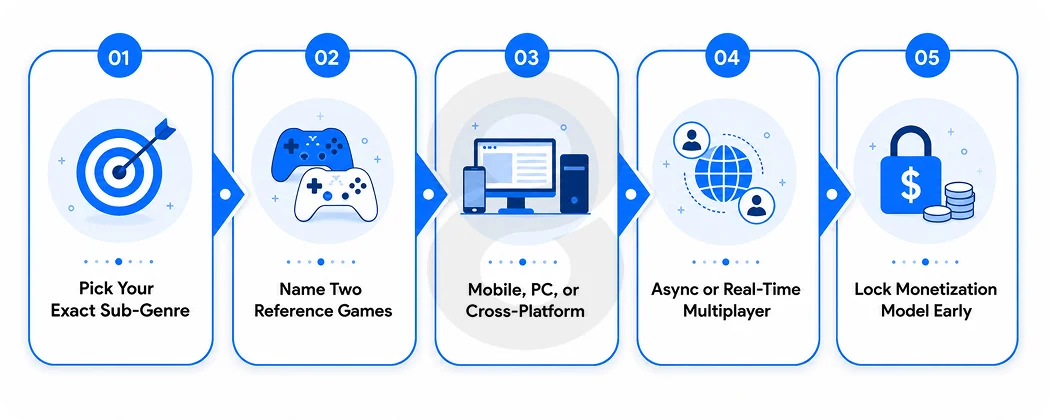
The single biggest cause of blown budgets is scoping after signing. Before you email a single studio, you should be able to answer these in one page:
Sub-genre and reference titles
“Strategy” is a lazy word. A tower defense game, 4X, RTS, and Clash of Clans style mobile base-builder have almost nothing in common technically even though they all sit under the same label. The easiest fix is to point at two or three shipped games and say “somewhere between these.” A studio can price that. Nobody can price “a strategy game.”
Platform
Mobile-first strategy is the biggest commercial market, but PC strategy players spend more per user and tolerate deeper systems.
Going cross-platform will inflate the budget by 20 to 40 percent. It stings but a lot less than deciding you want cross-play a year after launch. Retrofitting it usually costs two to three times what building it in from the start would have.
Multiplayer model
Asynchronous (attack someone’s base while they’re offline) is dramatically cheaper than real-time synchronous PvP, which needs serious netcode and server infrastructure. This one decision can swing your budget by six figures.
Monetization
Free-to-play with in-app purchases? Battle passes? Ads? A one-time premium price? This matters more than people think, because the monetization model dictates how the whole economy gets designed.
There’s no bolting it on in month eight. And if your concept involves on-chain asset ownership or tradeable units, say so upfront, because blockchain-based games carry economy and compliance decisions that reshape the entire build.
One more thing worth flagging early: if your concept leans on adaptive difficulty, smarter NPC opponents, or content that shifts with player behavior, say so in the first conversation. Studios with real AI game development capability approach opponent behavior and matchmaking very differently from teams that script everything by hand, and in 2026 that gap is widening fast.
Read More: 9 Best Game Engines for Mobile Development: Comprehensive Guide
Step 2: Where to Find Strategy Game Development Companies Worth Hiring
Be careful with “top 10 game studios” articles. Many are paid placements presented as independent rankings. They can help you put together an initial list, but do not treat inclusion as proof that a studio is reliable.
Before contacting a company, check its portfolio, client reviews, current team, technical experience, and role in the games it claims to have worked on.
Clutch and GoodFirms
Directories such as Clutch and GoodFirms are useful starting points because you can filter studios by different factors.
The overall rating only tells part of the story. Read the three and four stars reviews along with the negative ones. Comments about missed deadlines and unexpected costs are often more useful than polished client testimonials.
Check the type of project behind each review as well. A studio may have excellent feedback for casual mobile games but no experience with strategy game AI, multiplayer synchronization, complex economies, or large maps.
Store pages of games you admire
Find strategy games that resemble the product you want to build. They might share the same platform, visual style, scope, monetization model, or core mechanics. Then investigate who worked on them.
Publishers usually receive most of the public credit but external studios may have handled large parts of development.
Starting with a finished game gives you something concrete to evaluate. If a studio has already solved problems similar to yours, it will probably need less time to understand the project.
Still, ask what the company actually contributed. A logo in the credits does not mean the studio built the whole game. It may have supplied a few developers, completed a console port, or supported the main team during the final months of production.
Steam and app store credits
The full credits of a PC strategy game can reveal development partners that never appear in trailers, press releases, or publisher websites.
Look for terms such as:
- Co-development
- External development
- Additional programming
- Porting
- Multiplayer engineering
- Technical support
- Quality assurance
Art support
Steam discussions, patch notes, developer blogs, and launch announcements may provide more detail about which team handled a particular system or platform.
Mobile store pages usually contain less information, but they can still lead you to related games, publisher profiles, regional subsidiaries, and previous releases.
Pay attention to update history too. A studio that keeps fixing bugs and releasing improvements after launch may be a better long-term partner than one that disappears as soon as the first version ships.
Developer communities
Some of the best evidence of a studio’s technical ability comes from its developers rather than its marketing team.
Look for engineers and designers who participate in Unity forums, Unreal communities, GitHub projects, technical Discord groups, and game development forums. Their posts can show how they approach real production problems.
For a strategy game, useful subjects include pathfinding, AI decision-making, simulation architecture, procedural maps, save systems, networking, and CPU optimization.
Public contributions also reveal how clearly the team communicates. A developer who can explain a difficult system in plain language will probably be easier to work with during production.
When a studio shares its thinking publicly, you can inspect some of its work before sending the first email. A company website rarely gives you that level of detail.
Where the studio sits on the map affects two things: your budget and your meeting hours. Not much else. Asia remains the cost leader at around $24 to $41 per hour depending on seniority, while European rates run $31 to $39 for junior developers and $64 to $76 for seniors, with rates in all major outsourcing regions actually dipping year over year.
Here’s the uncomfortable truth about those bands, though. There are teams in Kyiv outperforming teams in California and plenty of the reverse. The price gap is real; the quality gap is a coin flip. Which is why the vetting section below matters far more than the country field on the invoice.
Read More: Game Programming Patterns: A Detailed Guide
Step 3: How to Vet a Strategy Game Development Company (5 Checks)
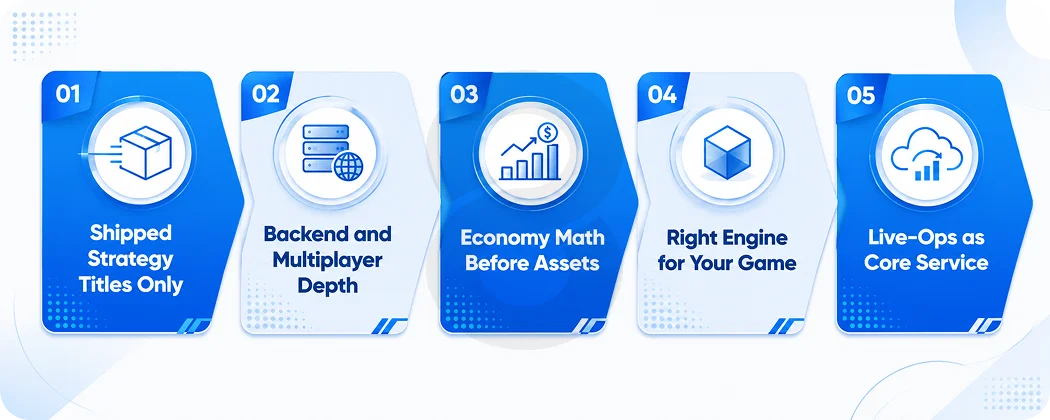
This is where most hiring decisions go wrong. Portfolios lie by omission, so dig into these five areas:
Shipped strategy titles
Ask specifically: “Which strategy games have you built, and are they still live?” Then play them. Then read their store reviews from three to six months after launch.
Early reviews reflect polish; later reviews reflect balancing, server stability, and whether the studio actually ran live-ops. A team whose strategy title collapsed 90 days in has already shown you their post-launch competence.
Backend and multiplayer depth
Ask them to describe, in plain terms, how they’d handle server-authoritative gameplay, cheat prevention, and a traffic spike during a launch event.
Strategy games lean hard on the same infrastructure disciplines as any serious software platform, including database design under concurrent writes, matchmaking queues, and real-time state sync. Vague answers here are disqualifying no matter how good the art reel looks.
Economy and balance design
Someone on the team should own the math. Ask who designs the resource economy and how they model it before a single asset exists.
Good studios prototype economies in spreadsheets and simulations first. If the answer is “we balance it during beta,” they’re planning to balance it on your players.
Engine and stack fit
Unity remains the default for mobile strategy because of its cross-platform pipeline and talent pool, with Unreal favored for high-fidelity PC titles and Godot gaining ground for 2D projects.
There’s no universally right answer, but there is a wrong one: a studio pushing the only engine they know regardless of your project’s needs.
Live-ops as a first-class service
Strategy games without content updates stagnate within 60 to 90 days. Ask what their post-launch retainer includes: seasonal events, new units, balance patches, and analytics-driven tuning. A studio that only quotes the build is quoting half the project.
Step 4: Strategy Game Development Cost in 2026
Numbers vary by scope, but the 2026 market has settled into fairly consistent bands:
| Project Scope | Typical Cost | Timeline |
|---|---|---|
| Prototype / Vertical Slice | $50,000 | 6–10 weeks |
| Casual Strategy (Single-player, Async PvP) | $250,000 | 4–7 months |
| Mid-core Strategy (Live Economy, Real-time PvP) | $1.5M | 8–14 months |
| Large-scale / Cross-platform Live Title | $1.5M+ | 12+ months |
These ranges line up with what the broader market reports. Mid-core strategy and RPG titles typically require 1.5 million depending on feature scope, and GDC’s State of the Industry data found 38 percent of mobile developers reporting budgets between 2 million for recent releases.
Three cost drivers deserve special attention for strategy specifically:
Multiplayer infrastructure
Real-time synchronous play adds server engineering, netcode, and ongoing hosting costs that async designs avoid entirely.
Live-ops
Plan for 30 to 50 percent of your development cost for the first year of post-launch operations. This is not optional in this genre.
Content pipeline
Every new unit or faction needs art, animation, balancing, and testing. A modular pipeline built early keeps this affordable; one bolted on later doesn’t.
The cheapest quote is rarely the cheapest project. A 150,000 rescue is a $240,000 game with a delayed launch.
Step 5: Contract Terms to Set With Your Strategy Game Developer
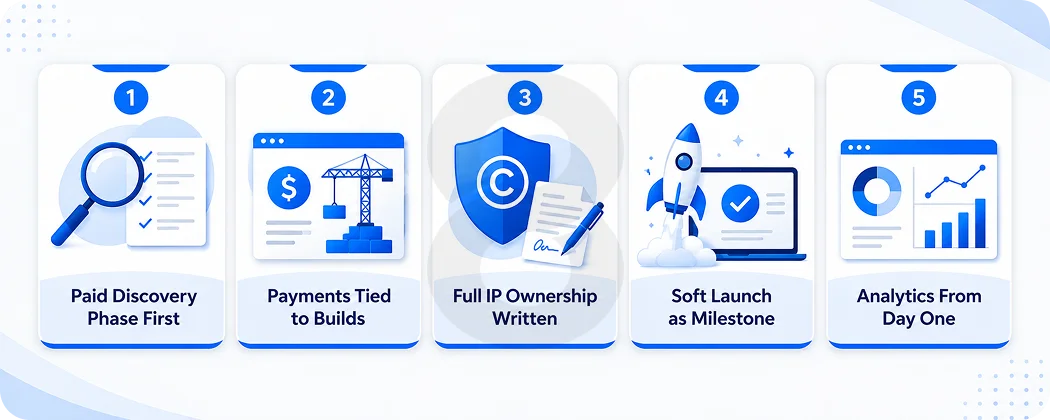
Once you’ve picked a studio, the contract determines whether the relationship survives month six. This applies whether you’re handing over the full build or using staff augmentation to slot external developers into your own team.
Start with a paid discovery or vertical slice
A 6 to 10 week paid prototype of the core loop tells you more about a studio than any proposal. And at the end of it you’re holding an actual build, something you can hand to twenty testers and watch, instead of a slide deck telling you what the game will eventually feel like.
Milestone-based payments tied to playable builds
Not documents or asset packs. Playable builds you can put in front of testers. Monthly builds are reasonable; quarterly is too slow to catch drift.
IP ownership in writing
You should own the source code, art assets, and design documents, full stop. Watch for clauses that license rather than transfer, and for third-party mobile SDKs or middleware baked in without disclosure, because those can complicate ownership and future porting.
Soft launch commitment
Release in one or two small markets first. Every serious strategy publisher does this, because a balance failure or a server meltdown in the Philippines costs almost nothing to fix compared to the same problem in a global launch.
Studios sometimes treat the soft launch as optional when timelines slip. Write it into the contract as a milestone so it can’t get quietly dropped.
Analytics from day one
Retention curves, session length, economy sink/source ratios, and conversion events should be instrumented in the first playable build. If a studio treats analytics as a post-launch add-on, they can’t do data-driven balancing, which means they can’t really do strategy games.
Exit and handover terms
Documented code, build pipeline access, and server credentials should transfer cleanly if the relationship ends. The best time to negotiate a breakup is before it can happen.
Read More: How Long Does it Take to Make a Video Game
Red Flags When Hiring a Strategy Game Development Company
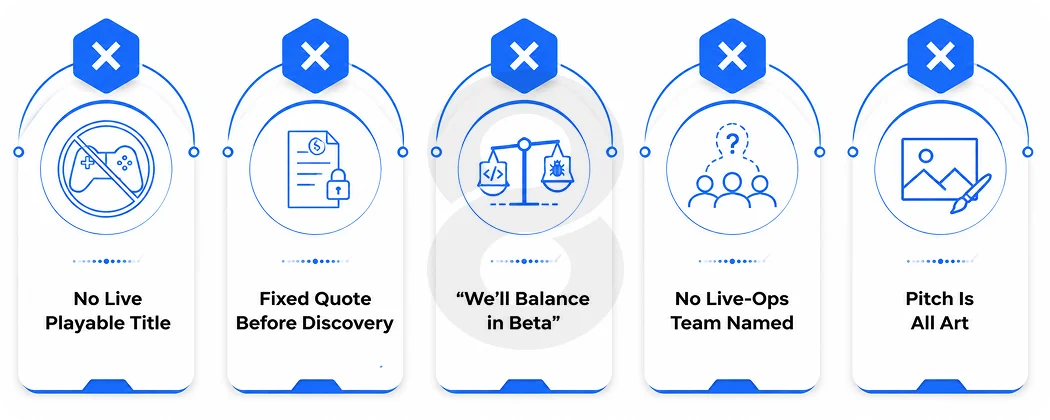
- No live strategy title you can play today: Everything else is theory.
- A fixed quote before a discovery phase: It means they’re either padding heavily or planning change orders.
- “We’ll balance it in beta”: Economy math comes first, always.
- No named live-ops plan or team: They’re quoting a launch, not a game.
- Reluctance to share client references: Two or three past clients on a call is a normal ask; dodging it isn’t.
- The whole pitch is art: Beautiful, dead games are the genre’s most common failure mode.
Read More: Ideas for Game Development: How Businesses Can Enter the Gaming Market
8ration’s Approach to Strategy Game Development
8ration is a custom software and game development company. On the gaming side, the work is mostly strategy and mid-core titles built for founders, IP holders, and companies stepping into games for the first time. Unity is the primary engine for cross-platform builds shipping to both iOS and Android.
The part that’s less visible from the outside, and honestly the part that matters most in this genre, is that the backend engineers are in-house. The people building the server infrastructure, matchmaking, and live-event systems sit on the same team as the people building the game itself.
Every project opens with a paid discovery phase, and that phase has to produce two things before full production gets a budget: a working economy model and a core-loop prototype you can actually play. If either falls apart at that stage, it falls apart cheaply. After launch, 8ration stays on through live-ops retainers, handling seasonal content, balance patches, and tuning driven by real player data.
Where a project needs supporting tools, admin dashboards or player-facing cross-platform companion apps, the same team builds those too. Ownership isn’t a negotiation, either. Code, assets, documentation, all of it belongs to the client from day one.