



Cross platform app development is the practice of building one application from a single codebase that runs on both iOS and Android. Instead of paying two teams to build and maintain two separate apps, you pay one team to build one.
Roughly a third of mobile developers now work with cross platform tools rather than native ones, according to Statista, and for most business apps it has quietly become the default choice rather than the budget compromise it used to be.
This guide covers what cross platform development actually is, when it makes sense and when it doesn’t, and what it costs.
What is Cross Platform App Development
Cross platform app development means writing your app’s code once and running it everywhere that matters, which for most businesses means iOS and Android. A framework like Flutter or React Native handles the translation. You give it one set of instructions and it produces apps that look and behave like they were built for each device from scratch.
The comparison everyone reaches for is native development, where each platform gets its own app in its own language. Swift on iOS, Kotlin on Android, two codebases, twice the invoices. There is also an older middle path. Hybrid app development wraps a web app inside a native shell, and it shows.
Hybrid apps tend to feel like a website doing an impression of an app. Cross platform tools used to carry the same cheap reputation, but modern frameworks compile to real native components, and for most apps the difference stopped being visible a while ago.
| Factors | Native | Hybrid | Cross-Platform |
|---|---|---|---|
| Codebases | Two | One (Web-Based) | One |
| Performance | Best Possible | Weakest | Near-Native for Most Apps |
| Cost | Highest | Lowest | Middle, Closer to Hybrid |
| Access to Device Features | Full | Limited | Full, Sometimes via Plugins |
| Maintenance | Two Apps to Update | One | One |
Why Businesses Choose Cross Platform App Development
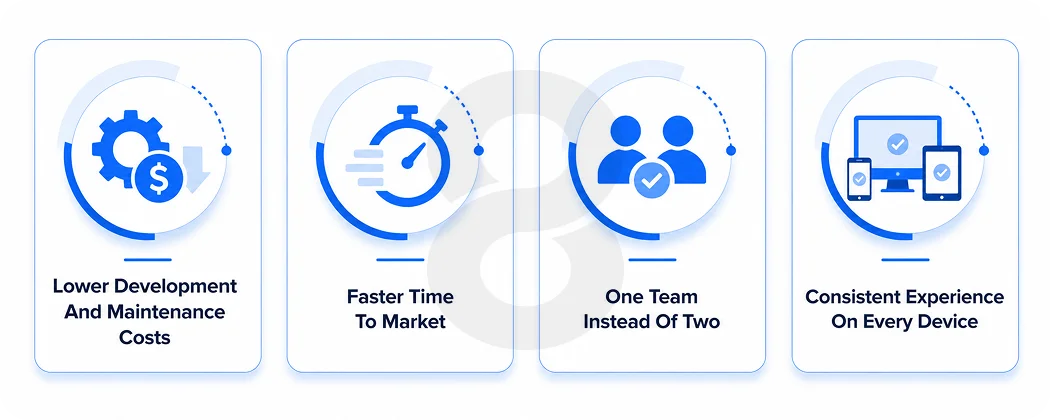
The short answer is money and speed, but it helps to see where those savings actually come from.
Lower development and maintenance costs
One codebase means one build to maintain and one bug backlog to work through. The initial quote is where everyone looks, but the real saving hides in year two and beyond. Every feature you add gets built once instead of twice and after a few years of releases that compounding quietly outgrows whatever you saved upfront.
Faster time to market
You launch on the App Store and Google Play on the same day. Ask any founder who watched a competitor own Android for six months while their own iOS-only app sat there. Speed to both stores wins arguments that no benchmark chart ever will.
One team instead of two
Hiring a Swift developer and a Kotlin developer, and keeping their work in sync, is a coordination problem that gets expensive fast. A cross platform team removes an entire category of “the iOS version does it differently” bugs because there is no separate iOS version.
Consistent experience on every device
Your users are split across both stores and always will be. The global mobile application market is expected to reach $626.39 billion by the end of this decade and none of that spend belongs to one platform. With a shared codebase the Android user and the iPhone user get the same product, and neither one waits an extra release cycle for a fix the other already has.
The Tradeoffs Nobody Mentions Upfront
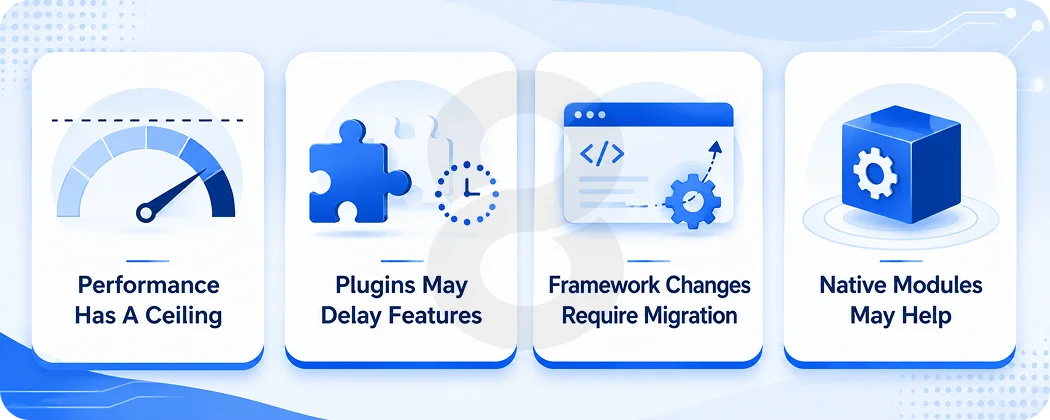
Most articles on this topic read like sales pages. Here is the part they leave out.
Performance has a ceiling
For standard business apps, the difference between cross platform and native performance is invisible to users. For 3D games, AR features, video editing, or anything doing heavy real-time computation, it is not. If your product roadmap points at that kind of work, budget for native modules or reconsider the approach entirely.
You depend on plugins for native features
When Apple or Google ships a new capability, native developers get it the same day. Cross platform teams wait for the framework or some community plugin to catch up. For mainstream features the wait is a few weeks at most. If your entire product hinges on a brand new sensor or API, a few weeks is an eternity.
Frameworks change under your feet
React Native rebuilt its entire architecture. Microsoft retired Xamarin and pushed everyone to .NET MAUI. Frameworks evolve fast, and major version migrations are real work that shows up in your maintenance budget.
Pick a framework with strong corporate backing and a large community and this risk stays manageable. Chase whatever was trendy on developer Twitter that month and you will probably be rewriting the app in three years.
Read More: How to Create an App: 8 Steps to Build an App
Best Cross Platform App Development Frameworks in 2026
Two frameworks account for most production apps being built today, with two more worth a look for specific situations. The 2025 Stack Overflow Developer Survey puts Flutter and React Native almost level, each used by roughly 14 percent of all developers, which is remarkable when you consider that figure includes every backend and web developer on earth.
Flutter
Google’s framework, using the Dart language. Flutter draws its own interface rather than borrowing native components, which gives it unusually consistent visuals and strong animation performance across devices.
Statista’s developer survey found 46 percent of cross platform developers use Flutter, making it the most used framework in the category. It is a strong fit for design-heavy consumer apps, and dedicated Flutter app development has become its own specialty for that reason. Google Ads and BMW’s connected car app are built with it.
Read More: Top 10 Flutter App Development Companies
React Native
Meta’s framework, built on JavaScript and React. Its biggest advantage has nothing to do with the technology. Millions of web developers already know React, so your existing web team can start shipping mobile screens without learning a new language, and hiring never becomes the bottleneck.
It renders real native UI components and runs large parts of Instagram, Shopify, and Discord. If you already employ React developers, picking anything else needs a very good reason.
Read More: Flutter vs React Native: Which Is Better for Business Apps in 2026?
Kotlin Multiplatform
JetBrains’ approach is different. Instead of sharing everything, you share business logic and write native interfaces for each platform. Teams that want native look and feel with less duplicated logic are adopting it steadily, and Google’s endorsement of it for Android gives it staying power. It suits companies with existing native teams more than companies starting from zero.
.NET MAUI
Microsoft’s successor to Xamarin, written in C#. Nobody picks MAUI out of passion. Enterprises pick it because their backend, their tooling, and half their engineers already live in the .NET world, and sharing code with those systems beats having a bigger mobile community.
Older frameworks like Ionic and NativeScript still earn their keep for teams with deep web roots or apps that mostly live inside webviews. New projects starting from zero almost always land on one of the four above.
| Framework | Language | Backed By | Best For |
|---|---|---|---|
| Flutter | Dart | Design-Heavy Consumer Apps & Brand Consistency | |
| React Native | JavaScript | Meta | Teams with React Talent & Fast Hiring |
| Kotlin Multiplatform | Kotlin | JetBrains & Google | Sharing Logic While Keeping Native UIs |
| .NET MAUI | C# | Microsoft | Microsoft-Stack Enterprises |
Cross Platform vs Native Development
This is the decision that actually matters, so here is the direct version. Choose cross platform when your app is built from standard components like feeds, forms, payments, chat, maps, and push notifications. Choose native when performance or deep hardware access is the product.
When cross platform is the right call
MVPs and first launches, where speed and budget decide whether the product exists at all. The same goes for consumer apps built on standard patterns, internal tools, marketplaces, and booking or content platforms.
In practice, that covers most apps businesses commission, including nearly everything in on-demand app development, where the entire product is a set of screens and a payment flow.
When native still wins
High-end mobile games, for a start. Native also earns its keep for intensive real-time work such as video processing, and for products built around new platform hardware, since dedicated iOS or Android app development gets you day-one access to new APIs.
Some regulated fintech products also lean native when security teams want the smallest possible dependency chain, though plenty of banking apps now ship cross platform without issue.
The middle ground
You do not have to pick a side and defend it forever. Plenty of production apps are cross platform with a handful of native modules bolted on where performance actually matters.
Camera-heavy features, Bluetooth integrations, and background processing often get this treatment. Good teams reach for it routinely instead of treating the decision as all or nothing.
Read More: Flutter App Development Cost in 2026: Complete Pricing Guide
How Much Does Cross Platform App Development Cost
Nobody can quote your app without knowing your feature list, and any article giving you one flat number is guessing. What can be said honestly is how the pricing works.
What actually drives the price
Feature complexity drives the price, full stop. A three-screen booking app and a marketplace with payments, chat, and an admin dashboard are different animals even in the same framework.
Then come the multipliers: backend work, third-party integrations, how ambitious the design is, and compliance if you are anywhere near healthcare or finance. The framework itself sits surprisingly far down the list, which surprises nearly everyone who asks for a quote.
Where the savings come from against native
You stop paying twice for the same feature. One implementation, one round of software testing, one pipeline to production, instead of duplicate versions of all three that you hope stay in sync. The saving continues after launch, because every update and fix also happens once. Over a multi-year product life, maintenance is where the gap with native gets widest.
Ways businesses keep the budget under control
Start with a genuinely minimal MVP and let real users decide what gets built next. Reuse standard components instead of designing every element from scratch. And resist scope creep during development, which inflates more budgets than any hourly rate ever has.
The Cross Platform App Development Process
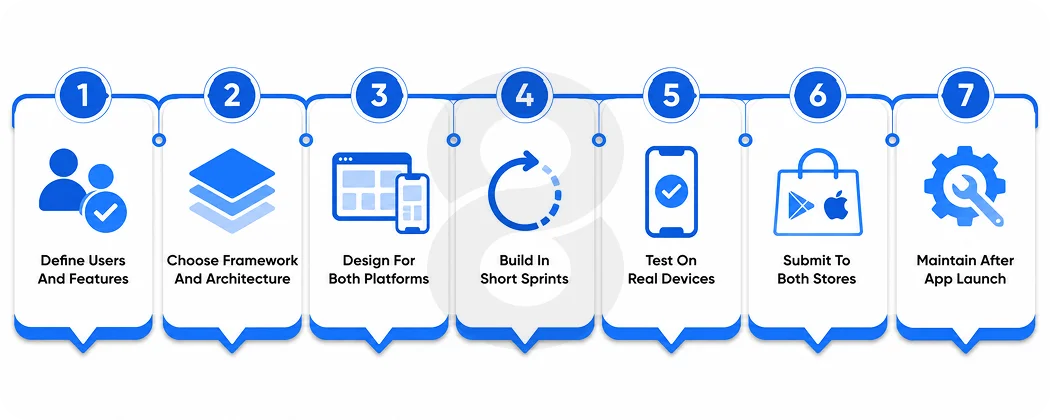
A competent agency will walk you through some version of these stages. If one skips the first step and jumps straight to quoting, be suspicious.
Discovery and planning
Defining who the app is for and which features actually belong in version one. This stage kills more bad projects than any other, which is exactly what it is for.
Framework and architecture decisions
Choosing the framework based on your feature list, your existing team’s skills, and your hiring plans. This is also where the team decides which parts, if any, need native modules.
UI and UX design
Designing screens that respect each platform’s conventions while keeping one visual identity. Cross platform does not mean identical. Good designers adapt navigation patterns so the app feels at home on both systems.
Development
Building in short sprints with working builds you can install and test throughout, rather than a long silence followed by a big reveal. Weekly builds are a reasonable thing to demand from any partner.
Testing on real devices
Simulators lie. An app that runs beautifully on a developer’s machine can stutter on a four-year-old budget Android, and that budget Android belongs to a paying customer. Real testing happens on physical devices, across screen sizes and OS versions, including the slow cheap ones nobody on the team actually owns.
Launch and store submission
Preparing both store listings, handling Apple’s review process, which rejects apps for reasons that occasionally border on the mystical, and shipping to both stores together.
Maintenance and updates
OS updates, framework updates, bug fixes, and new features. An app keeps needing work after launch, and that is normal. Any partner who does not raise post-launch support before you sign is telling you something.
Read More: Mobile App Development Process: From Idea to Launch
Examples of Successful Cross Platform Apps
The strongest argument for cross platform app development is who already uses it.
- Instagram runs large parts of its app on React Native, letting Meta ship features to both platforms from shared code at enormous scale.
- Google Ads is built with Flutter, which is worth noticing. Google trusts its own framework with the app that manages billions in advertising spend.
- Shopify moved its merchant apps to React Native and has been public about the productivity gains from sharing most of its code across platforms.
- BMW built its My BMW connected car app with Flutter, shipping one experience to drivers on both operating systems in markets around the world.
None of these companies lacks the money for native teams. They chose shared codebases because maintaining two versions of the same product is a bad deal even when you can afford it.
Read More: 10 Real-World Flutter App Examples That Will Inspire Your Next Build
How to Choose a Cross Platform App Development Partner
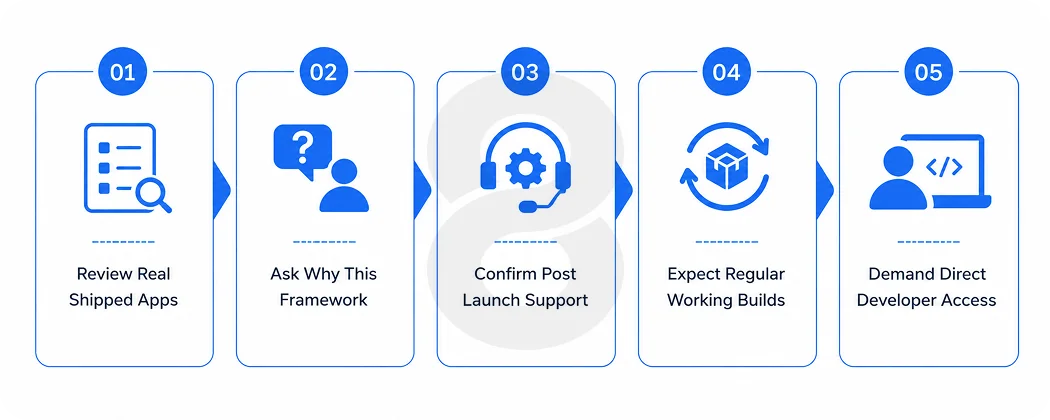
The framework matters less than the people using it. A few filters that separate serious teams from the rest.
Look at shipped apps, not slide decks. Ask for store links and download the apps yourself. Laggy scrolling and broken layouts on your own phone tell you more than any portfolio page.
Ask which framework they would pick for your project and why. A good partner reasons from your product and your hiring situation. A shop that gives the same answer to every client is selling what they have, not what you need.
Get post-launch support in writing. Pin down response times and update cadence, and ask what happens when a new OS version breaks something. The cheapest bid without a support plan is rarely the cheapest option by year two.
Check how they run mobile app development day to day. Weekly builds and direct access to the actual developers are good signs. If a team never pushes back on any of your ideas, some of which are bad, that is laziness dressed up as politeness.
Read More: How to Choose the Right Mobile App Development Company
How 8ration Approaches Cross Platform App Development
8ration’s cross platform app development is one of its core practices. The team works primarily in Flutter and React Native, alongside native iOS and Android when a project calls for it, which keeps framework recommendations grounded in what fits the product rather than what the bench happens to know.
Recent work spans consumer and business apps in travel, health tracking, ride sharing, marketplaces, and dating, most of them shipped to both stores from shared codebases.
Projects run through the discovery-first process described above, with working builds delivered throughout development and support continuing after launch. The same mobile team also handles adjacent work like wearable app development when a product extends beyond the phone.