


Every founder who grew up with a console eventually asks the same question. Can we build our own version of that game? Usually it is Mario. Swap out the character and setting, and the request is still the same one every time. Build a platformer that feels tight and responsive to move around in. After that, price it like a real product instead of a side project.
This guide breaks down what that actually takes. The version with real cost ranges, engine tradeoffs, and features that separate a platformer people finish from one they delete after level two.
None of this requires copying anyone’s characters, art, or level layouts, and it should not. What is worth studying is the genre’s mechanical DNA, the jump curve, the way levels teach without text, the pacing of difficulty across a world. Those are design patterns, not intellectual property, and they are what this guide focuses on.
What Makes a Mario Style Platformer Actually Work
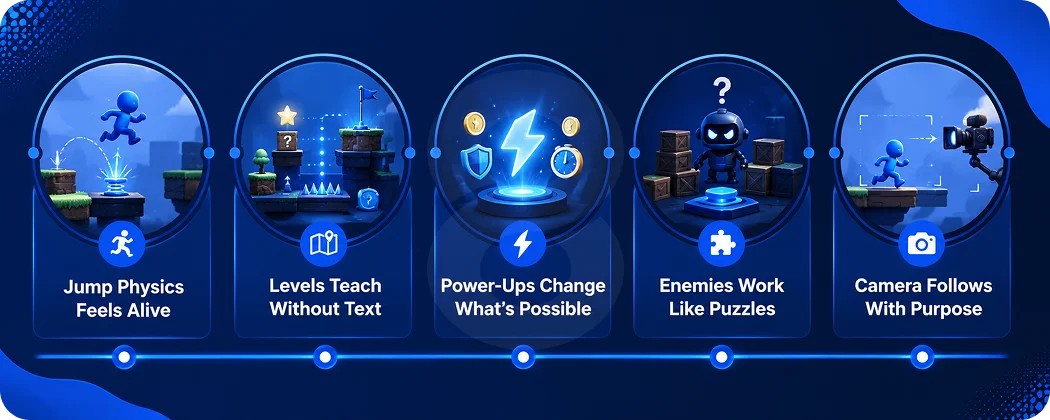
Most people who want to build a game like Mario start by describing the world. A jungle theme, a candy theme, a robot theme. That is the least important part. The games players compare you against nail four systems at the same time, and when a platformer skips one of them, players feel it even when the art looks great.
Precise jump physics and momentum
A good platformer jump changes height depending on how long the player holds the button. It gives the player a short grace period after they leave a ledge, so a late jump still registers. And the character accelerates into a run rather than snapping straight to top speed. None of that shows up in a pitch deck but it is the whole difference between a character that feels alive and one that just slides across the screen like a sprite on rails.
Level design that teaches through play
The first screen of a platformer should teach a mechanic without a tutorial popup. A single enemy placed where the player has to jump to avoid it teaches jumping. A gap that is slightly too wide for a standing jump teaches running starts. Good platformer levels are built backward from the lesson.
Power ups and progression systems
Power ups earn their place when they change what a player can do. A speed boost opens a gap that used to be too wide and double jump reaches a ledge that used to be out of range. Meanwhile, short window of invincibility gets a player past a hazard they could not survive before. Stack up numbers instead, more health, bigger damage, and none of that translates to this genre.
Enemy and hazard patterns
In this genre, enemies work more like puzzles than threats. A patrol route the player has to time. A hazard that punishes anyone who stands still. A jump that only clears if the player is already running. Enemy AI that reacts randomly to the player tends to feel unfair and it’s the last thing a platformer should feel like.
Camera and screen feel
A camera that snaps to the character’s exact position feels jittery the moment the player lands from a jump. Most platformers use a camera with a small dead zone, a region the character can move within before the camera reacts, plus a slight forward bias in the direction of travel so the player can see what is coming.
Screen shake, hit pause, and landing dust are small effects that add almost nothing to development time but do a disproportionate amount of work in making a jump feel physical instead of digital.
How Much Does it Cost to Build a Game Like Super Mario
Cost scales with scope. A team that wants “a full Mario style game” without defining how many worlds, how many enemy types, and which platforms, will get a quote that is either wildly low or wildly high because the estimator is guessing at the same things the client is.
| Build Type | Typical Cost Range | What You Get |
|---|---|---|
| Simple Prototype | $8,000 to $20,000 | One playable world, core jump mechanic, placeholder art, no save system |
| Small Polished Platformer | $25,000 to $60,000 | Full first world, 2 to 3 enemy types, original pixel art, basic level select |
| Full Mid-Size Release | $60,000 to $150,000 | Multiple worlds, boss fights, power-up system, sound design, save and checkpoint system |
| Multi-Platform Release | $150,000 and up | Console and PC ports, certification, controller support, localization, live ops |
Cost surveys of shipped indie titles put a simple 2D platformer at $20,000 to $50,000, and a more polished release with original art and audio somewhere between $50,000 and $150,000. Both ranges line up closely with the numbers above.
What drives the price up or down
- Art style is one of the biggest factors here. Hand drawn animation costs more than tile based pixel art, and a 3D character model runs roughly two to three times the price of an equivalent 2D sprite for the same cast size.
- Platform count. Every additional platform, mobile, PC, console, adds porting work, certification, and a separate QA pass.
- Level count. Each additional world is not just more art. It is more enemy variety, more music, and more QA hours to keep the difficulty curve consistent.
- Save systems and progression. Persistent saves, level select screens, and unlockable content all add engineering time that is easy to leave out of a first estimate.
In house team, freelancers, or a development studio
A solo developer or a two person team keeps cash cost lowest but stretches timeline to a year or more for anything beyond a small release, and both people are usually also holding down other work.
Freelancers hired individually, a contract programmer here, an artist there, cost more per hour but move faster, though someone still has to manage the handoffs between them, which is its own job.
A development studio bundles design, engineering, art, and QA under one project lead, which costs more upfront but removes the coordination overhead that sinks a lot of first time platformer projects somewhere in month four.
Which Game Engine Should You Use for a Platformer
For a Mario style game specifically, the engine decision is narrower than most comparison articles make it sound. This is 2D work, so the engines built for high end 3D rendering are not pulling their weight.
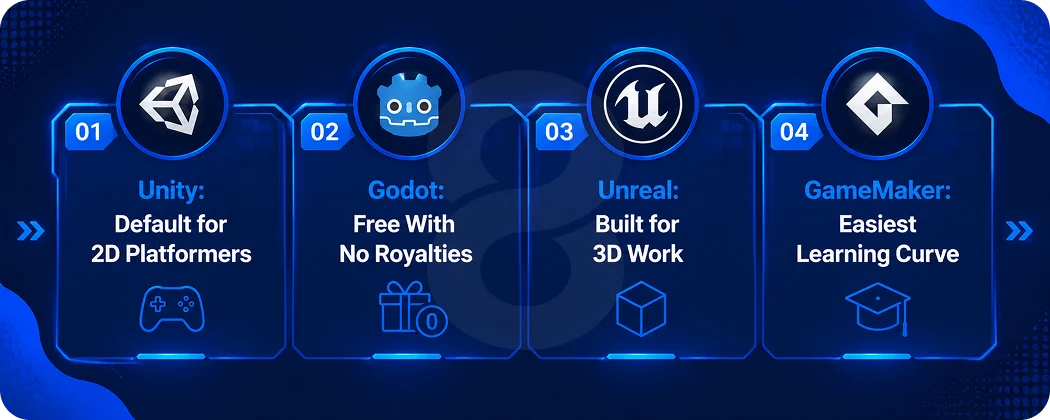
Unity remains the default for this genre because of its sprite tools, tilemap system, and mobile export pipeline. It is free for studios under a combined revenue and funding threshold, with paid tiers above that and no revenue royalty. Unity’s official pricing page has the current thresholds.
Godot is the free, open source alternative and has closed most of the gap with Unity for 2D specifically. There is no royalty at any revenue level, which matters if the game does well. Unreal Engine can do 2D through its Paper2D toolset, but most of its strength is in 3D rendering that a platformer does not need. It is free until $1 million in revenue, then a 5 percent royalty applies above that, according to Unreal Engine’s licensing terms.
GameMaker is worth a mention for teams that want the shallowest possible learning curve. It is built specifically for 2D and has shipped several well known platformers. Though its console publishing tier carries its own subscription cost and its scripting language does not transfer to other engines if the team later needs to move a project. For a studio planning more than one game, that portability question is usually what tips the decision toward Unity or Godot instead.
Read More: 9 Best Game Engines for Mobile Development
Choosing an Art Style for Your Platformer
Art style is a cost decision disguised as a creative one, and it should be locked before a single line of gameplay code depends on sprite dimensions.
Pixel art
The fastest and cheapest style to produce and iterate on, which is exactly why it dominates the genre outside of big budget releases. A single artist can produce a full character animation set in days rather than weeks, and revisions during the prototype phase, when the jump arc or hitbox size might still change, cost almost nothing to redo.
Hand drawn 2D
More expressive and harder to mistake for a template asset pack, but each animation frame takes meaningfully longer to produce and revisions during prototyping are more expensive. This style tends to fit better once movement is locked and the team is confident it will not need to redo animation sets.
3D characters on a 2D plane
Gives a more modern look and easier camera flexibility for cutscenes, at roughly two to three times the cost of an equivalent 2D character due to modeling, rigging, and animation work. This route only tends to make sense when the budget already assumes a longer production window.
Read More: How to Make a Video Game: Launch Your First Game
Core Features Every Mario Style Game Needs
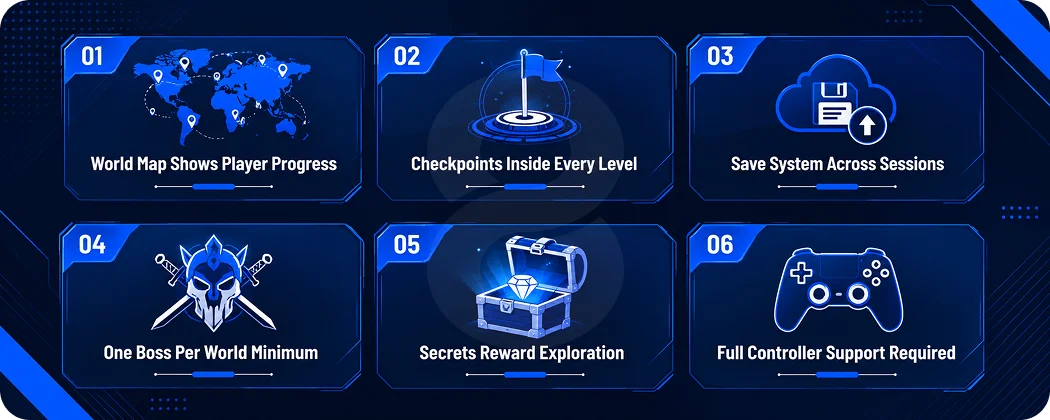
Beyond the moment to moment gameplay, players expect a set of surrounding features that are easy to underestimate during planning.
- A level select or world map screen so progress is visible
- Checkpoints within levels, not just at the start of each one
- A save system that persists across sessions on the target platform
- At least one boss encounter per world with a distinct pattern
- Secret areas or collectibles that reward exploration without being required to finish
- Full controller support if launching on PC or console, tested with actual hardware
None of these are optional in practice. Players raised on this genre notice their absence immediately, even if they cannot articulate what is missing.
Choosing Your Launch Platform
Platform choice changes the technical requirements of a game before a single level gets designed, so it is worth deciding early instead of treating it as a porting question to solve later.
Mobile
Touch controls need bigger hit zones than a physical button does, and the jump input has to forgive a slightly mistimed tap, since there is no physical click telling a player they pressed a beat too early or too late. Screen size variation across devices also means UI elements and camera framing need testing on more than one aspect ratio before launch.
PC
The most forgiving platform for a first release, since keyboard and controller support can ship separately and Steam’s review process is far lighter than console certification. Most indie platformers launch here first, partly for that reason and partly because this genre’s audience overlaps heavily with PC gamers who go looking for exactly this style of game.
Console
Adds a formal certification process on top of everything else, with its own checklist, timeline, and review fees that change depending on the platform holder. Controller input needs to meet the platform’s own responsiveness standards and certification failures usually mean a multi week delay to fix and resubmit rather than a quick patch.
Read More: What Are the Main Stages of Video Game Development
What the Development Timeline Looks Like
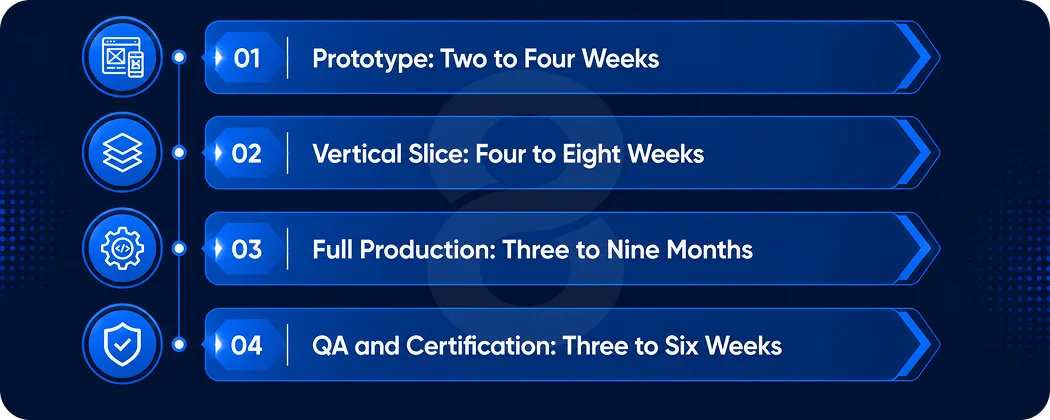
A realistic timeline separates into four phases, and skipping the first one is the most common reason platformer projects run over budget.
Prototype, two to four weeks
Core movement only. No final art, no full level. The goal is to confirm the jump and movement feel right before anyone spends time on assets built around them.
Vertical slice, four to eight weeks
One complete level with final art, one enemy type, and one power up, built end to end. This is what gets shown to investors or used to validate the art direction before scaling it across a full game.
Full production, three to nine months
Remaining levels, enemy variety, boss fights, audio, and the surrounding systems like save data and menus. Timeline length depends almost entirely on world count and platform count.
QA and certification, three to six weeks
Bug fixing, difficulty balancing, and if launching on console, the platform holder’s certification process, which has its own review timeline outside the team’s control.
Read More: How Long Does it Take to Make a Video Game
Common Mistakes When Building a Platformer Game
Locking the art style down before the movement feels right is the most expensive mistake on this list. Every physics tweak made after that point means reworking animation frames that were built around a jump arc that no longer exists. Teams that lock art early almost always end up either shipping a jump that feels slightly wrong or paying twice for the same animation set.
Building ten levels before confirming the core mechanic holds up for one is a close second. If the jump needs a fundamental change after level six is built, that change ripples through every level built before it, since level layouts are designed around specific jump distances and heights.
Treating difficulty as a single slider instead of a curve produces a game that is either too easy for the first three levels or unfair starting from level one. Difficulty in this genre needs to ramp per world and reset slightly at the start of each new world to reintroduce the player gently to a new mechanic.
Skipping controller testing until the final weeks is a scheduling mistake as much as a technical one. Input lag and dead zone issues that would take an afternoon to fix mid production can take days to trace once they are buried under months of additional code.
Underestimating QA time is specific to this genre. Precise movement games surface far more edge case bugs, getting stuck between two colliders, clipping through a moving platform, than turn based or menu driven games, and QA schedules copied from a different genre tend to run short.
Read More: Game Programming Patterns: A Detailed Guide
How to Monetize a Game Like Super Mario
Mobile gaming revenue worldwide is projected at roughly $134.22 billion in 2026, according to Statista’s mobile games market forecast, with average revenue per user near $61.65.
Separate research from Grand View Research projects the broader mobile gaming market growing past $256 billion by 2030, which is the kind of long runway that makes a well built platformer worth treating as a real product line rather than a one off release.
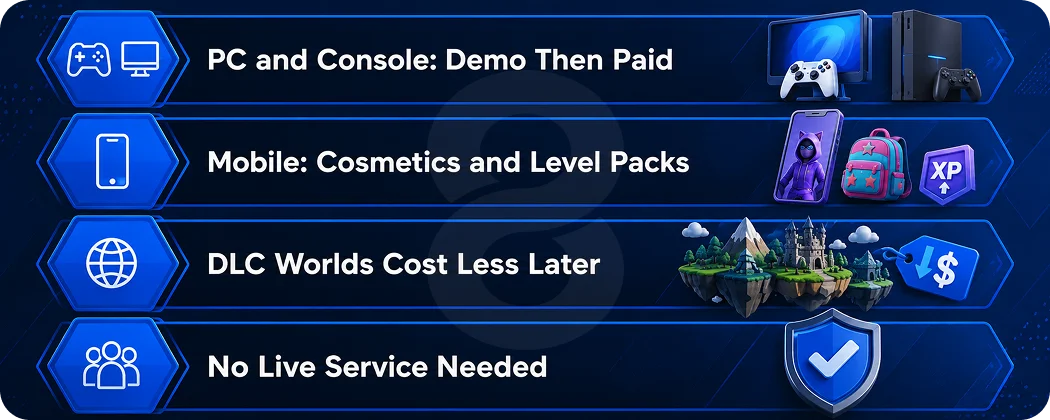
On PC and console, most indie platformers stick to a simple structure: a free demo covering the first world, then a paid unlock for everything after it. Mobile tends to go a different route, cosmetic purchases, level packs, maybe a small one time unlock, because ad interruptions are aggressive enough to wreck the precise timing this genre runs on.
Downloadable content, extra worlds, a new playable character, a harder difficulty mode, works well for this genre specifically because the core systems are already built. Adding a fourth world to an existing game costs a fraction of what the first three worlds cost, since the movement, enemy framework, and save system are already in place.
That makes platformers a reasonable candidate for ongoing revenue after launch, even without turning the game into a live service with daily logins and rotating shops, which tends to fight against what makes this genre appealing in the first place.
Read More: How to Hire the Best Game Development Team for Your Project
How 8ration Can Help You Build Your Platformer Game
8ration has built game projects across casual mobile titles and more mechanically demanding releases, and the platformer genre rewards exactly the kind of iteration heavy process a small dedicated team can run without layers of sign off slowing down a jump physics fix.
If you already have a concept, the game design and prototyping team can turn it into a testable build before any full art budget gets spent. If you are ready to scope the full project, the game development department has the team structure and process breakdown, and the cost calculator gives a starting estimate before the first call.