


Clutch lists over 3,300 companies in its gaming app developer directory, and most of them describe their process in near-identical language. This list narrows it to 11 studios worth shortlisting, with the details these roundups usually skip.
One thing to settle before the list. Searching for mobile game development companies returns two very different sets of results. Some are studios you can hire. Others are publishers like Tencent, Playrix, or Dream Games, which build their own titles and do not take client work. Everything below belongs to the first group.
The market these studios work in is larger than most people assume and harder to win in than it was five years ago. Newzoo put the global games market at $188.8 billion, with mobile accounting for $103 billion, or roughly 55 percent of all spending.
Sensor Tower’s data shows where the pressure is. Mobile game in-app purchase revenue grew about 1.3 percent to nearly $82 billion while game downloads fell. Fewer people are installing games. The ones who stay are spending more. That single shift should change what you look for in a development partner.
Quick Comparison of Top Mobile Game Development Companies
Company data below reflects public Clutch profiles as of July 2026. Rates and minimums are what each firm publishes, not quotes for a specific project.
| Company | Headquarters | Team Size | Hourly Rate | Min. Project | Best For |
|---|---|---|---|---|---|
| 8ration | New York, USA | Shared On Request | Shared On Request | Shared On Request | Games Needing Deep Backend And Economy Work |
| Stepico | Lviv, Ukraine | 50 To 249 | $25 To $49 | $10,000 | Studios Wanting A Games-Only Partner |
| Whimsy Games | Kyiv, Ukraine | 50 To 249 | $25 To $49 | $10,000 | Gamification And Retention-Led Builds |
| TekRevol | Houston, USA | 250 To 999 | $25 To $49 | $25,000 | US Delivery At Larger Team Scale |
| Galaxy4Games | Distributed | 10 To 49 | $25 To $49 | $5,000 | Small Full-Cycle Game Builds |
| Goji Labs | Los Angeles, USA | 50 To 249 | $100 To $149 | $25,000 | Premium US Product Engineering |
| X2 Labs | Cluj-Napoca, Romania | 10 To 49 | $50 To $99 | $75,000 | Funded Projects With Defined Scope |
| Apptunix | Mohali, India | 50 To 249 | $25 To $49 | $25,000 | Cost-Efficient Scale Across Genres |
| Tech Alchemy | London, UK | 50 To 249 | $25 To $49 | $25,000 | Web3 And Blockchain Gaming |
| CodigoDelSur | Montevideo, Uruguay | 50 To 249 | $25 To $49 | $5,000 | Nearshore Work In US Time Zones |
| ChopDawg.com | Philadelphia, USA | 10 To 49 | $50 To $99 | $1,000 | Early-Stage Concepts And Prototypes |
| Dotsquares | London, UK | 1,000 To 9,999 | $25 To $49 | $1,000 | Long Engagements With Large Bench Depth |
What a Mobile Game Development Company Does
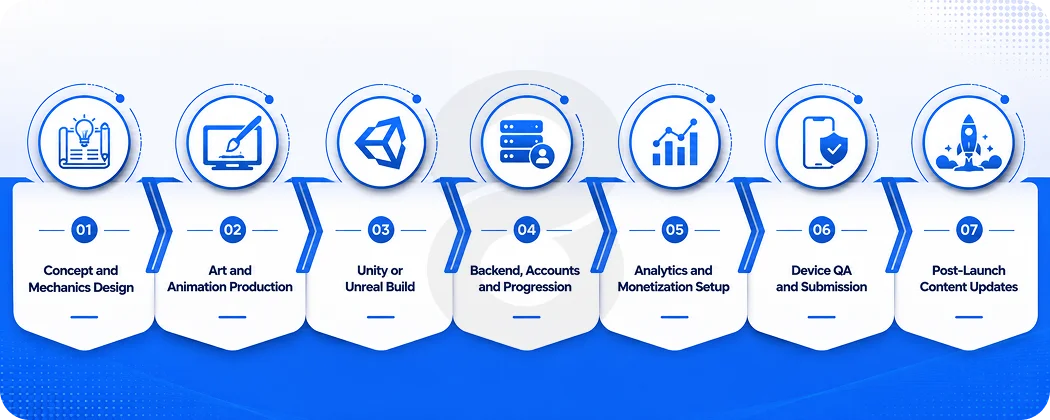
A mobile game development company builds games for iOS and Android under contract, for a client who keeps the IP. What sits inside that contract varies far more than the category name suggests.
Concept and game design are almost always included. Art and animation usually are, though a fair number of firms subcontract them to a separate studio and never say so. Engine implementation in Unity or Unreal gets advertised by everyone.
The field thins at backend and multiplayer, because gameplay engineers and server engineers are different hires and not every agency has made the second one. Thinner still at the far end. Device QA and store submission sit down there, and so does the update cadence that decides whether the game is still earning anything by March.
Worth settling in the first conversation rather than the fifth, because work a studio declines does not evaporate. It lands on you, usually about six weeks before launch.
Studios, publishers, and platform holders are not the same thing
A development studio builds your game and hands you the code. A publisher funds and markets games, usually in exchange for revenue share and often a slice of the IP. A platform holder runs the store. Confusing the first two costs founders real money, because pitching a build request to a publisher gets you a term sheet, and pitching a funding request to a studio gets you an hourly estimate. Know which one you are approaching.
What a full cycle engagement covers
Full cycle means the studio picks up your game design document and does not hand anything back until the build is live in both stores. The first milestone is a prototype of the core loop, art production follows and eats most of the schedule, and engine work runs alongside it in Unity or Unreal.
A backend holds accounts and save state. Analytics and monetization get wired in near the end, then device testing, then submission. Studios stop resembling each other after the build is approved.
Where studios differ most
Genre depth is the first, because someone who has balanced a match-3 economy before will not need three sprints to learn it. Backend capability is the second, since a studio with strong gameplay engineers and no server team will subcontract your multiplayer or talk you out of needing it. Whether they run live operations is the third, and it decides how your game behaves in month seven rather than week one.
How We Ranked These Mobile Game Development Companies
Every company here was pulled from Clutch’s mobile game developer listings and checked against five things: verified client review volume and how recent those reviews are, the share of the firm’s work classified as mobile game development, evidence of shipped titles rather than mockups, engine and backend depth, and whether the studio is realistically reachable for the budget it publishes.
The list spans regions on purpose. Four are US based, two are in Ukraine, two in the UK, and the rest sit in Romania, India, and Uruguay. Rates vary enough by region that limiting yourself to one market can double your budget for the same output.
It is also not a paid placement ranking, and it is not ordered by revenue. Ordering by revenue puts the largest agencies on top regardless of whether they are any good at games.
The 11 Top Mobile Game Development Companies Worldwide
Each entry below opens with five data points, then two paragraphs on what the studio is like to hire, then a line naming who should skip it. Read that last line first, because every agency will tell you what it is good at and almost none will tell you when to go somewhere else.
 8ration
Best for games that need real backend, economy, and blockchain engineering alongside the build.
- Headquarters: New York, USA
- Additional offices: Toronto, Dubai, Kuwait City, Karachi
- Certifications: ISO 9001, ISO 27001
- Engines and stack: Unity, Unreal, Godot, Photon, Nakama, Swift, Kotlin, Firebase, AWS
- Team size and rates: Shared on request
8ration builds mobile games alongside a full custom software practice, which is unusual in this category and matters more than it sounds. Most game studios are strong on gameplay and thin on servers.
8ration runs Unity and Unreal engine work next to backend teams that build fintech and blockchain systems, so multiplayer sync, in-game economies, and player data pipelines are handled by people who do that work every week rather than a subcontractor found mid-project.
The clearest example is Hayala, an Arabic social quiz game the team shipped on iOS and Android. The scoring is the unusual part. Points go to the funniest answer rather than the right one, which meant rebuilding the standard quiz loop from scratch instead of reskinning it. Real-time multiplayer sits on top of that, and the question bank runs to 1,000 items written with Arabic comedy creators and educators.
More than 100 beta players stress-tested the balance before release. Sessions now average over 45 minutes and 92 percent of players invite a friend inside their first week, which are retention and virality numbers rather than download numbers.
The other differentiator is coverage of newer game categories. Alongside standard iOS and Android builds, the team works on blockchain games for token and asset ownership systems, and AI driven games for adaptive difficulty and content generation. Few studios at this size credibly offer both.
Look elsewhere if you want a pure art outsourcing house or a publisher that will fund your title in exchange for revenue share.
 Stepico
Best for teams that want a partner doing nothing except mobile games.
- Headquarters: Lviv, Ukraine
- Team size: 50 to 249
- Hourly rate: $25 to $49
- Minimum project: $10,000
- Client rating: 5.0 on Clutch from 13 reviews
Stepico’s Clutch profile puts 100 percent of its focus on mobile game development. At 50 to 249 people that is close to unique, since most firms that size treat games as one line of business among six and staff accordingly. Prototyping and 3D art are the bulk of what clients hire them for.
They also handle blockchain integration and their own infrastructure, which is worth knowing if your title has an on-chain component and you would rather not manage two vendors. Completed work spans five countries, with Norwegian and Swiss clients sitting alongside the US ones.
The reviews are unusually consistent on one thing. Stepico adjusts scope as the project moves rather than holding you to the original statement of work, which is either the reason to hire them or a reason to write tighter change-order terms, depending on how you like to run projects. The one recurring complaint is slow ramp-up on unfamiliar technology. Raise your stack in the first call if it is anything unusual..
Look elsewhere if you need a US-based team for procurement or contracting reasons.
 Whimsy Games
Best for games where retention mechanics and gamification are the whole point.
- Headquarters: Kyiv, Ukraine
- Team size: 50 to 249
- Hourly rate: $25 to $49
- Minimum project: $10K
- Client rating: 5.0 on Clutch from 25 reviews
Whimsy Games is the second firm here running a 100 percent mobile game focus on Clutch, with 11 reviews covering game development specifically and all of them at 5.0.
Half their portfolio is not games at all. It is gamification built into other people’s products, which is a different skill from shipping a title and worth knowing before you brief them. AR and VR sit alongside as a second line.
One reviewer reported a 30 percent lift in player retention after a gamification build. Most Clutch reviews contain nothing that specific, so treat it as a single data point, though at least somebody had to go and measure it.
Project costs cluster in the $10K to $49K band. A funded MVP fits there.
 TekRevol
Best for US buyers who want a larger bench without US-premium rates.
- Headquarters: Houston, USA
- Team size: 250 to 999
- Hourly rate: $25 to $49
- Minimum project: $25,000
- Client rating: 4.8 on Clutch from 83 reviews
TekRevol lists 40 percent of its mobile focus as game development inside a much larger app practice, and has completed 56 US projects according to its Clutch profile. The team covers UI and UX, backend systems, and cloud multiplayer alongside standard app work.
The scale cuts both ways. You get availability, multiple time zones, and consulting support before production starts. You also get an agency where games are one line of business rather than the only one, so ask specifically which engineers will be on your project.
Look elsewhere if you want a boutique team where the founders are in your sprint reviews.
 Galaxy4Games
Best for small full-cycle builds where speed matters more than headcount.
- Headquarters: Distributed team
- Team size: 10 to 49
- Hourly rate: $25 to $49
- Minimum project: $5,000
- Client rating: 5.0 on Clutch from 3 reviews
Galaxy4Games classifies 80 percent of its focus as mobile game development and works on full-cycle production, meaning core mechanics, backend, database, and game logic under one team. One documented project was a music based educational game built from scratch for an educational video game company.
The review count is low, so treat the 5.0 rating as directional rather than proven. The $5K entry point suits a first playable or a scoped vertical slice.
Look elsewhere if you need a partner with a long verified track record or enterprise procurement credentials.
 Goji Labs
Best for well-funded US products where engineering quality outweighs cost.
- Headquarters: Los Angeles, USA
- Team size: 50 to 249
- Hourly rate: $100 to $149
- Minimum project: $25,000
- Client rating: 5.0 on Clutch from 85 reviews
Goji Labs is the most expensive firm on this list per hour and has the review volume to justify a look. Their Clutch profile shows 71 completed US projects and 28 mobile app development reviews, 27 of which are rated 5.0. Game development sits at 20 percent of their mobile focus.
Clients repeatedly cite schedule discipline. The recurring criticism is budget forecasting, so pin down change-order pricing in the contract rather than assuming it.
Look elsewhere if your total budget is under six figures, since the rate card will consume it quickly.
 X2 Labs
Best for funded projects with defined scope and a real production budget.
- Headquarters: Cluj-Napoca, Romania
- Team size: 10 to 49
- Hourly rate: $50 to $99
- Minimum project: $75,000
- Client rating: 5.0 on Clutch from 25 reviews
X2 Labs has the highest minimum project size on this list at $75K and lists 45 percent of its focus as mobile game development, with education titles as a second specialism. They publish fixed-price tiers on Clutch: roughly $13K for a proof of concept over three months, near $20K for a six-month MVP, and around $21K for a twelve-month full build.
That level of published transparency is rare here and shortens the budgeting conversation. Eleven of their completed projects were for US clients despite the Romanian base.
Look elsewhere if you are validating an idea and cannot commit past the $75,000 threshold.
 Apptunix
Best for broad genre coverage at the lower end of the rate scale.
- Headquarters: Mohali, India
- Team size: 50 to 249
- Hourly rate: $25 to $49
- Minimum project: $25,000
- Client rating: 4.5 on Clutch from 94 reviews
Apptunix lists 40 percent of its mobile focus as game development and has delivered projects in 19 countries, with 17 in the United States. The team covers native development and UI design in-house and works across social, education, and commerce categories alongside games.
The 4.5 rating is the lowest here, and the profile notes criticism of communication and timeline management on complex projects. Fair trade at this price band if you have a strong internal product owner.
Look elsewhere if you need the studio to run product decisions rather than execute against your spec.
 Tech Alchemy
Best for web3 games and titles with on-chain assets or token economies.
- Headquarters: London, UK
- Team size: 50 to 249
- Hourly rate: $25 to $49
- Minimum project: $25,000
- Client rating: 5.0 on Clutch from 33 reviews
Tech Alchemy splits its services across blockchain, mobile, and web work, with 20 percent of its mobile focus in games and a documented specialism in web3 gaming. Clients in the gaming sector specifically credited their understanding of web3 mechanics as the reason projects moved quickly.
Reviewers describe a team that avoids jargon and keeps non-technical founders in the loop, useful in a category where the tech outruns the business case.
Look elsewhere if your game has no blockchain component, since you would be paying for expertise you will not use.
 CodigoDelSur
Best for US companies that want overlapping working hours without US rates.
- Headquarters: Montevideo, Uruguay
- Team size: 50 to 249
- Hourly rate: $25 to $49
- Minimum project: $5,000
- Client rating: 4.8 on Clutch from 49 reviews
CodigoDelSur has completed 42 projects for US clients and operates in Central, Eastern, and Pacific time zones, which removes most of the async friction that offshore engagements create. Their single documented mobile game project sat in the $50K to $200K band and was rated 5.0.
Feedback mentions flexibility on scope changes and project managers who treat the product as their own. Some clients note rates run higher than other offshore options, though most concluded the output justified it.
Look elsewhere if you want a studio with a deep games-only portfolio rather than broad app experience.
 ChopDawg.com
Best for founders at the concept and prototype stage.
- Headquarters: Philadelphia, USA
- Team size: 10 to 49
- Hourly rate: $50 to $99
- Minimum project: $1,000
- Client rating: 4.8 on Clutch from 108 reviews
Three mobile game development reviews on Clutch, all 5.0, with average project cost landing between $50K and $200K. Worth noticing the gap between that and the $1,000 minimum on the profile of ChopDawg. A $1,000 minimum buys a conversation.
Small team, US based, and the pitch is aimed squarely at first-time founders. You are hiring someone to walk you through decisions you have not made before, which is a different service from executing a spec you have already written.
Reviewers keep coming back to the proposals and how precisely they set out timeline and deliverables, which tracks with that. Internal QA is the one thing clients said needed work.
Look elsewhere if you need a large team to run parallel production tracks on a live-service title.
What It Costs to Hire a Mobile Game Development Company
Published rates among the twelve studios above run from under $25 to $149 per hour, and stated minimum project sizes from $1,000 to $75,000. That range is real, not marketing noise, and most of it is explained by where the team sits and how senior the people on your project are.
Hourly rates and minimum project sizes by region
Rates below come from the public Clutch profiles of the companies in this list, checked in July 2026.
| Region | Published Hourly Rate | Typical Minimum Project | Example From This List |
|---|---|---|---|
| United States | $25 To $149 | $1,000 To $25,000 | Goji Labs, TekRevol, ChopDawg |
| United Kingdom | $25 To $49 | $1,000 To $25,000 | Dotsquares, Tech Alchemy |
| Eastern Europe | $25 To $99 | $10,000 To $75,000 | Stepico, Whimsy Games, X2 Labs |
| South Asia | $25 To $49 | $25,000 | Apptunix |
| Latin America | $25 To $49 | $5,000 | CodigoDelSur |
What studios publish as fixed price packages
A useful shortcut when comparing quotes is to look at what firms in this category publish as fixed-price tiers, since those numbers reflect what they can deliver profitably rather than what a salesperson hopes you will pay.
| Provider | Entry Tier | Mid Tier | Top Tier |
|---|---|---|---|
| Dotsquares | $1,000 MVP | $5,000 Scaling App | $10,000 Complex Build |
| X2 Labs | $13,240 Proof Of Concept | $19,933 Six-Month MVP | $20,813 Full Build |
| Emizen Tech | $8,000 Startup MVP | $30,000 Full-Featured App | $80,000 Enterprise Build |
| Infograins | $10,000 Basic MVP | $25,000 With Backend | $60,000 Enterprise Scale |
Clutch review data adds another layer. Reported average project cost for mobile game work ranges from under $10,000 at Apptunix, to the $10,000 to $49,000 band at Whimsy Games, to $50,000 to $199,999 at ChopDawg, Stepico, and CodigoDelSur. The same service, priced across a 20x spread, depending on complexity and who is doing it.
Read More: How Much Does It Cost to Make a Mobile Game?
Why the cheapest rate rarely produces the cheapest project
Hourly rate is one input into total cost. The others are how many revision cycles the studio’s process generates, how much rework happens when art was built without the technical constraints in hand, and how much of your own team’s time the engagement consumes. A $30 per hour team that needs three passes on every asset costs more than a $70 per hour team that gets it right in one.
Everything after launch is the cost people underestimate. Store submission, live operations, content updates, and the first balance changes based on real player data all sit outside a typical build quote. Get those priced before you sign.
How to Choose a Mobile Game Development Company
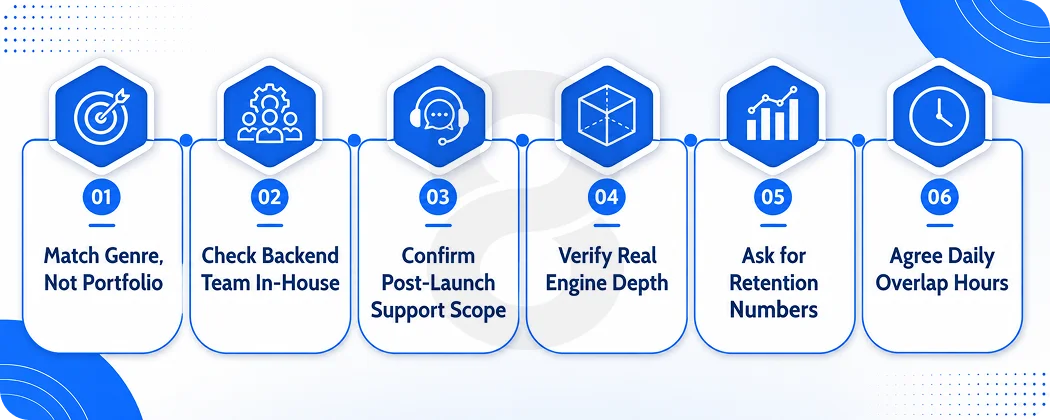
Most selection advice tells you to check the portfolio and read reviews, which is true and not very useful. These six checks separate studios that look similar on paper.
Match genre experience to your specific game
Four shipped puzzle titles beat forty mixed apps. By the fourth difficulty curve you already know where it breaks and roughly which week of playtesting it will break in. Ask which games in the portfolio sit closest to yours mechanically rather than visually, then ask what they got wrong on those projects.
The second question does most of the work. Studios that have genuinely shipped will have a list ready, because everyone who has launched a game carries one around.
Find out whether they build backends or only gameplay
Plenty of studios are excellent on the client and thin on the server. That is fine for a single player puzzle game. It stops being fine the moment your design doc mentions accounts, cloud saves, matchmaking, or anything resembling an in-app economy, because all of that is server work and none of it is what gameplay engineers do all day.
Ask who writes that code and whether they sit in the same building as the people writing the game. Subcontracted backends cause more slipped dates in mobile projects than any other single thing.
Ask what happens after the store approves your build
Sensor Tower data shows seventh day retention for top casual games sliding from early 2022 through late 2025. Players are harder to hold than they were three years ago, and the fix for that arrives in the updates. So ask what month three looks like.
Ask who is on the project then, what a content update costs, and how quickly the studio can change a number in the economy once live data says the number is wrong. A partner who goes quiet at submission leaves you tuning a system you did not design.
Verify engine depth against what your game needs
Unity suits most 2D and mid-complexity 3D mobile titles. Unreal makes sense when visual fidelity is the selling point. If a studio lists both plus four more engines and cannot say which one it would pick for your game and why, that list is marketing. Teams doing serious Unity work will have opinions about render pipelines and build sizes, not just logos.
Look at retention outcomes rather than download counts
Downloads are the easiest number to buy and the least informative. Ask for day-one, day-seven, and day-thirty retention on shipped titles, and average revenue per daily active user where the client allows it. Studios that track those numbers will answer quickly. Studios that do not will change the subject.
Confirm time zone overlap before you sign anything
Four hours of daily overlap is roughly the minimum for a project with real design iteration. CodigoDelSur operates across US time zones from Uruguay. Eastern European teams overlap comfortably with Europe and awkwardly with the US west coast. If you are building cross-platform apps with a distributed team, agree on a fixed daily window in writing.
Questions to Ask Before You Sign
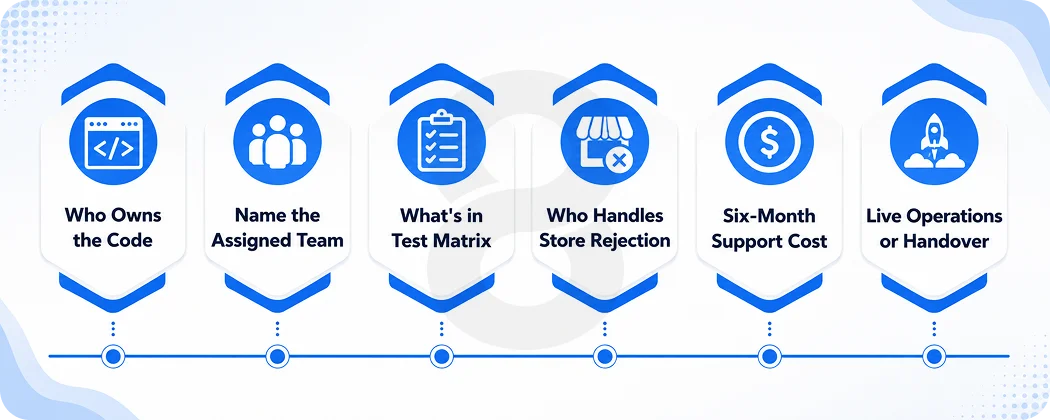
Send these to every studio on your shortlist. The answers will separate them faster than another round of portfolio review.
- Who owns the source code and game design document once the contract ends? Show me the clause.
- Name the engineers and artists on my project. What happens in month four if one of them leaves?
- What is in your test matrix? Device models and OS versions, please.
- If Apple rejects the build, who does the resubmission work?
- What does support cost in the first six months after launch?
- Can you run live operations, or does that land back on me at launch?
- Can you build and run live operations, or do you hand that back to me at launch?
- How do you price change requests once the scope is locked?
- If we part ways at any point, what does handover include and how long does it take?
Read More: 9 Best Game Engines for Mobile Development: Comprehensive Guide
Mistakes That Sink Mobile Game Projects
None of these are technical failures. They are scheduling and scoping decisions made in the first month, and every one of them gets more expensive to undo the further into the build you notice it.
Treating art and code as separate workstreams
Art produced without the technical constraints in hand gets rebuilt. Texture budgets, poly counts, and animation rigs need to be agreed before the artists start, otherwise you pay twice and lose weeks.
Budgeting for launch and not for month six
A mobile game that ships and then sits still will decay. Content updates, balance changes, and seasonal events are what keep a title earning, and none of that is in a build quote unless you ask for it.
Designing monetization last
Bolting an economy onto a finished game rarely works, because the pacing and difficulty curve were built without it. Sensor Tower’s data on rising in-app purchase revenue against flat downloads makes the point plainly: the money is in how well the game monetizes the players it keeps, and that has to be designed in from the start.
Read More: 10 Games Like Candy Crush to Inspire Your Next Mobile Game Project
Working with 8ration on Your Mobile Game
8ration builds mobile games for iOS and Android inside a company that also ships custom software for fintech and blockchain clients. That sounds like a footnote and is closer to the point: the server work most game studios hand to a subcontractor stays with people who are on the same payroll and in the same standup.
The mobile game development team takes projects from concept and mechanics design through to production in Unity or Unreal. Real-time multiplayer runs on Photon or Nakama depending on what the game needs. In-game economies are designed rather than bolted on at the end, and content updates keep going after launch, which is where most of the retention work happens anyway.
The clearest reference point is Hayala. The scoring system rewards creative answers over merely correct ones, which requires rebuilding the standard quiz-game loop from scratch.
The question bank was written with Arabic comedy creators and educators and balance-tested with over 100 beta players before release. After launch, sessions averaged more than 45 minutes and 92 percent of players invited at least one friend within their first week.
Beyond conventional builds, the team works on blockchain games for on-chain assets and token economies, and AI games for adaptive difficulty and generated content.