


Iterative AI is an approach to developing AI systems through repeated cycles of testing, feedback and targeted changes. A team starts with a working version, measures where it falls short and tests an improvement before releasing it. The cycle continues as the product and its users’ needs change.
For US businesses, the practical question is what happens after an AI feature goes live. Who investigates a wrong answer? Who checks whether an update actually helped? A useful development plan answers those questions before customers depend on the system.
More activity doesn’t automatically produce a better model. Each iteration needs evidence and a decision about what to keep.
What Is Iterative AI in Everyday Terms?
An iteration is one pass through a development cycle. The team identifies a problem, proposes a change and compares the result with the previous version. If the change passes the agreed checks, it can move toward release. If it doesn’t, the team investigates or rejects it.
In product development, iterative AI describes this working approach. It can apply to a prediction model, a document assistant or an AI feature inside a mobile app. It isn’t a particular model architecture or a guarantee of autonomous learning.
Planning AI application development around these cycles gives the project a way to handle uncertainty. The first version establishes what the system can do. Later versions should address specific shortcomings rather than add complexity without a clear purpose.
There are also iterations inside model training, where an algorithm repeatedly updates its parameters. That technical process is narrower than the product lifecycle. A team can improve an AI app by correcting its source documents while leaving the underlying model unchanged.
Online learning is another distinct idea: a compatible model updates incrementally from new data. A deployed AI app doesn’t necessarily do that. Feedback can simply enter a review queue until someone decides how it should be used.
The AI Development Lifecycle for Iterative Improvements
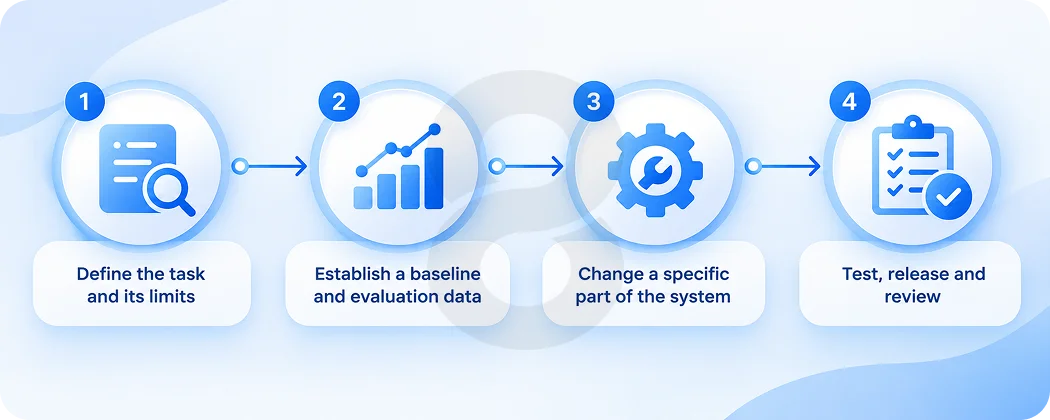
Start with a task small enough to evaluate. Then build a repeatable route from evidence to a release decision. The following sequence is a practical planning framework, not a fixed schedule every project must follow.
Define the task and its limits
Write down what the system should accomplish and what it should hand to a person. An internal assistant might locate an approved policy and explain it. Changing that policy or approving an exception would require separate authority.
A focused MVP development process can help keep the first release narrow. Ask for a usable workflow with a measurable result. An impressive demonstration is less useful if nobody can explain what counts as success.
Decide who will judge the output. A developer can check whether a response arrives correctly, but a subject specialist may need to determine whether its content is right.
Establish a baseline and evaluation data
The baseline is the result your next version must improve on. It might be an existing model, a simple rules-based process or the current manual workflow. Record its shortcomings before changing it.
Keep data used for development separate from data reserved for final testing. The scikit-learn guidance on data leakage explains how information leaking from test data into model development can produce overly optimistic performance estimates. A high score is misleading if the model had access to information it wouldn’t have in real use.
Include difficult examples as well as routine ones. For a document assistant, consider questions with conflicting sources, missing information and no valid answer. Decide how each should be handled before reviewing the model’s output.
Change a specific part of the system
Choose a change that follows from an observed failure. If the app retrieves an outdated document, investigate retrieval and document ownership. If the correct document is present but the answer ignores it, investigate the instructions and model behavior.
The work may belong in AI system integration rather than model training. A broken connection to current business data won’t be repaired by making the model larger.
Record the versions involved. Include the model identifier and any changed instructions or data sources. That record makes it possible to investigate why behavior changed later.
Test, release and review
Compare the candidate version with the baseline using the same criteria. Check whether the targeted error improved and whether previously acceptable behavior deteriorated. A regression is a new failure in something that worked before.
For changes that affect customers, consider a limited release with explicit stop conditions. Assign someone to review the outcome and retain a way to restore the previous configuration. The next cycle starts with what that release actually revealed.
Which Modules Can Improve Without Retraining?
Breaking an application into understandable modules helps a team choose where to intervene. A module is a component with a defined job, such as retrieving documents or checking whether a user may access them. The boundaries need to be clear even if the components run in one application.
The table below maps common problems to possible changes. These are diagnostic starting points, not promises that one change will solve every example.
| Module | Problem to investigate | Possible iterative improvement |
|---|---|---|
| Source data | Missing or outdated information | Correct records and identify an owner |
| Document retrieval | Relevant material isn’t found | Adjust indexing and relevance checks |
| Instructions | Answers use the wrong format | Clarify the requested output and test it |
| Model | Repeated task-specific errors | Compare alternatives or evaluate fine-tuning |
| App workflow | Users cannot recover from mistakes | Add correction and human handoff paths |
| Monitoring | Failures arrive without context | Record versions and useful error details |
Retrieval-augmented generation, or RAG, brings retrieved information into the generation process. Updating that information can change an answer without updating the model’s learned parameters. It still needs testing because finding a document and using it correctly are separate problems.
Consider fine-tuning an LLM when representative examples support a specific training objective. Fine-tuning updates a pretrained model for a task or behavior. It should follow a diagnosis rather than become the default response to every incorrect answer.
Keep the surrounding application in view. A model change can affect the format another component expects. Modular design helps isolate work, but tests still need to cover how the pieces behave together.
How to Tell Whether an Update Is Better
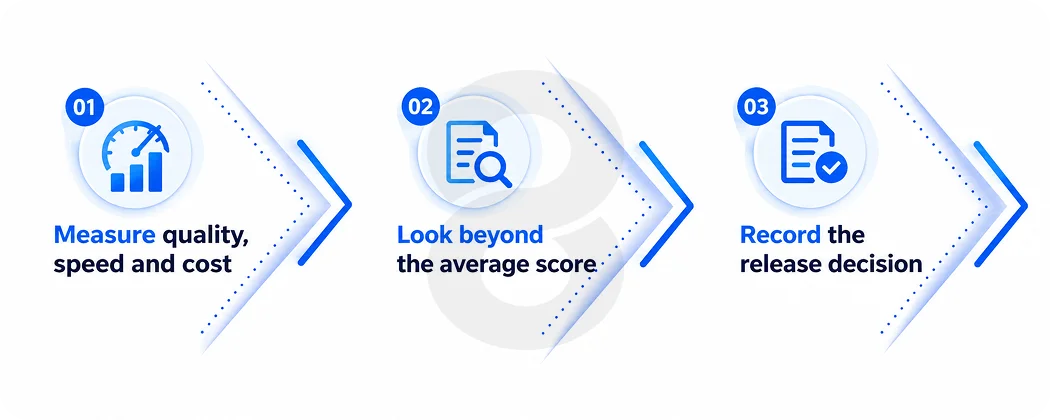
An update needs to solve a real problem without creating another. Agree on what success looks like before testing begins. That gives the team a clear basis for deciding whether the new version is ready for users.
Measure quality, speed and cost
Choose measurements that describe the task. For a prediction system, that may mean counting missed events and false alarms separately. For a document assistant, assess whether the answer is correct, supported by the source and useful for completing the request.
Production readiness extends beyond an isolated model score. Google’s research paper The ML Test Score examines testing and monitoring for production machine learning. Its broader lesson for a business owner is to ask how the whole system will be checked after deployment.
Track response time and cost alongside quality. An update that produces better answers but takes too long for the workflow may need further work. Define acceptable tradeoffs before the team starts comparing versions.
Look beyond the average score
Inspect important categories separately. A higher average score can hide worse results on a less common request. Review both the usual workload and the failures that would be costly to miss.
User ratings can help locate problems, but they aren’t a complete answer key. Someone may like a confident response that is factually wrong. Combine feedback with specialist review and observable task outcomes where those outcomes are available.
Record the release decision
Give each proposed release a short decision record: what changed, what was tested and why it was accepted or rejected. When evidence is weak, collecting better evaluation examples can be the next iteration.
Turning User Feedback Into Useful Changes
Feedback needs a route to the people who can act on it. Decide how users report a problem and what context the team needs to reproduce it. Avoid collecting sensitive content merely because it might be useful someday.
For AI chatbot development, separate complaints about incorrect facts from complaints about tone or an unsuccessful handoff. Those failures can look similar in a rating dashboard but require different fixes.
Ask reviewers to label the reason for a failure. A short category such as outdated source or unsupported answer is more useful than a long queue of thumbs-down reactions. Reviewers also need examples of what acceptable behavior looks like.
Asad Sheikh describes the importance of behavioral limits in 8ration’s published discussion of character chatbots:
Apply that discipline to feedback review. A complaint that the app refused a request doesn’t necessarily mean the refusal was wrong. Check the request against the product’s intended boundaries before changing its behavior.
Protect those boundaries when preparing new training examples. Review corrections for accuracy and permission to use them. Keep useful feedback from becoming an unfiltered source of mistakes in the next version.
AI App Development Options and Post-Launch Support
A business can buy an existing AI product, build around a hosted model or operate a model itself. None of those choices removes the need to evaluate the application. They change which parts of the system the business controls and who performs the ongoing work.
| Development option | What the business can typically change | Post-launch questions to settle |
|---|---|---|
| Configurable AI product | Settings and supported data connections | What evaluation and export tools are available? |
| Custom app with a hosted model | App workflow, instructions and integrations | Who tests provider updates and manages usage? |
| Custom app with a self-hosted model | Hosting and permitted model modifications | Who maintains infrastructure and release versions? |
| Incrementally updated model | Updates supported by the chosen algorithm | Who validates incoming data and detects regressions? |
Actual control depends on the product, license and contract. Confirm those details before selecting a route. More control can also mean more responsibility for the team operating the system.
Separate incident response from planned iterative improvements in the software maintenance and support agreement. Restoring a failed integration is different work from evaluating a new model. A contract should explain whether both are included and how each is prioritized.
Ask who owns the test set, source code and release history. Specify how urgent incidents reach the responsible person and what the handover includes if the development relationship ends. These details determine whether another team can continue improving the product.
Budgeting for Continuous AI Improvement
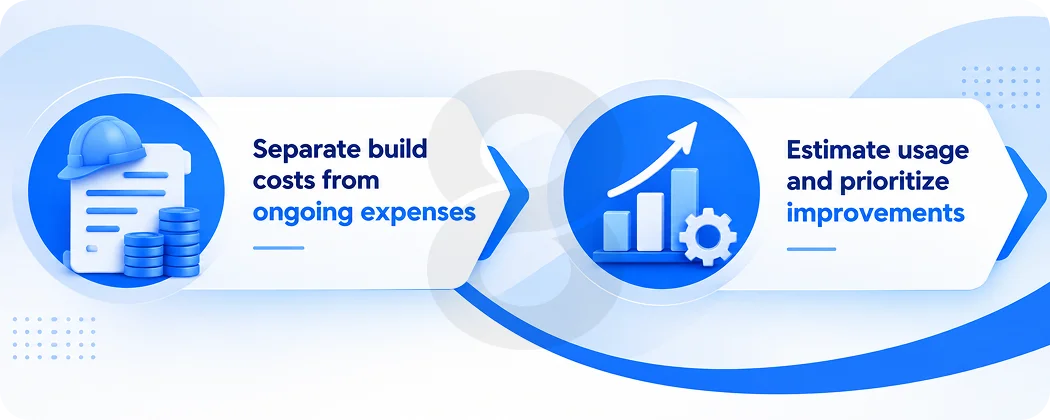
The launch budget is only part of the picture. Keeping an AI application useful also takes time and resources after release. A practical budget connects those ongoing expenses to the work the team expects to do.
Separate build costs from ongoing expenses
Plan for the first build and the cost of operating it. The recurring budget may include model usage, hosting, data preparation and staff time for reviewing output. Training costs belong in the plan when training is actually part of the chosen approach.
Request estimates by activity. A monthly support amount is hard to assess unless it identifies the work covered, available engineering time and expenses billed separately. Ask whether evaluating a provider’s replacement model counts as maintenance or a new project.
Estimate usage and prioritize improvements
Use expected activity to discuss usage costs. Consider how often the app calls the model, whether requests need retries and how much information each request includes. A calculator can help frame the app build, but it cannot settle ongoing AI expenses without those assumptions.
Keep the improvement backlog selective. A proposed change should name the problem it addresses and the evidence needed to justify another release. Some ideas will be worth investigating without being worth shipping.
Mistakes That Make Iteration Less Reliable
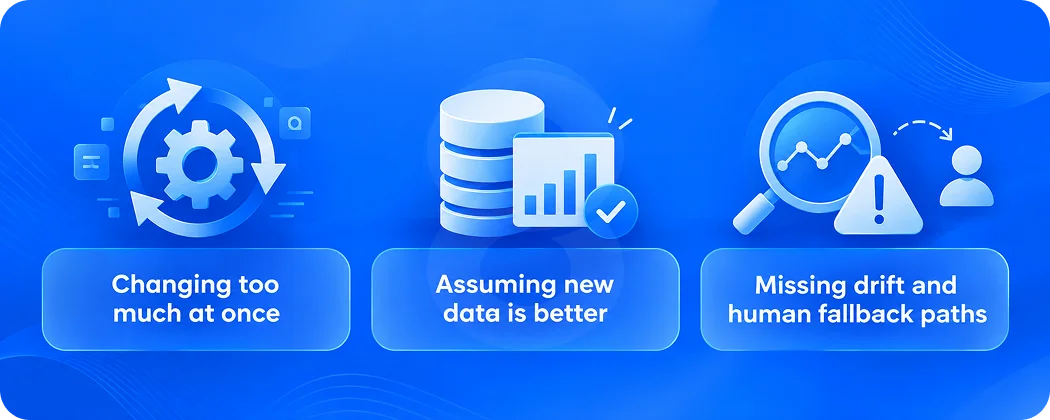
Repeated updates don’t guarantee steady progress. Teams need to understand what changed and why the results followed. Paying attention to a few common mistakes can make each round of testing more useful.
Changing too much at once
Changing several components at once makes a result harder to explain. If instructions, retrieval and the model all change in one release, the team may struggle to identify which change caused a new failure. Keep experiments focused where practical and document unavoidable dependencies.
Assuming new data is better
Another mistake is assuming that more recent data must be better. New records can contain errors or reflect a different workload. Check their quality and relevance before using them to update a model.
For US businesses, the NIST AI Risk Management Framework offers a voluntary structure for managing AI risks. Use risk review alongside performance testing rather than treating a higher score as the only release condition.
Missing drift and human fallback paths
Watch for changing inputs and outcomes after launch. Data drift describes changes in incoming data; concept drift describes changes in the relationship between inputs and the outcome being predicted. A drift alert should prompt investigation, not an automatic assumption that retraining will fix the problem.
Also define when the app should defer to a person. If the system cannot support an answer or complete an action within its permissions, the fallback should be part of the product design. Test that path as carefully as the successful one.
How 8ration Can Help Plan Iterative AI Work
8ration lists AI development, integration and ongoing maintenance among its services. A useful starting discussion should connect those services to a defined business task, the available data and the checks required before release.
An AI consulting engagement can address the choice between configuring an existing product and building a custom application. Request concrete outputs such as a prioritized scope, evaluation plan and ownership map for post-launch work.
The interface needs attention too. People should understand what the AI is doing, recognize when a result needs review and have a straightforward way to correct it. Include those requirements in the design brief.
When the feature lives on a phone, mobile app development must account for the complete interaction. Specify what users see while waiting and how the app handles a failed request. Put those behaviors into the acceptance criteria alongside answer quality.