


An AI demo can look convincing with a few carefully chosen examples. The harder question is whether it can handle your documents, fit your workflow, and produce results worth paying for.
AI POC development is the process of building a focused experiment to test whether an AI use case is technically feasible and potentially useful before committing to a larger implementation. It gives your team evidence about performance, data requirements, limitations, and operating costs.
That evidence should help you make a decision. You might move forward, narrow the scope, try a different approach, or stop before spending more.
This guide explains how to plan an AI proof of concept, estimate the work involved, and recognize when the results justify the next investment.
What Does an AI Proof of Concept Actually Prove?
An AI proof of concept examines the assumptions that could make or break a project.
For a document assistant, the question might be whether it can find and cite the right policy. For a forecasting tool, it might be whether predictions improve on an existing spreadsheet. For an automated workflow, it might be whether the system can complete a task without making unauthorized changes.
A useful POC should investigate four questions:
- Can the proposed approach perform the task?
- Is the available data sufficient?
- Does the result improve on the current process?
- Could the expected benefit justify further development and operation?
If those questions are still vague, AI consulting can help define the experiment before implementation begins.
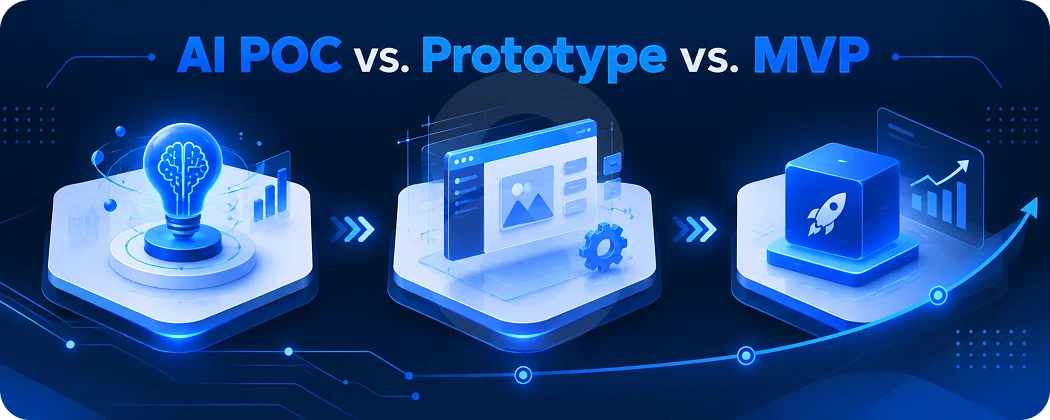
AI POC vs. Prototype vs. MVP
Teams sometimes use these terms interchangeably. For planning purposes, separating their goals helps prevent a short experiment from becoming an unfinished product.
| Stage | Main question | Expected output |
|---|---|---|
| AI POC | Can this approach work under defined conditions? | Tested implementation, results, and limitations |
| Prototype | How would someone interact with it? | A representation of the experience, which may include simulated functionality |
| MVP | Will users find value in a limited working product? | Usable software with a focused feature set |
| Pilot | How does it perform in a controlled operational setting? | Evidence from limited real-world use |
One project may combine these activities. The important part is agreeing on what the work must demonstrate before it starts.
Which Type of AI POC Do You Need?
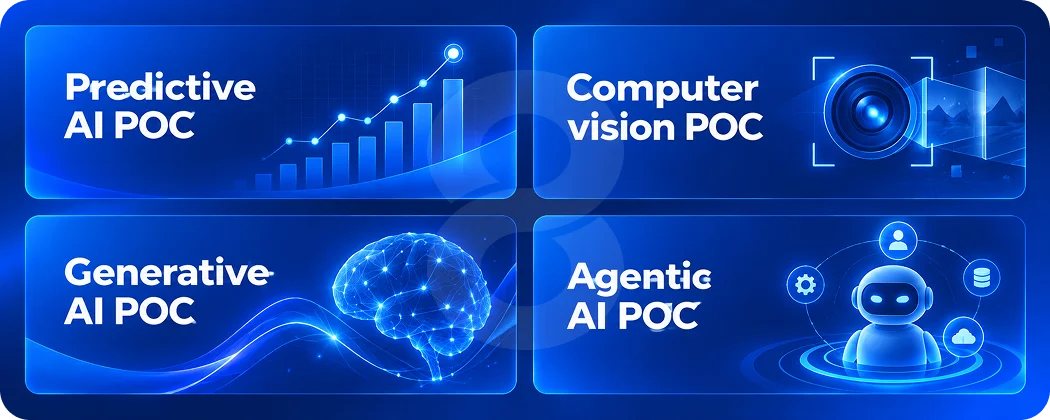
The business task should guide the technology choice. A prediction model, a document assistant, and an agent that updates business systems need different evaluation plans.
| Type | Example experiment | What to evaluate |
|---|---|---|
| Predictive AI POC | Forecast demand for a defined product group | Forecast error compared with the existing method |
| Computer vision POC | Identify a specific defect in product images | Missed defects, false alerts, and performance under different image conditions |
| Generative AI POC | Draft answers using approved support documents | Correctness, source support, usefulness, and review effort |
| Agentic AI POC | Gather information and prepare a system update for approval | Task completion, tool selection, permissions, and recovery from failures |
Generative AI POC: Test the Answer
A generative AI POC might summarize documents, draft responses, or extract information into a structured format.
For an internal knowledge assistant, retrieval-augmented generation, or RAG, can supply relevant documents to the model before it answers. The experiment should test both retrieval and the final response. Finding the wrong document and misreading the right document are different problems.
A generative AI development project should also test situations where the source material contains no answer. A confident response is not useful if the system has invented the missing information.
Agentic AI POC: Test the Actions
An agentic AI POC goes further by testing how a system chooses and uses tools across a task.
Consider an assistant that checks an order, finds the relevant policy, and prepares a replacement request. Each step introduces another opportunity for error.
Start with a restricted environment. Give the agent only the permissions it needs, require approval for consequential actions, and record which tools it calls. A persuasive explanation does not prove that it selected the right account or updated the correct record.
The AI POC Development Process
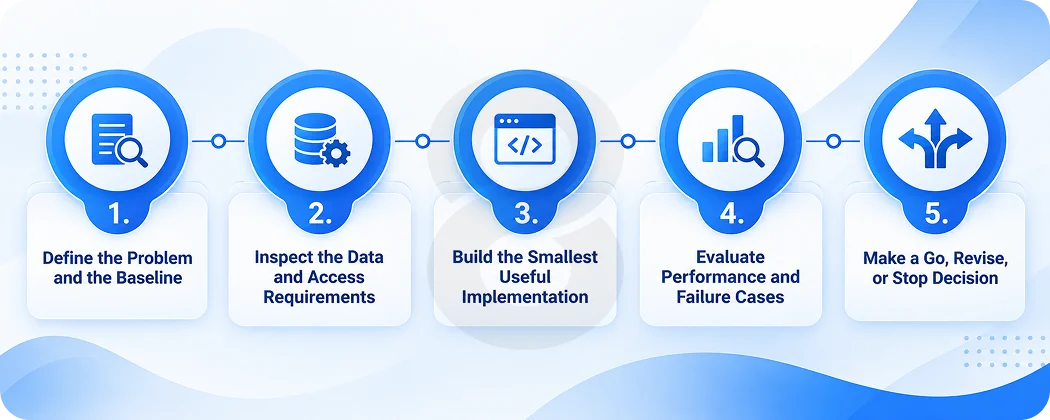
The process should make uncertainty smaller at each stage. Every activity needs to contribute to the final decision.
1. Define the Problem and the Baseline
Replace “we want to use AI in customer support” with a specific task.
For example:
Test whether an assistant can draft answers to common product questions using approved documentation, with less total handling time after human review.
Measure the current process first. How long does it take? Which mistakes occur? How often does someone need to escalate a question?
Also check whether ordinary workflow automation could solve the problem. A fixed rule or improved search function may be sufficient for a predictable task.
2. Inspect the Data and Access Requirements
Review the actual material the system would use. Check for missing information, conflicting versions, inconsistent formats, and access restrictions.
For document-based applications, ask who owns the content and how updates will reach the system. For predictive models, check whether historical records contain the inputs and outcomes needed for evaluation.
Keep a separate evaluation set that the team does not repeatedly use to tune the implementation. Otherwise, improvements can reflect familiarity with the test rather than better performance on new inputs.
3. Build the Smallest Useful Implementation
Build enough to test the core assumption. A simple interface or controlled script may be sufficient.
Depending on the task, this might involve an existing model, a basic retrieval pipeline, or a conventional machine learning baseline. Custom model training is not automatically necessary.
For language applications, LLM development decisions should follow the task requirements. Compare candidate approaches on the same examples before adding more infrastructure.
Document any shortcuts. A manually uploaded dataset or mocked system connection can be acceptable for a POC, provided everyone understands what remains untested.
4. Evaluate Performance and Failure Cases
Use a scorecard that reflects the workflow.
| Evaluation area | Question to answer |
|---|---|
| Task quality | Does the output meet the agreed standard? |
| Business usefulness | Does it reduce work after review and corrections? |
| Response time | Is it fast enough for the intended user? |
| Operating cost | What does an accepted result cost to produce? |
| Reliability | What happens when documents, tools, or services are unavailable? |
| Access control | Can the system expose information or perform actions outside its permissions? |
Microsoft’s evaluation guidance distinguishes measures such as groundedness and relevance for RAG applications from tool-call accuracy and task completion for agents. That supports a task-specific scorecard rather than one vague “accuracy” number.
5. Make a Go, Revise, or Stop Decision
Compare the results with the criteria agreed at the start.
Proceed when the evidence supports the next stage. Revise when a specific, testable change could resolve the shortfall. Stop when the approach cannot justify further spending under the current conditions.
The handover should include working code, setup instructions, evaluation results, known limitations, and a proposed next step.
How Much Does AI POC Development Cost?
AI POC development cost depends on engineering effort, data preparation, integrations, evaluation, and infrastructure.
A useful estimate starts with those components. A project using clean documents and one model API has a different budget from an agent that needs several system connections and detailed permission testing.
The table below shows illustrative planning scenarios, not market averages or 8ration quotes. Each assumes a blended delivery rate of $100 per hour, chosen solely to demonstrate the calculation.
| Illustrative scope | Total delivery hours | Labor at assumed rate | Assumed API and infrastructure costs | Example total |
|---|---|---|---|---|
| Focused classification or extraction experiment | 120–200 | $12,000–$20,000 | $500–$1,500 | $12,500–$21,500 |
| Document assistant with retrieval and evaluation | 200–400 | $20,000–$40,000 | $1,000–$3,000 | $21,000–$43,000 |
| Restricted agent workflow with tool integrations | 350–600 | $35,000–$60,000 | $2,000–$5,000 | $37,000–$65,000 |
These scenarios assume accessible data and a tightly defined scope. They exclude production rollout, ongoing support, major data remediation, specialist hardware, and additional licensing.
What Can Increase the Budget?
Data cleanup can become a substantial workstream if records are incomplete or documents disagree.
Connections to existing software also need attention. Authentication, undocumented interfaces, and test environments can take more effort than the initial AI implementation. Scope AI integration requirements before treating them as a minor addition.
Other cost drivers include specialist reviewers, custom labeling, repeated experiments, and security requirements. Identify these separately so you can see what is essential and what can wait.
Measure Cost per Useful Result
A low price per model request can hide an expensive workflow.
Include failed attempts, retries, retrieval, tool calls, and human review when estimating operating cost. If the output needs extensive correction, cheap generation may not produce savings.
For example, an answer that costs less to generate but takes longer to verify can be the worse option.
How Long Does an AI POC Take?
The timeline depends on scope and readiness. A focused experiment can be scheduled over several weeks, while unfamiliar data, multiple integrations, or complex agent behavior can extend the work.
The following is an illustrative six-week plan for a bounded document assistant with approved data access. It is not a delivery promise.
| Week | Main activity | Decision or deliverable |
|---|---|---|
| 1 | Define the use case, baseline, and success criteria | Agreed experiment scope |
| 2 | Prepare documents and evaluation examples | Usable dataset and initial test set |
| 3 | Build the first implementation | Working retrieval and response workflow |
| 4 | Test outputs and investigate failures | Initial evaluation report |
| 5 | Make targeted changes and retest | Comparison with the baseline |
| 6 | Review costs, limitations, and next steps | Go, revise, or stop recommendation |
Some activities can overlap. Others depend on access or decisions from your team.
Assign a business owner and an available reviewer before kickoff. A developer cannot resolve conflicting policy documents without someone who knows which policy is correct.
Benefits of AI POC Development
The immediate benefit is better evidence for a business decision. The eventual product may save time or improve service, but the POC must establish whether those outcomes are plausible.
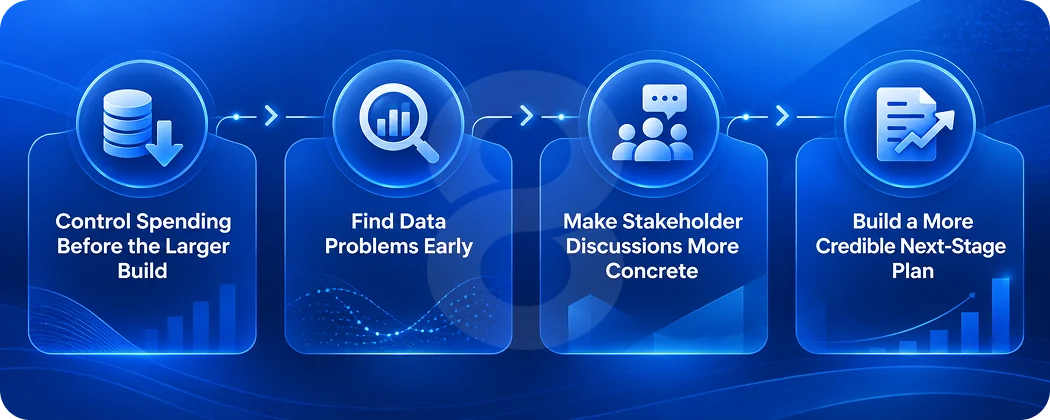
Control Spending Before the Larger Build
A limited experiment allows you to uncover weak assumptions before funding a complete application.
It can also show that a narrower feature would deliver most of the value. That finding can change the roadmap and reduce unnecessary work.
Find Data Problems Early
Missing labels, outdated documents, and inconsistent permissions are easier to address when the experiment is small.
The results can clarify whether you need better data management, a different model, or a simpler workflow.
Make Stakeholder Discussions More Concrete
A working demonstration becomes more persuasive when it includes measured results and visible limitations.
Instead of debating whether the technology seems promising, teams can discuss specific tradeoffs: review time, failure rates, integration effort, and operating cost.
Build a More Credible Next-Stage Plan
A POC exposes dependencies that a slide deck may miss.
Still, a successful experiment leaves production work ahead. Google’s MLOps guidance explains that operating an integrated ML system requires engineering beyond training a useful model, including testing, deployment, and monitoring.
AI POC Development Best Practices
A convincing demonstration should survive questions about how it was tested. These practices help keep the evidence useful.
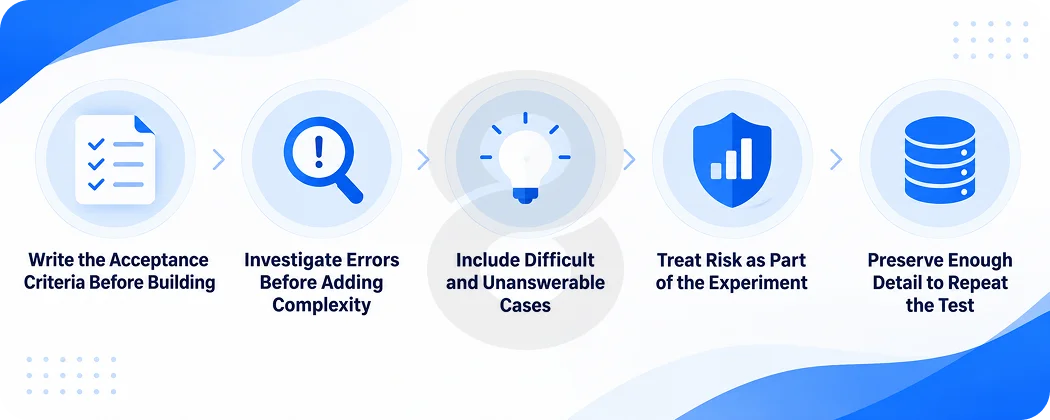
Write the Acceptance Criteria Before Building
Agree on the test cases, scoring method, budget limit, and decision date in advance.
Avoid changing the definition of success simply because the first implementation performs well on something easier to measure.
Investigate Errors Before Adding Complexity
When answers are weak, determine why. The problem could be retrieval, unclear instructions, missing information, or the model itself.
Consider LLM fine-tuning when the evaluation identifies a problem it is suited to address. It will not automatically fix outdated documents or incorrect permissions.
Include Difficult and Unanswerable Cases
Test incomplete requests, conflicting records, missing sources, and unavailable tools.
For agents, include attempts to trigger actions outside their scope. Check whether the system stops, asks for clarification, or safely escalates.
Record failures alongside successful examples so reviewers see the full picture.
Treat Risk as Part of the Experiment
Decide what information the system can access, which outputs require review, and who can approve actions.
NIST’s AI Risk Management Framework provides a voluntary approach to incorporating trustworthiness considerations into AI design, development, use, and evaluation. It is a useful reference for structuring these discussions.
Preserve Enough Detail to Repeat the Test
Record model versions, prompts, data versions, settings, and evaluation rules.
If a result changes, the team should be able to investigate what changed with it. Reproducibility also makes handover easier when a different team takes responsibility for the next stage.
What to Expect From AI POC Development Services
When comparing AI POC development services, ask what you will receive beyond a demo.
A clear proposal should identify:
- The business question and scope exclusions.
- Data access requirements and client responsibilities.
- The baseline, evaluation set, and success criteria.
- The implementation and integration boundaries.
- Code ownership, documentation, and third-party dependencies.
- Measured results and known limitations.
- An estimate of the work needed after the POC.
Useful AI POC solutions leave your team able to make an informed decision, including the decision to stop.
Give Your AI Idea a Clear Test
Start with the workflow you want to improve and the uncertainty holding you back. That might be answer quality, data readiness, response time, or whether an agent can complete a task within defined permissions.
8ration’s AI development services cover the broader path from planning and data preparation to integration and ongoing improvement. A focused POC can help establish what deserves to move along that path.
Bring your use case, sample inputs, and a description of the current process. Those details give the conversation somewhere practical to begin.