


WhatsApp had approximately 3 billion monthly active users as of early 2025, making it the most-used messaging platform on the planet. For businesses, that reach is a direct channel into conversations customers are already having every day.
WhatsApp chatbot development gives companies a way to run those conversations at scale. Whether the goal is automating customer support, qualifying inbound leads, or sending order confirmations, a well-built WhatsApp bot keeps the experience personal while reducing manual workload on teams. But getting there requires more than installing a plugin. It means making real decisions about features, architecture, integrations, and budget before writing a line of code.
This article walks through all of it: what a WhatsApp chatbot actually is, which features drive real business value, what the development process looks like in practice, which technology stack powers it, and what it costs to build.
What Is WhatsApp Chatbot Development?
A WhatsApp chatbot is an automated program that sends and receives messages inside a standard WhatsApp conversation. It connects to WhatsApp through Meta’s official WhatsApp Business API, processes incoming messages using programmed logic or an AI model, and returns responses in real time without human involvement.
WhatsApp bot development, as a technical project, means building a backend service that handles incoming webhooks from Meta, stores conversation state, routes messages through business logic, and connects to external systems like CRMs, inventory platforms, and payment gateways.
Three types of bots cover most production use cases:
Rule-based bots follow decision trees. A user selects from a menu and the bot responds based on predefined paths. These are fast to build and fully predictable, but limited to scenarios the developer mapped in advance.
NLP-powered bots use natural language processing to understand free-form user input. Frameworks like Dialogflow or Rasa analyze the user’s intent and extract key data before generating a response. These handle a wider range of queries but require training data and ongoing tuning.
AI agent bots combine large language models with tool-calling capabilities. The bot reasons about a query, retrieves information from external sources, and composes an accurate contextual response. This is where enterprise WhatsApp business development is heading in 2025 and beyond.
Why Businesses Invest in WhatsApp Bot Development
According to Statista, WhatsApp reached approximately 3 billion monthly active users by early 2025. It holds the top position among all global messaging apps. That user base spans more than 180 countries and covers markets where WhatsApp is the primary communication tool for both personal and professional use.
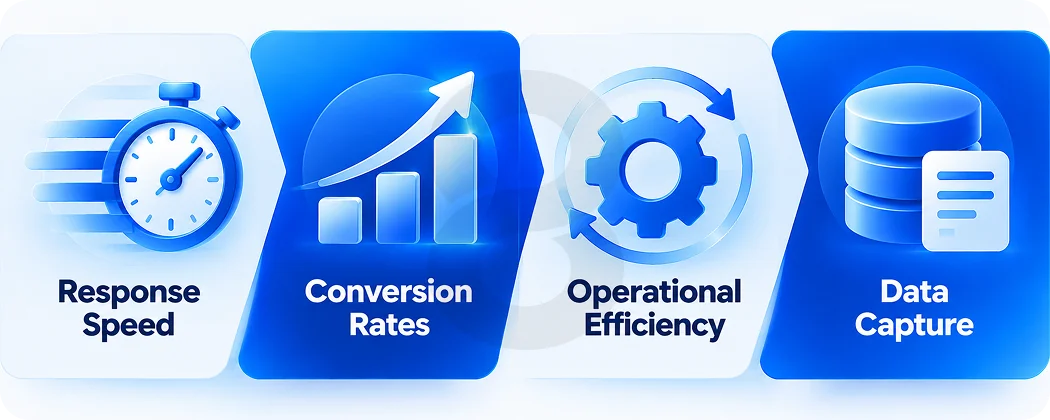
The business case for WhatsApp chatbot development comes from four directions.
Response Speed
A chatbot answers instantly, at 2 a.m. or on a holiday. Support teams working business hours leave gaps that cost leads and frustrate customers. A bot running 24/7 closes those gaps without adding headcount.
Conversion Rates
WhatsApp messages consistently see higher open rates than email campaigns. Customers engage with content on a platform they already trust and check multiple times a day.
Operational Efficiency
Repetitive queries like order status, appointment confirmation, and FAQ responses absorb support time without adding value. A bot handles those reliably, freeing agents to focus on queries that genuinely need a human.
Data Capture
Every conversation generates structured data: what users asked, where they dropped off, and what drove them to convert. That data feeds product and marketing decisions when the bot captures and forwards it correctly.
Core Features of a WhatsApp Chatbot
The features a business needs depend entirely on the use case. A support bot for an e-commerce store has different requirements than a lead qualification bot for a B2B product. These are the features that appear consistently across production WhatsApp bots built through the WhatsApp Business API.
| Feature | What It Does | Why It Matters |
|---|---|---|
| Automated FAQ responses | Answers common questions instantly without human involvement | Cuts support ticket volume and reduces wait time |
| Rich media messaging | Sends images, PDFs, videos, and location pins within the chat | Improves clarity for product support and order updates |
| Message scheduling | Queues messages to send at a set time or on a trigger event | Enables appointment reminders and follow-up campaigns |
| Human handoff | Transfers the conversation to a live agent when the bot cannot resolve the query | Prevents users from getting stuck in a dead end |
| CRM integration | Syncs conversation data with customer records in real time | Gives support and sales teams full context before they engage |
| Multilingual support | Detects the user’s language and responds accordingly | Serves diverse markets without building separate bots |
| Analytics and reporting | Tracks conversation volume, resolution rate, and drop-off points | Identifies where the bot is failing and what to fix |
| Payment collection | Allows users to complete a transaction within WhatsApp | Reduces checkout friction in commerce use cases |
Businesses that need conversational AI rather than scripted responses should look at 8ration’s AI chatbot development service. It covers the full scope from intent mapping to LLM integration and production deployment.
WhatsApp Chatbot Development Technology Stack
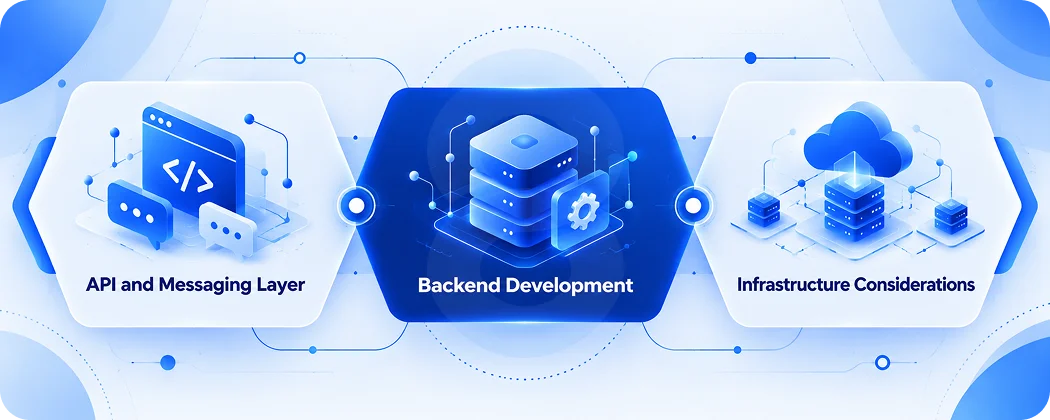
The technology stack for a WhatsApp bot breaks into four layers: the API layer, backend processing, AI and NLP, and infrastructure.
API and Messaging Layer
All production WhatsApp bots connect through Meta’s WhatsApp Business API, now available as the Cloud API. The API handles message delivery, read receipts, message status updates, and phone number management. Access requires a verified Meta Business account, a dedicated phone number, and either a direct Cloud API connection or approval through a Meta Business Solution Provider (BSP).
Backend Development
Node.js with Express.js is the most common choice for WhatsApp development. Its event-driven, non-blocking architecture handles the high volume of concurrent webhook events that a busy bot generates. This is where most WhatsApp development companies start.
Python with Flask or FastAPI works well when the bot requires heavy AI or machine learning components, since Python’s ecosystem for model integration is more mature.
PHP appears in legacy systems and simpler integrations but is less common in new builds.
| Layer | Primary Option | Common Alternative |
|---|---|---|
| Backend language | Node.js (Express.js) | Python (Flask / FastAPI) |
| Database | PostgreSQL or MongoDB | MySQL, Firestore |
| AI / NLP layer | OpenAI API (GPT-4o) or Dialogflow | Rasa, AWS Lex |
| Message queue | Redis | RabbitMQ |
| Hosting | AWS, Google Cloud Platform, Azure | DigitalOcean |
| Monitoring | Datadog, AWS CloudWatch | New Relic |
| Containerization | Docker + Kubernetes | Docker Compose (smaller builds) |
For the AI layer, 8ration’s generative AI development team builds and integrates LLMs that produce context-aware responses rather than canned replies. For businesses that want a fully autonomous bot capable of multi-step reasoning and tool use, 8ration’s agentic AI development services handle the architecture for those more complex systems.
Infrastructure Considerations
A WhatsApp bot in production must respond to Meta’s webhook delivery within a tight timeout window. Meta retries failed deliveries for a limited period, so an unreliable server means missed messages. Redis handles session state and queues between the webhook server and the processing layer. Docker and Kubernetes allow horizontal scaling when conversation volume spikes.
The WhatsApp Chatbot Development Process
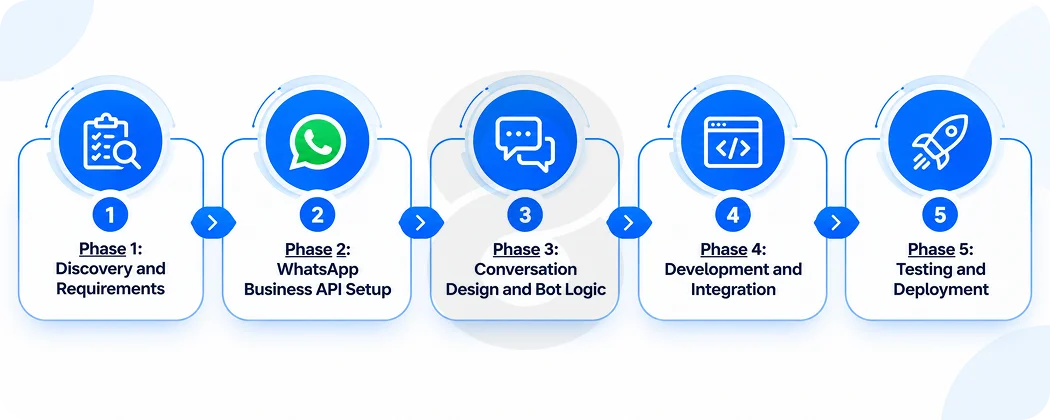
A production-ready WhatsApp bot moves through five phases from first decision to live deployment.
Phase 1: Discovery and Requirements
Define what the bot needs to do, who it serves, and which systems it must connect to. Map the conversation flows before writing any code. Vague requirements at this stage produce bots that fail on edge cases and require expensive rebuilds later.
Phase 2: WhatsApp Business API Setup
Register a Meta Business account and apply for WhatsApp Business API access. This includes phone number verification, business identity verification, and approval from Meta. The process typically takes two to five business days. Starting it early prevents it from becoming a bottleneck during development.
Phase 3: Conversation Design and Bot Logic
Design the conversation flows using decision trees or intent maps, depending on whether the bot is rule-based or NLP-powered. This phase produces the dialogue design document that developers build against. For AI-powered bots, it also includes assembling training data and engineering the prompts that shape the LLM’s behavior.
Phase 4: Development and Integration
Build the webhook server, connect it to the WhatsApp API, and implement the bot logic. Integrate with external systems: CRMs, order management platforms, databases, or payment gateways. This is the most time-intensive phase. Integration depth is the single biggest driver of development cost. 8ration’s system integration practice covers the CRM and backend connections most WhatsApp bots require.
Phase 5: Testing and Deployment
Test conversation flows end to end, including edge cases and failure scenarios. Verify webhook reliability under load. Deploy to a production environment with monitoring configured. After launch, review analytics and revise flows where users are dropping off or escalating to human agents unnecessarily.
WhatsApp Development Cost: A Realistic Breakdown
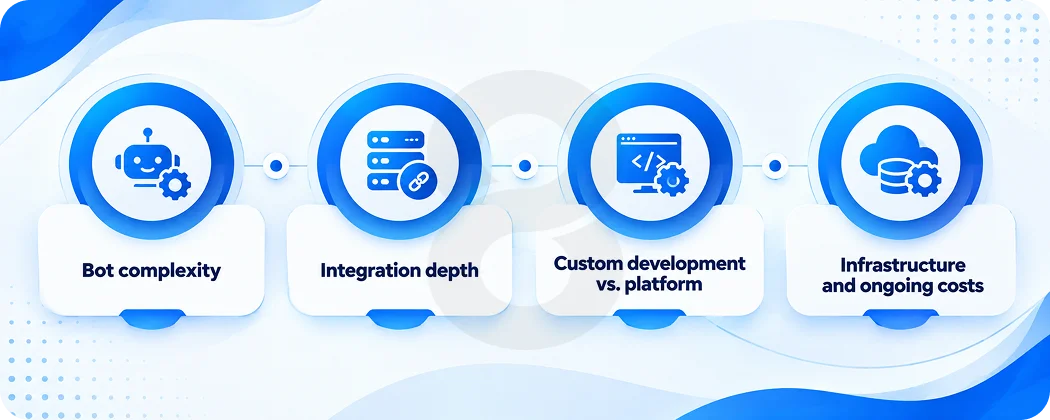
The cost of WhatsApp chatbot development has no single answer. The range is genuinely wide because the complexity of the work varies significantly depending on what the bot needs to do.
These are the primary cost drivers:
Bot complexity
Rule-based bots cost less because the logic is deterministic and requires less engineering time. AI-powered bots require model selection, prompt engineering, edge case testing, and ongoing refinement.
Integration depth
Each system the bot connects to adds development time. A bot that only sends static messages costs far less than one that queries an order database, updates a CRM record, and sends a payment link within the same conversation.
Custom development vs. platform
No-code platforms reduce build cost but limit customization and control. Custom development on the WhatsApp Cloud API takes more time upfront but gives the business full ownership of the system.
Infrastructure and ongoing costs
Meta charges per conversation, with pricing that varies by conversation type (service, marketing, utility, or authentication) and by country. Hosting, monitoring, and maintenance add to the monthly cost after launch.
| Bot Type | Estimated Build Cost | Estimated Monthly Cost |
|---|---|---|
| Basic rule-based bot | $5,000 to $15,000 | $100 to $500 |
| NLP-powered bot | $15,000 to $35,000 | $500 to $2,000 |
| AI agent with integrations | $35,000 to $80,000+ | $2,000 to $5,000+ |
| Enterprise custom build | $50,000 to $150,000+ | $5,000+ |
Build cost estimates reflect custom development. No-code platform builds start lower but trade flexibility for speed. Meta’s per-conversation pricing varies by country and message category.
For businesses exploring WhatsApp clone app development or building a messaging application with WhatsApp-like features from scratch, the scope extends well beyond a chatbot. That project involves building the messaging infrastructure itself and is a significantly larger engineering effort.
WhatsApp Chatbot Development with 8ration
8ration builds custom software products for startups and enterprises, with a practice area covering AI-powered applications, mobile apps, and backend systems. In the conversational AI space, the team has worked on chatbot architecture, LLM integration, and multi-platform messaging solutions across industries including e-commerce, healthcare, and logistics.
On WhatsApp projects, 8ration handles the full engagement: Meta API registration and setup, backend development, conversation design, CRM and third-party integrations, testing, and post-launch support. The team works with both Node.js and Python stacks and has experience connecting WhatsApp bots to platforms including Salesforce, HubSpot, Shopify, and custom backends built by the client.
For businesses evaluating whether to build directly on the WhatsApp Business API or through a third-party platform, 8ration’s software consulting team helps map the right approach given the use case, timeline, and budget before any development begins.
For businesses that also want to build native mobile applications alongside a WhatsApp integration, the team covers Android app development and iOS natively, or as a unified cross-platform build. The team treats WhatsApp message scheduling development, whatsapp business development, and standalone app builds as related capabilities that can be scoped independently or delivered together depending on what the project needs.