


A lot of businesses hear the word AI and instantly imagine something huge, advanced, and almost unreal in how much it can supposedly transform. They picture smart systems running operations, replacing repetitive work, making decisions, and somehow fixing every inefficiency without needing much support from the team. It sounds impressive, and honestly, it sells well in conversations too. But once companies start using these tools inside real workflows, things become much more practical very quickly. Most businesses are not struggling because they lack futuristic machine intelligence.
They are struggling because too many tasks are still manual, too many systems stay disconnected, and too much valuable time gets wasted on work that should have been simplified already. That is where the AGI vs AI conversation starts becoming useful. Because the real question is not which one sounds more advanced. The real question is which one actually helps people work better, faster, and with less friction every single day.
What AI Actually Means in Business Today
One of the biggest reasons this conversation gets confusing is that people keep using the word AI like it means one giant magical thing that somehow solves every business problem automatically. It does not work like that in reality. In business today, AI usually means systems designed to handle specific tasks efficiently, consistently, and at scale without needing the same manual effort every single time someone repeats that work. That is what businesses are actually using right now in useful ways.
Not machine consciousness. Not digital employees replacing entire companies and departments overnight. Just useful systems doing useful work inside practical workflows where efficiency, speed, and consistency actually matter every single day. These systems are already helping teams save time, reduce repetitive effort, and improve operations without creating unnecessary complexity around every simple process.
Here are some of the most common ways businesses use AI today:
- Customer support assistance
- Internal knowledge retrieval
- Smart search experiences
- Document summarization
- Repetitive task handling
- Lead qualification
- Content generation
- Recommendation systems
- Workflow routing
- Data classification
That may not sound dramatic enough for internet hype, but it is extremely valuable in real business environments where time, output, and team efficiency actually affect performance every single week. That usefulness matters much more than how futuristic it sounds in presentations. Because businesses do not usually win by buying the smartest-sounding technology available on paper. They win by using practical systems that remove friction from the work people are already doing every single day.
That is why current AI is already becoming valuable across operations, support, internal tools, and product workflows without needing a giant leap into machine reasoning first. This is where the AGI vs AI discussion needs to stay grounded in reality. Because if a business is still wasting time on repetitive admin, slow support, broken handoffs, and disconnected internal processes, then the real opportunity is not abstract intelligence. The real opportunity is execution that actually improves how work moves.
What AGI Actually Means
Now let’s talk about the thing people keep mentioning, like it is already sitting somewhere quietly running strategy, fixing operations, and solving business complexity without needing much guidance from actual humans. AGI stands for Artificial General Intelligence, and it refers to the idea of a machine that can reason, learn, adapt, and solve problems across many domains more like a human mind.
Not just one task or not one support function either. A much broader form of machine capability is what people are referring to here. In theory, that sounds incredible and extremely powerful for the future. In practice, it is still mostly a future-facing concept with a lot of speculation attached to it. That does not mean AGI is irrelevant or useless, but it definitely is not the thing most businesses should be structuring around today. That distinction matters more than people realize during planning.
Because once businesses hear “general intelligence,” they start imagining systems that independently manage operations, make strategic decisions, understand context across departments, and somehow replace large categories of human work very smoothly. Sounds powerful, sure, but real businesses are much more chaotic than those ideas usually account for. Most businesses are still dealing with broken process logic, unclear ownership, scattered knowledge, and inconsistent internal execution every single week.
Most businesses are still dealing with problems like these every week:
- Unclear processes
- Undocumented exceptions
- Scattered information
- Approval bottlenecks
- Outdated tools
- Inconsistent communication
So while AGI sounds like the ultimate answer, it is still not the practical answer for most businesses today. That is why the AGI vs AI discussion needs to stay connected to real business use.
Because businesses do not operate inside theory and imagination every day. They operate inside deadlines, pressure, broken systems, and teams trying to get work done properly.
Read More: How to Hire AI Developers in USA – A Strategic Approach in 2026
AGI vs AI: The Core Difference
If you strip away all the hype and dramatic language, the easiest way to understand AGI vs AI is this: AI is specialized, while AGI is generalized across many different contexts. AI is designed to do certain tasks well inside a clearly defined context and workflow. AGI would theoretically be able to reason across many different situations more broadly, flexibly, and independently over time. That difference may sound simple, but it changes everything about business automation.
AI is useful because it works inside a clearly defined lane where businesses need consistency. AGI sounds powerful because it aims to work across many lanes without needing constant task-specific design. While broader intelligence sounds better in theory, businesses do not always need broad intelligence to create value. Most of the time, they need systems that do one thing reliably and do it well. That is where current AI keeps winning in practical business settings today.
AI Usually Works Like This
- Built for support tasks
- Optimized for search or analysis
- Trained for a defined workflow
- Integrated into one operational area
AGI Would Theoretically Work Like This
- Broad reasoning across contexts
- More human-like adaptation
- Cross-functional problem solving
- Less dependence on narrow task design
And while AGI sounds more powerful in theory, businesses do not usually win because a tool sounds more impressive. They win because the tool solves something useful consistently without becoming another thing the team has to babysit constantly. That is why current AI keeps winning where it actually matters most. Because in business, reliability usually beats theoretical brilliance almost every single time. That is the point people keep missing in the AGI vs AI conversation.
Read More: 10 AI Hallucination Examples and Their Root Causes
Why AI Is Winning Business Automation Right Now
If the question is which technology is driving better business automation right now, the answer is AI very clearly, very practically, and honestly not even in a remotely close way.
Because AI is already being used inside real workflows every single day by teams that are not trying to be futuristic. They are simply trying to reduce wasted time and get useful work done faster. That is what makes it valuable in the first place. Businesses are already using AI to automate important parts of daily operations without needing to completely rebuild how everything works from the ground up.
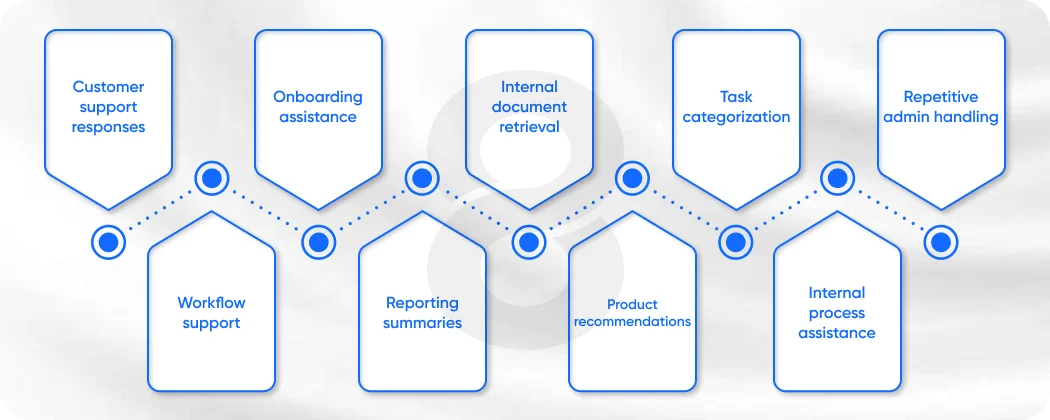
Here are some of the most common examples businesses are already using successfully:
- Customer support responses
- Onboarding assistance
- Internal document retrieval
- Task categorization
- Repetitive admin handling
- Workflow support
- Reporting summaries
- Product recommendations
- Internal process assistance
That matters because automation only becomes valuable when it actually fits into operations and improves work people are already doing every single day across different teams and departments.
And AI is already doing that across industries without needing some giant leap into general machine reasoning first. This is what makes the AGI vs AI conversation much less dramatic once you bring it back to business reality.
One technology is already reducing wasted time, helping teams move faster, and improving operational efficiency today. The other is still mostly a future concept with a lot of excitement attached to it.
And businesses should not build automation strategy around excitement or internet hype.
They should build it around usefulness that actually shows up in work.
Where AI Delivers the Most Business Value
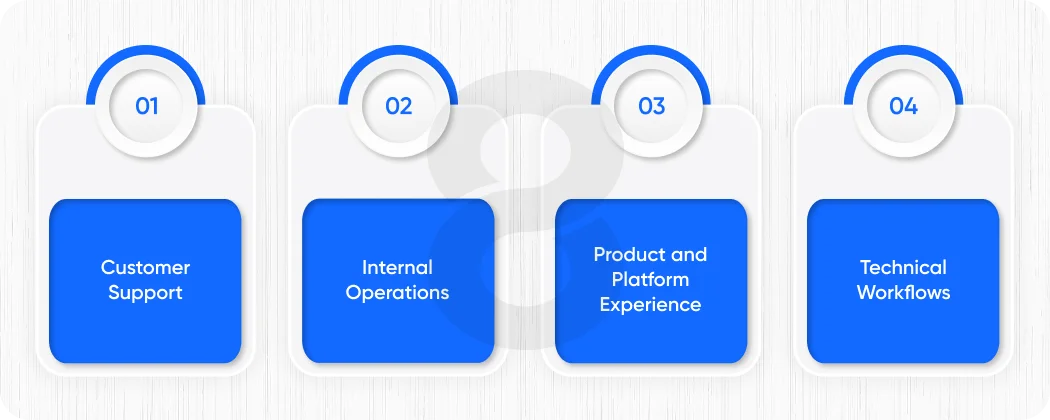
This is where the conversation becomes much more practical because a lot of people still think AI automation means one chatbot on a website and nothing much beyond that.
That is a very tiny part of the actual opportunity available today.
The real business value is much broader, much more useful, and much more operational than people usually expect once they start seeing it inside actual workflows.
1. Customer Support
Customer support teams deal with repetition constantly, and that repetition quietly drains time, patience, and team energy much faster than most businesses realize until it becomes painfully obvious.
Users ask similar questions every day, and handling all of them manually creates unnecessary pressure. That is where AI chatbot development becomes genuinely useful instead of just decorative on a website.
It can help with things like:
- Product questions
- Account help
- Order updates
- Feature guidance
- Basic troubleshooting
- Support routing
And when it is implemented properly, it does not feel robotic or unnatural to users. It simply feels faster, cleaner, and easier for both customers and support teams managing daily demand.
2. Internal Operations
This is where workflow automation starts creating serious business value because a lot of internal work is repetitive in the most exhausting and unnecessary ways across different teams.
It usually includes things like:
- Approvals
- Updates
- Task handoffs
- Reminders
- File movement
- Repetitive internal requests
AI helps reduce these bottlenecks by making repetitive processes move more smoothly without needing constant manual effort every single time something small needs to happen internally.
3. Product and Platform Experience
This is where AI integration becomes more strategic because it moves from being a support tool into becoming part of the actual user experience and product behavior.
Businesses are now embedding AI into areas like these:
- Search experiences
- Onboarding flows
- Smart prompts
- Recommendation layers
- User assistance systems
That does not just make products feel more modern to users. It makes them more useful in ways users actually notice and appreciate consistently.
4. Technical Workflows
AI is also quietly helping teams inside software development workflows by reducing repetitive effort and speeding up support-heavy technical tasks that usually consume time without adding much strategic value.
That often includes things like:
- Documentation support
- Coding assistance
- QA support
- Issue categorization
- Repetitive engineering tasks
And in some cases, it also supports mobile app development teams by improving testing, feature logic, internal product support, and workflow-related implementation tasks across product delivery cycles.
AGI vs AI Comparison
# |
Aspect |
AI |
AGI |
| 1 | Definition | Built for specific tasks and narrow business use cases | Designed to think, learn, and reason across many domains |
| 2 | Current Use in Business | Already used in operations, support, analytics, and automation | Mostly theoretical and not practically used in business today |
| 3 | Reliability | More predictable when trained and integrated properly | Still uncertain for real-world structured execution |
| 4 | Implementation | Easier to deploy into existing workflows and tools | Complex, unclear, and not ready for practical deployment |
| 5 | Cost Efficiency | More affordable and easier to scale for business needs | Likely expensive and resource-heavy if deployed later |
| 6 | Best For | Repetitive tasks, support, search, routing, and workflow optimization | Broad reasoning and future cross-domain decision-making |
| 7 | Business Value Today | High, measurable, and already useful | Low for now, mostly future potential |
| 8 | Control and Safety | Easier to monitor, test, and refine over time | Harder to control in unpredictable business environments |
| 9 | Adoption Readiness | Ready for use right now across many industries | Still not mature enough for most real business operations |
Stop Waiting for Future Tech and Start Fixing Real Work Today
If your business is serious about automation, efficiency, and actually improving how work gets done, then the smartest move is not waiting around for some perfect futuristic system. It is using the technology that already works, already fits, and already solves real problems inside real workflows. The businesses that move earlier usually gain the edge faster, because they are not chasing hype, they are building useful systems that actually help people work better every single day.
Conclusion
The conversation around automation gets exaggerated very quickly, and that usually pushes businesses toward the wrong priorities before they even understand what problem they are actually trying to solve. People start focusing too much on futuristic intelligence, giant breakthroughs, and who builds the smartest machine first. That sounds exciting, sure, but real business value rarely comes from the loudest or most dramatic technology. It usually comes from simpler things that improve work immediately.
It comes from reducing friction, helping teams move faster, making systems easier to use, and removing repetitive tasks people are already tired of doing manually every single week. That is why this comparison matters so much for actual businesses trying to invest wisely. The better answer is not always the more ambitious one.
It is usually the one already working in real operations today. Businesses do not win by waiting for perfect technology later. They win by using practical technology properly now, before everyone else catches up.