


The cost of a chatbot is classified into four categories based on project scope and complexity: Basic AI chatbot: $2,000 to $5,000; Simple AI chatbot: $5,000 – $25,000; Mid-level AI chatbot: $26,000 – $100,000+; Advanced AI chatbot: $150,000 – $1,000,000+.
Businesses are growing more reliant on artificial intelligence in creating interactions with their customers, and it is difficult to know the actual cost of AI chatbots. This answer is dependent on a thorough understanding of the issues of development, infrastructure, and maintenance to determine the extent to which it costs to develop an AI chatbot.
The global AI chatbot market is projected to expand significantly, reaching as much as $28.95 billion by 2029 with strong annual growth, reflecting accelerated enterprise investment and adoption.
This guide demystifies the cost of development of custom AI chatbots, disaggregating the cost elements of natural language processing (NLP) engines into the cost of cloud hosting and how to estimate meaningful return on investment that even the most skeptical CFOs will believe warrants your enterprise investment.
Understanding the AI Chatbot Cost Landscape
The cost of an AI chatbot differs radically with the sophistication and needs of the business. First, therefore, organizations need to determine the location of their needs in the chatbot complexity spectrum. Essential chatbots may cost as low as $3,000-$10,000 to implement, and more sophisticated conversational AI systems with machine learning can cost between $50,000 and more than $300,000 to implement in the enterprise.
In addition, it is important to be able to differentiate between ready-to-use solutions and custom-made development. Ready-to-use chatbot applications such as Drift or Intercom have paid subscription plans starting at $500-$2,500/month, with custom AI chatbot development offering custom functionality, which fits exactly with specific business processes and brand voice.
Read More: 20 Best AI Apps for Android to Build Profitable Products
Key Cost Components in AI Chatbot Development
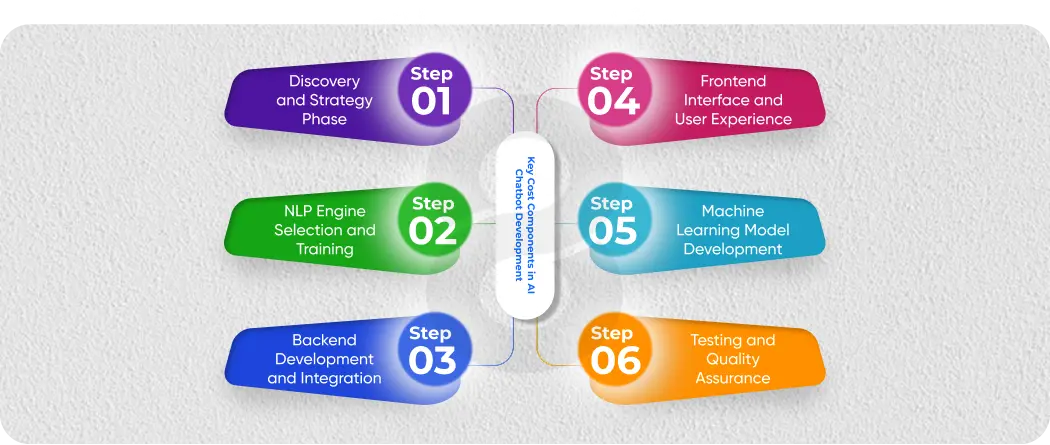
Knowing all the cost aspects of AI chatbot development would assist businesses in making sound budgets, preventing surprises, and focusing on features that would provide tangible value. An open cost breakdown will be used in the strategic process of decision-making in the chatbot lifecycle.
1. Discovery and Strategy Phase
This step determines the success of chatbots by matching the objectives of the business with those of the users. The teams develop a clear scope through the use of stakeholder interviews, journey mapping, and architecture planning, and save on rework, delays, and wasteful escalation of costs later.
2. NLP Engine Selection and Training
The choice of NLP directly has an influence on the intelligence and cost of chatbots. To make the decision between the open-source, cloud-based, and enterprise NLP systems and train them using the specific data in the domain, it is important to have skilled data scientists and invest considerable effort to provide their intent recognition with a high degree of accuracy.
3. Backend Development and Integration
The backend development allows real-time data communication between the chatbots and the enterprise systems. The combination of CRMs, databases, APIs, authentication layers, and payment gateways adds complexity, particularly when dealing with legacy environments, which also affects overall development costs and times.
4. Frontend Interface and User Experience
Chatbot adoption and satisfaction depend on user experience. The need to design easy-to-use interfaces on the web, mobile, messaging, and voice platforms demands UX skills, uniform branding, and conversational design specific to the channel of interaction.
5. Machine Learning Model Development
Sophisticated chatbots are based on personalized machine learning models in terms of sentiment recognition, predictions, and personalization. The features require specific data science infrastructure, lengthy training phases, and ongoing optimization, making the AI chatbot development quite expensive.
6. Testing and Quality Assurance
Comprehensive testing is the guarantee of chatbot reliability, security, and scalability. The functional, load, security, accessibility, and cross-platform testing avoid failures, safeguard brand reputation, and facilitate user experiences without challenges after the launch.
AI Chatbot Development Cost Breakdown
Cost Component |
Estimated Cost Range |
Primary Activities |
Impact on Overall Cost |
| Discovery & Strategy | $5,000 – $15,000 | Requirements gathering, user journeys, architecture planning | Defines scope and minimizes rework |
| NLP Engine & Training | $15,000 – $80,000 | NLP selection, intent training, entity modeling | Directly affects chatbot intelligence |
| Backend Development | $20,000 – $100,000 | System integrations, APIs, security, databases | Scales with system complexity |
| Frontend & UX | $10,000 – $40,000 | Multi-channel UI/UX design, accessibility | Drives user adoption and engagement |
| Machine Learning Models | $25,000 – $150,000 | Predictive analytics, personalization, adaptive learning models | Enables advanced and intelligent features |
| Testing & QA | $8,000 – $30,000 | Functional, security, load, and compliance testing | Ensures stability, trust, and reliability |
Ongoing Costs: The Hidden Financial Considerations
Infrastructure and Hosting ($500 – $5,000+ monthly)
Beyond initial development, cloud infrastructure represents a continuous expense. Costs scale based on:
- Conversation volume (API calls to NLP services)
- Data storage requirements
- Bandwidth for multimedia content
- Redundancy and disaster recovery provisions
Therefore, enterprises must budget for infrastructure that scales with adoption rates.
Maintenance and Updates ($10,000 – $50,000 annually)
Additionally, chatbots require ongoing refinement:
- NLP model retraining with new conversation data
- Bug fixes and performance optimization
- Security patches and compliance updates
- Content updates reflecting policy or product changes
Human Support and Escalation (Variable)
Moreover, even the most sophisticated AI requires human backup. Organizations must account for:
- Live agent salaries for complex escalations
- Training programs for seamless AI-human handoffs
- Quality monitoring and conversation auditing
Read More: Artificial Intelligence in Automotive – Transforming the Future of Driving
How Much Does It Cost to Build an AI Chatbot: Real-World Examples
Understanding real-life AI chatbot costs allows businesses to match investment levels with scale, complexity, and objectives. Depending on the customization, intelligence, integrations, and long-term operational requirements, costs range from small service bots that exist to large enterprise-level bots.
Business Type |
Primary Use Case |
Key Capabilities |
Estimated Cost Range |
| Small Business | Customer support & scheduling | FAQ automation, basic NLP, website chatbot | $15,000 – $40,000 |
| Mid-Market Company | Lead qualification & sales | Multi-channel AI chatbot, CRM integration | $50,000 – $120,000 |
| Enterprise Organization | End-to-end conversational AI | Custom NLP, omnichannel, compliance-ready architecture | $200,000 – $500,000+ |
Small Business Customer Service Bot
In the case of small businesses, AI chatbots are based on automating the FAQs and scheduling, and keeping the cost as minimal as possible. These are based on ready-made platforms, restricted NLP intent processing, single-channel implementation, and reduced implementation periods with simple CRM connectivity.
Mid-Market Sales Qualification Chatbot
The mid-market companies invest in AI chatbots to screen leads and shorten the sales cycles. The advanced intent recognition, the multi-channel deployment, the integration of CRM and marketing automation, and the tailored conversational logic to the sales workflows make these bots.
Enterprise-Grade Conversational AI Platform
Formidable companies are using complex conversational AI systems that need tailored NLP implementations, multichannel and voice, enterprise security, multilingualism, and end-of-life integrations with legacy systems, which take longer to develop and require specific teams of AI engineers.
Read More: Artificial Intelligence for Finance – Transforming Banking and Investments
Calculating ROI: Justifying Your AI Chatbot Investment
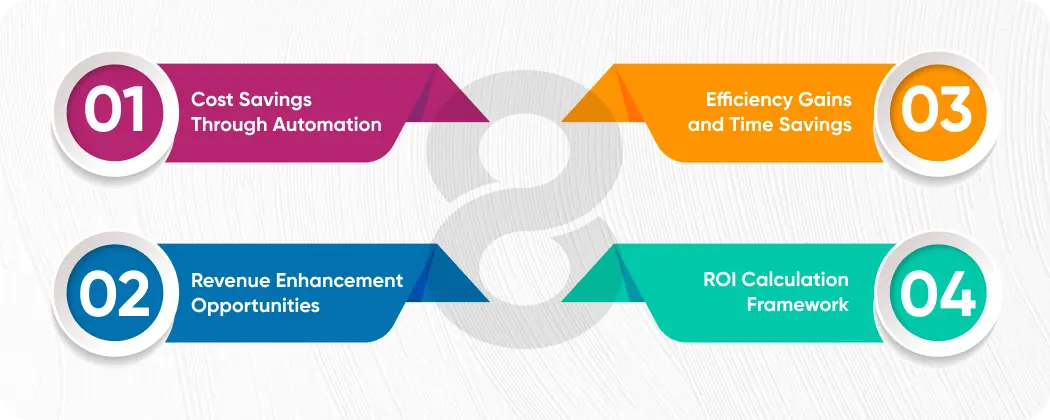
ROI calculation assists businesses in rationalizing the investment of AI chatbots with quantifiable results. Through the quantification of the cost savings, revenue growth, and efficiency gains, the decision-makers can have the confidence to align the spending of the chatbots with the actual value of the business.
Cost Savings Through Automation
The AI chatbots minimize the cost of operations by automating high-volume contact, reducing staffing, and eradicating overtime and training, as well as providing a consistent and 24-hour customer experience.
- Customer service headcount reduction: If your support team handles 10,000 monthly inquiries at $5 per interaction, and a chatbot resolves 70%, that’s $35,000 monthly savings ($420,000 annually)
- Extended service hours: 24/7 availability without overtime costs
- Reduced training expenses: Less onboarding for repetitive query handling
Revenue Enhancement Opportunities
In addition to savings, chatbots are explicitly being used to generate revenue by enhancing conversions, making it possible to qualify upsell contextually, gathering qualified leads out of hours, and turning a customer conversation into a scalable revenue stream.
- Increased conversion rates: Instant response to purchase inquiries can lift conversions by 15-30%
- Upselling and cross-selling: Personalized recommendations based on conversation context
- Lead generation: Qualifying prospects outside business hours captures opportunities competitors miss
Efficiency Gains and Time Savings
Chatbots can improve the productivity levels of the employees in an organization through speeding up the rate at which they respond, shortening the time taken to handle tasks, and liberating the employees so that they can handle more complex tasks that will lead to increased satisfaction and improved overall organizational performance.
- Faster issue resolution: Average handling time reduced by 40-60%
- Employee satisfaction: Staff focus on complex, fulfilling work rather than repetitive queries
- Data collection: Automated conversation analytics reveal customer pain points
ROI Calculation Framework
The organized ROI system provides comparisons of annual benefits and expenses to assist enterprises in assessing financial performance, as well as to focus on optimization and illustrate the profitability of AI chatbot programs in the long term.
Therefore, use this formula to quantify returns:
ROI = [(Annual Benefits – Annual Costs) / Total Investment] × 100
Example:
- Total development cost: $80,000
- Annual infrastructure and maintenance: $30,000
- Annual customer service savings: $120,000
- Revenue increase from improved conversion: $50,000
First-year ROI: [(170,000 – 30,000) / 80,000] × 100 = 175%
According to All About AI, approximately 78 % of global enterprises have integrated conversational AI into at least one customer-facing function, with adoption especially high among Fortune 500 companies.
Strategic Considerations for Budget Optimization
Phased Implementation Approach
Rather than building everything simultaneously, consider:
- Phase 1: MVP with core use cases (3-4 months, 40% of total budget)
- Phase 2: Enhanced NLP and additional channels (2-3 months, 30% of budget)
- Phase 3: Advanced features and integrations (3-4 months, 30% of budget)
This approach spreads costs while demonstrating value incrementally, making it easier to secure additional funding.
Build vs. Buy Analysis
Moreover, evaluate whether how much AI chatbot costs justifies custom development or if platform solutions suffice:
Build Custom When:
- Unique industry requirements demand specialized functionality
- Competitive differentiation through proprietary conversational experiences
- Complex integration with proprietary systems
- Data sovereignty concerns prevent cloud-based solutions
Buy Platform When:
- Standard customer service needs
- Faster time-to-market is critical
- Limited technical resources in-house
- Lower risk tolerance for large capital expenditures
Vendor Selection Criteria
When evaluating development partners, assess:
- Domain expertise: Previous work in your industry
- Technical capabilities: In-house AI/ML talent vs. outsourced components
- Pricing models: Fixed-price vs. time-and-materials vs. value-based
- Post-launch support: Availability for ongoing optimization
Read More: 10 Examples of Chatbots – Top AI Bots Transforming Businesses
Hidden Costs to Anticipate
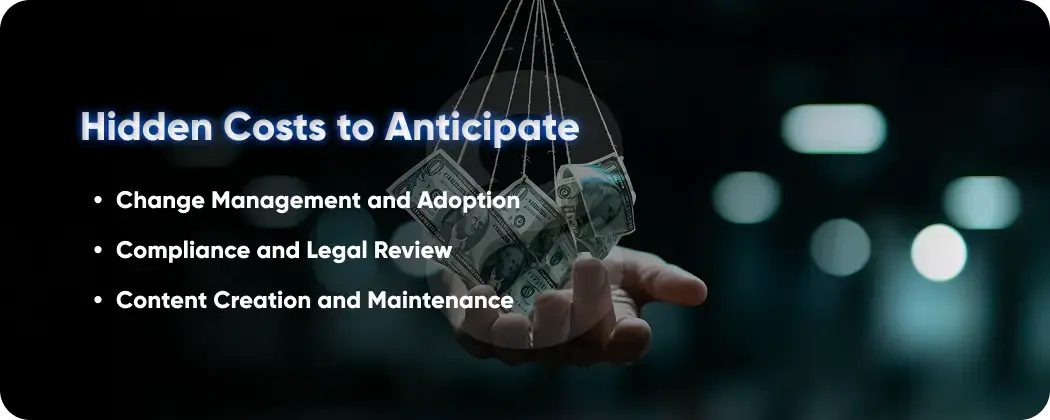
In addition to the cost of development, enterprise AI chatbots pose hidden operational costs to the long-term returns. Early adoption, compliance, and content maintenance budgeting will result in a more successful implementation and longer chatbot operation at scale.
Change Management and Adoption
To effectively implement AI chatbots, organizational preparedness, empowerment of the employees, and performance exhibition are essential. Such investments guarantee that teams have trust, utilization, and constant enhancements on AI-based systems of customer engagement.
Compliance and Legal Review
The regulated industries should also set aside finances to address the legal control, privacy management, and accessibility requirements to make sure that AI chatbot interactions are legal, secure, and risk-free at every stage of their lifecycle.
Content Creation and Maintenance
Chatbots work on the basis of dynamic chat content. Continued investment in content development, localization, and optimization will make it relevant and accurate and provide similar user experiences in the various markets.
Estimated Hidden Costs for Enterprise AI Chatbot Implementation
Cost Category |
Cost Component |
Estimated Cost Range (USD) |
Frequency |
| Change Management & Adoption | Employee training programs | $5,000 – $20,000 | One-time / Annual |
| Change Management & Adoption | Internal communication campaigns | $2,000 – $8,000 | One-time |
| Change Management & Adoption | Stakeholder alignment workshops | $3,000 – $10,000 | One-time |
| Change Management & Adoption | Performance monitoring dashboards | $2,500 – $7,500 | One-time |
| Compliance & Legal Review | Privacy policy updates | $3,000 – $12,000 | Annual |
| Compliance & Legal Review | Legal review of AI conversations | $5,000 – $15,000 | Annual |
| Compliance & Legal Review | Compliance audits (GDPR, CCPA, HIPAA) | $10,000 – $40,000 | Annual |
| Compliance & Legal Review | Accessibility certification | $2,000 – $6,000 | One-time |
| Content Creation & Maintenance | Conversational flow writing | $4,000 – $15,000 | Initial |
| Content Creation & Maintenance | Multimedia response creation | $3,000 – $10,000 | Initial |
| Content Creation & Maintenance | Content localization & translation | $2,500 – $12,000 | Per market |
| Content Creation & Maintenance | Ongoing content audits & updates | $3,000 – $10,000 | Quarterly / Annual |
Maximizing Value While Controlling Costs
To achieve the highest ROI and manage the costs of AI chatbots, companies have to be smarter in their development plans and balance technology options, data efficiency, and performance monitoring at the onset.
Leverage Open-Source Technologies
Open-source solutions enable businesses to lower initial AI chatbot design expenses and remain flexible and scalable, and retain ownership of their conversational AI stack.
- Open-source NLP frameworks like Rasa and Botpress
- Community-supported language models
- Cloud-agnostic, vendor-lock-in-free architectures
Prioritize Data Quality Over Quantity
Differentiation on high-quality training data enhances chatbot accuracy, lowers retraining costs, and provides greater user experiences without scaling up the overall AI chatbot costs.
- Annotated, intent-rich conversations
- Demographically representative user samples
- Continuous feedback-driven improvements
Implement Robust Analytics from Day One
The early analytics implementation will allow optimizing faster, reducing the costs of the AI chatbot in the long run, and delivering performance adequate to the enterprise and user requirements.
- Conversation completion rates
- Intent recognition accuracy
- CSAT and NPS tracking
8ration’s Approach to Scalable AI Development for Chatbots
At 8ration, our AI development will provide businesses with the opportunity to develop chatbots that are not just automated but also provide a significant ROI. Our state-of-the-art NLP, multi-channel conversational design, and smooth backend integrations will help in providing customized solutions that lower operational expenses, improve customer interactions, and streamline work processes.
We are deeply committed to building scalable, intelligent AI solutions that help your chatbot to develop with your business and deliver long-term value, strategic vision, and a digital transformation framework that is future-ready.
Final Thoughts!
It is necessary to comprehend AI chatbot development cost, and to do it, total ownership expenses should be considered in addition to the starting investment. Although the cost of an AI chatbot may depend on the agency building it, with strategy and execution in stages with defined ROI models, positive returns can be produced in 12-18 months.
The companies that invest in the development of their own AI chatbots today are competitive, and they turn support into a strength. With the careful requirement analysis and strategic pricing of AI chatbots, companies are assured of a chance to budget solutions that provide tangible value in a time of increasing customer service demands.