




AI plays a major role in the finance industry by improving decision-making, optimizing risk management, and personalizing financial services through real-time data analysis.
The global financial ecosystem is undergoing a quick development using information, computerization, and advanced forecasting knowledge. At the intersection of this change, however, is the Artificial Intelligence of Finance, which is transforming the operations of banks, investment firms, and fintech companies.
With institutions handling vast data, increasing customer expectations, regulatory requirements, and real-time decision-making, AI has turned into a strategic requirement and is no longer a futuristic concept. Algorithms and fraud detection, as well as personalized banking and credit risk modelling, are all now based on AI.
With machine learning, natural language processing (NLP), predictive analytics, and automation, Artificial Intelligence in Finance is transforming the banking and investment ecosystems into more efficient, more accurate, more scalable, and more innovative ones.
Understanding Artificial Intelligence in the Financial Context
Artificial intelligence can be defined as systems that can mimic human intelligence through learning and recognizing patterns, and making wise decisions with few human interventions. Whether structured or unstructured data, transaction history, market feeds, customer behavior, or regulatory documents are used, AI systems in the financial sector generate insights at scale.
Discussing AI in finance, one should expect:
- Financial machine learning, predictive modeling and anomalies
- Document analysis and sentiment analysis based on natural language processing
- Identity verification and compliance computer vision
- Operation and customer service intelligent automation
All this contributes to smarter, faster and safer financial ecosystems as decision accuracy has been enhanced. Operational risk is reduced, processes are automated, and customer-centric financial experiences can be scaled.
Read More: 10 Examples of Chatbots – Top AI Bots Transforming Businesses
How Is Artificial Intelligence Used in Finance?
AI has also been thoroughly integrated into modern financial systems. Allowing financial institutions to automate various more complicated operations, analyze large amounts of data, and improve accuracy.
The use of Artificial Intelligence in finance the process assists organizations in realizing better information and enhancing security and decision-making based on data along the financial value chain.
AI Application |
Key Benefit |
Real-World Example |
| Fraud Detection | Reduce financial crime, minimize losses | AI-based anomaly detection in transactions |
| Credit Scoring | Faster, more inclusive approvals | Alternative data used for loan approval |
| Algorithmic Trading | Optimize execution, reduce bias | AI-driven high-frequency trading |
| Customer Personalization | Enhance engagement & satisfaction | AI chatbots for banking support |
| Compliance Automation | Ensure regulatory adherence | Automated AML reporting |
Subsequently, Artificial Intelligence of Finance allows organizations to transition from being reactive organizations to proactive and predictive financial operations.
Artificial Intelligence in Banking: Redefining Customer-Centric Services
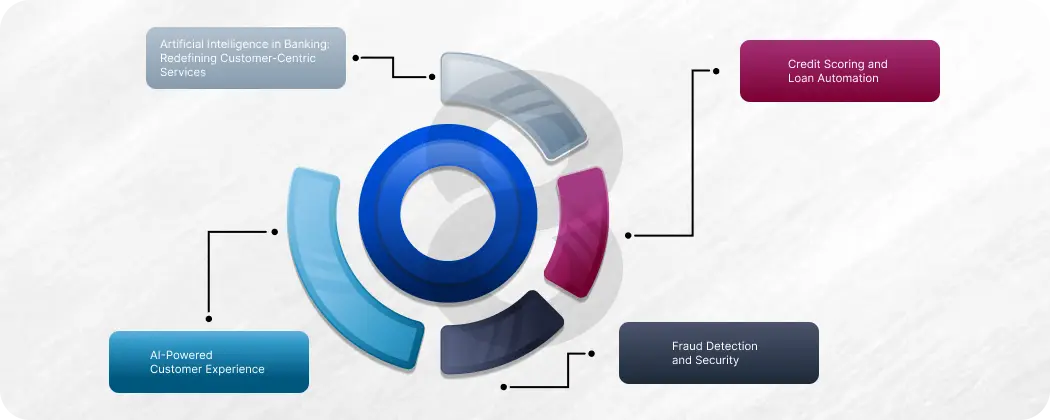
Artificial intelligence in banking has completely changed the way financial organizations interact with their clients and conduct business activities internally. The past banking systems are quickly being replaced by smart, data-driven applications with a focus on personalization, operational effectiveness, a new security perspective, and real-time provision of financial services.
AI-Powered Customer Experience
Chatbots and smart virtual assistants that use AI to assist customers around the clock ensure faster customer service by responding to any queries, transactions, and account management. These systems apply the use of natural language processing and behavioral analytics to provide individualized and context-driven interactions and to minimize the amount of overhead.
Fraud Detection and Security
The fraud detection systems powered by AI constantly process the data involved in transactions in real-time to determine abnormalities and suspicious activity. Contrary to the conventional rule-based methods, machine learning models evolve according to the emerging fraud patterns, enhancing the accuracy, reducing the false positives, and enhancing the overall financial security.
Credit Scoring and Loan Automation
AI makes credit assessment more accurate and more inclusive due to its ability to analyze other sources of data, including transaction history, spending habits, and financial trends. Also, this will speed up the loan issuances, decrease the risks of default, and increase the data-driven decisions in the lending process by the banks.
Read More: 25 Best AI Language Models – Choosing the Right Model for Your Project
AI in Investment Management: Smarter, Faster, Data-Driven Decisions

AI has radically transformed the investment landscape by making investment management provide vast amounts of real-time, high-velocity data where traditional slow human-only analysis is ineffective, sluggish, and more likely to fail to capture new opportunities.
Algorithmic Trading
By constantly monitoring the market, past price changes, liquidity trends, and real-time indicators, additionally, AI-based algorithms also trade at the best point possible, which reduces the likelihood of emotional bias considerably, cuts down latency, and increases the effectiveness of the trade overall.
Portfolio Optimization
Machine learning models compare the correlation between the assets, volatility, diversification, and risk tolerance of the investor and offer dynamically optimized portfolios that are in alignment with the individual or institutional financial objectives and in response to market fluctuations.
Market Forecasting
Using AI-powered financial analytics to identify latent trends, predict market trends, and evaluate macroeconomic trends, investment firms can predict risks, capitalize on opportunities, and enhance the accuracy of strategic planning using large volumes of data.
Read More: How Much Does Artificial Intelligence Cost
Machine Learning in Finance: The Analytical Backbone
Machine learning in finance is the foundation of the majority of AI-based systems. Moreover, ML models are also unlike those in the static algorithms in that they get better and better as they are fed more data.
Applications include:
- Predictive risk modeling
- Customer churn analysis
- Fraud pattern recognition
- Credit default prediction
Through the employed supervised and unsupervised learning approaches, the financial institutions are able to acquire adaptive systems that adapt to changes in the market. Such flexibility is essential in unstable and extremely controlled settings.
Read More: How to Make an Artificial Intelligence: Complete Guide
AI-Driven Financial Analytics and Decision Making
In modern finance, we possess plenty of data, yet have no wisdom unless it is intelligently interpreted. To address this gap and convert massive and complex data into applicable intelligence to support operational effectiveness and risk-sensitive financial development, AI-driven financial analytics will be helpful.
Real-Time Insights
Continuous processing of real-time live market feeds, transactional data, and customer interactions by AI systems helps in the creation of dynamic pricing based on real-time information, instantaneous risk alerts, forecasting, and quick reaction to market cycles and new financial opportunities.
AI in Financial Decision Making
In the context of loan approval, repositioning investment portfolios, and any other financial decisions, AI reduces human error and improves consistency, governance, and compliance. Moreover, the explainable AI results of advanced decision-support systems guarantee the transparency, auditability, and regulatory consistency of financial operations.
According to Global Growth Insights, in the banking sector, about 65% of institutions use AI for fraud prevention, while 58% leverage AI for customer personalization.
AI-Powered Financial Services and Fintech Innovation
The blistering emergence of AI-driven financial services has increased the pace of expansion of fintech startups and digital-first financial products. AI serves as the key driver of automation and personalization, predictive analytics, and scalability of the most disruptive and competitive innovations in fintech today.
Fintech App Development
With AIs, mobile banking, payment applications, robo-advisors, and digital wallets are becoming more personalized, cheaper to defraud, and more actively automated. Fintech development of apps today is more dependent on AI-based designs to make them scalable and secure.
AI Applications in Financial Services
Key AI applications in financial services include:
AI Tool |
Function |
Business Impact |
| Robo-Advisors | Portfolio management & recommendations | Personalized investment at scale |
| Automated Underwriting | Credit & risk analysis | Faster loan approvals, reduced errors |
| Payment Gateways | Transaction monitoring & fraud detection | Secure, real-time payments |
| Customer Engagement Tools | Predictive insights & recommendations | Improved retention and satisfaction |
By combining financial software development with AI capabilities, companies can deliver seamless, future-ready digital financial products.
Custom AI Solutions and AI Development for Finance
Financial institutions do not work similarly; therefore, the current development of AI in finance focuses more and more on specifically developed AIs that are based on specific business models, compliance schemes, and sophisticated data environments. Moreover, instead of using generic tools, specialized AI architectures can help financial organizations deal with certain operational issues, streamline processes, and discover new insights.
Custom AI initiatives often include:
- Proprietary risk models that are meant to measure credit, market, and operational risk more precisely.
- Automated compliance to address the changing regulatory and reporting requirements, industry-specific.
- Core banking systems with AI augmentation to enhance the process of transactions, interaction with customers, and system intelligence.
- Predictive analytics engines, anomaly detection engines, and proactive decision-making engines.
Furthermore, combined with powerful financial software development, purpose-built AI solutions provide scalable, secure, and future-resilient platforms that achieve long-term competitive differentiation in the financial services environment.
Benefits of Artificial Intelligence in Finance
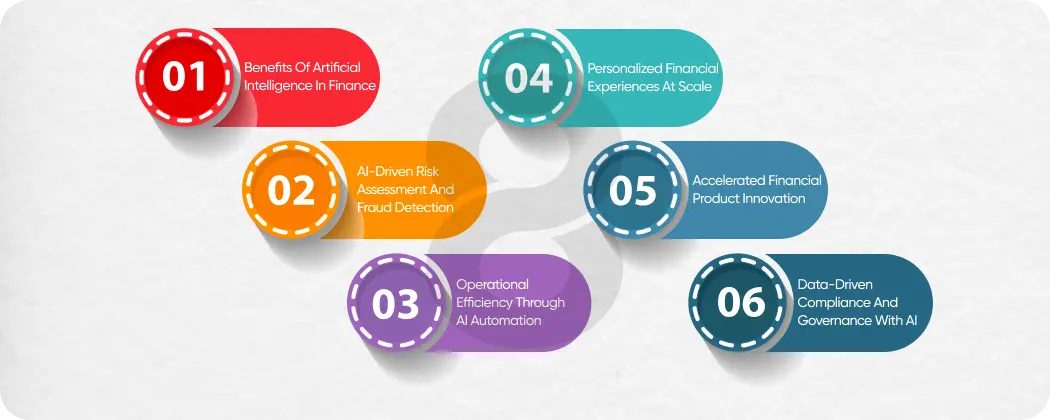
Finance Artificial Intelligence enables organizations to upgrade their operation, minimize risk, and discover intelligent decision-making. Using AI in finance, financial institutions can obtain predictive analytics, automation, and personalization, which increase competitiveness, compliance, and financial resilience in the short and long term.
AI-Driven Risk Assessment and Fraud Detection
Financial artificial intelligence therefore, applies machine learning algorithms to analyze large quantities of transaction data in real-time to detect anomalies, forecast risk, and prevent fraud with increased accuracy and with fewer false positives and more overall financial security.
Operational Efficiency Through AI Automation
Financial services AI automation takes repetitive jobs that involve data entry, reconciliation, and reporting. This reduces the workforce error, accelerates the workflow, reduces operational expenses, and allows the financial departments to engage in projects that are of high value and strategic importance.
Personalized Financial Experiences at Scale
Finance systems based on AI make it possible to interact with customers on a hyper-personal scale and apply predictive analytics and behavioral insights. Moreover, banking organizations will be able to provide their customers with custom product advice and live customer services that increase customer satisfaction and loyalty.
Accelerated Financial Product Innovation
Financial Artificial Intelligence enhances speed in product development, enabling quick data analysis, automated testing, and predictive modeling. This enables fintech firms and banks to introduce creative financial products in a shorter time and comply promptly with market requirements.
Data-Driven Compliance and Governance with AI
In the financial sector, AI enhances regulatory compliance through the automation of monitoring, reporting, and auditing. High-level analytics will assist institutions in early identification of compliance risks, transparency, and efficiency in adapting to new compliance requirements.
Read More: List of Best Mobile Banking Apps to Inspire Your Fintech Solution
Challenges and Ethical Considerations
Artificial Intelligence in Finance brings operational, ethical, and regulatory challenges regardless of its transformative potential. Financial bodies have to strike a balance between innovation and responsibility through transparency, fairness, and security of AI-based financial systems.
Key challenges include:
- The risk of privacy and cybersecurity in AI-based financial platforms.
- Complexity of AI algorithms and lack of transparency and explainability of models.
- Regulatory compliance issues in the world’s financial jurisdictions.
- Algorithms’ bias and unfairness issues affecting financial choices.
Moreover, these issues can be solved by strong governance structures, ethical AI activities, and constant oversight to achieve trustworthy and compliant AI implementation.
Read More: 15 Fintech Industry Trends for Innovative App Development
The Future of Artificial Intelligence in Finance
Smart collaboration, highly developed automation, and data-driven decision intelligence will become the future of artificial intelligence in the financial sector. The AI will augment human expertise instead of killing it and allow people to have smarter, faster, and more personalized financial services.
Key future trends include:
- Generative AI for financial reporting, insights, and advisory services
- Hyper-personalized banking experiences powered by real-time analytics
- Autonomous financial agents managing transactions and portfolios
- AI-driven regulatory technology (RegTech) for proactive compliance
As AI models mature, financial institutions are shifting away from simple task automation toward strategic augmentation. This evolution will unlock new opportunities for efficiency, innovation, and deeper institutional trust.
How We Build Intelligent AI Solutions for Modern Financial Institutions

At 8ration, we develop custom AI systems that are in line with the real-world financial processes. To provide quantifiable results, our process of AI development in the financial domain brings together domain knowledge, secure system architecture, and scalable machine learning models.
We are investing in tools like fraud detectors, predictive risk analytics, and AI-based decision-support systems. These investments are designed to increase the accuracy, compliance, and operational efficiency of our banking and investment platforms.
Embracing the Intelligent Financial Era
To sum up, indeed, Artificial Intelligence in Finance is no longer a technological advantage; it has become a strategic necessity. AI is changing all levels of the financial ecosystem, whether it is revolutionizing the way banking works. Improving investment management or driving fintech innovation and data-driven decision-making.
Those organizations that are now adopting AI will experience enhanced efficiency, risk control, and better customer experiences. Delays in risk-taking may lead to falling behind in a very competitive data-driven market. With the future of the financial sector, ultimately, there is one thing that is certain: AI is not merely defining the future of finance, but it is the future of finance.