


Somewhere, a shipping container in the Pacific is reporting its temperature to a platform nobody’s watching. Not because someone set a reminder. The sensor does it every few minutes, automatically, and has been doing it for hours. The same thing is happening on a pipeline in Wyoming right now, in a hospital room, in a cornfield in Iowa that nobody’s walking through. That’s what 17 billion connected devices actually looks like.
Most explanations of the Internet of Things stay comfortable at the abstract level. “Connected devices.” “Operational efficiency.” “Data-driven decisions.” Good phrases. Not much help when you’re deciding whether to put sensors on a production line or build a connected platform for field operations. This guide goes past the framing.
What is the Internet of Things?
IoT is a network of physical objects with sensors, software, and connectivity built in. They collect data and send it over the internet automatically. No human intervention required at each step.
A factory floor sensor monitoring operating temperature. A shipping container reporting its location and humidity every few minutes. A wearable sending a patient’s heart rate to a clinical platform while they’re at home. The common thread isn’t the device type. It’s that they’re all connected and feeding data somewhere useful, in real time.
Sensors and actuators sit at the base… interacting directly with the physical world. But they can’t do anything with the data they collect on their own. That’s what the connectivity layer is for. WiFi and 5G handle that in most environments.
Low-power protocols like LoRa take over where those don’t reach, typically in agricultural settings or remote infrastructure. From there, a data platform collects and processes what comes in. An analytics or AI layer at the top is what turns those readings into decisions.
IIoT is the industrial version. Factories, ports, agricultural systems, energy grids. Consumer IoT is what’s in your home. The architecture overlaps considerably. The stakes don’t.
Why IoT Benefits Are Inseparable From Digital Transformation
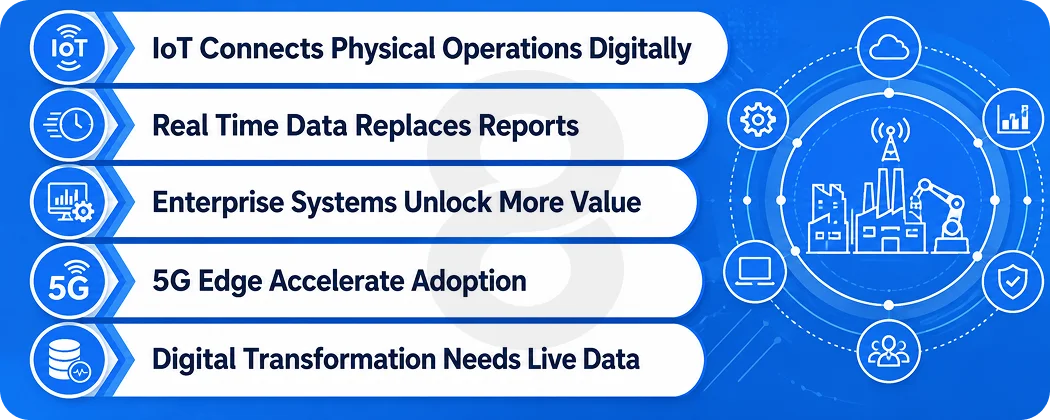
“Digital transformation” is probably the most overused phrase in business right now. But it describes something real: replacing slow, manual, disconnected operations with systems that share data and move fast. The problem is you can’t do that if your data still lives in weekly reports and ERP logs. You’re upgrading software while the physical operation stays analog.
IoT is what closes that gap. It puts sensors on the things that generate operational data, gets that data moving in real time, and feeds it into the analytics and AI tools that digital transformation actually runs on. Without it, you’re not changing how the operation works. You’re changing what software the operation runs.
McKinsey Global Institute puts IoT’s potential economic impact at $3.9 trillion to $11.1 trillion per year. More than two thirds of that comes from business to business applications. Not consumer gadgets. The same research notes that interoperability between connected devices and existing enterprise systems accounts for roughly 40% of the total realizable value, a useful reminder that connected devices alone are only half the problem.
Statista puts the global IoT market at $1.3 trillion last year, growing at over 26% a year. A lot of that acceleration comes from 5G and edge computing maturing at the same time. Each makes the others more capable.
Read More: Internet of Things App Development: A Business Owner’s Guide
The Core Benefits of Internet of Things
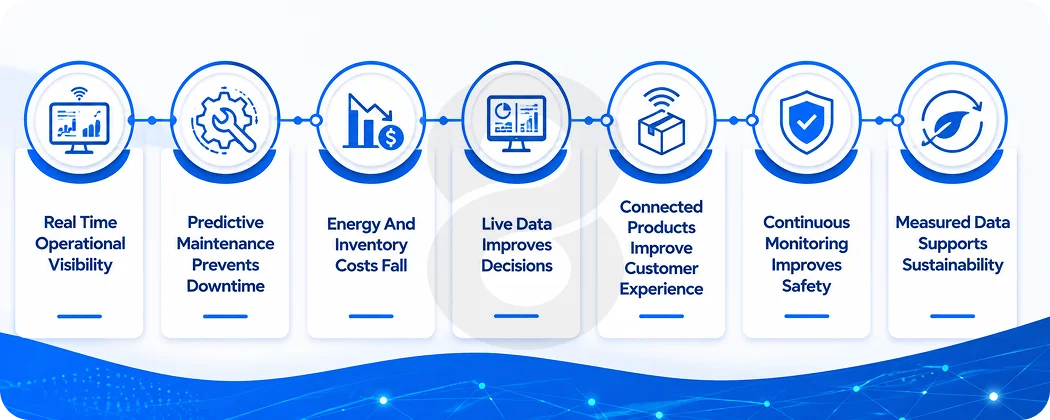
The returns from IoT show up in a few consistent places across industries: visibility, maintenance, cost, and safety. Some of these are obvious once you see them. Others take a while to show up on a balance sheet but compound significantly once they do. Here’s where the documented impact is clearest.
Real time visibility across every operation
Most operations run on stale data. A report gets pulled, someone interprets it, a decision gets made based on conditions from last Tuesday. By the time the response is ready, the situation has changed.
IoT makes operational data continuous. The fleet manager who used to get a daily position report now has a live feed. Every truck’s location. The temperature inside every reefer unit. Whether any driver is running behind. Yesterday’s log told you what happened. This tells you what’s happening.
Transparency Market Research projects the connected machines market at $1.1 trillion by 2031. That kind of investment doesn’t happen in a sector where the ROI is murky.
Predictive maintenance that actually prevents problems
Unplanned downtime is expensive in a way that’s easy to underestimate until you’ve sat through a production halt waiting on an emergency parts shipment. Then the cost becomes very concrete: not just the repair, but the lost production hours, the missed delivery commitments, the downstream scramble.
IoT sensors pick up the early signals before failure happens. Vibration running slightly off. Temperature drifting outside the normal band. Current draw that’s a few percent higher than last week. The system flags it. Maintenance gets scheduled during a planned window. The machine doesn’t break during a production run.
Nine in ten manufacturers consider smart manufacturing a top competitive priority. Besides, more than half of industrial IoT deployments point to predictive maintenance as their biggest source of returns, according to IoT Analytics.
Catching a problem before the machine stops is cheap. Reacting after it stops means paying for the repair, the production hours you won’t get back, and every delivery that was counting on that output.
Cost savings that compound over time
The cost reduction from IoT comes from several directions at once, which is part of why it’s hard to summarize in a single number.
Start with energy. Smart sensors adjust lighting, HVAC, and industrial power consumption based on actual occupancy and real production output, not preset schedules. Buildings stop running at full load when nobody’s in them. At scale, that’s a meaningful cut on utility costs before you’ve changed anything else.
Inventory is less obvious but equally real. When you have live visibility into stock levels, you stop ordering too much and you stop running out. Both sides of that problem are expensive. Overstocking ties up capital. Stockouts mean lost sales and expedited shipping to compensate. Real time visibility makes ordering more precise on both ends.
McKinsey puts the global economic impact of IoT at $5.5 trillion to $12.6 trillion by 2030. The full methodology is in the McKinsey Global Institute IoT mapping report. At the household level, the same research estimated IoT automation saves around 100 hours of labor per year. What that number looks like inside an enterprise operation is a different order of magnitude.
Decision making that runs on live data instead of last month’s reports
Business decisions have always depended on data. The problem is that “data” usually means historical data, already processed and already delayed. A manager making a call on Monday morning is working from last week’s numbers, which is already too late if the relevant condition changed on Thursday.
When devices are feeding data continuously, you can see what’s happening right now. A demand spike in a specific category this afternoon. A delivery running behind by two hours. A machine’s error rate climbing in the past 45 minutes. That specificity changes how fast a business can respond, and it changes what kinds of decisions are even possible.
There’s a direct AI connection here. IoT generates the real world data stream that AI models need to make accurate predictions. Without continuous inputs, those models are pattern matching on history. With live sensor data, the system catches anomalies and responds before anyone has thought to check a dashboard.
Customer experience that adapts to how people actually behave
A thermostat that learns your schedule and adjusts before you get home. A piece of industrial equipment that reports back usage patterns so the manufacturer knows how it’s actually being used in the field, not how engineers assumed it would be used. A retail store that adjusts digital signage based on where customers are actually spending time.
The B2B implication is probably the most underutilized part of this. Companies selling connected equipment can redesign based on real usage data before customers file complaints. They can price maintenance as a subscription because they have the performance data to make that model work. McKinsey describes this as one of IoT’s least-discussed advantages: when you can see how a product is actually being used, you can sell outcomes instead of hardware.
Workplace safety that doesn’t depend on someone noticing
An inspector walking a floor twice a shift is going to miss things. Not because they’re bad at the job. Because it’s a big floor, a short window, and some failures give no warning until they’re already happening.
IoT sensors work continuously. Smart wearables detect heat stress and exposure to toxic agents. Environmental monitors measure gas concentrations and structural vibration around the clock. When readings cross a threshold, the alert fires immediately. The system doesn’t get tired, distracted, or pulled onto something else.
This matters most where a missed signal has serious consequences: offshore energy, chemical processing, and construction.
Sustainability gains you can actually measure
A lot of sustainability commitments are based on estimates. IoT makes them based on measurements.
Instead of pulling monthly meter readings, you get live consumption data from every facility. A building that reads occupancy in real time stops wasting energy on empty floors. Smart grids balance loads against actual demand. When investors or regulators ask for verified ESG data, that’s what IoT backed reporting can provide. The difference between a policy and evidence.
Real deployments have produced documented results. Barcelona’s Digital Twin program, which runs live IoT sensor data through a virtual city model, achieved an 8% reduction in emissions. Singapore’s Traffic Brain cut average commutes by 27% through dynamically adjusted signal timing. These aren’t pilot figures. They’re operational outcomes from connected infrastructure at city scale.
IoT Benefits by Industry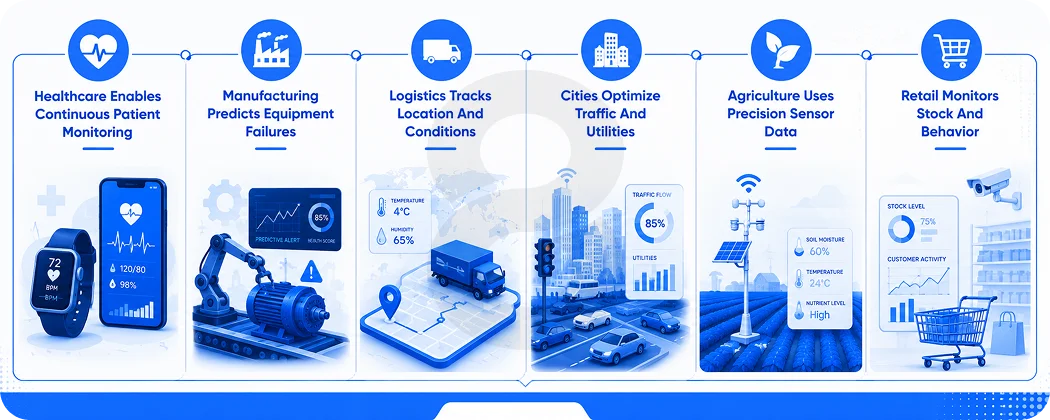
The same underlying technology plays out differently depending on the environment it’s deployed in. A sensor network on a factory floor solves a different problem than one in a hospital room or a cornfield, even if the architecture looks similar. These are the industries where the returns are most clearly documented.
Healthcare and the shift to continuous monitoring
The wearable on a patient’s wrist knows more about how their heart is doing between visits than a cardiologist sees in one appointment. Healthcare has always been episodic by necessity. You can only assess someone when they’re in front of you. Connected monitoring removes that constraint. Data flows to clinical platforms continuously, and something worrying gets flagged long before it shows up as a symptom.
Take someone managing hypertension. A normal reading on Tuesday and a dangerous spike on Thursday look identical on a weekly check. The check only shows you Tuesday.
McKinsey puts the potential value of remote patient monitoring at between $170 billion and $1.6 trillion a year. Most of that gap comes down to how fast healthcare systems actually move. By 2026, AI assisted remote care systems detect anomalies in real time, with providers running hybrid care models that combine clinic visits with connected home monitoring.
Manufacturing and Industry 4.0
Industry 4.0 is, practically speaking, mostly IIoT. Sensor networks across equipment and production lines feeding into a central platform. Defects caught before a product leaves the floor. Maintenance scheduled before a machine fails. Energy consumption tied to actual output rather than a fixed schedule. The smart factory concept that’s been discussed for years is now the operational standard at scale.
What’s made this more powerful recently is the digital twin: a virtual replica of a physical production environment updated continuously by live sensor data. Plant managers can model the impact of a process change or a scheduled maintenance window before acting on it. Simulate what happens when one line goes offline before shutting anything down.
Deloitte’s 2025 Smart Manufacturing Survey found 92% of senior executives see smart manufacturing as their primary driver of competitiveness. IIoT market value sits at $275.70 billion in 2025, with manufacturing growing at roughly 20% CAGR in connected device deployments according to MarketsandMarkets research.
Supply chain and logistics
Every logistics operation knows this problem: the shipment disappeared somewhere between origin and destination, and nobody can say exactly where. IoT doesn’t solve the logistical complexity, but it removes the visibility gap almost entirely.
GPS trackers and condition sensors push location, temperature, and shock data in real time. If a refrigerated truck drifts above the temperature threshold, the alert fires before anyone makes a call or the product shows up damaged at the warehouse.
83% of organizations that implemented IoT reported measurable efficiency improvements. Modern supply chains function as event driven systems where disruptions trigger corrective actions automatically: inventory drops below threshold, restocking workflows activate.
Smart cities and public infrastructure
Singapore’s Traffic Brain cut average commutes by 27% through dynamically adjusted signal timing across thousands of connected cameras and detectors. That’s worth naming specifically because it’s not a modest improvement. It’s a meaningfully different commuting experience for a city of 5 million people, driven by IoT infrastructure managing traffic in real time.
The same logic applies across public services. Water monitoring catches pipe leaks before they become sinkholes or contamination calls. Waste trucks that route based on fill sensor data stop running half-empty through neighborhoods that don’t need them yet. The global smart cities IoT market is projected at $312 billion in 2026.
Agriculture and precision farming
Farmers have always worked from observation. Check the soil, watch the sky, walk the field. IoT doesn’t replace any of that. What it adds is a data layer that observation alone can’t give you, at the resolution that actually matters.
Soil moisture sensors show which zones need water right now, not which ones are up on the schedule. Field-level weather stations catch readings that regional forecasts miss entirely. Crop health sensors pick up early signs of disease or pest pressure before anything is visible to the eye. The outcome is irrigation when the crop needs it and fewer inputs burned per acre.
Retail and the connected store
Retail has always had a visibility problem. You know what sold yesterday. You don’t know how customers moved through the store, which products they picked up and put back, or how a layout change on Tuesday affected purchasing through the rest of the week.
IoT changes the granularity. Foot traffic sensors map how customers actually move. Smart shelves detect stockouts in real time rather than at the next inventory audit. Customer behavior data feeds directly into demand forecasting, based on what people are actually buying rather than what last quarter’s spreadsheet guessed.
According to The Business Research Company, the retail IoT market was valued at $39.52 billion in 2024 and is projected to reach $46.41 billion in 2025.
Read More: Best 45+ Internet of Things Examples Across Different Industries
The Convergence Nobody Talks About: AIoT, Edge Computing, and 5G
IoT by itself is a data collection system. What’s made it genuinely powerful in 2025 and 2026 is what’s running on top of it.
AIoT (AI and IoT working together) is the most important shift. IoT collects continuous real world data from physical environments. AI processes it, finds patterns, and takes action. Separately, both are useful. Together, they enable systems that self correct in real time without waiting for human review.
A manufacturing system that catches the early signature of a bearing failure before the vibration sensor crosses any preset threshold. A hospital monitoring system that flags early sepsis indicators hours before a clinician would catch it on rounds.
Edge computing is really a question of where the processing happens. Send everything to a central cloud and you’re adding latency and burning bandwidth on every data packet. Process it locally, at the device or a server sitting nearby, and the response doesn’t have to wait on a round trip.
For use cases where milliseconds matter (autonomous braking, real time quality control on a production line, surgical robotics), that is not a performance preference. It’s a requirement. Edge also keeps sensitive data from leaving the facility, which matters for compliance.
5G is what makes high density IoT deployments practical at scale. A single 5G base station can support thousands of connected devices simultaneously at low latency. For large manufacturing facilities or smart city infrastructure, that connectivity spec changes what’s architecturally possible. The combined market sits at $1.3 trillion, growing at 26.3% CAGR.
Challenges Worth Knowing Before You Invest in IoT
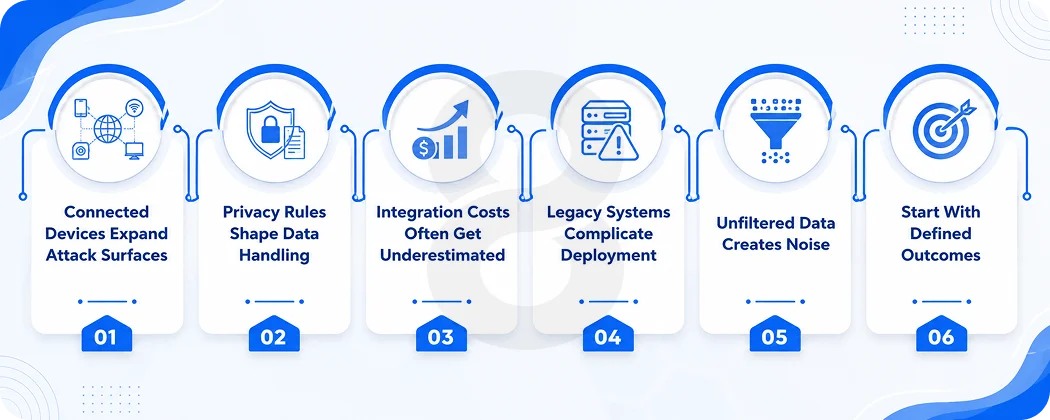
IoT’s benefits are real. So are the failure modes.
Security is where most concerns start, and it deserves the attention it gets. Every connected device is a potential entry point. Many IoT devices ship with weak default credentials, minimal encryption, and infrequent firmware update cycles.
A compromised device doesn’t just leak data. It can give attackers access to the network behind it. Security needs to be designed into the architecture from the start. Retrofitting it after deployment is expensive and rarely complete.
Data privacy layers on top of that. GDPR, HIPAA, and a growing set of US state level privacy laws all have implications for how IoT data is collected, stored, and processed. If you’re deploying continuous monitoring devices that collect data on employees or customers, the compliance strategy has to exist before the first device goes live, not after someone asks where the data is going.
Then there’s cost. Hardware, connectivity infrastructure, platform licensing, integration work, and maintenance all add up before you see measurable ROI. The integration part is usually where project budgets get underestimated. Legacy systems weren’t designed to ingest real time sensor streams. Bridging that gap takes more engineering time than most initial estimates account for.
Finally, data overload is a real failure mode that doesn’t get discussed enough. A large IoT deployment generates a lot of data. If you haven’t defined what you’re measuring and what action each measurement should trigger, most of it becomes noise. The organizations that get the best returns from IoT started with a specific operational problem, not a general desire to be “more connected.”
Read More: How to Build HIPAA & GDPR Compliant Apps
How to Start Getting IoT Benefits in Your Business
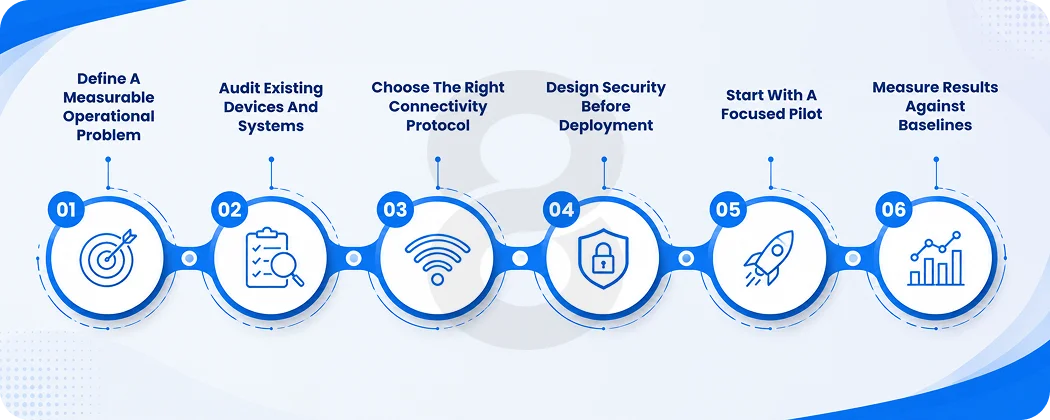
Most failed IoT projects started with the technology rather than the problem.
Before picking a platform or speccing out devices, name the specific operational pain you’re solving. Not “improve efficiency,” which is unmeasurable. Something concrete: reduce unplanned downtime on production line 3. Cut cold chain spoilage below 2%. Shorten patient discharge time by 30 minutes. A specific outcome gives you a baseline. Without one, you can’t tell whether the IoT investment actually worked.
From there, audit what you already have. What’s connected? What protocols are in use? Where does data currently live? This matters because integration costs are where IoT project budgets most often get underestimated. Organizations with older infrastructure routinely discover that bridging legacy systems with real time sensor data is more work than the device selection and platform setup combined.
Connectivity protocol follows from the use case. LPWAN protocols like LoRa suit long range, low power sensor networks in outdoor settings. WiFi 6 handles high density indoor environments. 5G covers high bandwidth, low latency industrial applications. Choosing the wrong protocol for the environment creates problems that are expensive to correct later.
Build security into the architecture before anything else. Device authentication, network segmentation, encrypted data transmission, and a firmware update pipeline are not optional. Then start small. One production line, one warehouse zone, one facility. A focused pilot teaches you more about your actual deployment environment than any planning document will, and it lets you prove ROI at a scale where failure is recoverable.
How 8ration Can Help With IoT Development
8ration has built IoT applications across manufacturing, healthcare, agriculture, and logistics, covering the full pipeline from device connectivity and data ingestion through to real time dashboards and AI integration. The work involves both the sensor and connectivity layer and the software that makes the data useful.
One of 8ration’s clients, Lina Alvarez (IT Project Manager), described the outcome directly: “8ration connected all our IoT devices through one smart app. Real time data access and device control have completely optimized our operations.”
On the agriculture side, Chem Savy combines connected sensor data with AI to give farmers real time crop disease diagnosis. Munitora brings the same connected platform thinking to livestock farming. In healthcare, Cardiac Fitness gives users daily cardiovascular health data through continuous monitoring built around five clinical protocols.
The team also builds the AI layer that makes sensor data actionable: agentic AI systems that trigger automated responses based on incoming data streams, and generative AI integrations that surface insights from sensor data without requiring someone to manually sift through it.
For companies still mapping out where to start, 8ration’s software consulting service covers architecture planning, connectivity protocol selection, security design, and integration planning before hardware is purchased. The right starting point is a specific operational problem, not a platform decision.
Read More: Top 10 IoT Development Companies in the USA
Conclusion
The benefits of Internet of Things technology aren’t abstract. Factories have cut unplanned downtime by double digit percentages. Hospitals are catching critical patient deterioration hours earlier than traditional monitoring would allow. Cities are managing traffic and energy infrastructure with live data rather than quarterly inspection cycles. These are operational results from deployed systems, not projected outcomes from vendor whitepapers.
The shift happening in 2025 and 2026 is the convergence with AI and edge computing. That’s what turns a sensor network into something that actually responds, not just reports. The data gets processed and acted on, often before a human operator has registered that anything changed.
For any business considering IoT, the starting point is the problem, not the technology. What does the unplanned downtime actually cost? What does spoilage run annually? What would shaving 30 minutes off the discharge process mean for a hospital unit? Get specific about that first. The investment case follows from the problem, and so does the architecture.