


Behind all of these devices/sensors/trackers that are connected to the Internet today is some type of software, and that software really is what transforms raw data into information that a person can take action on.
This guide will take you through a typical connected product IoT application development process, its pricing, and how to avoid the pitfalls of most first-time projects.
The brief version: No longer a niche experiment reserved for tech giants, IoT application development has become a reality. Today it’s a growth lever that’s embraced mainstream, and the market agrees.
As per the global Internet of Things market, by 2026, global revenue is projected to hit a staggering US$1.18 trillion, of which a significant portion, US$321.68 billion, will be generated by IoT in the industrial sector.
That sort of spending does not occur due to the popularity of IoT. It’s happening because connected products are providing the solutions to common, costly operational issues.
What Is Internet of Things App Development?
Internet of Things (IoT) App Development is the process of developing applications to connect tangible devices, sensors, and machines with the internet.
However, an IoT application isn’t a common mobile or web application that gets a lot of input and returns the information back to the user. Moreover, it is a continuous stream of data from the hardware, often real-time, that is then converted into something accessible to the business user and that can be acted upon.
Most completed IoT projects typically feature three interconnected layers: the device layer (sensors and hardware), the network layer (the protocols and gateways that transport data), and the application layer (the dashboard, mobile application or web platform that a user sees and uses to control all of the above).
The critical objective of 8ration’s IoT app development services is to ensure the successful integration of all three layers. The key challenge that sets 8ration’s IoT app development services apart from traditional software projects is the successful integration of all three layers.
Read More: Enterprise App Development: A Complete Guide
Why Businesses Are Investing in IoT App Development
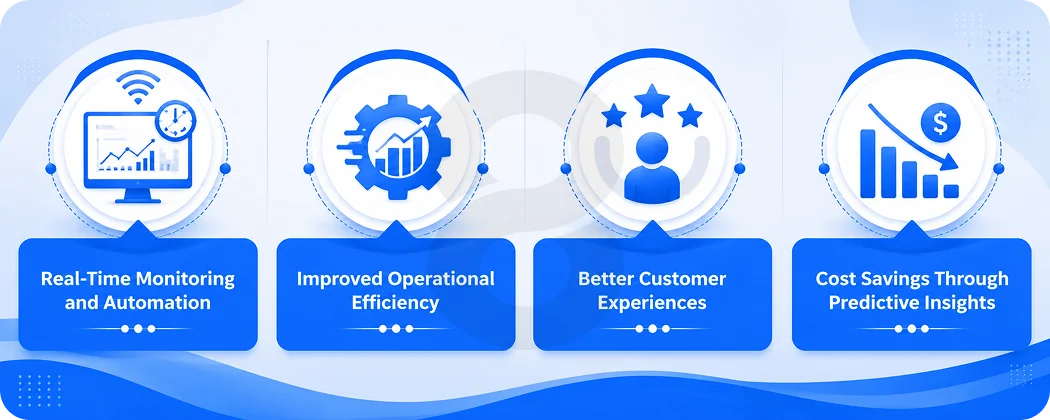
Businesses don’t purchase IoT simply for the sake of it. Typically, there are four measurable benefits that make up the investment case.
Real-Time Monitoring and Automation
Manual inspections or customer complaints wait days behind – connected devices report status on a continuous basis so problems are identified as soon as they occur. This is a more proactive approach than reactive monitoring, greatly reducing response time and enabling teams to make routine adjustments without someone manning a dashboard 24/7.
Improved Operational Efficiency
Automated routine checks and adjustments save time and alleviate the risk of human error in manual monitoring. The connected system can enable more productive use of time for teams who would typically spend hours logging readings or walking factory floors, and can automatically alert teams to exceptions, reducing the number of hours spent on mundane data collection tasks.
Better Customer Experiences
Businesses can now differentiate premium products from commodity products by providing features that customers have come to expect, such as remote control, usage data and proactive alerts features that are enabled through connected products.
Not only do customers receive more information about the performance of a product, but they also have a direct line to businesses for continuous interaction after purchase, which gives businesses a better chance of building customer loyalty and retaining customers over time.
Cost Savings Through Predictive Insights
Sensor data enables businesses to detect problems and prevent an entire catastrophe, rather than being forced to pay for emergency fixes and unscheduled downtime.
Most businesses can see a 10% to 40% reduction in maintenance costs with connected manufacturing systems, and a 30% to 50% reduction in machine downtime with predictive maintenance solutions powered by IoT, within the first year.
Industries Using IoT Applications Successfully
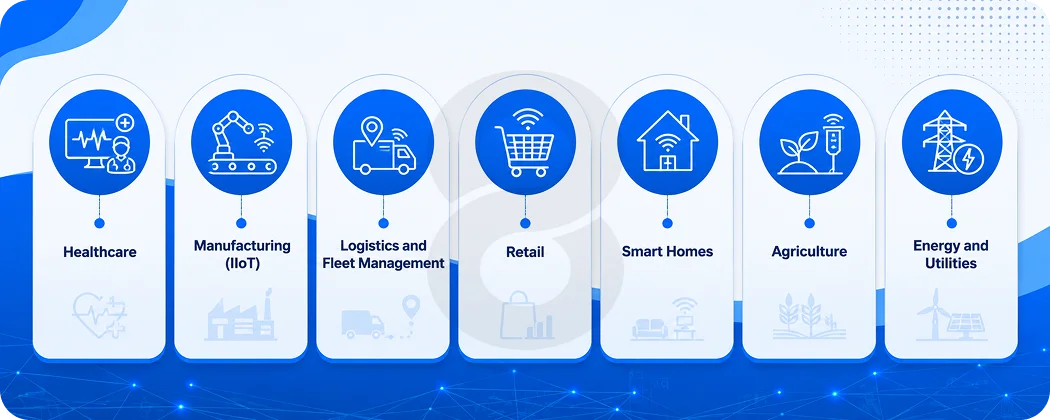
IoT is not a one-size-fits-all technology. Each industry uses connected applications differently, and the ROI shows up in different places.
| Industry | Common IoT Use Case | Primary Business Benefit |
|---|---|---|
| Healthcare | Remote patient monitoring, connected medical devices | Fewer hospital readmissions, continuous patient data |
| Manufacturing (IIoT) | Predictive maintenance, production line sensors | Reduced downtime, lower repair costs |
| Logistics & Fleet Management | GPS tracking, route optimization, cold chain monitoring | Fuel savings, on-time delivery accuracy |
| Retail | Smart shelves, inventory sensors, customer footfall tracking | Reduced stockouts, better inventory turnover |
| Smart Homes | Connected thermostats, security systems, voice control | Energy savings, convenience-driven customer loyalty |
| Agriculture | Soil sensors, irrigation automation, livestock tracking | Higher yields, reduced water and resource waste |
| Energy & Utilities | Smart meters, grid monitoring, load balancing | Reduced outages, more accurate demand forecasting |
Healthcare
For chronic disease management and post-surgical care, connected wearables and remote monitoring devices provide an opportunity to monitor vitals away from the hospital.
Manufacturing (IIoT)
One of the largest uses of industrial IoT is on factory floors, where sensor-based predictive maintenance directly reduces unplanned downtime, one of the most expensive issues a factory has.
Logistics and Fleet Management
For our logistics software development clients transporting temperature-sensitive products, real-time tracking of the vehicle and driver is crucial, as it allows them to monitor their cargo in real time.
Retail
Smart shelving and stock sensors provide a real-time inventory display to help retailers avoid out-of-stock situations while reducing overstocking.
Smart Homes
From thermostats to security cameras, consumer IoT products are one of the most prominent ways that everyday consumers are becoming involved in connected technology.
Agriculture
For instance, based on his agriculture software development projects, Sensor-driven irrigation and soil monitoring is a use case that has been created for farms to use water and fertilizers more precisely.
Energy and Utilities
Smart meters and grid sensors enable utilities to better manage load and pinpoint outages at even earlier stages than customers realize there is a problem.
Read More: Best 45+ Internet of Things Examples Across Different Industries
Types of IoT Applications Businesses Can Build
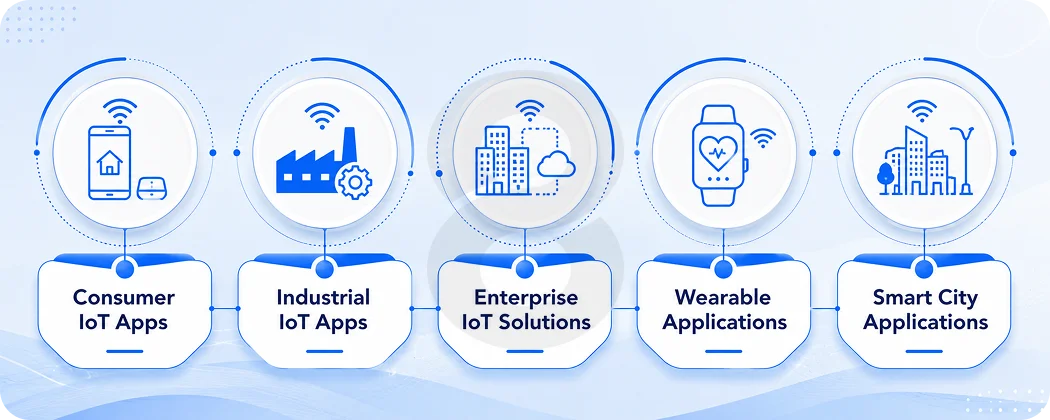
Not all IoT projects are the same. In general, there are five types of IoT applications.
Consumer IoT Apps
Consumer IoT apps enable people to link everyday items, such as smart locks, fitness bands, connected appliances and more to a dedicated mobile app. Typically, the ease of setup and usability of daily operation of these applications are evaluated, as the end user is not a technical buyer. Here, simplicity, quick pairing, and a clean interface are more important than configurability.
Industrial IoT Apps
Industrial IoT apps track and manage machines, production lines and factory equipment, typically for reliability and uptime consideration. As opposed to consumer apps, downtime here carries a direct dollar cost, so these applications focus on continuous data logging, redundancy and alerting over flashy designs, where missing an alert can lead to production lines becoming stalled.
Enterprise IoT Solutions
Enterprise IoT solutions connect the dots across departments and are often linked to the existing ERP or CRM software a business is already employing. These platforms are usually used by multiple teams at the same time, like operations and finance, and require the ability to correlate sensor data with a business’s existing records to deliver one unifying view rather than multiple reports in silos to decision makers.
Wearable Applications
Wearable applications measure health, fitness or safety on the body and report the data to a phone or cloud dashboard. Here the greatest engineering challenge is the efficiency of the battery and the accuracy of the data; the device must be worn at all times. 8ration has a special practice of developing wearable apps to build these.
Smart City Applications
At the municipal level, smart city applications operate public infrastructure, such as traffic lights, waste collection, public utilities, etc. The projects are often deployed with numerous distributed devices spread out over a large geographical area, making network reliability, longevity of the hardware and centralized monitoring much more critical than when deployed in a single location.
Read More: Top 10 Mobile Apps for Businesses
How the IoT Application Development Process Works
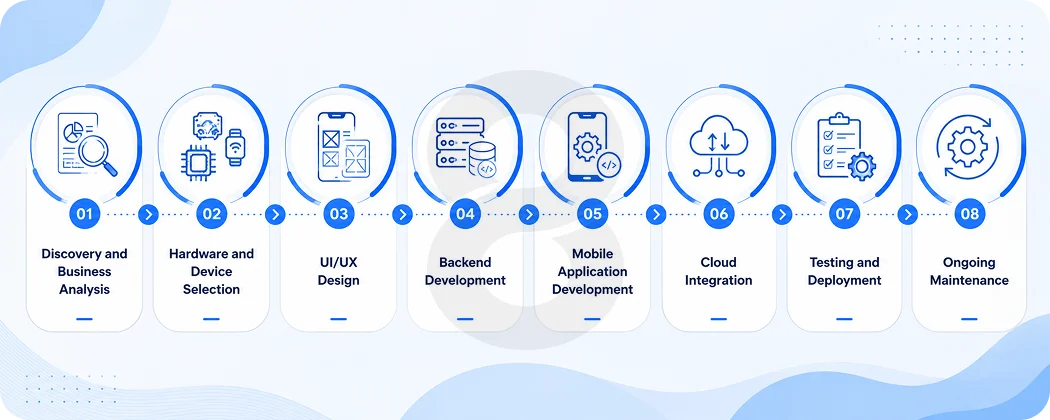
There are eight stages that are essential for a successful IoT project and failure to jump any of them is where projects tend to overspend or go over time.
Discovery and Business Analysis
During this stage, your team defines the problem the app will solve, identifies the target users, and outlines how the app will meet their needs before writing any code. Teams also determine the number of connected devices, estimate data volumes, and identify compliance requirements early. Clear planning helps prevent costly changes later. In contrast, poor requirements often increase the budget and delay IoT projects because many teams overlook the discovery phase.
Hardware and Device Selection
This step includes selecting sensors, chipsets and connectivity modules which are appropriate to the app’s real world environment. Various parameters such as power, range, field durability, etc., affect hardware applicability and can require costly re-design of the application later on if the hardware choice is wrong.
UI/UX Design
This phase creates dashboards and mobile user interfaces to make complex sensor data easy to understand at a glance. Clarity is the key, especially when users are making rapid operational decisions based on what they see, and a cluttered dashboard can lead to slow response times – when speed is important.
Backend Development
This phase involves creating the data pipelines, APIs, and the servers that handle incoming device data. Since this layer deals with constant, high frequency data streams, instead of sporadic user requests, this layer must be designed to be scalable, reliable, and fast to process data, and cannot simply be a standard web app backend.
Mobile Application Development
This step will give rise to the iOS and Android applications with which end users communicate to monitor and control devices. Developers must ensure the mobile app remains responsive, even when the network connection is unstable. Many IoT devices operate in the field, warehouses, or remote locations where internet connectivity is often unreliable. The app must continue to perform well under these conditions to deliver a consistent user experience.
Cloud Integration
This stage is responsible for linking the app with cloud infrastructure for storage, scaling and remote access. By enabling the elasticity to accommodate a surge in device activity, cloud platforms offer the storage capacity to store historical sensor data for future trend analysis and predictive modelling.
Testing and Deployment
This stage tests the functionality of the devices, the correctness of the data, and the performance of the application in a real-life network scenario. Testing an IoT app is not just about looking at the interface; it’s also about simulating lost connections, hardware failures, and heavy device loads to ensure that the system operates reliably in the real world.
Ongoing Maintenance
After launch, the team patches firmware, updates the app, and continuously monitors security. IoT products require ongoing improvements because new vulnerabilities emerge, devices age in the field, and user needs change over time. A well-defined maintenance plan keeps the app secure, reliable, and high-performing, making it just as important as the initial development process.
Essential Features Every IoT App Should Include
Regardless of industry, most successful IoT applications share a core set of features.
| Feature | Why It Matters |
|---|---|
| Real-time data monitoring | Lets users see live device status instead of stale reports |
| Remote device control | Allows users to adjust settings or trigger actions from anywhere |
| Push notifications | Alerts users immediately when a threshold or anomaly is detected |
| Analytics dashboards | Turns raw sensor data into charts and trends decision-makers can use |
| User authentication | Restricts device access to authorized users only |
| Device management | Lets admins add, remove, or reconfigure connected devices |
| Offline synchronization | Keeps the app functional and syncs data once connectivity returns |
| Firmware update support | Pushes security patches and feature updates to devices remotely |
IoT App Development Technology Stack
The right technology stack depends on the use case, but most IoT applications draw from a fairly consistent set of tools.
- Frontend technologies: React Native, Flutter, and Swift/Kotlin for native mobile experiences.
- Backend frameworks: Node.js, Django, and Spring Boot for handling device data at scale.
- Cloud platforms: AWS IoT Core, Microsoft Azure IoT Hub, and Google Cloud IoT for device management and storage.
- IoT protocols (MQTT, CoAP, BLE, Zigbee): lightweight messaging protocols built specifically for low-power, high-frequency device communication.
- Databases: time-series databases like InfluxDB alongside traditional SQL/NoSQL databases for structured records.
- AI and edge computing integration: machine learning models running closer to the device itself, reducing latency for decisions that cannot wait for a round trip to the cloud.
The AI-Augmented IoT (AIoT) market segment has scaled rapidly to reach roughly $102 billion, reflecting how much of this stack is now shifting toward smarter, on-device processing rather than pure cloud dependence. For businesses layering machine learning on top of sensor data, 8ration’s AI development team works alongside the IoT engineering team to build these predictive layers.
Read More: 40 Best Technology Stacks for Mobile App Development
IoT App Security Best Practices
Because IoT applications sit at the intersection of physical hardware and cloud software, they carry a wider attack surface than a typical app. A handful of practices form the baseline for any serious deployment.
- Device authentication ensures only verified hardware can connect to the network.
- End-to-end encryption protects data as it moves between the device, gateway, and cloud.
- Secure APIs prevent unauthorized systems from intercepting or manipulating device commands.
- Data privacy compliance keeps the application aligned with regulations like GDPR or HIPAA, depending on the industry.
- Firmware security closes vulnerabilities in the device’s underlying software, not just the app layer.
- Continuous monitoring flags unusual device behavior that could indicate a breach before it spreads.
Internet of Things App Development Cost
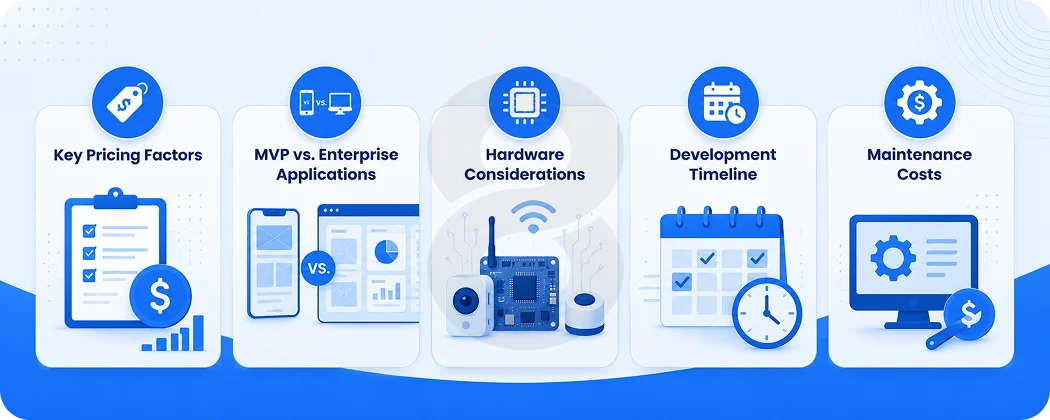
Cost is usually the first question business owners ask, and the honest answer is that it depends heavily on scope. A few factors consistently drive the final number.
Key Pricing Factors
Several factors determine the overall cost of an IoT app. These include the number of connected devices, the complexity of backend data processing, the required third-party integrations, and whether the project also involves designing custom hardware alongside the software. Furthermore, more devices and integrations generally mean more edge cases to handle, which directly increases both development time and ongoing support cost.
MVP vs. Enterprise Applications
A minimum viable product focused on one or two core features costs significantly less than a full enterprise platform that manages thousands of devices across multiple locations. Starting with an MVP lets businesses validate the concept with real users and real device data before committing to the larger investment an enterprise rollout requires.
Hardware Considerations
If sensors or custom hardware need to be sourced or designed, that adds both cost and lead time separate from the software development itself. Off-the-shelf sensors are usually faster and cheaper to deploy, while custom hardware, though pricier upfront, can be worth it for specialized use cases standard components cannot support.
Development Timeline
Longer timelines with more testing cycles, especially for industrial or medical-grade applications, increase overall cost. Projects with strict compliance requirements or safety-critical use cases need additional rounds of validation, which extends the schedule but is not a step worth cutting short given what is at stake if something fails.
Maintenance Costs
Ongoing firmware updates, cloud hosting, and security monitoring are recurring costs that continue well after launch. Businesses that budget only for the initial build often underestimate this ongoing expense, even though ignoring maintenance is exactly what leads to the security vulnerabilities and device failures that are far costlier to fix later.
| Cost Factor | Lower Cost Scenario | Higher Cost Scenario |
|---|---|---|
| Device count | Small pilot (under 100 devices) | Enterprise rollout (thousands of devices) |
| Feature scope | Basic monitoring and alerts | Full analytics, AI, and automation |
| Integrations | Single platform | Multiple ERP/CRM/legacy integrations |
| Compliance needs | Minimal regulatory requirements | HIPAA, GDPR, or industry-specific certification |
Common Challenges in IoT Application Development
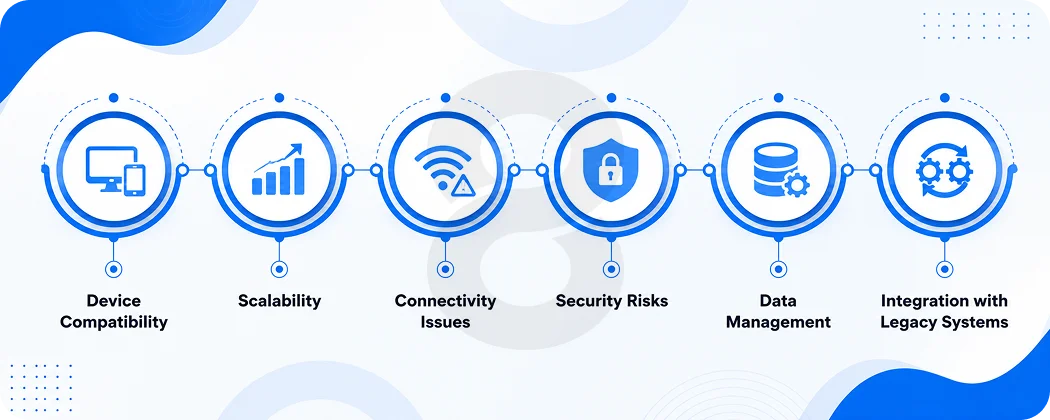
Even well-funded IoT projects run into a similar set of recurring obstacles.
Device Compatibility
Getting different hardware brands and chipsets to communicate reliably with one shared platform is harder than it sounds, especially when a project mixes vendors over time. Inconsistent firmware standards between manufacturers can force development teams to build custom compatibility layers just to keep every device speaking the same language.
Scalability
Designing an architecture that still performs well when device count grows from hundreds to thousands is a common breaking point. A system that works fine in a small pilot can slow down or become unreliable at scale if the backend was never built with that level of concurrent data in mind.
Connectivity Issues
Handling spotty or intermittent networks, especially for devices deployed in remote or industrial environments, requires the app to gracefully manage dropped connections rather than fail outright. Offline data caching and automatic resync become essential features rather than nice-to-haves once a device leaves a stable Wi-Fi environment.
Security Risks
The expanded attack surface created by every additional connected device is one of the most underestimated challenges in IoT projects. Each new sensor or gateway is a potential entry point, which means security cannot be treated as a single feature but needs to be considered at every layer of the system.
Data Management
Processing and storing the sheer volume of data continuous sensors generate without drowning the backend is a real engineering challenge. Businesses often collect far more raw data than they can actually use, so filtering, aggregating, and archiving that data efficiently matters just as much as collecting it in the first place.
Integration with Legacy Systems
Connecting new IoT platforms to older enterprise software that was never built with connected devices in mind often requires custom middleware. Legacy ERP or inventory systems rarely have native support for real-time device data, so bridging that gap is frequently one of the more time-consuming parts of a rollout.
Read More: Mobile App Development Challenges: Avoiding Costly Pitfalls in Your Next Project
How to Choose the Right IoT App Development Company
Not every software agency that lists “IoT” on their services page has actually shipped a production-grade connected product. A few things are worth checking before signing a contract.
Technical Expertise
Look for expertise in the specific protocols and cloud platforms your project needs, not just general mobile or web development skills. A team that understands MQTT, edge computing, and device provisioning will avoid costly architectural mistakes that a purely web-focused agency might not catch until well into development.
Industry Experience
Industry experience relevant to your use case matters, since healthcare IoT and industrial IoT have very different compliance and reliability requirements. A partner who has already navigated HIPAA rules or industrial safety standards will move faster and avoid the compliance gaps a first-time team in that sector might miss.
Portfolio Evaluation
Portfolio evaluation should confirm whether the company has actually launched IoT products, not just prototypes that never made it to real users. Ask to see live applications with real device deployments, since a polished demo built in a controlled environment does not guarantee the platform can handle real-world conditions.
Development Methodology
An agile development methodology allows for hardware-related surprises without derailing the whole timeline. Because IoT projects often hit unexpected hardware issues mid-build, a rigid waterfall approach tends to struggle, while iterative sprints let teams adjust scope and priorities as real device testing surfaces new information.
Post-Launch Support
Post-launch support matters because IoT apps need continuous firmware and security updates long after the initial launch. A development partner who disappears after deployment leaves a business exposed to unpatched vulnerabilities. So ongoing support terms should be discussed and agreed upon before the contract is signed, not after.
Questions to Ask Before Hiring
Before signing, ask how the team handles hardware failures during testing, what their approach to firmware updates looks like, and how they plan to scale the platform from a small pilot to full deployment. The clarity of these answers usually says more about a vendor than their sales pitch does.
Read More: Top 10 IoT Development Companies in the USA (2026 Rankings)
Future Trends Shaping IoT Application Development
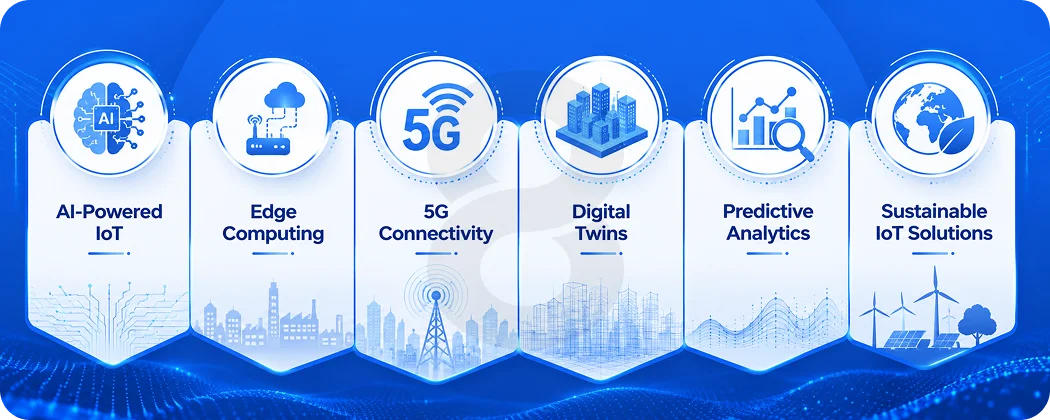
IoT is still evolving quickly, and a few trends are already shaping how new applications get built.
AI-Powered IoT
AI-powered IoT is moving beyond simple alerts toward systems that can predict failures and recommend actions automatically. Instead of simply flagging that a reading is out of range, these systems increasingly analyze patterns across historical data to tell a business what is likely to happen next and what action to take.
Edge Computing
Edge computing is pushing data processing closer to the device itself, cutting latency for time-sensitive decisions. Rather than sending every reading to the cloud for analysis, devices can now process data locally, which matters enormously for use cases like industrial safety systems where even a short delay could be costly.
5G Connectivity
5G connectivity is enabling far more devices to stay connected simultaneously with lower latency than previous network generations. This matters most for dense deployments, like smart city infrastructure or large factory floors, where thousands of devices need to communicate reliably without straining older network infrastructure.
Digital Twins
Digital twins let businesses simulate physical assets virtually, testing changes before applying them to real equipment. A virtual replica of a machine or facility lets teams model the impact of a change, like a new maintenance schedule, without risking downtime or damage on the actual physical asset itself.
Predictive Analytics
Predictive analytics continues to be one of the biggest value drivers, turning historical sensor data into forward-looking maintenance and operations decisions. As more historical data accumulates, these models get more accurate, making this one of the areas where long-term IoT investment tends to keep paying off well after launch.
Sustainable IoT Solutions
Sustainable IoT solutions are gaining traction as businesses use connected sensors specifically to reduce energy and resource waste. Businesses now use IoT applications for everything from smart irrigation in agriculture to energy monitoring in commercial buildings. They adopt these solutions not only to reduce costs but also to meet growing sustainability goals and comply with evolving reporting requirements.
Read More: Trends Every App Development Agency Should Be Following
Why Choose 8ration for Internet of Things App Development
8ration builds connected applications for businesses that need their hardware and software working as one system, not two separate projects bolted together after the fact. The team handles the full stack of an IoT product: device integration, mobile and dashboard interfaces, cloud backend architecture, and the ongoing firmware and security updates that keep a connected product reliable years after launch.
Work spans multiple verticals, from agriculture platforms that help farms manage irrigation and crop health, to consumer-facing apps that give users control over connected devices in real time. Rather than treating IoT as an add-on to standard mobile development, 8ration’s engineering, AI, and mobile teams work together from the discovery phase onward. So the hardware, backend, and user-facing app are designed around the same data model from day one.