


A change in the healthcare landscape has occurred that is permanent. Patients now expect to schedule appointments, check their lab reports, see a specialist and pick up a prescription, all from a browser tab or phone screen. All of those slick interactions are the result of a meticulously crafted healthcare web app, and the teams creating them are driving the next generation of medicine. Bringing it a step further, what used to be a service is now an expectation, and health organizations that can’t deliver are quietly eroding patient numbers.
This is no ordinary tech tale. It’s a tale of trust. The software needs to be swift, precise, secure and compassionate when a patient logs into a portal to read the result of a biopsy or a cardiologist pulls up a dashboard to check overnight telemetry data. This guide details the healthcare web app development market, vital features, and how to select among healthcare web app development companies, along with the actual cost of it done properly in 2026.
Why Healthcare Web Apps Have Become Mission-Critical
Ten years ago there was only a “find a doctor” search box and a static website on a hospital’s digital footprint. Without a strong digital infrastructure, health systems are losing out on patients who are taking the opportunity to switch to a competitor that does have one. The global digital health market was valued at USD 312.9 billion in 2024. It is projected to increase from USD 387.8 billion in 2025 to approximately USD 2.19 trillion by 2034, expanding at a compound annual growth rate (CAGR) of 21.2% during the forecast period.
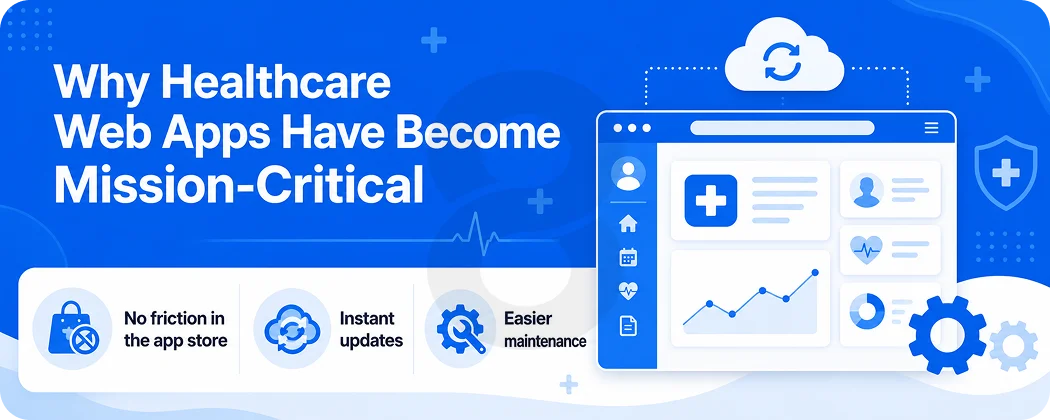
That explosion is centered on healthcare web application development. There are some advantages of a web app that are very important in a regulated field, which is absent from native apps:
It’s device-agnostic, meaning it functions on every browser, from the old-fashioned Android phone to Windows desktops to the newest iPad.
- No friction in the app store: Patients engage immediately
- Instant updates: Compliance patches and feature releases deploy without waiting for app store approval cycles
- Easier maintenance: A single code base to maintain over time, hence lower engineering cost
Clinicians are, too, power users of browser-based tools. In 2026, almost every EHR portal, clinical decision support console, telemedicine console and population health platform is web-first. The browser is now the clinical work station. Meanwhile, with the distinction between consumer health apps and clinical use apps no longer starkly defined, patients are taking what they learned from banking apps and streaming services into the health experience.
What Makes Healthcare Web App Development Unique
Creating a web app for healthcare is not the same as creating a SaaS project management application. It is categorically different in three dimensions.
Compliance with regulations is a prerequisite. Compliance with regulations is a must.
HIPAA is the law that any application that works with Protected Health Information (PHI) in the United States has to follow. There were a lot of stringent security rule changes in 2024. The same model applies to other markets (GDPR/EU, PIPEDA/Canada, PDPA/S.E.A).
It’s important to embed compliance from the beginning, rather than patching it on at the end. That means:
- Secure data in transit & secure data at rest
- Role-based access control (RBAC) using least privilege mechanisms
- Automatic logout and re-authentication
- No matter what happens, every access to the data is captured in an immutable log
- DOCUMENTED data breach response plans
- Implemented Business Associate Agreements with all third-party vendors
Developers who don’t have a lot of compliance experience often underestimate the cost of development and the extent to which it influences all technical decisions. An incorrectly configured storage bucket is not a bug; it’s a HIPAA violation that could result in six-figure fines and public disclosure.
Read More: How to Build HIPAA and GDPR Compliant Apps: A Security Checklist
Core Features of a Modern Healthcare Web App
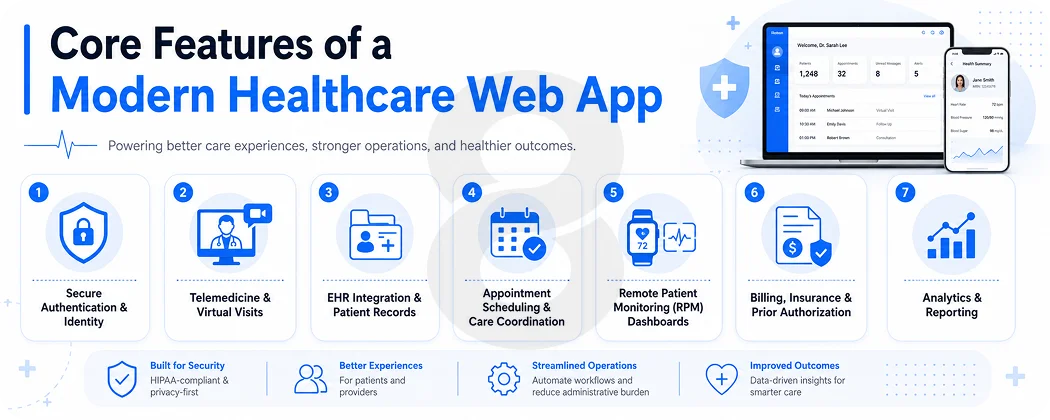
These features are non-portable and not self-contained modules. If connected correctly, they create a connected ecosystem that creates compounding value for each stakeholder in the care continuum.
Secure Authentication & Identity
2026 is the time when multi-factor authentication, biometric login and SSO integration with hospital identity provider become standard. The WebAuthn and passkey paradigm has become the norm for passwordless flows. Identity is the basis of personalization, audit trail, and the willingness of patients to interact with health information digitally.
Telemedicine & Virtual Visits
WebRTC video consultation has become a commodity feature. The differences are:
- Noise cancellation and real-time transcription using AI.
- Structured note generation and summarization of visits automatically
- In-session e-prescribing with Pharmacy Networks
- Concurrent session for high-volume telehealth programs.
EHR Integration & Patient Records
Bidirectional FHIR data exchange, medication reconciliation, and problem list management provide a holistic perspective of the patient’s health record to clinicians and patients. The aim is to reduce the pain of having to explain their entire medical history to each new provider they visit, which is time-consuming, error-prone, and discourages patient trust.
Appointment Scheduling & Care Coordination
Intelligent scheduling, automated reminders, and waitlist management are table stakes when it comes to self-service scheduling. AI-powered scheduling in 2026 can predict no-show occurrences and proactively schedule appointments, a proven ROI driver. Others are taking it further, alerting patients who are due for preventive screenings and sending them reminders to schedule an appointment on the platform, transforming the portal from a reactive to a proactive care management solution.
Remote Patient Monitoring (RPM) Dashboards
Data from the wearables (Apple Watch, Garmin, CGM, blood pressure cuffs, etc.) continuously streams to clinician dashboards that can be configured with alert thresholds. Key capabilities include:
- Longitudinal trend visualization of biometrics with clinical notes
- Alerting based on thresholds with escalation workflows
- Patient engagement dashboards to support compliance
- Chronic disease care management integration
Billing, Insurance & Prior Authorization
Cost estimators, insurance verification and automated prior authorization workflows are all patient-facing and significantly reduce administrative burden. In a typical practice, approximately 16 hours of physician and staff time are lost each week to prior authorization. This inefficiency allows automation to have a direct and measurable impact on both costs and physician burnout.
Analytics & Reporting
The analytics layer, population health dashboards, tracking of quality measures or operational reporting, are now required for value-based care contracts. If health systems aren’t able to prove quality outcomes, they could jeopardize payer contracts. And analytics infrastructure has become a cost of doing business, rather than just a bonus.
Read More: Modern Healthcare App Features: Top 10 Essential Additions for 2026
Technology Stack Options for 2026
The option to select a specific stack isn’t one that can be made solely on a technical basis; it also has strategic implications, such as availability of talent, long term maintenance costs, and integration with the rest of the health IT world.
Frontend
- React / Next.js 15: Dominant for complex healthcare applications, Next.js preferred for public facing portals that require SEO.
- The VA Design System / NHS Design System: WCAG compliant component libraries, designed specifically for healthcare.
- Svelte 5 / SolidJS: Rising in the clinical dashboard arena of performance-sensitive applications
Backend
For real-time features, WebSockets for live RPM data, WebRTC signaling, rich ecosystem is provided with node.js and TypeScript.
- Python with Pandas, Numpy, and Scikit-Learn: Ideal for data science and machine learning components.
- Python with SQL: Best for data databases and data processing.
In many platforms, GraphQL is supplanting REST in order to get accurate and efficient FHIR data retrieval.
Infrastructure
- AWS: Market Leader for HIPAA data portfolios; the widest range of HIPAA compliant services;
- Microsoft Azure: A favorite among health systems already using the Microsoft platform.
- Microsoft Azure: A health system favorite for those that are already using the Microsoft platform
- Google Cloud: best AI/ML tooling for clinical genomics and radiology AI
- Standard containerization at scale with auditable, reproducible deployments via Terraform: Kubernetes.
AI & Machine Learning
One of the biggest changes from 3 years ago is the level of integration of AI into the healthcare web app stack. The main architectural pattern is retrieval-augmented generation (RAG) and a clinical knowledge base, which grounds model outputs in verifiable, up-to-date medical facts. Ambient clinical documentation, drug interaction checks, diagnostic suggestions and drafting prior authorization letters are among the applications. Hallucination detection, with corresponding workflows of human-in-the-loop review, are essential component of every AI pipeline in a clinical setting, as there are no abstract consequences to a fabricated drug dosage.
Read More: 13 Must-Have EHR Features in 2026 for Efficient Healthcare Management
The Development Process: From Discovery to Launch
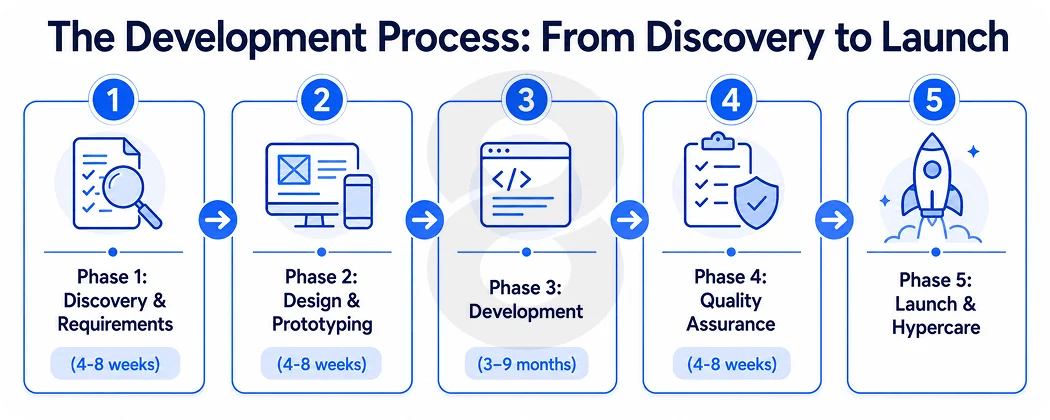
Skipping any part is a type of technical debt that will carry a disproportionately high cost in a regulated setting. An issue identified after launch that does not meet compliance requirements can result in operations being stopped until remediation is completed.
Phase 1: Discovery & Requirements (4-8 weeks)
Stakeholder interviews with clinicians, patients, administrators, and compliance officers; workflow mapping of the current state; regulatory scoping; and technical architecture planning. This is where the most critical decisions are going to be taken and where the best return on your efforts is going to be had.
In Phase 2: Design & Prototyping (4-8 weeks)
students will design and prototype solutions. The designs of high-fidelity prototypes are tested by real clinical users before writing one line of production code. At this point, a successful healthcare website design and app development process often brings up workflow needs that product managers can see as common sense, but nurses and patients who are to use it will not.
Phase 3: Development (3–9 months)
Two-week sprints, followed by CI/CD pipelines that are triggered through each pull request:
- Automated unit and integration tests against the FHIR sandboxes.
- Static analysis security scans (SAST) and dependency vulnerability checks.
- Penetration testing from third-party security companies every 3 months.
- Documents that need to be signed: HIPAA Security Risk Assessment, System Security Plan, BAA execution
Phase 4: Quality Assurance (4-8 weeks)
Functional testing, performance load testing, accessibility audits, and cross-browser validation. An open enrollment portal that fails is a patient care failure.
Phase 5: Launch & Hypercare
Initial implementation with pilot sites and real-time monitoring dashboards with a dedicated hypercare engineering team available within the first 30-60 days of implementation.
Read More: 10 Telehealth Mobile App Success Stories: What Worked and What Didn’t
Choosing Among Healthcare Web App Development Companies
Healthcare web app development firms vary from one person to a huge company that specializes in HIPAA. A faceless demo won’t serve as a substitute for a thorough reference check. When considering potential partners look for the following:
- Compliance depth: Commitment to compliance (dedicated compliance officer, sample BAAs, security policies, past audit reports)
- Clinical domain experience: Case studies from similar clinical circumstances; evidence of real clinician study of workflow
- Track record of EHR integration: Production integrations (not just sandboxes!) with EHRs in your ecosystem
- Post launch support model: Contractually agreed support model for continued patching, feature development, compliance monitoring as regulations change
CTOs or CMIOs that they have spoken with directly at health systems, and their experience in dealing with production incidents and challenging compliance results.
If the team has never interacted with an ICU nurse or a revenue cycle manager, they’ll create workflows that work in a demo and break on the job. The lack of domain depth doesn’t mean it’s a cheap domain; it means it’s not a good domain.
Read More: Top 10 Healthcare App Development Companies in UK (2026 Guide)
Cost Considerations
When it comes to healthcare web application development, don’t prioritize the cheapest quote. Any reduction in investment in quality engineering pales in comparison to the cost of a security violation, regulatory fines, breach notification, reputational damage and litigation. Breach remediation expenses are five to 10 times higher than the cost of a less experienced partner, and that’s the hard way.
Product Type |
Initial Development |
Annual Maintenance |
| Patient portal (scheduling, messaging, telehealth) | $400,000 – $1,200,000 | $80,000 – $200,000 |
| Clinical decision support dashboard | $250,000 – $800,000 | $60,000 – $150,000 |
| Remote patient monitoring platform | $500,000 – $1,500,000 | $100,000 – $250,000 |
| Consumer wellness app (lower regulatory burden) | $150,000 – $500,000 | $30,000 – $80,000 |
A better way to discuss development cost focuses on value gained per dollar spent, cost savings per hour of administrative time, incremental revenue from improved patient retention, and savings from avoided readmissions. In that context, a well-constructed healthcare web app is not an expense, but rather a worthwhile investment. It is infrastructure.
Trends Defining Healthcare Web App Development in 2026
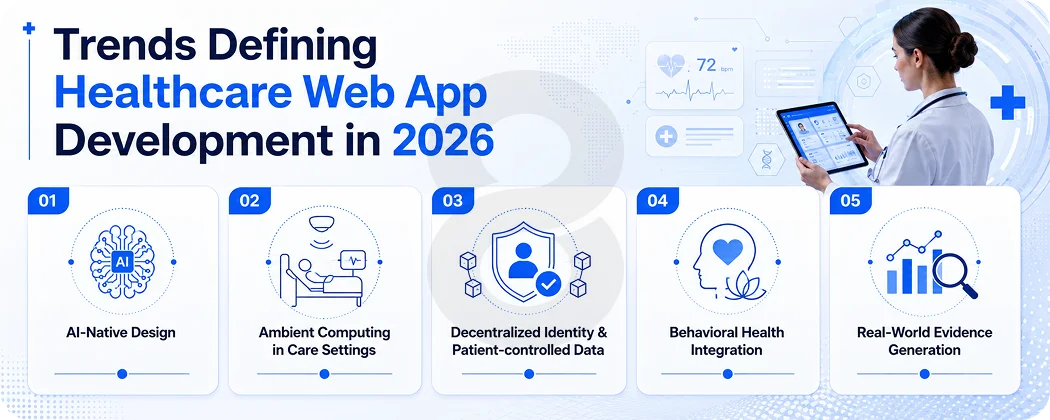
Field is rapidly advancing. If you don’t consider your healthcare web app to be a “work in progress,” then you will be losing on several fronts at the same time. Here are some of the trends that will define the future of healthcare software development:
- AI-Native Design: Apps developed from the beginning using AI as a first-class interaction method, with insights being brought to the fore in the clinical workflow, not just a chatbot.
- Ambient Computing in Care Settings: Voice-controlled browser applications are common in surgical suites and those in an ICUs where hands-free operation is required. Speech API integration for the Web and custom clinical voice models are transitioning from pilot projects to production. Integration of WebSpeech API and custom clinical voice models are transitioning from pilot to production.
- Decentralized Identity & Patient-controlled Data: After TEFCA implementation, patients can share smaller pieces of their records with specific providers without having to contact medical records, a paradigm change in patient-provider data relationship.
- Behavioral Health Integration: The biggest rising section in healthcare web app development. One in five adults has a mental health condition, but digital behavioral health tools were relatively unsophisticated. That gap is closing quickly with platforms with embedded validated screening tools (PHQ-9, GAD-7), integrated scheduling of therapy and longitudinal outcome tracking.
- Real-World Evidence Generation: Health systems are creating layers of web applications on their EHRs that allow them to systematically gather patient-reported outcomes and then upload them to research pipelines, eliminating the need for a separate research infrastructure.
Conclusion
In 2026, healthcare web app development is one of the most challenging, challenging, and rewarding domains of software engineering. Developers are building these applications now, and these applications will affect the lives of millions of people in healthcare over the next 10 years. They will help patients receive timely diagnoses, enable clinicians to manage chronic conditions effectively, and help people feel informed and respected as stakeholders in their own healthcare.
Success in healthcare engineering requires more than strong technical skills. It demands both deep knowledge of clinical process, regulatory requirements, and the human factors of patients experiencing illness and healthcare workers under time constraints. It requires that accessibility and usability in healthcare website and application design be treated as clinical priorities rather than secondary considerations. The selection of healthcare web app development companies that are truly as serious about compliance as they are about the project. Finally, it involves choosing healthcare web app development companies that are as committed to compliance as they are to delivering the project.
The organizations of the future that will continue to shape healthcare are not necessarily the largest buildings or those with the most beds. Instead, they are the ones that invest wisely in digital infrastructure to ensure care is excellent, well-coordinated, and continuously improving. Patients waiting for better tools, haven’t needed them more.
Looking to start a healthcare web application development project? Work with a professional development partner as early as possible, ideally before you have a full picture of your requirements. This allows you to design compliance architecture, EHR integration strategy, and clinical UX research into your product from the ground up.