



That number you got from a competitor’s pricing page or an agency quote from two years ago is basically useless now.
The market has matured. A quiz app with push notifications was good enough in 2019. Today, learners expect personalized content paths, cross-device syncing, offline access, and some flavor of AI feedback. The bar has moved significantly.
The global education technology market was valued at $187 billion in 2025 and is projected to grow to $213.2 billion in 2026, at a CAGR of 10.8% through 2033. According to Statista, revenue in the online education market worldwide is projected to reach $221.71 billion in 2026.
That growth means more sophisticated apps, more complex builds, and more money. The sections below break down exactly where that money goes.
How App Type Shapes Your Entire Budget
This is where most founders go wrong. They come in thinking all educational apps are roughly the same, just different subjects, different colors. They’re not. The type of app you’re building determines your architecture, your backend complexity, your compliance requirements, and ultimately your price tag more than any individual feature does.
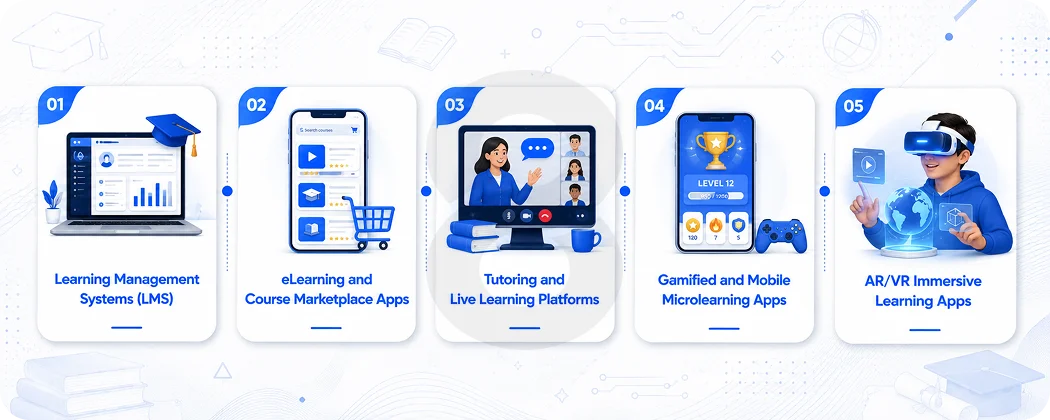
Learning Management Systems (LMS)
LMS platforms are the heaviest builds in the EdTech category. They require multi-user role logic (students, instructors, admins, sometimes parents), content versioning, reporting dashboards, and long-term progress tracking that has to survive course updates without corrupting learner histories.
A standard LMS product is estimated to cost between $30,000 and $60,000 for a moderate-sized user base. When the platform must synchronize with HR software or external analytics tools, development complexity rises, and budgets often reach $80,000 or more.
eLearning and Course Marketplace Apps
Think of something in the range of Udemy or Coursera, but scoped to your niche. These apps focus on structured content delivery and need solid video streaming, progress tracking, monetization (subscription, per-course, bundles), and a content management system that non-developers can actually use.
The cost here depends heavily on how the content is delivered and updated. A static course library is much cheaper than a dynamic marketplace where third-party instructors upload and manage their own content.
Tutoring and Live Learning Platforms
Platforms for booking tutors and delivering live instruction require scheduling systems, payment processing, and real-time communication features. Costs for tutoring and live learning platforms typically range from $70,000 to $140,000.
Real-time video, availability calendars, instant booking, and payment splits between platform and tutor add meaningful backend complexity that gets expensive quickly.
Read More: How to Build an Appointment Scheduling System
Gamified and Mobile Microlearning Apps
Apps like Duolingo use gamification mechanics (streaks, XP, leaderboards, rewards) to drive retention. These are often cross-platform and designed for short, daily sessions. The design work is intensive, and the engagement logic requires careful backend architecture to avoid abuse.
Adaptive microlearning apps for wearables usually cost between $10,000 and $22,000 and take 3 to 4 months to develop, including bite-sized content delivery, AI-driven recommendations, device compatibility, and synchronization with mobile platforms.
Read More: 7 Best Apps for Brain Training 2026
AR/VR Immersive Learning Apps
The expensive end of the spectrum. Any time you’re building spatial interactions, 3D model rendering, or real-world overlay experiences, you’re in a different cost category entirely.
Immersive learning apps using AR and VR typically cost $8,000 to $24,500 and take 4 to 6 months to develop at the simpler end. Full enterprise VR training simulations for industries like healthcare, manufacturing, or aviation can run north of $150,000.
Read More: 10 Best Education App Development Companies
Educational App Cost by Type (2026)
| App Type | Estimated Cost Range | Development Timeline |
|---|---|---|
| Simple Quiz / Flashcard App | $15,000 – $30,000 | 2 – 3 months |
| eLearning MVP (single platform) | $30,000 – $60,000 | 3 – 5 months |
| LMS (standard, moderate users) | $40,000 – $80,000 | 4 – 6 months |
| Course Marketplace (multi-instructor) | $60,000 – $120,000 | 5 – 8 months |
| Tutoring / Live Learning Platform | $70,000 – $140,000 | 6 – 9 months |
| AI-Powered Adaptive Learning App | $80,000 – $180,000 | 6 – 10 months |
| Enterprise LMS (multi-tenant, integrated) | $100,000 – $250,000+ | 8 – 14 months |
| AR/VR Training Simulation | $80,000 – $300,000+ | 6 – 14 months |
What Actually Drives the Cost Up (And What Doesn’t)
Most educational app cost calculators will give you a list of features and let you check boxes. That’s not really how it works in practice. The real cost drivers are architectural, not cosmetic.
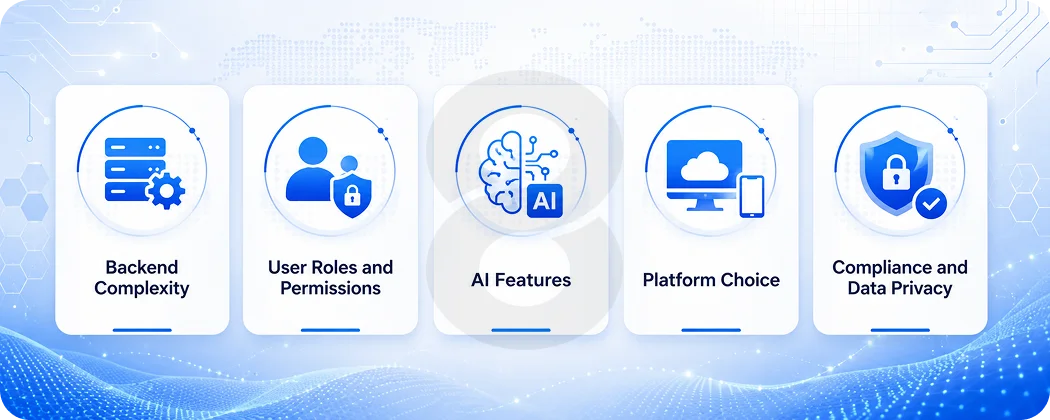
Backend Complexity
Educational applications usually appear simple to users; they provide lessons, quizzes, reminders, progress indicators, and certificates. However, behind the interface sits a complex backend system that includes content management, user permissions, analytics, integrations, and infrastructure designed for scaling.
The frontend might take 30% of the total build. The backend often eats the other 70%.
User Roles and Permissions
Educational platforms rarely serve a single audience. Learners, instructors, administrators, and content managers all interact with the system differently. Each role introduces additional logic, interface states, and testing requirements, causing complexity to grow faster than expected.
Every additional user role you add isn’t just another dashboard to design. It’s a whole new set of data access rules, notifications, workflows, and edge cases that need to be tested across every feature.
AI Features
In 2026, if your app doesn’t adapt to the student, it is dead on arrival. Adding AI tutors or automated grading adds about 30% to your total bill.
And yet, it’s increasingly worth it. AI in education is the fastest-growing segment, with a CAGR of 42%, reaching $23 billion in 2026. Users now expect their learning tools to know something about how they learn.
Platform Choice
Native iOS and Android apps built separately cost more, sometimes double, compared to a cross-platform build using Flutter or React Native. Cross-platform reduces upfront cost but may limit deep device integrations like camera-based AR or complex animations.
Compliance and Data Privacy
If you’re building for schools or handling children’s data, COPPA (in the US), FERPA, and GDPR in Europe all add compliance overhead that nobody budgets for until a lawyer gets involved. Don’t be that person.
The Hidden Costs Nobody Mentions in Their Proposal
This is the part where people get burnt. You get a $60,000 quote, think you have a handle on the budget, and then reality starts arriving in invoice form.
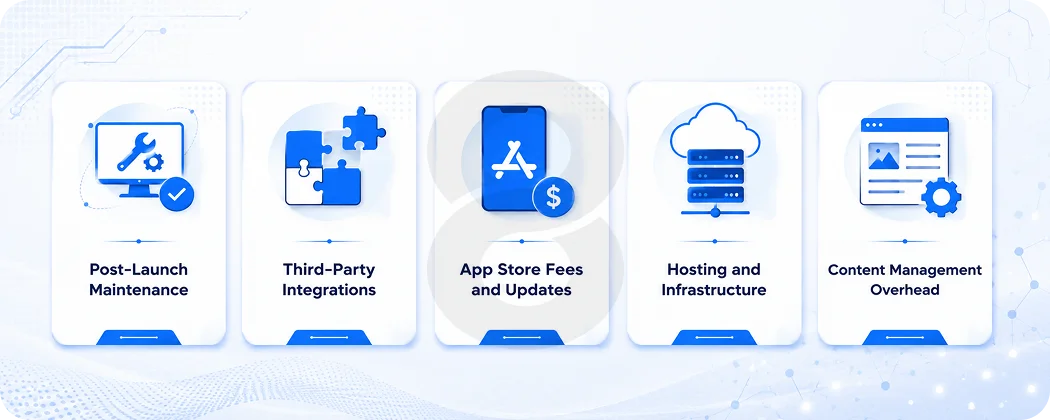
Post-Launch Maintenance
Usually, maintenance cost is around 15–20% of the total development cost per year. On a $70,000 app, that’s $10,500 – $14,000 per year just to keep things secure, updated, and compatible with new OS versions. Most people don’t budget for this until something breaks.
Third-Party Integrations
Stripe for payments, Zoom for live sessions, Twilio for SMS notifications, Mixpanel for analytics. Every integration seems small but adds time and cost. API configuration, error handling, webhook management, and synchronization logic all add up.
App Store Fees and Updates
Apple and Google both take a 15–30% cut of in-app purchases and subscriptions. App store submissions require testing. OS updates break things. These aren’t optional costs.
Hosting and Infrastructure
Cloud infrastructure scales with users. A launch-day budget of $200/month on AWS can become $2,000/month if you hit unexpected scale. Planning for auto-scaling and caching from the beginning saves money long-term.
Content Management Overhead
Someone has to create, update, and maintain the actual learning content. If you’re building a platform for others to upload content, moderation and quality control become ongoing operational costs.
Read More: Mobile App Development Cost 2026
Development Team Costs: What Region You Build In Matters
The same educational app can cost dramatically different amounts depending on where your development team is based.
A senior developer in the US may charge $78–$125+ per hour, whereas similar expertise in India could cost $20–$40 per hour.
Eastern European countries such as Poland, Ukraine, and Romania typically charge $35–$70 per hour, attracting Western European clients looking for cultural proximity and data protection compliance.
For educational apps specifically, the quality of the team matters more than the hourly rate. An app that fails to handle concurrent users, loses learner progress data, or has accessibility issues will cost far more to fix post-launch than it would have to build properly the first time.
Hourly Rates by Region (2026)
| Region | Junior Developer | Mid-Level Developer | Senior Developer |
|---|---|---|---|
| USA / Canada | $60 – $90/hr | $90 – $130/hr | $130 – $180+/hr |
| Western Europe | $50 – $75/hr | $75 – $110/hr | $100 – $140/hr |
| Eastern Europe | $25 – $40/hr | $40 – $60/hr | $55 – $75/hr |
| Latin America | $20 – $35/hr | $35 – $55/hr | $50 – $70/hr |
| South Asia (India/Pakistan) | $15 – $25/hr | $25 – $40/hr | $35 – $55/hr |
Breaking Down Education App Costs by Development Phase
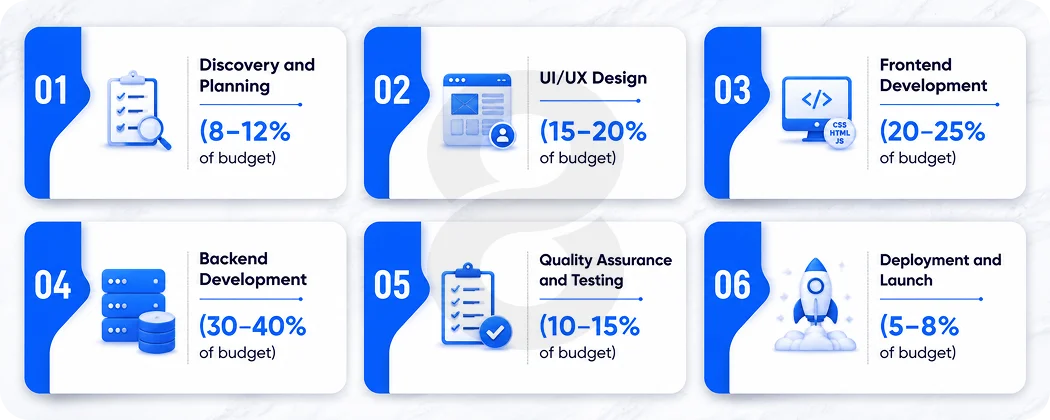
Understanding where your budget actually goes helps you make smarter trade-offs. Here’s how a typical education app development cost breaks down across the development lifecycle.
Discovery and Planning (8–12% of budget)
This is the phase that people cut to save money and then pay for in expensive rework. A solid discovery phase includes user research, technical architecture planning, competitive analysis, and wireframing. Skipping it is how projects end up three months in, halfway through a rebuild.
For a $100,000 project, expect $8,000 – $12,000 here. Worth every dollar.
UI/UX Design (15–20% of budget)
Educational apps live or die by their UX. If learners find the interface confusing, they stop learning. Retention is directly tied to usability. Custom design is more expensive than template-based design but meaningfully improves engagement metrics. For a $100,000 build, expect $15,000 – $20,000 for design.
Frontend Development (20–25% of budget)
Building what users actually see and interact with: lesson screens, progress dashboards, quiz flows, onboarding, notifications. Cross-platform frameworks like Flutter can compress this cost by allowing a shared codebase across iOS and Android.
Backend Development (30–40% of budget)
The largest slice of most EdTech projects. APIs, databases, authentication, content delivery, user permissions, analytics pipelines, payment processing. This is where most of the real complexity lives and where scope creep is most dangerous.
For a custom eLearning platform built to scale, the backend is not a place to cut corners.
Quality Assurance and Testing (10–15% of budget)
Manual and automated testing across devices, operating systems, network conditions, and user roles. Educational apps often need accessibility testing too, which adds time.
Deployment and Launch (5–8% of budget)
App store submission, server configuration, monitoring setup, and initial performance optimization.
Read More: Mobile App Development Process – From Idea to Launch
Typical Budget Breakdown for a $100,000 Educational App
| Phase | Cost Estimate | % of Total |
|---|---|---|
| Discovery and Planning | $8,000 – $12,000 | 8 – 12% |
| UI/UX Design | $15,000 – $20,000 | 15 – 20% |
| Frontend Development | $20,000 – $25,000 | 20 – 25% |
| Backend Development | $30,000 – $40,000 | 30 – 40% |
| Quality Assurance | $10,000 – $15,000 | 10 – 15% |
| Deployment | $5,000 – $8,000 | 5 – 8% |
AI Integration in Educational Apps: What It Costs and Why It’s Hard to Skip
The AI in education market is growing at a 42% CAGR, reaching $23 billion in 2026. That’s not a trend anymore. That’s the baseline expectation for serious EdTech products.
84% of learners report increased engagement with gamified EdTech solutions, and eLearning through EdTech platforms improves information retention rates by 25% to 40%. When AI-driven personalization is layered on top of that, the results are even stronger.
What AI actually adds to an educational app:
Adaptive learning paths that adjust difficulty and content sequencing based on performance data. Automated feedback on written answers or code submissions. AI tutoring chatbots for 24/7 support. Predictive analytics to identify students at risk of dropping out. Content recommendation engines.
For a custom AI development integration in an educational app, expect to add $15,000 – $50,000+ to the base build cost depending on complexity. A basic recommendation engine sits at the lower end. A full adaptive learning system with natural language feedback pushes toward the top.
Strategies to Reduce Educational App Development Cost Without Cutting Quality
The goal isn’t to build cheap. The goal is to build smart. There’s a real difference.
- Start with a genuine MVP: Not “MVP” as a buzzword that means “full product we’ll call lean because we like the word.” A real MVP: one core user problem, solved well, shippable in 8 – 12 weeks. Validate the concept before building the whole platform.
- Choose cross-platform development: A well-executed mobile app development project built in Flutter or React Native can save 30–40% versus separate native builds for iOS and Android, without meaningful quality loss for most educational apps.
- Prioritize backend architecture early: It sounds counterintuitive to invest more upfront, but poor database design and an unmaintainable API structure will cost double to fix at scale. This is where the difference between a $60,000 app that needs a full rebuild in 18 months and one that runs cleanly for five years lives.
- Phase your AI features: A basic analytics dashboard and progress tracking in version one. Content recommendations in version two. Adaptive learning paths in version three. Many projects exceed budget because teams focus on features instead of system design, scalability, and long-term product goals.
- Don’t outsource based on price alone: A team quoting $15/hour that’s never shipped an education product will cost more than a $45/hour team that’s done it ten times. Ask for EdTech-specific portfolio work before you commit.
- Plan your content management system properly: How instructors, admins, or editors update content post-launch is often more expensive than anticipated. A clean CMS built into the original scope avoids costly workarounds later.
The Android app development or iOS build you skip testing on will find a way to remind you about that decision in your first week of public launch.
Read More: How to Choose the Right MVP App Development Company for Your Startup
Maintenance, Updates, and the Long Game
Nobody wants to talk about this in the initial pitch, but it’s half the real cost of running an educational product. Hidden costs in educational app development include app store fees, third-party integrations, server hosting, marketing, and ongoing maintenance.
Annual maintenance at 15–20% of build cost means:
- $30,000 app: $4,500 – $6,000/year to maintain
- $80,000 app: $12,000 – $16,000/year
- $150,000 app: $22,500 – $30,000/year
That’s for keeping things working. It doesn’t include new features, redesigns, or responses to competitor moves. Content updates are an ongoing cost too. A language learning app with outdated vocabulary packs loses users.
A coding course that still teaches deprecated frameworks destroys credibility. The products that survive in EdTech long-term are the ones whose teams treat launch as day one, not finish line.
Is It Still Worth Building an Educational App in 2026?
The market says yes, with conditions. The global EdTech market is expected to reach around $404 billion in total expenditure, with 14 EdTech unicorns holding a combined valuation of $33.84 billion as of February 2026. The global eLearning market has 620 million active learners in 2026, and MOOC completion rates have improved to 12.6%, up from 6% in 2020.
The spaces still open: corporate upskilling, K-12 supplemental learning in underserved markets, vocational training, and accessibility-first tools for neurodiverse learners. The spaces that are crowded: generic course platforms, basic quiz apps without a content strategy, language apps that aren’t meaningfully better than what already exists.
Clear differentiation and a real underserved audience make the education app development cost worth it. Without that, the math gets harder.
Read More: How to Create an App: 8 Steps to Build an App in 2026
How 8ration Approaches Educational App Builds
Every educational app project starts the same way at 8ration: with architecture, not aesthetics. Before any screen gets designed, the team maps out data flows, user roles, content structure, and scalability requirements.
That upfront work is what keeps projects on budget and prevents costly rebuilds six months post-launch. From cross-platform mobile app development to full AI development integration, the focus stays on building something that actually grows with your user base.