



Hiring the wrong app team hurts in a way you only understand after the damage is already done.
You join the kickoff call, hear all the right words, scan a proposal that looks clean enough, and try to ignore the timeline that feels a little too neat. You want to believe it because you’re tired, the runway is shrinking, and honestly, you need something to move.
Then three months pass.
The app is half working. Users are confused. The budget has taken a hit. And someone on Slack is asking whether the onboarding flow was ever approved or whether everyone just nodded at the same Figma screen and hoped for the best.
That is why choosing the right MVP app development company matters. You need a team that understands your first product is a test of real user behavior. People need to use it, come back to it, pay for it, or at least show you clearly why they won’t.
Why Startup MVPs Fail Before They Even Launch
A lot of MVPs die quietly before users ever touch them. Once the landing page goes live and the app reaches TestFlight, the founder usually shares the launch on LinkedIn and the team gets a few polite comments.
After that, user behavior starts telling the harder truth. Confusion shows up in the flow, speed becomes a problem, the release feels late, or the product already costs too much to keep pushing. Founders just ignore them because the team is already busy.
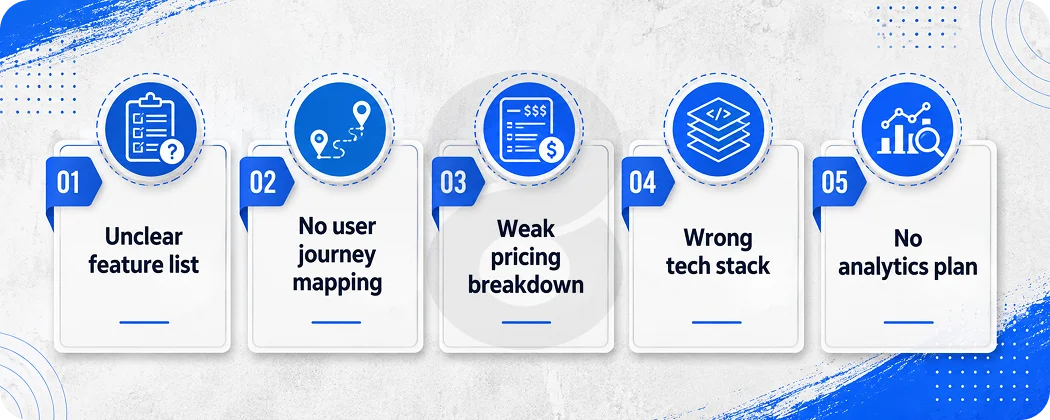
Some warning signs are easy to spot. The first signs usually appear early. The company accepts your feature list without debate, sends one large estimate with no clear breakdown, starts UI screens before mapping the user journey, and picks a tech stack based on preference instead of product fit.
Nobody talks about analytics until launch week. QA happens at the end, which is basically how bugs throw a farewell party inside your app.
An app development MVP should answer a business question. The proof changes by product. A restaurant app may need to show that owners can accept orders through the flow, while a healthcare app may need to prove that patients can book appointments without calling.
A driver app may need to test whether users keep location sharing on long enough for the product to work. For a dashboard, the real question is whether small businesses will pay for it after trying it.
If the app does not answer that question, you built software. You did not validate anything. The data backs this up in uncomfortable ways. CB Insights analyzed hundreds of startup post mortems and found that no market need ranks as the top reason startups fail, sitting above running out of cash and getting the team wrong.
How to Shortlist the Right MVP App Development Company
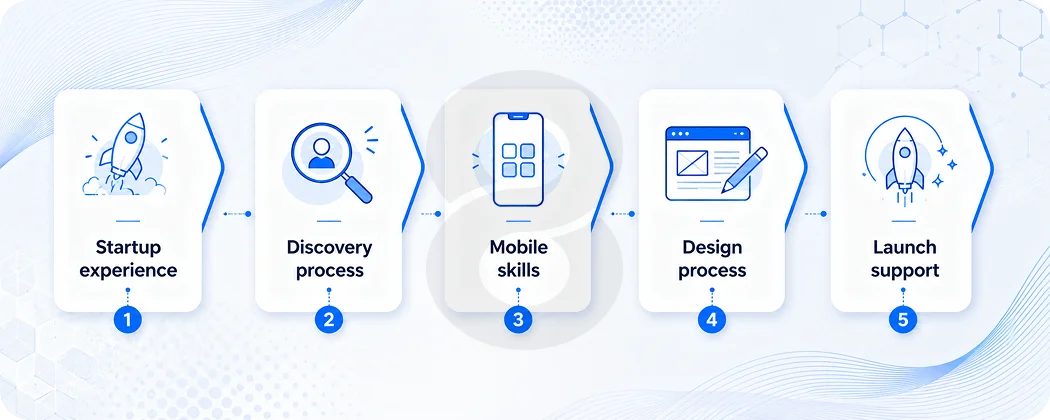
The first filter is simple. Look for companies with real startup work in their portfolio, especially projects where tight scope, limited budget, and fast validation mattered. Enterprise delivery can be impressive, but startups need a different muscle. They need fast thinking, clear scoping, honest tradeoffs, and comfort with uncertainty.
Start with five to seven companies. Look at their case studies, app store links, design quality, technology range, and whether they explain outcomes. A pretty portfolio with no results is decoration. You want to see what changed after launch.
Look for outcomes behind the project. The case study should explain whether the app attracted users, helped with funding, reduced development time, or received support after release.
Check whether they offer proper early stage product validation instead of jumping straight into development. Then look at their mobile strength.
If your product leans hard on iOS, Android, push notifications, offline access, maps, payments, or camera features, please do not hand it to a team that only treats mobile like a squeezed down website. That mistake gets expensive fast.
So before you book calls, ask for two things. A relevant app example and a rough explanation of how they would approach your product. Good teams ask for context before pricing the work. Weak teams send a package price before they understand the product.
Read More: MVP Vs Full Product On-Demand App Strategy: Which One Saves More Money?
Ask About Discovery Before You Ask About Cost
Cost matters because startup money disappears fast, and some agency quotes make it feel like nobody in the room has ever worried about runway.
But asking for cost before discovery is how you get fake certainty. A company can guess based on similar projects, but it cannot responsibly price your mvp mobile app development without understanding user roles, feature depth, integrations, compliance needs, admin tools, and launch goals.
A useful discovery phase should give you something you can hold the team accountable to. You should receive user journeys, feature priority, technical notes, API risks, rough architecture, design direction, timeline, estimate range, and a clear version one scope. If discovery ends with a vague PDF and a happy paragraph about your vision, you paid for vibes.
This is where many founders get trapped. Free discovery feels attractive because nobody wants another upfront cost. But free discovery often means the company is doing just enough to close you, not enough to protect you. Paid discovery is not always better, but it forces both sides to treat the planning work seriously.
A good discovery sprint can save months. A bad one just delays the invoice.
Review Their UI/UX Process Like Your Budget Depends on It
Because it does. Bad UX is annoying because it doesn’t always look bad at first.
Sometimes the screenshots look clean. The buttons are in the right place and the colors feel fine. Everyone in the meeting nods because the screen looks “professional enough.”
Then real users open it. They get stuck during signup.
They either miss the main action, don’t understand the pricing, or leave checkout halfway through. Some delete the app after one confused session, and now the team is sitting there wondering whether the problem is marketing, pricing, onboarding, or the product itself. Usually, it started with the flow.
The numbers tell the same story. Around 25% of users abandon a mobile app after a single session, and roughly 71% churn within 90 days. The product rarely gets a second chance to explain itself, which is why the flow decides retention more than the visual polish does.
For app development mvp work, design should start with flow, not decoration. The team should map the user path from first open to first value. This is not overthinking but the point where retention starts.
A strong team will create wireframes, clickable prototypes, design systems, and usability checks before heavy engineering begins. They will also explain what should not be custom designed yet. You do not need a massive visual system for a basic MVP. You do need enough design quality that users trust the product.
If your startup is building a consumer app, marketplace, delivery product, fintech tool, health app, or booking platform, invest in mobile app design work early. Not because pretty screens win. Because clear screens reduce support tickets, angry reviews, and founder panic.
Read More: UX Design for Trust: Principles Behind App Experiences at 8ration
Compare Technical Skills Without Pretending You Are the CTO
Nontechnical founders often feel exposed during technical calls. You do not want to ask a basic question and sound clueless. But honestly, the right team will not make you feel stupid. They will explain tradeoffs in plain language.
Push them on technical choices. A good team should be able to explain the tech choice without making you feel like you walked into an engineering exam. They should tell you why native makes sense in some cases, why Flutter or React Native makes sense in others, and where the tradeoffs will show up later.
For many startup MVPs, cross platform development is the route that hurts the least. You get iOS and Android from one shared codebase, which usually means fewer hours, fewer moving parts, and fewer budget conversations.
It can save money and help you launch faster. And when the runway is already making people nervous, that matters more than anyone wants to admit.
But it is not always the answer. Apps with heavy device features, intense performance needs, or complex native interactions may need a different approach.
A good MVP mobile app development partner will not worship one technology. They will match the stack to the product.
You also need clear answers on code review, documentation, repository access, ownership, handover, and what happens if another team takes over later.
These questions feel uncomfortable before signing. They feel much worse after a breakup.
Read More: How to Create an App: 8 Steps to Build an App
Understand MVP Development Cost Before You Sign
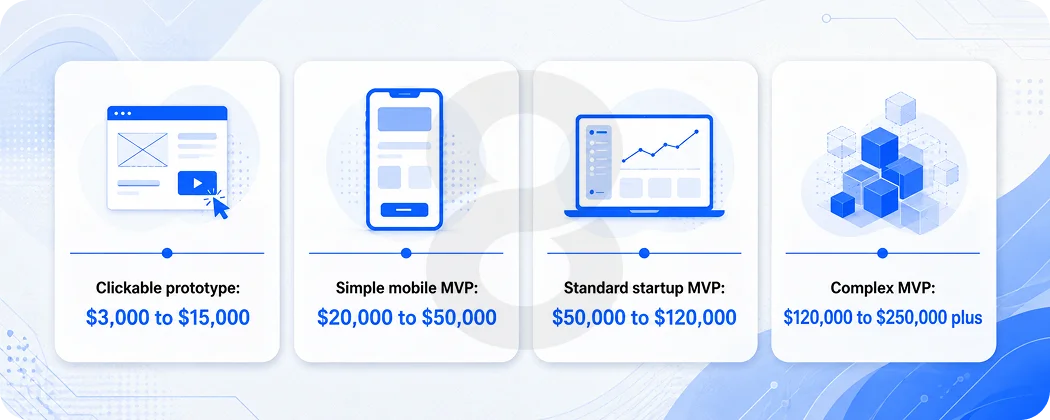
MVP cost is where a lot of founders start sweating, and honestly, fair enough. The number depends on scope, team location, design depth, backend work, platform choice, integrations, and any compliance requirements hiding in the corner.
If someone gives you a fixed price after a five minute call, they are either guessing or trying to get you into the sales funnel. Maybe both.
A simple app with login, basic profiles, one main user flow, admin access, and basic notifications can sit around $20,000 to $50,000. That is the cleaner version, the one where the product has limits and everyone agrees not to turn it into a “small” version of a full company.
A mid level MVP with payments, maps, chat, scheduling, analytics, and custom backend logic can land between $50,000 and $120,000. More complex products with AI, fintech flows, health compliance, marketplaces, real time data, or multi role dashboards can go much higher.
The quote should explain the logic behind the number, including features, hours, roles, phases, assumptions, and exclusions. If the company only gives you one clean total, ask for the detailed version because that is usually where the real risks appear.
Do not pick the cheapest quote because you are scared. Pick the clearest quote because you are serious.
Look for Scope Discipline, Not Just Speed
Every company says it can build fast, so do not judge that claim by the sales pitch alone. Ask what the team would remove from your MVP.
The answer will tell you how seriously they think about scope. A real MVP app development company will push back when the product starts getting bloated. It will help you separate must have features from nice to have ideas, explain what can wait, and protect your runway even when adding more features would increase the invoice.
That kind of scope discipline protects the product and the budget, especially when every new feature sounds harmless in a meeting.
Here is what it means. A founder may want social login, referral rewards, AI recommendations, a loyalty wallet, live chat, advanced filters, subscriptions, and a full analytics dashboard in version one. Some of those features may matter later. But the first question is simpler. Can users complete the core action and get value?
The real test depends on the product. A fitness app may need users to create a plan and come back for a week. A delivery app has to prove that customers can place and track an order without asking for help. In SaaS, the stronger signal is a team choosing the product over the spreadsheet they already hate.
MVP app development works when version one is narrow enough to finish and useful enough to test.
Check Their Testing, Analytics, and Launch Plan
Founders love launch day until the first crash report lands.
Testing cannot be an afterthought in mvp mobile app development. Even a lean MVP needs QA across devices, screen sizes, operating systems, network conditions, payment flows, push notifications, and user roles.
If the app has location tracking, booking slots, media uploads, real time chat, or subscriptions, testing gets even more serious.
Ask what their QA process includes. Manual testing, automated checks, regression testing, API testing, performance checks, security review, and app store readiness should be part of the conversation.
You may not need all of it on day one, but you need enough to avoid embarrassing failures in front of your first users.
Analytics matter just as much. Your MVP should track activation, drop offs, retention, conversion, feature use, crash rate, session length, churn, and user feedback. Otherwise, you will launch and still argue from opinions.
QA protects the product before launch, while analytics shows what needs fixing after real users start touching it.
And yes, post launch support should be written into the agreement. Bugs, fixes, severity levels, response times, maintenance cost, and new feature pricing. Get it all clear before anyone celebrates.
Read More: Mobile App Development Process – From Idea to Launch
Watch for Red Flags During Sales Calls
The sales process is usually a preview of delivery. If they are vague before money changes hands, do not expect magical clarity after the deposit.
Be careful when a team promises a full MVP in four weeks without asking hard questions, says yes to every request, avoids code ownership, or cannot explain who will actually work on your project.
Also watch how they talk about your idea. A good partner respects your vision while still questioning the weak parts before they become expensive. They will question weak assumptions and seek what evidence you already have. They will also tell you where the idea is risky. It might sting a little. That is fine. Better in a meeting than after launch.
Here are questions worth asking.
- What would you remove from this MVP?
- What could break the timeline?
- Which integrations need early validation?
- Who owns the code and design files?
- What happens after launch?
- How do you define a bug versus a new feature?
- What metrics should we track in the first 30 days?
If they answer clearly, keep talking. If they dodge, move on.
Read More: Why 80% of Apps Fail: A Founder’s Guide to Success
Decide Whether You Need Native, Cross Platform, or Web First
Your platform choice should come from users, budget, and how the product actually works.
Mobile makes sense when your users spend most of their time on phones and the product depends on push notifications, camera access, location, offline mode, or app store presence. A web MVP may be the better first move when the early users are internal teams, B2B buyers, admins, or people who will mostly use the product from a desk.
If you need both iOS and Android without building two separate apps from scratch, cross platform app delivery can keep the cost and timeline more controlled. This decision affects budget, development speed, testing, maintenance, and how quickly you can put the first version in front of users.
An app development mvp should start on the platform where your first real users are most likely to act. Many startups waste money building iOS, Android, and web together because they are afraid of missing users. That fear is expensive. Start where your first real users are. Build there. Learn there. Then expand.
Ask the company to explain the tradeoff in plain English. If they push the most expensive route without evidence, question it. If they push the cheapest route without explaining future limits, question that too.
Good technical advice usually sounds boring. That is a compliment.
Read More: Flutter vs React Native: Which Is Better for Business Apps
Why Choose 8ration for MVP App Development
8ration works best for founders who need strategy, design, development, and launch support in one place. That matters when the product is still early and small decisions can create big messes later.
The team can help shape the MVP, design the first user flow, select the right technology stack, build the mobile or web product, test it properly, and improve it after launch.
For startups, that joined up workflow is useful because handoffs are where things often fall apart. The designer assumes one thing. The developer builds another. The founder expected a third. Then everyone discovers the mismatch during QA, which is exactly when nobody has patience left.
8ration’s strength is practical product execution. The goal is a focused first version that users can try, understand, and judge without getting buried under extra features.
Final Checklist Before You Hire
Before you sign, slow the process down enough to see the gaps. That feels frustrating when the idea finally seems real, but this step can save months of avoidable stress.
Ask for a scoped proposal instead of a single price. It should explain who is on the team, what discovery includes, what the estimate excludes, how changes are handled, how communication works, whether weekly demos are included, how payments are tied to milestones, and who owns the code, design files, and documentation.
Then look at how the company responds. Clear answers show maturity. Defensive answers reveal risk.
The right MVP app development company will help you build less at first, learn faster, and avoid turning your startup into an expensive guessing game. That is the whole point. You are not trying to win an award for the most features in version one. You are trying to find out whether the product deserves version two.