



You already know the feeling in case you have been running generative AI at scale. Your engineering department delivers a smooth artificial intelligence feature. Users love it. Engagement climbs. Three weeks later you get your cloud bill, and you are looking at a line entry that appears to have a typo in it. It isn’t.
It is the age of the token tax, the silent, compound cost, that each generative AI application pays each inference call. With organizations competing to integrate large language models into their products and internal processes, the field of FinOps in AI has ceased to be a nice-to-have and has become a mandatory issue on the boardroom level. AI spend management should not be only about cost reduction in 2026. It is all about creating a sustainable, predictable, and intelligent cost infrastructure that grows with your aspirations.
This blog demystifies the real meaning of the token tax, why it even takes mature engineering organizations by surprise, and how intentional FinOps AI practices and tooling can assist you in predicting, managing, and optimizing it throughout your entire AI/ML pipeline.
What Is the Token Tax and Why Does It Spiral?
Large language models are computed using tokens as the unit of computation. Each word, each mark of punctuation, and each character of whitespace you input into a model, or have as an output of it, costs money. Individually, cents per thousand tokens are not very crucial. It is a large operation cost line, and it will compete or even surpass a whole legacy infrastructure budget at the scale of a production application with millions of requests per day.
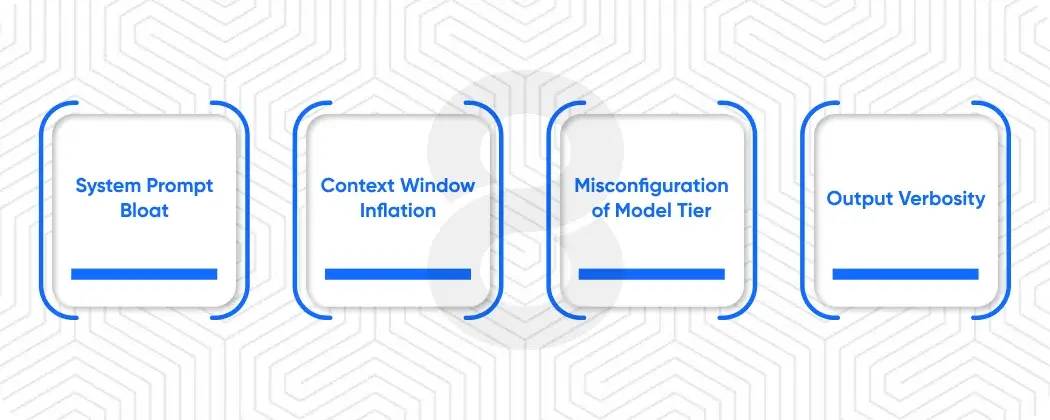
Not only is the token tax volume. It puts together in a manner that is not immediately evident.
System Prompt Bloat
Enterprise applications frequently overburden system prompts with elaborate front-loads to implement tone, persona, compliance rules, or domain-based backgrounds. These prompts may be 2,000-5,000 tokens and actually get re-sent with each and every user request. When serving 100,000 requests a day, your system can burn 200–500 million tokens daily before processing a single user message.
Context Window Inflation
The Retrieval-Augmented Generation pipelines add the retrieved document bits into the model setting. Conversation history: Multi-turn conversational applications repeat all conversational history with every turn. Both trends increase the number of per-request tokens as a session matures, a phenomenon occasionally referred to as context drift. A discussion beginning with 1000 tokens per turn can be easily expanded to 8 000 tokens without any sound by the tenth turn.
Misconfiguration of Model Tier
Frontier models are not necessary in all tasks. However, most groups give in to the temptation to use their most able and most costly model on every request, even basic classification, intent recognition. Or response verification tasks, which can be accomplished equally well by a smaller and less expensive model. This is the working alternative to rushing with groceries in a Formula 1 car.
Output Verbosity
LLMs are properly trained to be comprehensive. They will tend to generate much more output than is required without clear restrictions on output length. The appropriate prompt structure, which has a clear output format, can minimize the output token counts by 40-60 percent without any quality degradation.
These four factors combined imply that two AI applications that have the same amount of traffic at the user interface may experience an order of magnitude difference in their token cost simply due to architectural choices and prompt-level choices.
Why Traditional FinOps Falls Short for AI Workloads
Classical FinOps applies practices such as tagging resources, right-sizing instances, and using reserved capacity to infrastructure workloads, where cost is measured by compute time and storage. Generative AI violates this model in several important ways.
AI Costs Are Request-Shaped, Not Time-Shaped
The price of an API call could be a fraction of a cent or even several cents based on the immediate structure, model, and output size, regardless of the time that it takes to run. The more traditional cost allocation tools, such as CPU hours or GB-months, merely fail to provide this level of detail.
AI Costs Are Non-Linear
The increasing user base does not necessarily double your AI expenses. In case your application involves long-session conversations, the expenses may get super-linear with respect to the depth of conversation. On the other hand, you can increase usage with the same costs in case of the correct optimization of the situation.
Accountability Is Diffuse
A microservices system may have a dozen or more groups of people making calls to the same AI APIs without a central view of who is using what. Unless instrumented purposefully, AI cost will be an indistinguishable lump on the bill of the cloud-shared service account that has no identifiable owner.
This is exactly why serious organizations with regard to FinOps, AI, and ML are establishing specific practices that extend much beyond regular cloud cost oversight. The tooling is different. The models of mind differ. And organizational muscle to do it well is slow to build and is developed purposely.
The global cloud FinOps market size was valued at USD 15.11 billion in 2025. The market is projected to grow from USD 16.79 billion in 2026 to USD 39.04 billion by 2034, exhibiting a CAGR of 11.12% during the forecast period.
Read More: What is Spatial Intelligence? Examples, Uses, and Improvement Tips
The Four Pillars of a Modern FinOps for AI Practice
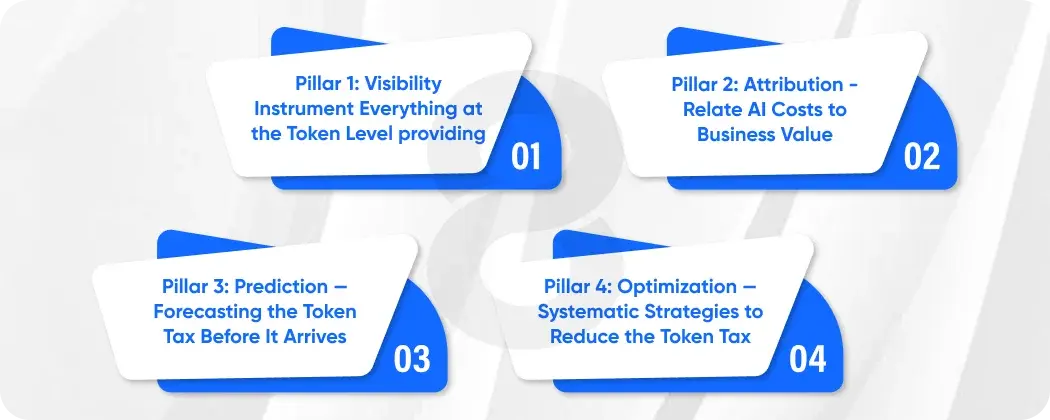
The 2026 vision for effective FinOps AI structures the practice around four interrelated disciplines: visibility, attribution, prediction, and optimization. Optimization strengthens the other disciplines, and teams need all four to build a mature and resilient AI cost management practice.
Pillar 1: Visibility Instrument Everything at the Token Level
You cannot control things that you cannot quantify. The first and most fundamental need of any FinOps user to use AI is the real-time, granular telemetry of each inference call that your application makes.
What to Log on Every AI Call
This implies that you will have to capture at least the following information about each request:
- Model used: What model level was used to process the request
- Number of input tokens: Number of consumed tokens in the prompt
- Number of output tokens: The number of tokens produced during the response
- Feature or user flow: What feature of the application made the call
- Response latency: Time to first token and response time to completion
Teams must organize this information, make it queryable, and present it in dashboards that engineering, product, and finance teams can read and act on in real time, instead of leaving it buried in raw logs that no one will ever read.
The Questions Visibility Must Answer
This aims at providing specific, operational questions on demand: What is the most expensive feature of my application when called by AI? Which user group consumes tokens disproportionately?
Teams need to determine what proportion of overall AI expenses comes from system prompt tokens versus real user content. They must also track which model tiers handle which types of requests and assess whether that routing is optimal.
Without this level of instrumentation, the token tax remains hidden, and invisible costs stay unmanaged.
Pillar 2: Attribution – Relate AI Costs to Business Value
Raw spend visibility is not enough but is needed. The second tier of FinOps practice in AI maturity is attribution, linking AI costs to the business results they produce.
The Apps Associates FinOps for AI and ML Framework
Here, organized apps bring to the table FinOps of AI and ML systems, adding much value to the organization. The main premise is that AI spend must never be assessed in isolation but only when it is compared to the value it generates. An AI customer support system at a price of 0.04 dollars per fully resolved ticket is much more justifiable as compared to one that will incur the same price but will not solve the problem. A document summarization feature offered to premium-tier subscribers costs more per token than the feature offered to free-tier subscribers.
Cost-Per-Value Metrics
Attribution frameworks establish a per-unit-of-value costing method for every AI-based feature. Common examples include:
- Price per successful completion of tasks: For task automation features
- Per-user session costs by cohort: divided into subscription or user type
- CPR/DR allowed: AI-aided sales/upsell processes
- Cost per deflected support ticket: For conversational AI in customer service
These metrics put the token tax in ROI language, which is comprehensible by the finance stakeholders. They also design the appropriate incentive systems to motivate engineering groupings to make value-per-token choices versus capability benchmarking.
Pillar 3: Prediction – Forecasting the Token Tax Before It Arrives
Among the most agonizing aspects of AI cost management, there is the delay between decision-making and outcomes. A developer writes a new prompt, a feature becomes available, and weeks later, on the consolidated cloud bill, the cost effect is visible, at which point it would be difficult to roll it back with considerable organizational tension.
Design Time Token Budget Forecasting
Major organizations now implement token budget forecasting as an integral part of development and deployment processes and evaluate cost projections as rigorously as performance benchmarks. At the application design phase, teams estimate the token budgets for every AI-driven application feature before writing a single line of code. Teams take assumptions about the amount of expected input tokens on the basis of past behavior. Make estimates about the length of outputs on the basis of immediate product design choices, and make estimates about request volumes on the basis of forthcoming product expansion forecasts.
Cost Regression Detection during Deploy Time
At the deployment phase, AI cost telemetry has become increasingly common in canary releases as a first-class deployment signal, in addition to latency and error rate. When a new prompt design increases the average number of output tokens by 30 percent, teams must treat it with the same urgency as a 30 percent rise in P99 latency. They should address cost regressions as bugs and fix them before they reach full production traffic.
ML-Powered Cost Estimation
The prediction issue is an increasingly important application of machine learning. The teams are training cost prediction models that take the historical inference logs and predict with a high level of precision the estimated cost of tokens of a particular more precise prompt, user session, or workflow. These are models that drive a real-time cost estimation tooling that displays developers the estimated impact of a timely change in cost to the monthlies before they commit it to the codebase, cost awareness as far left in the development process as possible.
Pillar 4: Optimization – Systematic Strategies to Reduce the Token Tax
After attaining visibility, attribution, and predictive capability, optimization turns into an organized, repetitive engineering process and not a single cost-cutting event. The following are the most influential levers, which will mature FinOps for AI teams in 2026.
Prompt Compression and Semantic Caching
Compression methods can significantly reduce token usage. In prompt compression, smaller auxiliary models compress verbose prompts into shorter versions that preserve the same semantics, often reducing input tokens by 30–50 percent with little quality loss.
Dynamic Model Routing
AI platform teams can apply one of the most leverageable optimizations through intelligent request routing. In this approach, a lightweight classifier analyzes each incoming request and routes it to the most cost-effective model tier. A carefully developed routing system can service 60–70 percent of requests on smaller, lower-priced models and reserve frontier model capacity for complex reasoning tasks. When your lowest-price model tier is a tenth of your highest-price one, sending half of your requests to low-cost models reduces total AI expenditure by almost 47.5%, a revolutionary effect on any organization that is doing AI at scale.
Output Length Governance
Context Window Management
Batch Inference for Async Workloads
Not all AI tasks require a response to take 500 milliseconds to respond to. Latency of a few minutes or hours is generally tolerable in document processing, content generation pipelines, data enrichment processes, and compliance review processes. The largest providers of AI provide batch inference APIs on asynchronous workloads at a strong discount, frequently 40-60 percent of the price of a synchronous API. One of the most easily available cost reduction opportunities that any AI engineering team has is to identify and migrate eligible workloads to batch inference.
FinOps Tools for AI ML Pipelines: The 2026 Landscape
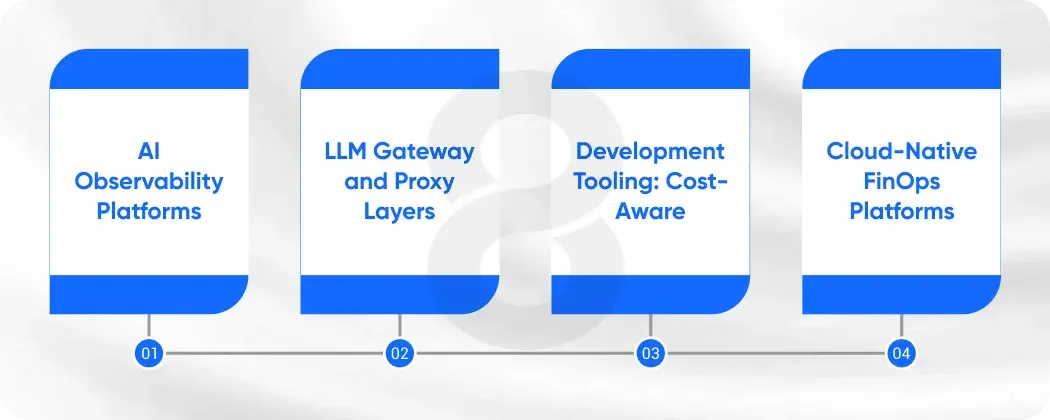
AI Observability Platforms
More recent platforms, such as LangSmith, Weights and Biases, and Arize AI, are now offering token-level trace logging, cost attribution by feature and user group, and cost spike anomaly detection as a feature of the serving model, naturally. These are the platforms that have turned out to be the backbone of FinOps as an AI practice in mature organizations.
LLM Gateway and Proxy Layers
Tools such as LiteLLM and Portkey lie in between your application code and the model APIs, and you get to maintain centralized control over model selection, rate limiting, caching, and cost tracking of each team in your organization. Instead, they address the attribution diffusion problem by building one instrumented chokepoint containing all the AI spend flow. Which is especially useful when it comes to large engineering organizations, in which one or more teams independently invoke AI APIs without coordination.
Development Tooling: Cost-Aware
A new type of IDE integration and CI/CD pipeline plugins now present real token cost estimates at the development workflow itself. This approach moves cost consciousness to the left-hand side of the equation, enabling teams to catch expensive, last-minute designs during the code review phase instead of discovering them on the monthly cloud bill after incurring the costs.
Cloud-Native FinOps Platforms
Organizational Design: Who Owns AI FinOps?
The Federated FinOps Model
The best system to adopt by 2026 is a federated one: a narrow central AI platform group is the owner of the observability infrastructure, sets cost standards and token budget rules. Operates the forecasting models, but embedded cost champions in each product engineering team are responsible for the AI money spent by their particular feature.
This form prevents the two forms of failures that afflict less mature organizations. In the first case, a finance or platform team attempts to control AI expenses in a completely centralized setup without the product background needed to make quality decisions. In the second case, individual engineering groups operate in a completely decentralized setup where they cannot see their AI budget or have an organizational incentive to minimize it.
The rails are determined by the central team. The champions in the train are the embedded champions.
The global cloud FinOps market is expanding rapidly, with a projected market size anticipated to rise from about USD 14.88 billion in 2025 to USD 26.91 billion by 2030, featuring a CAGR of 12.6%.
Read More: How to Make an Artificial Intelligence in 2026
The Road Ahead: From Cost Management to Cost Intelligence
With increasingly more intense penetration of generative AI into enterprise software, the token tax will simply increase in absolute terms. The organizations that develop strict FinOps for AI practices today will expand on their terms. They will scale AI-powered experiences with confidence since they know, forecast, and control the economics of inference.
The transition that will occur in 2026 is the reactive cost management changing to proactive cost intelligence. Even the most successful AI engineering organizations do not simply spend money to track their token usage but use the token usage data to make more effective architectural decisions. Focus on higher value features, and negotiate more favorable model pricing with providers, as well as produce products that are economically viable at scale.
The token tax is real. It is also predictable and measurable, and with the appropriate FinOps solution in AI/ML pipelines, it is also fully manageable. Those organizations that mandate AI cost discipline as an essential engineering skill on par with reliability and security are those that will be in a position to achieve maximum speed, experiment the most, and create the most long-lasting AI-powered products in the coming years.
It is not a question of the ability to invest in AI in terms of FinOps. On a large scale, the question is, can you afford not to?