



If you’ve been asking yourself how much it costs to make a health app, you are within the proper region. The health app enterprise exploded after 2020 and hasn’t bogged down since. From guided workouts and calorie trackers to AI-powered coaches and wearable integrations, health apps now cover every nook of the wellness industry, and clients cannot get enough of them. But before you could build the subsequent Peloton or MyFitnessPal, you would want a clear-eyed view of health app improvement prices.
Budgeting incorrectly is one of the principal motives that promising health startups fail in their first 12 months. Either they run out of money mid-construction, or they ship an undercooked product that customers abandon fast. Neither final result is acceptable when you have an extraordinary idea and a real market to serve.
This manual covers each important cost element, design, development, trying out, infrastructure, launch, and protection with real numbers, comparison tables, and expert breakdowns so you can plan your investment with complete self-belief.
The Fitness App Market: Why It’s Worth the Investment
Before diving into prices, it enables one to understand why the funding makes experiences inside the first location. The global fitness app marketplace was valued at about $5.7 billion in 2024 and is projected to grow at a compound annual growth rate of 14.3% through 2030, reaching nearly $14.7 billion. Over 86 million people inside the United States on their own used a health app in 2024, and that number keeps rising as smartphones emerge as more effective and fitness awareness grows globally.
In app purchases and subscription models are sort of, the main ways fitness apps end up making revenue now, and the leading apps like Noom, Calm, and MyFitnessPal have been pulling in hundreds of millions each year thanks to repeat memberships. Also wearable tool integration, like Apple Watch, Fitbit, and Garmin, has kind of slid from being a premium differentiator into a more standard consumer expectation, for most people. What this indicates for builders is simple: the opportunity is widespread; however, the bar for quality is better than ever. A nicely funded, properly deliberated development technique isn’t non-obligatory; it’s the price of admission.
Types of Fitness Apps and Their Base Costs
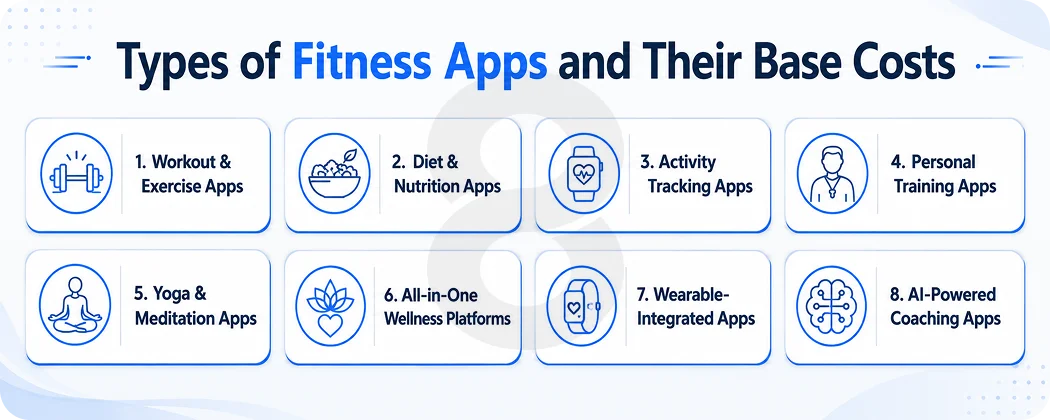
Not all health apps are really made equal, and the kind you end up choosing to build from has a big impact on your overall health app improvement cost. A basic yoga steering app with pre recorded sessions running, works very differently, in a technical way and also in a money way, compared to an AI powered private learning platform with live video coaching and biometric sync.
App Type |
Description |
Estimated Cost Range |
| Workout & Exercise Apps | Exercise libraries, video demos, workout plans | $20,000 – $80,000 |
| Diet & Nutrition Apps | Calorie counting, meal planning, and food database | $25,000 – $90,000 |
| Activity Tracking Apps | Step counting, GPS runs, heart rate monitoring | $30,000 – $100,000 |
| Personal Training Apps | Live/recorded coaching sessions, scheduling | $40,000 – $150,000 |
| Yoga & Meditation Apps | Guided sessions, breathing exercises, sleep tools | $20,000 – $70,000 |
| All-in-One Wellness Platforms | Combines workout + nutrition + sleep + coaching | $100,000 – $300,000+ |
| Wearable-Integrated Apps | Deep integration with Apple Watch, Fitbit, and Garmin | $60,000 – $200,000 |
| AI-Powered Coaching Apps | Personalized plans via ML, adaptive workouts | $80,000 – $250,000+ |
The most crucial strategic insight right here is that building a niche-centered app will almost always be inexpensive and faster to validate than launching a huge health platform from day one. Many of the brand-new, largest fitness apps, which include Headspace and Strava, started as single-motive equipment before expanding their feature sets over a couple of years and funding rounds.
Read More: Healthcare App Development Cost in 2026: A Detailed Guide
Fitness App Development Cost by App Complexity
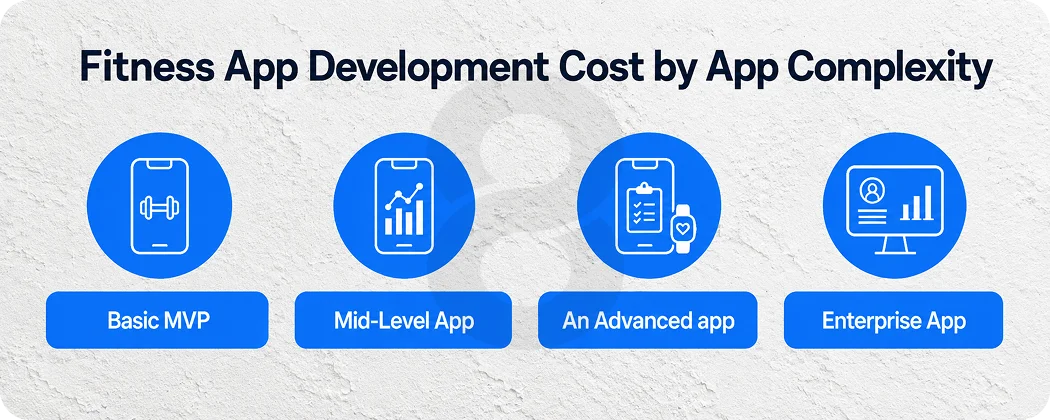
The most frequent manner to estimate how much it costs to make a fitness app is via a complexity tier. Broadly speaking, apps fall into 4 categories: basic MVP, mid-level, advanced, and enterprise. Each tier represents not simply more features but a fundamentally specific funding in infrastructure, crew length, and timeline.
Complexity Level |
Features Included |
Timeline |
Cost Estimate |
| Basic MVP | User auth, 1–2 core features, basic UI, single platform | 2–4 months | $15,000 – $40,000 |
| Mid-Level | Multi-feature, social elements, third-party APIs, analytics | 4–8 months | $40,000 – $100,000 |
| Advanced | AI recommendations, video streaming, wearables, and payments | 8–14 months | $100,000 – $200,000 |
| Enterprise | Full-stack wellness platform, custom CMS, B2B tools, scale infrastructure | 12–24 months | $200,000 – $500,000+ |
Basic MVP
A basic MVP is the starting line for most first-time founders. It usually includes user registration and login via e-mail or social media, one core function that includes an exercise library or step tracker, fundamental push notifications, an easy but purposeful UI, and aid for a single platform, either iOS or Android. The intention isn’t perfection; it is validation.
Mid-Level App
A mid-level app builds at the MVP with multi-platform aid, progress tracking with visible records, 0.33-party API integrations like Spotify or Google Fit, and in-app purchases or subscriptions. billing, and simple social or community capabilities. This is the tier where most funded startups perform once they enter the market significantly.
An Advanced app
An advanced app introduces the abilities that separate top apps from brilliant ones: AI-driven personalized exercise or nutrition plans, staying on call for video streaming, wearable device syncing, gamification like badges and leaderboards, and chat or live coaching functionality. These features require more engineering intensity, larger teams, and longer timelines.
Enterprise App
An enterprise platform is an exclusive class altogether. These are white-label solutions built for gyms or health brands, complete with admin panels, B2B client management tools, HIPAA compliance wherein fitness data is stored, a custom CMS for content management, and dedicated cloud infrastructure constructed to deal with tens of thousands of concurrent users. Very few organizations start here; most grow into it.
Read More: Mobile App Development Cost 2026
Cost by Platform: iOS vs. Android vs. Cross-Platform
Your platform selection is one of the most impactful cost variables in the entire health app improvement process, and it is one of the first decisions you may want to make.
Platform |
Pros |
Cons |
Cost Impact |
| iOS Only | Higher-value users, faster approval, better for premium apps | Excludes ~72% of global users | Baseline cost |
| Android Only | Larger global reach, better for emerging markets | More device fragmentation, slower revenue | Similar to iOS |
| iOS + Android (Native) | Best performance and UX per platform | Double the development cost | 60–80% over a single platform |
| Cross-Platform (React Native / Flutter) | One codebase for both platforms, faster build time | Slight performance trade-offs | 20–40% over a single platform |
| Web App (PWA) | No app store, accessible via browser | Limited device access, lower engagement | Lowest cost option |
Building natively for both iOS and Android concurrently promises a great person experience on every platform, but it essentially approaches funding parallel improvement efforts, one in Swift or Objective-C for iOS and one in Kotlin or Java for Android. For maximum startups, this is an unnecessary fee at the early level.
Cross-platform frameworks like Flutter (constructed by Google) and React Native (constructed by Meta) have matured considerably in recent years and at the moment are able to deliver near-native performance for maximum fitness app use instances. They allow a single engineering team to jot down one codebase that compiles to both iOS and Android, lowering development time and cost by kind of 30–40% as compared to completely local twin-platform development. For maximum fitness startups, that is the encouraged method, you get each platform at a fragment of the value, with suited overall performance exchatrade-offs the average user will never notice.
Read More: iOS App Development Cost in 2026: A Detailed Guide
Feature-by-Feature Cost Breakdown
One of the most beneficial things you could do at some point of early-degree making plans is wreck your app down feature via function and understand the cost contribution of every factor. This gives you a granular roadmap for prioritization and helps your becoming aware of where you can defer spending to a later model.
Feature |
Estimated Development Cost |
Complexity |
| User Registration & Auth | $1,500 – $3,000 | Low |
| User Profile & Settings | $2,000 – $4,000 | Low |
| Workout Library (static) | $3,000 – $6,000 | Low |
| Custom Workout Builder | $5,000 – $10,000 | Medium |
| Calorie & Nutrition Tracker | $6,000 – $14,000 | Medium |
| Progress Tracking & Charts | $4,000 – $8,000 | Medium |
| Push Notifications | $1,500 – $3,500 | Low |
| Apple Health / Google Fit Integration | $3,000 – $6,000 | Medium |
| Wearable Device Sync (Fitbit, Garmin) | $8,000 – $18,000 | High |
| Video Streaming (on-demand) | $10,000 – $25,000 | High |
| Live Video Coaching | $15,000 – $35,000 | Very High |
| In-App Payments & Subscriptions | $5,000 – $12,000 | Medium |
| Social Feed & Community | $8,000 – $20,000 | High |
| AI Workout Personalization (ML) | $20,000 – $60,000 | Very High |
| Gamification (badges, streaks) | $4,000 – $9,000 | Medium |
| Multi-language Support | $3,000 – $8,000 | Medium |
| Admin Dashboard / CMS | $8,000 – $20,000 | High |
| Chat / Messaging | $7,000 – $18,000 | High |
The most critical lesson from this breakdown is how quickly costs compound. An app with user authentication, an exercise library, development monitoring, Apple Health integration, push notifications, and in-app subscriptions, which feels like a fairly modest function set, could already be valued at $25,000 to $55,000 before you’ve added a single superior characteristic. Every feature you upload multiplies your fee, your timeline, and your post-release protection burden. If you are building an MVP, pick out three to five functions that address your users’ biggest problem with excellence, as opposed to spreading your price range thin across an extended function list.
Read More: MVP Development Cost in 2026: $10k – $100k
Cost by Developer Location and Team Type
Where you hire your improvement group could have one of the most important single impacts on your overall health app improvement fee. The worldwide software program expertise market is exceptionally fragmented, and hourly fees range dramatically by location, from time to time by a factor of ten or greater between the highest and lowest cost markets.
Region |
Avg. Hourly Rate |
500-Hour Project Cost |
Quality |
| USA / Canada | $100 – $200/hr | $50,000 – $100,000 | Very High |
| Western Europe (UK, Germany) | $75 – $150/hr | $37,500 – $75,000 | Very High |
| Eastern Europe (Ukraine, Poland) | $35 – $75/hr | $17,500 – $37,500 | High |
| Latin America (Mexico, Brazil) | $30 – $65/hr | $15,000 – $32,500 | Medium–High |
| India | $15 – $40/hr | $7,500 – $20,000 | Medium–High |
| Southeast Asia | $15 – $35/hr | $7,500 – $17,500 | Medium |
Beyond geography, your choice of hiring version matters simply as a whole lot as location. An in-residence group offers you the highest alignment and great manipulability; however, it comes with salaries, benefits, workplace overhead, and long-term dedication. It’s ideal for organizations with multi-year, large-scale product roadmaps.
- Freelancers provide flexibility and affordability; however, they require strong venture management for your aspect to coordinate successfully, and they carry greater risk for complicated, integrated builds.
- An outsourcing organization presents a managed, multidisciplinary group, including designers, developers, and QA engineers, under one agreement, making them the most realistic preference for maximum startups.
- Nearshore companies in Latin America or Eastern Europe offer the additional advantage of time-zone alignment with North American or Western European customers, permitting real-time collaboration at a fraction of the in-house price.
Read More: Android App Development Cost in 2026: A Detailed Guide
Development Phase Breakdown: Where the Money Goes
Understanding how your price range is shaped throughout the improvement lifecycle is vital for setting practical expectations and warding off surprising overruns. Most founders think about app development as, on the whole, a coding exercise; however, design, testing, and infrastructure together regularly account for as much as 40–50% of the full undertaking value.
Phase |
What’s Included |
% of Total Budget |
| Discovery & Planning | Requirements, market research, user stories, tech stack selection | 5–10% |
| UI/UX Design | Wireframes, prototypes, design system, and user testing | 10–15% |
| Frontend Development | All screens, navigation, animations, and responsiveness | 20–30% |
| Backend Development | APIs, databases, server logic systems, and admin tools | 25–35% |
| Third-Party Integrations | Payment gateways, health APIs, analytics tools | 5–10% |
| QA & Testing | Manual and automated testing, bug fixing | 10–15% |
| Deployment & Launch | App store submission, cloud infrastructure setup | 3–5% |
| Post-Launch Support | Bug fixes, updates, and performance monitoring | Ongoing |
For a $100,000 health app, a sensible split could look something like this: layout money owed for roughly $12,000, frontend development around $28,000, backend improvement near $32,000, 0.33 birthday celebration integrations approximately $8,000, QA and testing about $12,000, release and DevOps roughly $5,000, plus a $3,000 contingency buffer in case of sudden scope shifts or technical stumbling blocks. Many groups pass the contingency buffer and emerge as scrambling; don’t be that crew.
Hidden Costs Most People Forget
Even pro founders get caught off guard by expenses that are not included in a developer’s initial quote. These hidden costs are absolutely predictable as soon as what to look for, but they can add tens of hundreds of bucks to your general spending if you don’t plan for them upfront.
Databases, server logic systems:
App keep expenses are the first worry for plenty of first-time developers. Apple costs $99, in line with the year’s developer application charge, at the same time as Google costs a one-time $25 registration rate, modest on their own; however, it is the beginning of a protracted listing. SSL certificates and protection audits emerge as essential and luxurious while your app handles health facts or fee information, and they’re non-negotiable for constructing personal trust. Cloud infrastructure on AWS, Google Cloud, or Azure scales together with your consumer quantity and may vary from $200 per month for an early-level app to $2,000 or greater per month as you grow.
Content advent is one of the most underestimated line objects in health app development. Workout motion pictures, expert pictures, academic reproduction, and voiceover recordings can cost anywhere from $5,000 to $50,000 or more, depending on production grade, and without terrific content, even a technically perfect health app will fail to retain customers. Legal and compliance writings, which include privacy policies, terms of service, and HIPAA compliance for apps that deal with clinical fitness facts, provide another $2,000 to $15,000 to your finances. And subsequently, advertising and app save optimization are fees that regularly equal or exceed the improvement budget itself; constructing an excellent app is most effective 1/2 the battle, and user acquisition is expensive in every fitness app class.
Read More: Flutter App Development Cost in 2026
Cost of Maintaining a Fitness App After Launch
Launch day isn’t always the end of your spending; it is the beginning of a brand new and everlasting financial dedication. Many founders finance carefully for improvement and then are blindsided by way of how a great deal it costs to keep an app alive, competitive, and steady in the years that follow
Maintenance Category |
Annual Cost Estimate |
| Bug fixes and minor updates | $5,000 – $15,000 |
| OS version compatibility updates | $3,000 – $8,000 |
| Server and cloud hosting | $2,400–$24,000 ($200–$2,000/mo) |
| Analytics and monitoring tools | $1,200 – $6,000 |
| Security patches | $2,000 – $8,000 |
| New feature development (v2+) | $10,000 – $80,000+ |
| Customer support infrastructure | $1,200 – $12,000 |
| Total Annual Maintenance | $25,000 – $150,000+ |
Monetization Models and How They Affect Development Cost
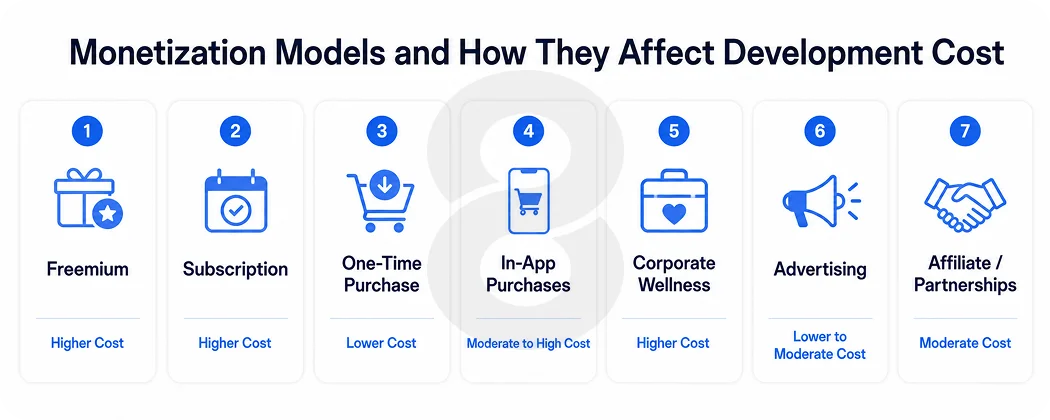
The way you propose to make cash immediately impacts what you need to build and, consequently, what you spend on improvement. Choosing your monetization model early is not just a business method selection; it is a technical structure selection that impacts your backend, your billing infrastructure, and your function roadmap.
Monetization Model |
How It Works |
Added Dev Cost |
| Freemium | Free core, paid premium features | $5,000 – $15,000 (paywall logic) |
| Subscription | Monthly/annual recurring billing | $6,000 – $14,000 (Stripe/RevenueCat integration) |
| One-Time Purchase | Pay once, use forever | Low added cost |
| In-App Purchases | Buy specific content (meal plans and programs) | $5,000 – $12,000 |
| Corporate Wellness | B2B licensing to employers/gyms | $15,000 – $40,000 (admin & reporting tools) |
| Advertising | Ad network integration | $3,000 – $8,000 |
| Affiliate / Partnerships | Commission from supplement or equipment brands | Low technical cost |
Subscriptions are by far the most profitable and sustainable monetization model for fitness apps. Apps like Noom, Calm, and Headspace generate the overwhelming majority of their sales thru monthly and annual club plans, and buyers strongly desire subscription-based, totally enterprise models due to their predictable routine sales. If you propose to use subscriptions, build that infrastructure from day one using tools like Stripe or RevenueCat; retrofitting a subscription billing system into an existing app architecture is way more steeply priced than constructing it in from the start. The corporate well-being segment is likewise hastily developing, with employers more and more purchasing employee fitness app licenses as a workplace well-being gain, and this B2B channel can generate appreciably higher sales in line with accounts than consumer subscriptions.
Read More: The Real Cost of App Maintenance: What Budget Percentage Should You Allocate?
Real-World Examples: What Apps Like These Actually Cost
It allows anchoring the numbers in opposition to real merchandise you’re already familiar with. While precise construction costs for primary apps are never publicly disclosed, enterprise estimates based totally on feature complexity and team length deliver us dependable approximations for what it’d cost to build similar products these days.
Subscriptions are by far the most profitable and sustainable monetization model for fitness apps. Apps like Noom, Calm, and Headspace generate the overwhelming majority of their revenue through monthly and annual membership plans, and investors strongly prefer subscription-based business models because of their predictable recurring income. If you plan to use subscriptions, build that infrastructure from day one using tools like Stripe or RevenueCat; retrofitting a subscription billing system into an existing app architecture is significantly more expensive than implementing it from the start. The corporate wellness segment is also rapidly growing, with employers increasingly purchasing employee fitness app licenses as part of workplace wellness benefits, creating a B2B revenue channel that can generate much higher account value than consumer subscriptions.
Read More: Mobile App Development Process – From Idea to Launch
Real-World Examples: What Apps Like These Actually Cost
It helps to anchor these estimates against products people already recognize. While exact development costs for major apps are rarely made public, industry estimates based on feature complexity and team size provide realistic approximations of what it would cost to build similar products today.
App Benchmark |
Type |
Estimated Build Cost Today |
| MyFitnessPal-like app | Nutrition + activity tracker | $80,000 – $150,000 |
| Peloton-like app | Live + on-demand video, community | $200,000 – $500,000+ |
| Nike Training Club-like app | Workout library + guided programs | $60,000 – $130,000 |
| Calm-like app | Meditation + sleep + audio | $50,000 – $120,000 |
| Fitbit-like wearable companion | Device sync + health dashboard | $80,000 – $200,000 |
| Simple yoga app MVP | Guided videos + progress tracking | $20,000 – $50,000 |
It’s well worth noting that those estimates reflect a floor-up construct these days, using modern-day development tools and Go platform frameworks. The authentic variations of those apps cost a long way more in total due to the fact they have been constructed iteratively over many years with huge in-house engineering groups, went through a couple of complete redesigns, and scaled their infrastructure as their consumer base grew into the hundreds of thousands. You’re not competing with Peloton’s contemporary product on day one; you are competing for a specific underserved user phase in which a centered, well-carried-out app can win decisively.
How to Reduce Fitness App Development Cost Without Cutting Corners
Smart founders find creative methods to construct lean without compromising on the fine that customers honestly experience. The intention isn’t to spend as little as feasible; it’s to spend successfully, validate quickly, and scale your investment as your revenue grows.
The best unmarried fee-reduction method is beginning with an authentic MVP. This method resists the temptation to build each function on your wishlist and, as a substitute, focuses your initial price range completely on the 2 or 3 abilities that deliver the core cost proposition of your app. Many successful fitness apps were released with noticeably restrained feature sets. Strava famously started out as a simple GPS run tracker and added complexity most effectively after proving that customers cherished the central enjoyment.
Using cross-platform frameworks like Flutter or React Native is the following highest-impact selection, as discussed in advance. Combined with leveraging off-the-shelf SDKs for common capabilities, Stripe for payments, Auth0 for authentication, Mux for video, and Mixpanel for analytics, you may do away with months of custom development work and redirect those finances toward the capabilities that simply differentiate your product.
Hiring a good nearshore or offshore development business enterprise as opposed to constructing an in-house group from scratch can reduce your hard work fees by means of 40 to 60 percent without a significant quality sacrifice, provided you make investments of time in proper vetting and onboarding. And eventually, going for walks, a structured design sprint before a single line of code is written can save extensive quantities of money via catching costly UX mistakes and misaligned assumptions early, earlier than they’re baked into your structure.
Read More: How to Create an App: 8 Steps to Build an App in 2026
Key Questions to Ask Before You Budget
Before you finalize your health app improvement finances, take the time to think through those foundational questions. The clearer your answers, the more correct your estimates may be, and the fewer highly-priced surprises you will come upon mid-undertaking.
- Start with the aid of articulating the unmarried center hassle your app solves better than any current competitor, and affirm that you know precisely who your target user is and which platform they generally use.
- Determine whether you’re constructing for iOS, Android, or each, and have a phased plan for every one. Identify which functions are simply crucial for your release as opposed to those that belong for your post-release roadmap.
- Find out whether or not your app will require HIPAA compliance or other regulatory requirements, because this provides widespread value and a timeline. Establish how you will monetize from day one and verify that your tech stack can help it. Budget for post-release upkeep one by one from improvement.
- Set apart marketing finances; this is absolutely impartial of your development finances, because without person acquisition, even the high-quality-built app inside the global may not grow.
Final Thoughts
Understanding how much it charges to make a fitness app is ready far more than arriving at a single quantity. The actual answer depends on your function set, your platform selections, your crew, and your long-term vision for the product. But with the special breakdowns, contrast tables, and actual-world benchmarks on this guide, you currently have the whole lot you need to plan your funding intelligently and have productive, price-range-aware conversations with developers, buyers, and co-founders.
The health app space is aggressive; however, it constantly rewards niche attention and pleasant execution. A properly built $60,000 yoga app that solves a specific, underserved problem with excellence will outperform a $300,000, well-known well-being platform that tries to be the whole thing to everybody each and every time. Start lean, validate speedily, concentrate on your customers relentlessly, and scale your investment as your sales grow to aid it.
Start lean. Validate speed. Scale cleverly.
If you are ready to take the subsequent step, begin by writing an in-depth digital product requirements report and inquiring about charges from three to five development businesses or freelancers; use the characteristic breakdown tables in this manual as your RFP baseline. The more particular you are about what you need to construct, the more accurate and similar your prices might be.