


If you’ve attended any of the founder pitch meetings of the past few years, you’ve likely heard the phrase “we’re building the next DoorDash, but for X” with some variation. Those decks are not normally seen past a demo. Not because it’s a terrible concept, but because the person pitching the idea felt that it was something that they would just copy, put a new logo on it, and wait for the orders to start coming.
It doesn’t function like that. If you have ever shipped any of these apps or interacted with a driver who went offline while they were out delivering, you know what comes after the wireframes.
This guide explains what it actually takes to build a food ordering app in 2026, how much it costs, and where most teams waste their budgets.
Why Food Delivery Apps Are Still Worth Building in 2026
So far, the market hasn’t slowed down, even though it seems busier. The total online food delivery revenue is expected to nearly double to $1.51 trillion in 2026, so there’s no dearth of new players. But the days of competing head-to-head with giants are over. It’s a dark kitchen, campus delivery, halal-centric, and office catering, and so on and so forth.
Consumers are also more price-sensitive. At the lower order value, the growth is more difficult to sustain when it is driven by discounts, so it’s easier to justify loyalty programs, subscriptions and seamless reordering. Meanwhile, many platforms are merging restaurant, grocery, and convenience delivery to future-proof their growth and optimise logistics.
Read More: Best POS System for Restaurant: Build a Custom POS Solution Instead of Buying Software
It’s more than a slick app for winning these days. Customers expect it to be quick, personalized, and easy to order again. More significantly, founders need to consider regional delivery expenses, availability of riders and regulations early in the process, as fixing prices and logistics after launch will be much more costly than doing it right.
Read More: Best Apps for Delivery Drivers to Inspire Your Next Delivery App
How Food Delivery App Development Actually Works
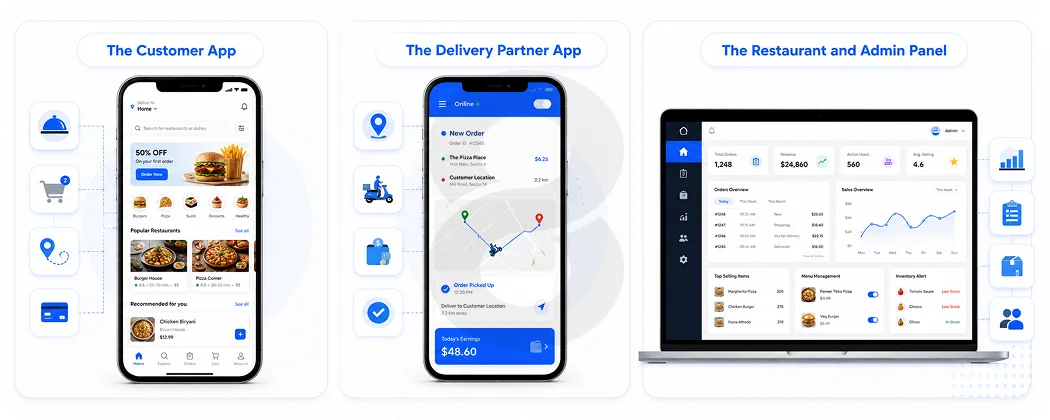
Most first time founders picture a single app. Order food, track the rider, get the food. In reality, food delivery app development means building at least three separate products that all talk to each other in real time, plus the backend that keeps them in sync.
Skipping any one of these three pieces, or bolting them together as an afterthought, is where most delivery startups get stuck. A weak driver app means late deliveries, a weak restaurant panel means wrong orders, and a weak admin dashboard means nobody can see what’s actually happening across the platform until a customer complains on social media.
The Customer App
It is the component that everyone is looking at and where users will make their first impression in the first thirty seconds. This is where menu browsing, cart, checkout, order tracking and support happen.
The little things that make the difference between a happy customer and a disheartened one are typically insignificant, such as a quick menu load time when cellular connection is poor, a straightforward breakdown of delivery fees prior to checkout, and whether reordering an earlier meal requires 2 taps or 10.
The Delivery Partner App
Riders and drivers need something built for speed, not polish. Route optimization, batch delivery assignment, earnings tracking, and offline mode all matter more here than visual design. A driver losing GPS signal in a parking garage or a dead zone shouldn’t mean a lost order or a confused customer staring at a frozen map.
Read More: Location-Based App Development for Startups: Improve Efficiency & Reduce Costs
The Restaurant and Admin Panel
This is the plainest one and the one that is most likely to be underfunded in the planning phase. Restaurants require a means of managing menus, real-time out-of-stock alerts, and being able to view incoming orders without missing any during a rush.
Read More: How to Make a Restaurant App: Cost, Features & Step-by-Step Guide
Admins need visibility into everything, order status, payout schedules, fraud flags, support tickets, and platform wide analytics. A weak admin panel is often the actual reason a “great app” falls apart at scale, long before customers notice anything wrong on their end.
| Component | Core Purpose | Must Have Features |
|---|---|---|
| Customer App | Ordering and discovery | Menu browsing, cart, live tracking, payments, ratings |
| Delivery Partner App | Fulfillment | Route optimization, batch orders, earnings dashboard, offline mode |
| Restaurant/Admin Panel | Operations control | Menu management, order queue, payout reports, analytics, dispute handling |
The backend software tying all three together needs to handle real time order status updates, payment processing, and location data without lag, because a five second delay in an order status update is the difference between a smooth experience and a support ticket.
Features That Keep People From Deleting Your Food Mobile Application
Feature lists for food ordering apps tend to look identical on paper. Everyone lists “live tracking” and “multiple payment options” like that’s a competitive edge in 2026. It isn’t. Every serious app already has those. The features that actually move retention numbers are the ones that reduce friction in moments users don’t consciously notice.
A few that matter more than founders expect:
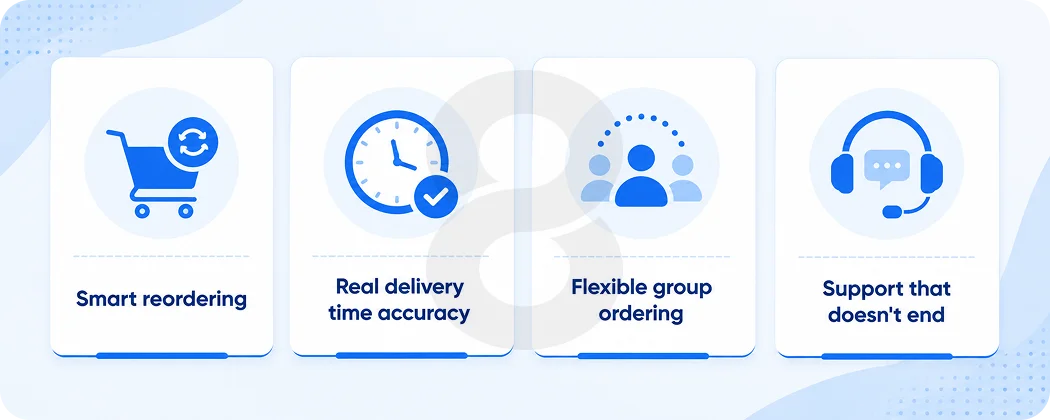
- Smart reordering: Most repeat customers order the same three or four meals on rotation. Surfacing those instantly, instead of making someone rebuild a cart from scratch, cuts checkout time significantly.
- Real delivery time accuracy: Nothing kills trust faster than an ETA that’s consistently wrong. Predictive ETA models that account for kitchen prep time, not just driving distance, make a measurable difference in satisfaction scores.
- Flexible group ordering: Office and family orders where multiple people add items to one cart are increasingly common, and apps without this feature lose that use case entirely to competitors.
- Support inside the app that doesn’t dead end: Chatbots that can’t resolve a missing item or a cold delivery just push angry users to leave a bad review instead.
- Loyalty structures that reward frequency, not just spend: With order values under pressure across the industry, apps rewarding consistent ordering behavior are seeing stronger retention than apps chasing one time discount hunters.
Smarter recommendation and prediction layers, the kind powered by AI models trained on ordering history and local demand patterns, are becoming a baseline expectation rather than a nice to have. A food mobile application that can predict what someone wants before they open the menu tends to convert faster than one that makes users search from scratch every time.
What Food Delivery App Development Cost Really Looks Like in 2026
This is usually the first question founders ask and the hardest one to answer honestly, because “it depends” is true but useless without context. That number is driven far more by logistics complexity than by screen count. A simple menu browsing screen costs almost nothing to build. Real time route optimization for hundreds of concurrent drivers is a different problem entirely.
Three factors drive most budget variations: the number of platforms (iOS, Android, web, plus separate apps for customers, drivers, and restaurants), the sophistication of the logistics engine, and whether developers build a custom backend or use existing infrastructure and APIs for maps, payments, and messaging.
| App Tier | Typical Scope | Estimated Cost Range |
|---|---|---|
| MVP | Single city, basic ordering and tracking, manual dispatch | $25,000 to $50,000 |
| Mid Tier | Multi-city, automated dispatch, loyalty program, analytics | $60,000 to $120,000 |
| Enterprise | Multi-region, AI-powered routing, grocery/convenience expansion, advanced fraud detection | $150,000 and up |
Region also plays a real role. Development teams in North America and Western Europe typically charge two to three times more per hour than teams in South Asia or Eastern Europe, without necessarily delivering a better product. It’s common for founders to overpay for a brand name agency and underpay attention to whether the actual engineers on the project have shipped a delivery platform before, versus a generic CRUD app with a different label on it.
Read More: Food Delivery App Development Cost in 2026: A Detailed Guide
Ongoing costs matter just as much as the initial build and get ignored far too often in early budgeting. Server costs scale with order volume, third party API fees for maps and SMS notifications add up fast at scale, and iteration after launch based on real user data is not optional if the goal is a platform that actually grows.
Choosing the Right Food Delivery App Solution for Your Business
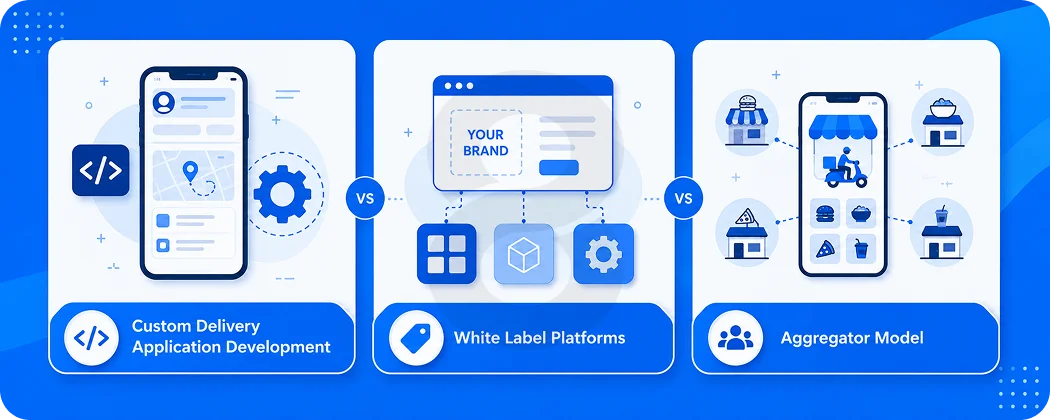
There isn’t one right answer here, and anyone promising one is selling something. The right food delivery app solution depends on budget, timeline, and how differentiated the business actually needs to be from day one.
Custom Delivery Application Development
Building from scratch gives full control over features, branding, and future scalability. It’s the right call for businesses planning to differentiate on logistics, loyalty mechanics, or a specific niche that platforms bought off the shelf don’t support well. It’s also the most expensive and slowest path, and it requires a development partner who actually understands the operational side of delivery, not just app design.
White Label Platforms
Prebuilt platforms that founders can quickly rebrand and launch offer a practical way to test a market without making a large upfront investment. The tradeoff is limited customization and, often, shared infrastructure that makes it harder to stand out or scale past a certain point without eventually rebuilding.
Aggregator Model
Some businesses don’t need their own delivery fleet at all. Building a discovery and ordering layer that routes fulfillment through existing courier networks can work well for restaurant groups or regional players who want an app presence without owning logistics. It’s lighter on operational overhead but comes with less control over the actual delivery experience.
Most founders end up somewhere between custom and white label, using proven third party components for things like payments and maps while building custom logic around the pieces that actually differentiate the business. That hybrid approach tends to be the most realistic path for a team without unlimited runway.
Read More: Restaurant App Development Cost in 2026: Full Breakdown for Restaurant Owners
Mistakes That Kill Food Delivery Apps Development Projects
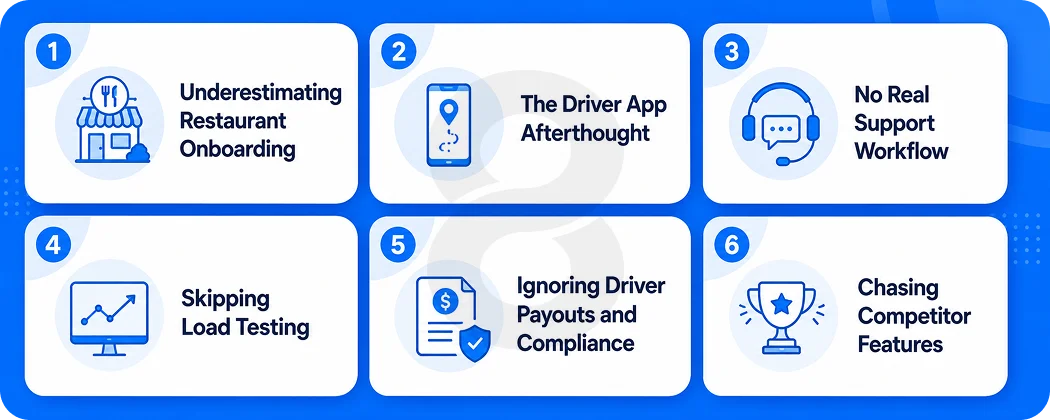
Enough of these show up repeatedly across different teams that they’re worth naming directly, even if it’s not comfortable to hear mid project.
Underestimating Restaurant Onboarding
An app with zero restaurants on it is just a menu with nothing behind it. Getting restaurant partners onboarded, training them, and keeping their menus updated requires sales and operations as much as technology, yet most technical founders completely underplan it.
The Driver App Afterthought
Founders pour budget into the app customers use and treat the driver app like a lightweight companion tool. Drivers who deal with a buggy, confusing app quit fast, and driver churn quietly kills delivery reliability before customers even notice.
No Real Support Workflow
Orders go wrong. Food arrives cold, items go missing, addresses get typed wrong. Apps that launch without a clear refund and resolution process burn trust in the first few weeks, right when early reviews matter most.
Skipping Load Testing
Nothing wastes a launch budget faster than a server that can’t handle a Friday night spike because nobody stress tested it beforehand. This happens more often than most agencies will admit.
Ignoring Driver Payouts and Compliance
Getting driver payments wrong, late, or not compliant with local labor rules creates legal exposure and driver attrition at the same time. It’s rarely glamorous work, but it’s foundational.
Chasing Competitor Features
Many founders feel tempted to match every feature in a rival app after seeing its app store listing, but users rarely need half of those features, even in the competitor’s app. Moreover, teams that build lean, watch usage data closely, and add complexity only when it’s justified tend to ship faster and spend less doing it.
None of these problems are peculiar. They’re boring, operational, and completely avoidable with the right planning upfront, which is exactly why they keep happening anyway. Eventually, all founders go through this late-night order syncing session on a dashboard, only to find out why the orders stopped syncing.
Not all of the apps that make it to the end are the ones with the flashiest launch party. They’re not built by teams that only anticipated the boring ways they could fail after failure.
How 8ration Helps With Food Delivery Mobile App Development
For every restaurant group, regional start-up, and entrepreneur who requires more than a template build, 8ration is right for you. The team completes the food delivery mobile app development lifecycle by building the customer app, delivery partner app, and restaurant and admin dashboard as one unified system rather than connecting three distinct systems afterward.
This includes designing the underlying app architecture for real-time order tracking and route optimization, as well as checkout and reorder flows to lower cart abandonment, and AI powered demand prediction for restaurants to plan inventory, rather than guess.
Commercial systems for digital storefronts can be extended into delivery-driven storefronts, as delivery-focused checkout logic can be implemented on the same commerce systems already in place.
8ration also supports businesses across the food and restaurant industry more broadly, not just app builds in isolation, helping restaurant groups and delivery startups think through the operational side of launching a platform, not only the technical one.
Whether the goal is a single city MVP or a multi region platform with grocery and convenience categories layered in, the team scopes the build around actual operational needs rather than a generic feature checklist copied from a competitor’s app store listing.