


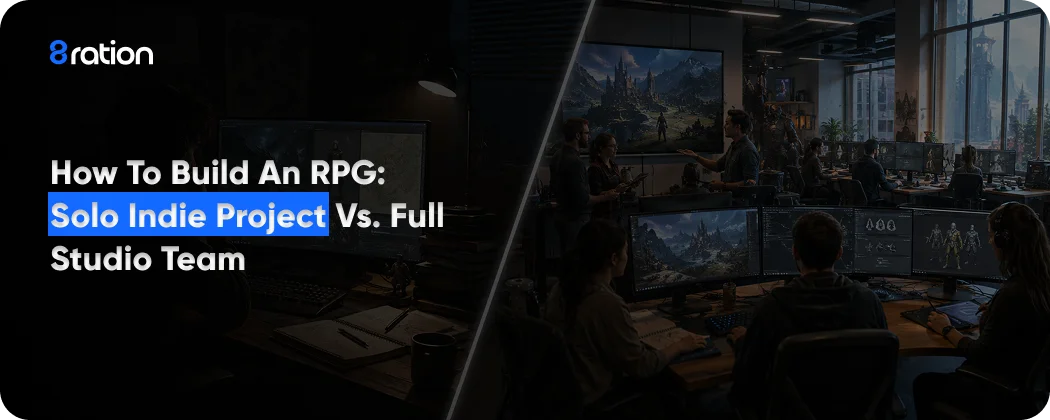
You’re about to ask yourself questions you didn’t expect. Not just “what engine should I use?” but “can I actually finish this?” That’s the gap between wanting to make an RPG and making one.
Solo indie developers face a brutal 70% failure rate once work begins, and RPGs are some of the worst offenders. They look simple until you start scoping them. A quest system sounds like one task. Then you realize you need dialogue trees, NPC schedules, inventory management, and ways to track progress. Each of those is its own rabbit hole.
The core difference isn’t indie versus studio. It’s about what you’re actually building and how much you can realistically sustain. An RPG demands systems. Systems take time. Time is what kills most projects, whether you’re solo or leading a team.
Here’s what you need to know before you pick your path.
The Solo Developer Path: Creative Freedom, Crushing Workload
Working alone sounds romantic. You control everything. No meetings. No compromises. Your vision stays pure because there’s nobody to dilute it.
Reality is different.
The solo devs who fail almost always fail on scope. They start an open-world RPG with a crafting system, skill trees, and 40 hours of quests. Two years in, they are 15% done and burned out. This isn’t a skill problem. It’s math.
The Time Math Doesn’t Work
Creating an RPG as a solo developer is one of the toughest challenges in game development. You’re expected to code, design visuals, write, manage audio, test the game, and market it. In a professional studio, those responsibilities are spread across entire teams for a reason.
By 2025, indie games are still being built by small teams that average just 18 months of development time, yet they face a brutal 70% failure rate. Eric Barone spent 4.5 years on Stardew Valley working 10 hours a day, 7 days a week. That’s exceptional, not standard. For every Barone, thousands of developers quit after year two because they’re burnt out and nowhere near done.
The financial pressure makes it worse. Full-time indie devs comprise 40% of the scene, but 60% work part-time while holding another job. If you need to keep your day job, you’re looking at 3-5 hours a day on your game after work. That’s not a timeline for an open-world RPG. That’s a timeline for a tightly scoped game you can actually ship.
What Solo Devs Actually Do Well
This sounds like a downer. It’s not. Solo developers ship games. They just ship different games.
Solo devs also cut out the middlemen. You don’t have to wait for other teams to weigh in on new changes or conduct tests, you can adapt as they go and choose your next steps without considering other individuals involved. This agility is real. You iterate fast. You test an idea on Monday, implement feedback on Tuesday, and move forward without committee meetings.
The best solo projects know what they are. Toby Fox’s Undertale is a 2D top-down RPG with turn-based battles. Undertale is a 2D, story-driven RPG created primarily by solo developer Toby Fox. Not a 3D open world. Not photorealistic.
A confined experience with systems that fit together tightly. That scope allowed Fox to spend time on writing, music, and the core mechanic that makes Undertale special: the choice between fighting and sparing enemies.
Toby Fox didn’t need a 50-person team to make something revolutionary. He needed clear constraints.
The Skill Gap Problem
Honest reality: most solo developers aren’t equally skilled at programming, art, music, and design. That’s not failure. That’s the nature of the work.
The choice is either to accept the gap or spend years trying to close it. Some solo devs lean into placeholder art and focus on mechanics. Others hire freelancers for specific assets (music, voice acting, pixel art) while handling the code directly.
This works, but it eats into budget and timeline. This is also where bringing in a specialized outside team, rather than a freelancer for a single asset, can pay off; a group like 8ration’s AI Development team can build an entire NPC behavior system rather than a single one-off piece of art or code.
The sneaky danger is comparing progress to other developers. Watching other developers showcase polished devlogs can make an unfinished project feel inadequate by comparison, even when both projects are at similar stages of actual difficulty. That comparison trap is emotional quicksand. Progress should only be measured against a personal finish line, not someone else’s highlight reel.
The Full Team Path: Speed, Coordination, Complexity
A team isn’t inherently better. It’s different. It lets you do things solo developers can’t.
With five programmers, one focuses on combat AI while another builds the inventory system. With an artist team, one person handles environments while another does character design. Parallel work. That’s what teams buy you.
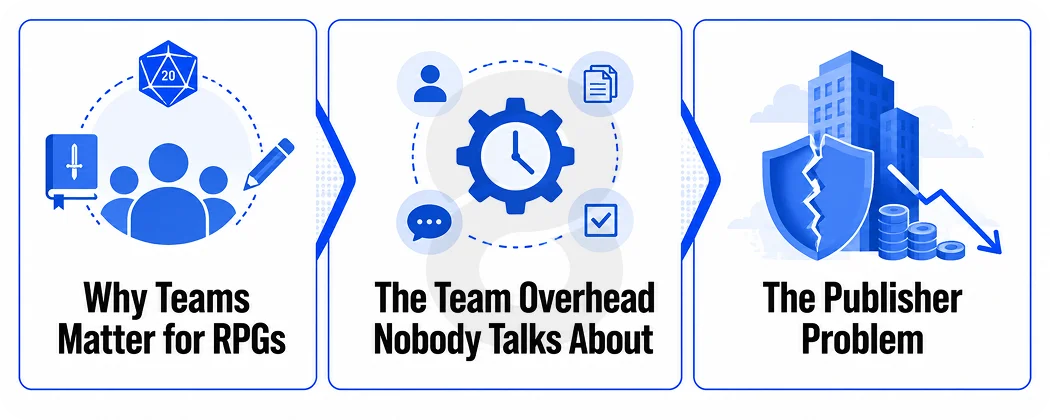
Why Teams Matter for RPGs
Each member of the game development team brings a unique set of skills to the table, ensuring that every aspect of the game, from conceptualization to execution, combines into a high-quality made game. For RPGs specifically, this matters a lot.
A typical small RPG team might look like this:
| Role | Responsibility | Why It Matters |
|---|---|---|
| Gameplay Programmer | Implements combat systems, quest mechanics, character progression | RPG systems are interconnected. One bug breaks everything |
| AI Programmer | Builds NPC behavior, enemy tactics, dialogue triggers | RPGs live on character interactions and believable enemies |
| Tools Programmer | Creates editors for level design, dialogue systems, item databases | Saves days of manual work and prevents data entry errors |
| Lead Designer | Defines game vision, quest structure, mechanical interactions | Someone has to say “no” to scope creep |
| Narrative Designer | Writes dialogue, quest text, world lore | Ensures consistency and emotional impact |
| Environment Artist | Builds dungeons, towns, forests, UI layouts | Players spend hours in these spaces |
| Character Artist | Designs and models characters, NPCs, monsters | First impression matters; bad character art kills discovery |
| Animator | Brings combat, movement, and special effects to life | Makes interactions feel responsive and satisfying |
A team of 8-12 can build what a solo developer would take 5-10 years to make in 18-24 months. But that assumes no communication friction, no scope creep, and nobody leaving halfway through.
The Team Overhead Nobody Talks About
Adding people doesn’t divide the work equally. It adds management overhead.
You need someone running meetings. Someone tracking milestones, resolving conflicts between what the designer wants and what’s technically feasible, and testing whether the programmer’s AI implementation actually works the way the designer intended.
Project managers oversee the entire game development process. They are responsible for planning, scheduling, and coordinating tasks among different departments. This is a full-time job on its own. Your team of 8 might spend 10% of its capacity on coordination. That’s not wasted. It’s the oil that keeps the engine running. But it’s real time that doesn’t directly go toward making the game.
Bad team dynamics can kill a project faster than technical challenges. Misaligned vision, unclear scope, poor communication, these are team killers. A solo developer at least knows what’s happening because they’re doing everything.
Read More: Simulation Game Development: From Concept to Launch
The Publisher Problem
Here’s where team development gets complicated. An Over Powered Game Marketing analysis of games released in 2024 showed that third-party published games had a mean revenue twice as high and a median revenue five times higher than games without a publisher.
That sounds great. But publishers have changed. Devolver already reduced the average spending per game from $3 million in 2022 to $2 million in 2024, with plans to lower that to $1 million by 2026. They’re not funding ambitious new IPs. They’re sequels and known properties.
If you’re a new studio trying to fund a team through a publisher, the window is narrowing. Your options become bootstrapping (risky), venture capital (controlling), Kickstarter (unpredictable), or keeping day jobs (slow).
Read More: How to Hire the Best Game Development Team for Your Project
Scope Control: The Real Difference Between Success and Burnout
Forget solo versus team for a moment. The actual line between shipped and abandoned is scope.
A practical scope test: describe your game in one sentence. If you cannot, it is too big. Then list every feature and cut half of them. Ship what remains. Add the rest in updates if the game finds an audience.
This isn’t advice. It’s survival.
Most developers know this intellectually and violate it anyway. You start with a simple idea. Then you think, “What if we added crafting?” Crafting requires recipes. Recipes require a UI. The UI needs icons. Now you’re making 200 icons instead of shipping the game.
This is scope creep. It’s silent. Each addition feels small. Collectively, they derail the project.
Building With Reality in Mind
If you’re going solo, your game needs to work in 1-3 years. Not because that’s ideal, but because that’s how long most people can sustain unpaid work or part-time work. After that, you’re burning out. Life happens. Motivation fades.
The games that work are the ones where:
- The core loop is tight: You can describe what the player does moment-to-moment in a few sentences. Not what the story is. What they actually do every minute of play.
- Content is generated or reusable: Procedural dungeons, repeatable quests, modular encounters. Anything that doesn’t require 200 hours of manual work.
- Quality comes from mechanics, not breadth: Undertale is amazing because of its dialogue and combat mechanics, not because it has 100 hours of content. Balatro is a card game with incredible depth, not a sprawling open world.
- The end is visible: You know what “done” looks like. Not “the game is perfect.” Done is “the core experience works, it’s polished enough to ship, and people understand how to play it.”
For team projects, scope creep is different but still deadly. The team wants to justify its existence, so features keep expanding. Project managers need to actively say no, over and over. That’s their actual job.
The Hidden Burnout Problem
Both paths lead to burnout, just differently.
Solo developers burn out because they’re doing eight jobs and none of them are going well. Solo game development is a burnout machine. You are the programmer, artist, musician, QA tester, marketer, and accountant. There is no team to share the load and no manager to notice when you are working 80-hour weeks.
Team developers burn out because of misalignment, endless scope, and the pressure to justify budgets. If your team is funded, there’s an expectation to ship something. If you miss that window, the funding dries up.
The thing that keeps you going isn’t the team size. It’s believing in what you’re making. Your passion should drive your projects. Making a game for the challenge of it, rather than because you truly love the concept, can sap your motivation.
If you’re building an RPG to prove you can code, you’ll quit. If you’re building an RPG because you have a story or a mechanic that genuinely excites you, you’ll find a way to finish it.
Read More: How Long Does it Take to Make a Video Game
Real Examples: What Actually Works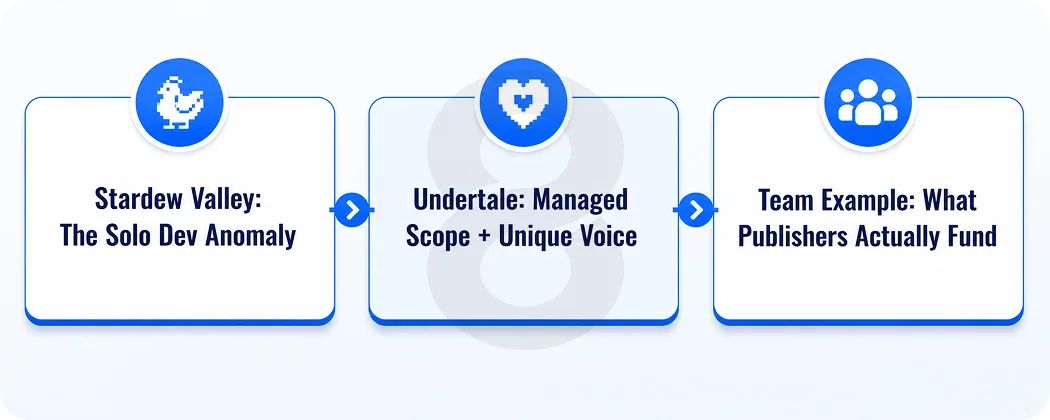
Stardew Valley: The Solo Dev Anomaly
Stardew Valley is one of the most impressive solo development stories in modern gaming. Eric Barone spent four and a half years creating the entire game from home, handling programming, pixel art, animation, music, and sound design himself.
But here’s the thing: Barone had advantages. He didn’t need the income during development. He was young and had the stamina for 10-hour days. Moreover, he had a clear vision rooted in a game he loved (Harvest Moon). And critically, he shipped a life sim, not an epic RPG.
Since its 2016 release, it has sold millions of copies on multiple platforms, including an impressive 425,000 copies on Steam in its first two weeks. It’s the outlier. It works because everything aligned. For every Barone, there are ten thousand people who tried and couldn’t finish.
Undertale: Managed Scope + Unique Voice
Developed over the course of two and a half years by first time developer Toby Fox, the mad lad crafted nearly every aspect of Undertale by himself, including the game’s catchy soundtrack.
Undertale works because it’s a 2D game with a focused scope. The combat is turn-based. The environments are small. The genius is in the writing and music, not the technical complexity.
Fox worked on Earthbound ROM hacks in high school, which may explains why the writing and music in Undertale matches that of the Mother franchise. He spent his development time on what made the game special, not trying to out-engineer a AAA studio.
Read More: What Are AAA Games? Breaking Down the Biggest Titles in Gaming
Team Example: What Publishers Actually Fund
Publishers fund sequels and known properties now. But historically, teams have built massive RPGs because parallel work scales. The Elder Scrolls series, Dragon’s Dogma, Baldur’s Gate 3 (Larian Studios, ~150+ people), these require teams.
Teams handle systems complexity. Solo developers handle focused experiences.
Read More: Ideas for Game Development: How Businesses Can Enter the Gaming Market
The Tools That Actually Enable RPG Development
Most solo developers aren’t limited by tools anymore. They’re limited by time and scope.
Godot is the best engine for solo devs in 2026. Free forever, 120 MB download, text-based scene files that work with version control, and a scripting language you can learn in days
Unity and Unreal also work. For teams, Unreal scales to larger projects if you have engine specialists. For solo developers, the overhead of either engine can cost more time than the features gain.
The real competition isn’t between engines. It’s between shipped games and projects that never launch. Tools matter less than discipline.
Read More: Unity Game Engine: A Game Development Guide for Businesses
Money, Failure Rates, and What Success Actually Looks Like
Let’s be honest about the financial reality.
The median indie game in 2024 made around $180, with games at the 30th percentile generating $30 or less. That’s not a typo. Most indie games make almost nothing.
But the distribution is wild. This increased to $28,600 at the 90th percentile, $1.4 million at the 99th percentile, and $15.1 million at the 99.9th percentile.
The indie market works like venture capital on games. Most projects fail or make trivial money. A few breakout hits generate massive returns. The median is useless because it’s dominated by failures.
For teams, this gets worse. If you’re burning $50,000 a month on salaries and need to hit a break-even point, your math requires success. Solo developers can at least finish without commercial success. A team needs revenue or backing.
Read More: 9 Best Game Engines for Mobile Development: Comprehensive Guide
Tables: Solo vs. Team Development
Development Timeline & Scope Comparison
| Factor | Solo Developer | Small Team (5–8) | Mid Team (15–20) |
|---|---|---|---|
| Time to complete a story-driven RPG | 3–7 years | 18–24 months | 12–18 months |
| Average feature scope | Minimal, cut heavily | Moderate, full vision | Expansive, multiple systems |
| QA testing time | Done in-house, often incomplete | Structured testing, part of schedule | Dedicated QA team, extensive coverage |
| Marketing effort required | Everything solo | Divided among team | Dedicated marketing role |
| Tool learning curve | High (you learn everything) | Medium (specialists in areas) | Low (each person specializes) |
| Flexibility to change direction | High (only you to convince) | Medium (consensus needed) | Low (larger inertia) |
Financial Reality: Solo vs. Team Projects
| Metric | Solo (Average) | Solo (Top 10%) | Team (Median Published) | Team (Top Publishers) |
|---|---|---|---|---|
| Development cost | $0–30k (self-funded) | $0–100k (occasional funding) | $500k–2M | $2M–10M+ |
| Development time | 2–5 years | 1–3 years | 18–24 months | 24–36 months |
| Expected revenue (50th percentile) | $180 | $28,600 | $500k–1M | $5M+ |
| Probability of profitability | 30% | 50–60% | 60–70% (with publisher) | 80%+ |
| Probability of completion | 30% | 40–50% | 70–80% | 85%+ |
Common Mistakes That Burn Out Developers
- Starting with the wrong scope: You think you want to make Dragon’s Age, but you’ve never shipped a game. Start small. Make something you can finish in 2 years. Build from there.
- Trying to be great at everything: You’re not a world-class programmer and world-class artist. Pick what you’re strongest at and either outsource the rest or accept it’ll be simpler.
- Building alone and hiding your progress: Isolation kills motivation and blinds you to bad decisions. Share work regularly, get feedback, and let people see the game early. Community builds momentum.
- Not prototyping first: Spend a month making the core mechanic work. Does it feel good? Is it fun? If not, nothing else matters. You can’t polish your way out of a bad mechanic.
- Ignoring the importance of finishing: A finished, simple game is infinitely better than an abandoned, ambitious one. Shipping builds reputation and income. Abandoned projects build shame.
How 8ration Helps You Build Your RPG
Whether you’re going solo or with a team, the technical foundation matters. Choosing the wrong engine or architecture costs months; fixing broken systems mid-development costs years.
8ration helps independent developers and studios tackle the challenges that derail projects. For solo developers, we build specific systems you can’t reasonably handle alone, quest systems tracking branching dialogue, NPC schedules, and dependencies. Our Full Stack Developer specialists create interconnected systems so you focus on design.
For teams, we integrate with your structure, building components that plug into your web and mobile game. Combat systems, progression mechanics, inventory management, work that’s critical but specialized.
Our AI game development team designs behavior trees and decision systems that make NPCs react meaningfully to player choices. Our UI/UX Design team builds responsive, intuitive interfaces that matter for RPGs.
The core truth: the complexity doesn’t disappear. It either gets distributed or it doesn’t. Either way, you’re paying the cost.
The Bottom Line
Building an RPG is possible solo or with a team. The path you choose determines the scope you can realistically achieve, not whether you succeed.
Solo developers win through clarity. They know exactly what they’re building and cut relentlessly. They compete on unique vision, tight mechanics, and emotional resonance, not technical scale. Success is far from impossible: it favors those who ship small, polished products, build and nurture an audience, control scope tightly, and leverage marketing consistently.
Teams win through velocity. They can tackle ambitious scope, parallel work, and complex systems. But they require funding, communication discipline, and alignment on vision. A misaligned team is worse than a solo developer because more people can move in wrong directions faster.
Either way, you’ll face the same wall: your own limitations, time pressure, and the market. The indie game market size is expected to grow from USD 4.85 billion in 2025 to USD 5.54 billion in 2026 and is forecast to reach USD 10.83 billion by 2031 at 14.32% CAGR. The market is growing. But so is the noise. Standing out means finishing what you start, making something people want to play, and then iterating based on player feedback.
That’s true whether you’re in your bedroom or a 20-person studio.