


Simulation games are strange. They’re the genre nobody talks about at parties, and yet they generate billions of dollars and show up in places most people would never expect: pilot training cabins, surgical theaters, military command centers, corporate onboarding programs. You’ve got The Sims running on one side of the spectrum and an industrial drilling simulator on the other. Same genre, completely different expectations.
Building a simulation game is also one of the most technically demanding things a studio can take on. It’s not like building a platformer where you iterate on “fun” until something clicks. With simulations, you’re chasing accuracy. You’re chasing believability. And when you miss, everyone notices, especially the people who actually know what the real thing is supposed to feel like.
This guide breaks down the full process, from the first conversation about a concept to a working, deployed product. If you’re evaluating simulation game development services for a training program, a commercial title, or something in between, this is what you actually need to know.
What Makes Simulation Games Different From Everything Else
Most game genres can survive a certain amount of unrealism. Players forgive physics that feel a little off, enemies that move a little too predictably, worlds that don’t quite make sense. The genre allows it.
Simulation games promise believable versions of real-world systems. If a flight simulator mishandles crosswind landings, a medical simulator gets anatomy wrong, or a city builder models unrealistic traffic, players quickly lose trust. Accuracy isn’t just a feature, it’s the foundation that keeps simulation games credible, engaging, and worth playing.
This creates a fundamentally different development philosophy. The reference material matters as much as the creative direction. Subject matter experts are stakeholders, not optional consultants. And the QA process isn’t just functional testing, it’s validation.
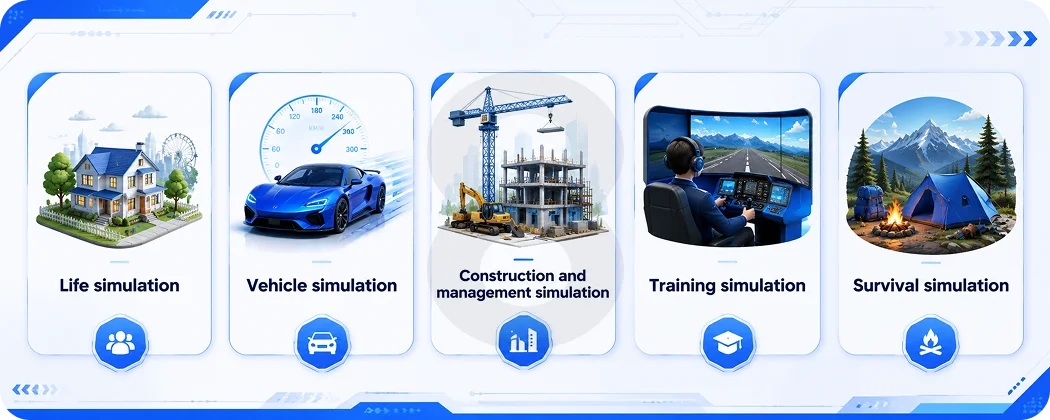
There are also a handful of sub-genres under the simulation umbrella, and they don’t all get developed the same way:
- Life simulation: games like The Sims, where players manage characters, relationships, and social dynamics. Heavy on emergent behavior, NPC logic, and long-term player engagement mechanics.
- Vehicle simulation: flight sims, racing sims, naval sims. Physics accuracy is everything. Players in this category are often enthusiasts who will immediately notice if something is wrong.
- Construction and management simulation: city builders, hospital managers, theme park designers. These live or die on economic modeling and systems complexity.
- Training simulation: built for industrial, medical, military, or corporate clients. Not primarily entertainment. Accuracy is a regulatory requirement, not a preference.
- Survival simulation: games like DayZ or ARK, where resource management and environmental threat modeling drive the experience.
Each simulation genre demands different technical expertise. During discovery, 8ration’s product development team defines the right approach early, ensuring the project starts with the right strategy and technical foundation.
Read More: How to Make Idle Game: Why Hiring Experts Beats DIY Development
The Six Phases of Simulation Game Development
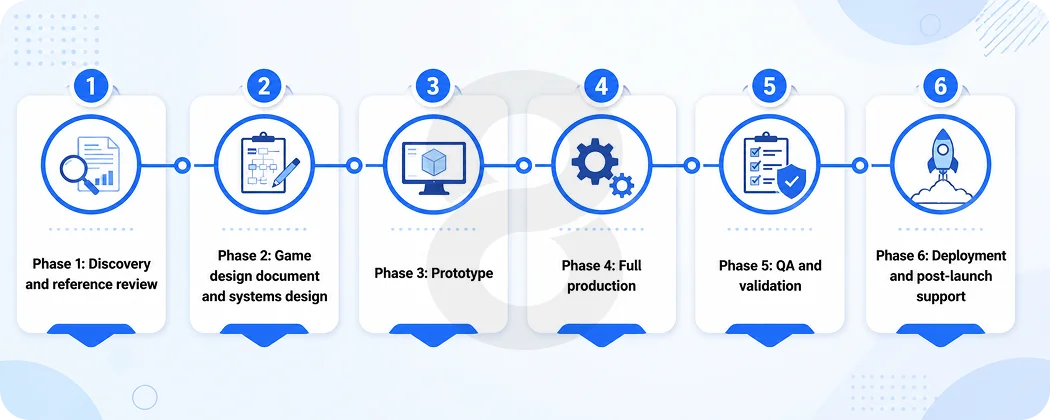
Here’s where a lot of clients get surprised. They come in thinking a simulation game is built like software: you write requirements, someone codes it, you test it, you ship it. The reality is messier and more iterative than that, and for good reason.
Phase 1: Discovery and reference review
Before a single line of code gets written, the development team needs to understand what they’re simulating. That means reviewing training objectives, reference data, hardware constraints, and stakeholder requirements.
For enterprise training simulations, this phase involves identifying subject matter experts who will validate the build at each milestone. For commercial titles, it means researching the genre, understanding what players expect, and mapping out what accuracy level the market actually demands (it varies more than you’d think).
Skipping or rushing discovery is how projects end up three months into production with a physics system that doesn’t match the reference documents. Getting it right upfront is worth every hour.
Phase 2: Game design document and systems design
A simulation game without a solid game design document (GDD) is a simulation game that will be redesigned five times in production. The GDD covers scenario flows, scoring logic, interaction patterns, and the architecture of the simulation’s core systems.
For training simulators, this is where the scoring rubric gets built: what constitutes success for a trainee, how debrief data is captured, how scenario difficulty scales. For commercial games, it’s where the progression loop, monetization model, and content roadmap get documented.
This phase is also where the physics and AI systems architecture gets agreed on before anyone writes engine code. Changing the physics model halfway through production is expensive in a way that’s hard to explain until you’ve done it once.
Phase 3: Prototype
The prototype is not the game. This is a thing studios say and clients hear but don’t always believe until they see it. A simulation prototype exists to validate specific hypotheses: does this physics model feel right, does this interaction pattern make sense, does this scenario flow work in practice?
Playable prototypes let subject matter experts and stakeholders engage with the core experience before full art and content production begins. This is where you catch the expensive mistakes cheaply. A prototype that reveals a fundamentally wrong assumption saves months of rework later.
The prototype output should be documented, not just a build, but a written summary of what was validated, what was adjusted, and what assumptions carry forward into production.
Phase 4: Full production
This is the longest phase and the one that involves the most parallel workstreams. Engineering, art, and scenario content all run concurrently, and coordination between them is where 8ration’s software development and production management practices matter most.
For simulation games specifically, the engineering and art pipelines are tighter than in most other genres. Environment geometry has to match the physics simulation’s collision data. Character rigs have to match the animation requirements of the scenario. VR interaction layers have to match the headset’s input model.
Milestone builds go out on a regular cadence and get reviewed against the agreed scenarios. Subject matter expert review should be structured into every milestone, not saved for the end. Problems caught at milestone four are recoverable. Problems caught at final QA are expensive.
Phase 5: QA and validation
Quality assurance in simulation development has two components that don’t always exist in other genres. The first is standard functional QA: bug hunting, performance testing, regression testing across target hardware.
The second is subject matter validation. A simulation can be technically functional and still fail its primary purpose. Pilots, surgeons, operators, or domain experts need to review the simulation against real-world behavior and sign off on it. This validation process has to be built into the schedule, not bolted on at the end.
For enterprise clients, this phase often produces a formal validation report that may need to satisfy regulatory or institutional requirements. Build that expectation in from the start.
Phase 6: Deployment and post-launch support
Simulation games don’t end at launch. Enterprise training simulations need scenario updates as procedures change, hardware compatibility patches as new VR devices release, and instructor dashboard improvements as organizations figure out how they actually use the tool.
Commercial simulation titles need content updates to keep communities engaged. The long tail of revenue for simulation games often comes from DLC, scenario packs, and subscription tiers, all of which require an active post-launch development relationship.
Post-launch support isn’t a nice-to-have for simulations. Build it into the contract.
Engine Selection and the Tech Stack Decision
Unity or Unreal Engine 5. That’s the choice most simulation projects eventually come down to, and it matters more than most people realize going in.
Both engines are used in serious simulation work. Both have robust physics systems, VR support, and established pipelines. The decision depends on what you’re actually building, which is exactly what 8ration’s software development team maps out during discovery.
| Factor | Unity | Unreal Engine 5 |
|---|---|---|
| High-fidelity photorealistic visuals | Solid, but not the primary strength | UE5 with Nanite and Lumen is the category leader |
| Mobile and cross-platform deployment | Strong, especially for Android and iOS | More complex pipeline for mobile |
| VR support (Meta Quest, PC VR) | Excellent, widely used for Quest builds | Strong, particularly for PC VR and enterprise |
| Talent pool availability | Large, broad | Smaller but deep for high-end projects |
| Learning curve for team onboarding | Lower | Higher |
| Physics simulation complexity | Capable for most simulation types | Better for vehicle, flight, and destruction physics |
| Cost / licensing | Free up to revenue threshold | Free up to $1M lifetime revenue, then 5% royalty |
| Asset marketplace and community | Unity Asset Store, very large | Fab marketplace, growing rapidly |
If your simulation demands photorealistic graphics, advanced vehicle physics, or realistic destruction, UE5 is often the better choice. For cross-platform support, mobile compatibility, and faster development, Unity usually comes out ahead.
Beyond the engine, most simulation games also need physics middleware, AI systems, backend infrastructure for data collection, and VR support when required. These early technology decisions matter because selecting the wrong tools can force expensive rework and architectural changes later in development.
Read More: Unity Game Engine: A Game Development Guide for Businesses
What Actually Drives the Cost of Simulation Game Development
This is the question everyone has and nobody wants to ask directly, so here’s a straight answer.
High development costs account for roughly 25% of industry-cited challenges in simulation game production. Realistic graphics, physics engines, and VR and AR integration all demand significant upfront investment.
Cost is driven by five variables more than anything else:
| Cost Variable | What It Means in Practice |
|---|---|
| Scenario count | Each scenario requires logic, art, QA, and SME validation, costs stack |
| Platform targets | VR plus desktop plus mobile is three production pipelines, not one |
| Physics fidelity requirements | High-accuracy physics (flight, surgical, industrial) requires specialized engineering |
| Subject matter complexity | Highly regulated industries (aviation, medical) require more validation cycles |
| Post-launch scope | Scenario update cadence, LMS integration, hardware compatibility, all cost money |
A focused single-scenario training simulator on one platform can be built for somewhere in the $90,000 to $150,000 range with the right team. Multi-scenario simulators with VR support, instructor dashboards, and LMS integration typically run from $150,000 upward, with complex enterprise projects reaching $350,000 and beyond.
Commercial simulation titles are scoped differently. 8ration’s product development team works through the audience, monetization model (in-app purchases, DLC, subscriptions), and content roadmap together, since all of it affects the production budget and the expected return on that investment.
The honest advice: don’t budget backward from what you want to spend. Figure out the minimum scope that actually achieves your objective, one validated scenario that proves the concept, and build out from there.
The Role of AI in Modern Simulation Development
Generative AI is reshaping design pipelines. 62% of studios are already using it to generate worlds and assets, compressing development timelines and costs. That number is only going up.
In simulation game development specifically, AI plays several distinct roles that are worth understanding separately.
AI for procedural content generation cuts the time and cost of building scenario variations. Instead of hand-authoring twelve scenario permutations, a well-structured procedural system can generate hundreds of valid variations from a defined ruleset. This is particularly valuable for training simulations, where scenario diversity prevents rote memorization of correct responses.
Read More: How Long Does it Take to Make a Video Game
AI for NPC behavior is where life simulation and enterprise simulation both benefit enormously. NPC agents that respond plausibly to trainee actions, escalate scenarios appropriately, and model human-like decision-making create a much more effective training environment than scripted response trees.
AI for analytics and performance modeling is the piece enterprise clients often underestimate. A simulation that captures granular trainee behavior data and uses machine learning to identify performance patterns (what decision points cause the most errors, which scenario elements are consistently misunderstood) creates feedback loops that improve both the training and the simulation itself over time. This kind of backend work is where 8ration’s software development capability plugs directly into the game layer.
The AI development implications for commercial titles are different but equally significant. Games like inZOI, which debuted in 2026, are building real-time generative AI into the core loop, allowing NPCs to respond dynamically and environments to shift based on player behavior. Moreover, this is where the genre is heading, and simulations built now that don’t account for AI-driven content are going to feel dated quickly.
Read More: How Much Does It Cost to Make a Mobile Game?
The Platforms That Matter in Simulation Gaming Right Now
Platform decisions in simulation development aren’t just technical, they determine your audience, your control scheme, your art pipeline, and your monetization options.
Mobile captured 59.40% of the online simulation games market in 2025. VR and AR devices post the fastest growth at a 19.45% CAGR to 2031. Training and education simulations are set to grow at a 17.62% CAGR to 2031.
For entertainment-focused simulation games, mobile is where the volume is. Farming sims, city builders, and life simulation titles have massive mobile audiences who engage in shorter sessions with touch-optimized controls. 8ration’s mobile app development team treats this platform as a primary market, not a compromise, since it’s where a significant chunk of the simulation genre actually lives.
For training and enterprise simulations, VR is the fastest-growing platform and for good reason. There’s a meaningful body of evidence that immersive VR training produces better knowledge retention and skill transfer than screen-based alternatives, particularly for procedural tasks. Meta Quest 3 and PC VR headsets are the two standard targets for enterprise simulation builds right now.
PC and console remain important for commercial simulation titles, particularly in the vehicle simulation and management simulation sub-genres. Microsoft Flight Simulator’s continued commercial success, and its cultural staying power, demonstrates that there’s a serious, paying audience for high-fidelity desktop simulation experiences.
The multi-platform question is where budgets get real. Building a simulation that runs on PC, VR, and mobile from the same codebase requires architectural decisions made early in production, the kind of cross-platform software development planning that has to happen before art or content work starts. It’s doable, but it’s not free, and the interaction model differences between platforms are significant enough that they need to be designed for specifically, not retrofitted.
What 8ration Brings to Simulation Game Projects
8ration builds across the full spectrum of what simulation game development requires: software engineering, mobile platforms, AI integration, product strategy, and ecommerce and enterprise infrastructure for clients who need LMS integrations, scoring APIs, or instructor dashboards. These disciplines don’t stay in their lanes on a simulation project, since a training simulator that feeds performance data into an analytics dashboard is a software product with a game frontend as much as it is a game.
Moreover, the team follows the same structured methodology across all of it: discovery to understand objectives, phased delivery with documented milestones, and post-launch support scoped in from day one. Furthermore, for clients still deciding between a training simulator, a commercial title, or something in between, the starting point is a scoping conversation, not a proposal.