




Hiring developers often sounds simple when businesses first start thinking. Post a job listing, review resumes, hire someone, then begin building. Reality usually turns out slower, messier, and far less predictable. E-commerce projects contain many moving parts and hidden complications. Magento projects are even more demanding than typical e-commerce builds. The platform is powerful, flexible, and sometimes difficult to manage properly. Because of that power, it demands developers with very specific experience.
Many businesses rush hiring decisions because they want quick store launches. Speed matters, but rushing hiring decisions often creates bigger problems later. The wrong developers can easily waste months of time and a serious budget. Bugs begin appearing, integrations suddenly break, and security risks appear. Eventually, the entire project timeline stretches much longer than expected.
This guide highlights 5 red flags to watch for when hiring Magento developers in 2026, covering skills, pricing, security, and communication. You’ll also learn how to evaluate developers before making hiring decisions, helping keep your project organized and moving forward from the start.
Why Magento Development Is Different
Magento was designed mainly for large and complex e-commerce operations. It supports massive product catalogs, complex pricing rules, and global storefronts. Businesses can manage thousands of products and many simultaneous transactions. That flexibility is powerful, but development becomes technically demanding quickly. Magento developers must understand the deeper system logic and platform architecture. Developers working with Magento usually need several important technical capabilities.
- PHP architecture knowledge and strong backend programming logic
- Database optimization strategies for a very large product catalog
- API integrations with payment gateways and shipping logistics services
- Security standards required for processing online financial transactions
- Performance optimization strategies for heavy traffic online stores
Many companies still underestimate how complicated Magento projects really become. They assume regular web developers can easily handle Magento development work. That assumption usually leads to unstable code and project delays. Fixing those mistakes later often costs much more time and money because of this risk, companies search specifically for Magento developers for hire. Specialists usually understand Magento deeply rather than learning during projects.
What Magento Developers Actually Do
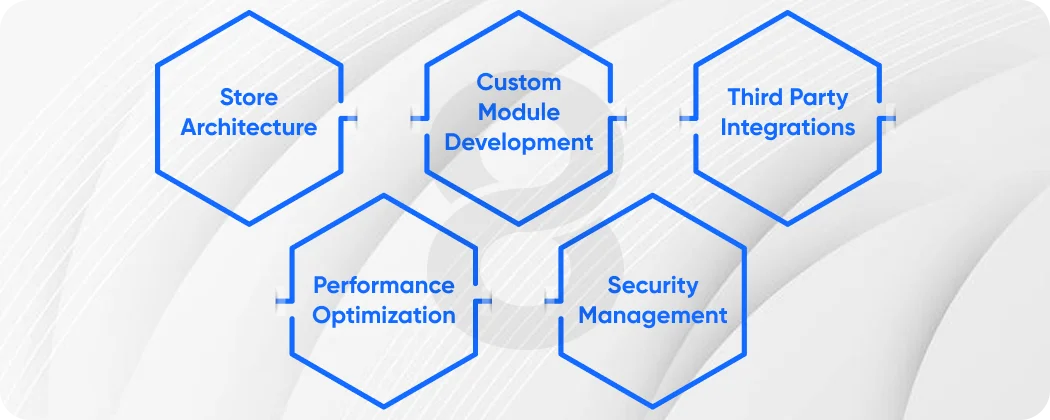
Before hiring developers, it helps to understand their real responsibilities first. Magento developers handle far more tasks than simply building store pages. Their role usually involves several critical technical and architectural responsibilities.
Store Architecture
Developers design the underlying structure supporting the entire online store. This includes databases, product categories, backend logic, and infrastructure planning. A strong architecture ensures the store scales smoothly as traffic increases.
Custom Module Development
Most businesses require features not included within default Magento installations. Developers, therefore, build custom modules extending existing Magento functionality. These modules support unique business operations or specialized customer experiences.
Third Party Integrations
Modern e-commerce systems depend heavily on external digital service integrations. Magento developers connect payment systems, shipping providers, CRMs, and analytics. These integrations usually rely on APIs connecting multiple software platforms.
Performance Optimization
Magento stores easily slow down without careful performance optimization work. Developers implement caching systems and optimize database queries carefully. They also reduce page load times for a better customer experience.
Security Management
E-commerce platforms manage sensitive data, including payment information and customers. Developers must follow strict security practices to protect transactions and user information. Ignoring these practices can expose businesses to major financial risk. Companies searching for magento developers for hire usually expect expertise here.
Read More: Best Scalable Ecommerce Technology Stack for Enterprise
Key Skills Every Magento Developer Should Have
Hiring decisions become easier when the required technical skills are clearly defined. Magento development requires programming expertise combined with deep platform knowledge. Several core technical skills usually separate strong candidates from weaker ones.
Important skills include:
- Strong experience with PHP programming and backend application development
- Detailed understanding of Magento architecture and platform components
- Experience working with MySQL databases and query optimization techniques
- Familiarity with REST APIs and GraphQL integration framework
- Knowledge of caching technologies improves Magento performance significantly
- Frontend knowledge, including HTML, CSS, and a modern JavaScript framework
- Experience managing cloud hosting environments and deployment pipelines
Without these technical capabilities, developers often struggle with complex store requirements. Projects may stall frequently while inexperienced developers attempt learning fundamentals.
Read More: 15 Best Apps Like Temu for E-Commerce Store Ideas
Top 5 Red Flags to Avoid in 2026
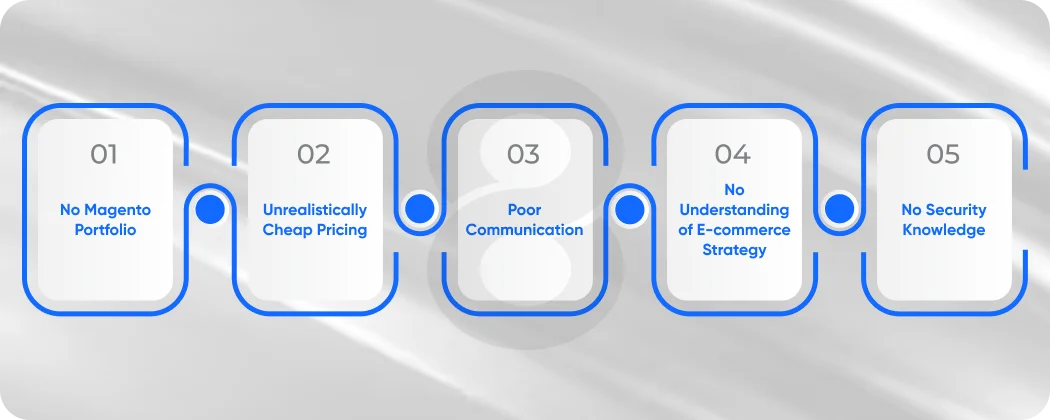
Red Flag 1: No Magento Portfolio
A developer without real Magento projects should immediately raise concern. Many freelancers claim Magento knowledge, but worked mostly with simpler platforms. Platforms like WordPress or Shopify require very different technical understanding. Magento requires deeper architectural thinking and backend development expertise. Developers must manage complex product structures and advanced checkout systems.
They also handle scalable backend logic supporting high transaction volumes. Without real project experience, developers usually learn while building their store. Learning during development increases mistakes and unexpected project delays. When evaluating Magento developers for hire, request actual Magento store examples. Visit those websites yourself and evaluate performance, design, and reliability.
Red Flag 2: Unrealistically Cheap Pricing
Budget always matters when businesses begin hiring for software development. However, extremely cheap development pricing usually signals potential hidden risks. Magento development requires significant expertise and professional technical experience. Experienced developers generally understand their value within the marketplace. Very cheap freelancers sometimes outsource work to unknown subcontractors quietly.
That approach often causes inconsistent code quality and confusing communication. Pricing usually varies depending on experience level and geographic location. Understanding typical ranges helps businesses evaluate offers more realistically.
Typical ranges generally look something like this:
- Junior developers cost less but work more slowly overall
- Mid-level developers offer balanced pricing and reliable productivity
- Senior developers charge more but often deliver results faster
Businesses frequently search globally for Magento developers for hire today. Offshore development teams sometimes reduce cost without sacrificing technical quality. However, extremely low pricing usually indicates deeper experience limitations. Cheap hiring decisions sometimes cost much more to fix mistakes later.
Red Flag 3: Poor Communication
Communication problems ruin many development projects surprisingly quickly. Magento projects involve multiple technical phases and detailed coordination. Developers must explain technical challenges clearly to nontechnical business owners. Without clarity, businesses cannot track progress or understand project changes. Poor communication easily leads to confusion around requirements and deadlines. This confusion eventually slows development and frustrates both sides involved.
Common warning signs include:
- Very slow responses when questions appear during discussions
- Explanations that remain vague or confusing for nontechnical stakeholders
- Project updates are lacking in detail about progress or upcoming tasks
When evaluating magneto developers for hire, observe communication very carefully. Early conversation patterns usually reflect future collaboration during real projects.
Red Flag 4: No Understanding of E-commerce Strategy
Some developers focus purely on technical code without business awareness. However, Magento developers should understand practical e-commerce strategy basics. Technology decisions strongly influence customer experience and sales performance. Developers should understand concepts such as conversion optimization and checkout usability.
Important concepts include:
- Conversion optimization within the product and checkout experience
- Logical product catalog organization, helping customers browse easily
- Smooth mobile performance supporting growing smartphone shopping trends
Ignoring these factors in eCommerce app development may deliver technically functional stores. Unfortunately, those stores might perform poorly from a business perspective. Developers combining technology knowledge with commerce insight become extremely valuable. Businesses searching for magnet developers for hire often prioritize that experience.
Red Flag 5: No Security Knowledge
Security represents one of the most critical elements in e-commerce development. Magento stores process payments and store sensitive customer personal information. Developers must understand secure coding standards and encryption technologies.
They must also follow compliance requirements protecting financial transactions. Security failures can seriously damage businesses and customer trust quickly.
Potential consequences include:
- Major data breaches exposing private customer personal information
- Payment fraud is damaging financial operations and the company’s reputation
- Long-term loss of customer trust and brand credibility
Developers should also monitor Magento security patches and software updates regularly. Ignoring security updates creates vulnerabilities that attackers may exploit later. Security awareness remains essential when evaluating Magento development candidates.
Understanding Developer Experience Levels

Magento developers usually fall within three common professional experience categories.
Junior Developers
Junior developers normally possess one or two years of experience. They remain affordable but often require supervision from senior engineers. Complex Magento features may take them longer to complete successfully.
Mid-Level Developers
Mid-level developers offer balanced productivity and moderate hourly rates. They can implement most Magento features independently without heavy supervision.
Senior Developers
Senior developers possess deep experience with Magento architecture and scaling. They usually solve complex problems faster and reduce long-term project risk. Their rates remain higher, but efficiency often offsets overall development cost.
Many businesses searching for magnet developers for hire prefer mixed teams. Senior engineers often guide junior developers, improving overall productivity.
Read More: 7 eCommerce Giants Winning the Mobile App Game (and How They Do It)
Offshore vs Local Magento Developers
Developer location significantly affects hiring cost and talent availability. North American developers typically charge some of the highest hourly rates. European developers vary widely depending on country and experience level. Asian development teams usually provide more affordable development options. Offshore hiring has therefore become very common across global businesses.
It allows companies access to skilled talent while managing development budgets. However, offshore collaboration requires strong management and communication discipline. Time zones and language differences sometimes complicate project coordination. Companies exploring magnet developers for hire frequently review global candidates.
Read More: How to Hire a Shopify Expert Developer for Headless Commerce
Cost of Hiring Magento Developers
Magento development costs vary widely depending on experience and complexity. Hourly developer rates differ based on expertise and geographic location.
Typical ranges generally include:
- Junior developers charge lower rates but progress more slowly
- Mid-level developers offering moderate pricing with stable productivity
- Senior developers charging higher rates with advanced problem-solving ability
Project-based pricing also changes depending on the required store functionality. A basic Magento store setup may cost between ten and forty thousand dollars. Large enterprise Magento systems often exceed one hundred thousand dollars easily.
Those projects include integrations, automation systems, and scaling infrastructure. Businesses searching for magnet developers for hire should request clear estimates. Transparent pricing discussions help prevent confusion later during development.
Read More: What is Full Stack Developer? Scaling Your Tech Stack Without Doubling Your Team
Technical Questions to Ask Before Hiring
Interviewing developers properly often reveals their actual technical expertise. Ask detailed questions covering Magento architecture and development workflows. Experienced developers should answer confidently using real project examples.
Important topics include:
- Magento module development structure and coding best practices
- Database optimization methods improving large catalog performance
- API integration strategies connecting external commerce services
- Caching systems improving Magento page speed and scalability
- Security practices protecting transactions and sensitive customer information
Strong candidates usually provide clear answers supported by previous experience.
Importance of Project Planning
Good planning prevents many expensive development mistakes later. Magento projects require structured documentation and carefully defined timelines. Without planning, developers may struggle to understand priorities and deliverables.
Planning usually includes:
- A detailed feature list describing the store functionality requirements
- Integration requirements connecting payment and logistics service
- Testing phases, verifying checkout flows, and system reliability
- Launch strategy coordinating deployment and marketing preparation
A well-structured plan significantly improves development efficiency and delivery speed.
Magento Extensions and Custom Development
Magento offers thousands of extensions adding features quickly to stores. These extensions expand functionality without requiring full custom development.
Common extensions support features like:
- Payment gateway integration for secure transaction processing
- Shipping management systems calculate delivery costs automatically
- Analytics platforms tracking sales and customer behavior insight
- Marketing automation tools are improving retention and campaign performance
However, not every extension integrates perfectly with every Magento installation. Developers must evaluate compatibility and avoid conflicts between extensions. Sometimes developers must build custom modules instead of using extensions.
Performance Optimization Strategies
Magento stores easily slow down when optimization practices are ignored. Developers apply several technical strategies to improve speed and stability.
Common strategies include:
- Advanced caching systems reduce repeated database queries significantly
- Optimized database queries handling large product catalogs efficiently
- Content delivery networks distribute assets across global servers
- Image compression reduces page weight without harming visual quality
These improvements help maintain fast loading speeds during heavy traffic.
Testing and Quality Assurance
Testing represents a critical stage within every Magento development project. Developers and QA specialists verify store functionality before launch.
Testing processes usually check:
- Checkout functionality across multiple devices and browsers
- Payment gateway integrations are working correctly with the transaction
- Mobile responsiveness supporting smartphone and tablet shoppers
- Page loading speed across different geographic network locations
Skipping testing often causes serious errors appearing after store launch.
Launch and Post Launch Support
Launching a Magento store does not finish development responsibilities. Online stores require continuous updates, monitoring, and technical maintenance. Security patches and platform updates appear regularly across Magento releases. Magneto developers for hire must implement those updates to maintain store stability. Businesses should plan long-term developer support before launching stores. Reliable teams providing maintenance become valuable long-term technical partners.
Conclusion
Hiring the right Magento developer requires careful evaluation and patience. E-commerce platforms demand technical expertise and clear professional communication. Developers must also understand real-world online retail operations. Hiring mistakes easily introduce delays, security risks, and unexpected expenses. Recognizing warning signs early helps businesses avoid those painful problems. Companies evaluating portfolios and technical knowledge make stronger hiring decisions.
Communication ability and strategic thinking also matter greatly during evaluation. Many businesses search for magneto developers for hire for specialized expertise. Specialists usually deliver stronger integrations and scalable technical solutions. Choosing experienced professionals improves performance and long-term platform stability. Taking extra time during hiring ultimately saves time and money later.