


Enterprise AI is not an experiment on a single platform any longer. Nowadays, the leaders of B2B industries operate dozens of AI agents at the same time, some of them in CRM pipelines, others controlling communication channels, and others coordinating complex ERP processes. The problem? These agents do not often use the same language.
The Model Context Protocol (MCP) is exactly where the Model Context Protocol (MCP) comes in. MCP, invented by Anthropic and spreading quickly throughout the enterprise software world, is becoming the common language of interoperability, enabling AI agents to communicate, share context, and make joint decisions across diverse business platforms, such as Salesforce, Slack, and SAP.
This guide will deconstruct what MCP is, why it is important to the strategy of enterprise AI and software development, and how your business can use it to release the laissez-faire cross-platform development of AI agent workflows that tour your whole software ecosystem.
What Is Model Context Protocol (MCP)?
The Model Context Protocol is an open standard that describes how the AI map and agents exchange context with other tools, data sources, and services. Imagine that it was a layer of API, but you have in mind its dynamic, stateful nature of AI interactions.
Instead of creating unique integrations in each case of the AI-to-tool integration, MCP offers standardized interfaces. An AI agent based on MCP is able to invoke a Salesforce record, fetch a Slack thread, or query an SAP ERP module over the same protocol structure, significantly lowering the complexity of integrating any two together.
Key components of MCP include:
- MCP Servers: Lightweight processes that put tools, resources, and data at the risk of AI agents
- MCP Clients: The AI models or orchestration layers that use those tools
- Context Streams: Continuous, formalized flows of information that enable agents to have a stake in a multi-step workflow.
- Tool Definitions: Monitored schemas describe what each service connected to the system can do and how to call it.
The Enterprise Interoperability Problem
Sizable organizations, especially the B2B business, often run along a dispersed technology stack. Salesforce has a sales team that lives in Salesforce. SAP is used in operations and finance. Slack works as an internal collaboration tool.
In the meantime, the mobile app development teams release client-facing applications that should be capable of drawing the information on all three systems in real-time. Such platforms were never intended to share AI context, and that poses severe bottlenecks.
An example of this is a typical situation when a sales AI agent detects a deal with high value that is about to close in Salesforce. The next step would be to confirm the availability of inventory in SAP and inform the team head responsible about it through Slack. In the absence of interoperability standards, this would mean three invocations of each agent, manual handoff, or fragile custom scripts.
Under MCP, the whole flow of work turns into one coordinated flow. A single AI agent that has the necessary MCP server connections can access all three systems, maintaining full context at each step.
Read More: The ‘Decision Trace’ Protocol – Building Audit-Ready AI Agents for Regulated Industries
How MCP Connects AI Agents Across Salesforce, Slack, and SAP
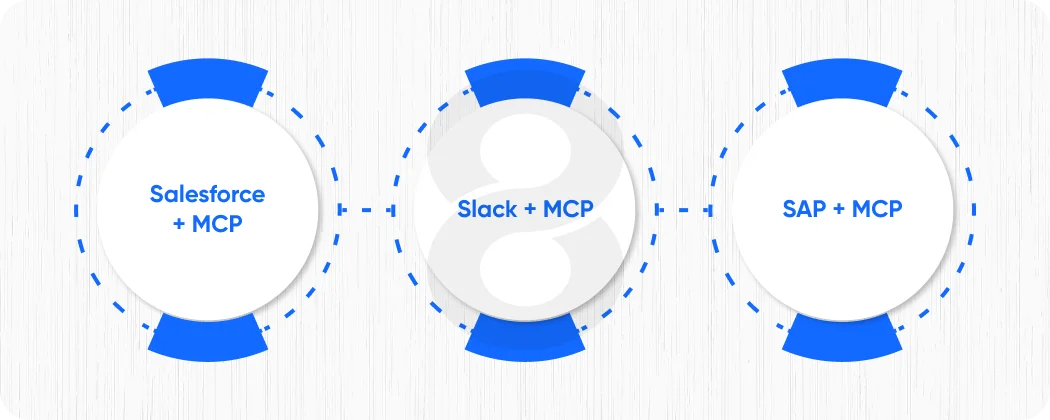
Salesforce + MCP
Salesforce is already starting to add MCP-compatible tooling with its Agentforce platform. MCP tools empower AI agents to interrogate workflows, automation rules, and CRM objects. This standardized protocol enables agents to query lead status, advance opportunity stages, and access customer interaction history.
This implies that AI can be integrated directly with custom Salesforce applications without rewriting integration logic, which is common with teams that invest in CRM app development.
Practical use cases include:
- Real-time CRM signals to qualify deals and do it automatically.
- AI agents that send Salesforce records when external events are detected in SAP or Slack.
- Context-based sales training agents that fetch the complete customer history before each interaction by the reps.
Slack + MCP
The MCP integrating Slack turns the team communication into an actionable data source for AI agents. Instead of just notifying, AI agents are able to read the context in threads, detect action items, delegate tasks, escalate issues, and still be conversationally aware.
This is of particular importance to cross-platform development teams that need to coordinate between web, mobile app development, and backend services, where Slack threads will transmit important contextual information not shared between systems.
In MCP, a Slack-connected AI agent can:
- Track certain channels of decision triggers and take downstream action independently.
- Make longer conversation threads concise and drive structured results to Salesforce or SAP.
- Multi-agent workflows coordinate workflows in AI systems via structured message posting of handoff messages between the systems.
SAP + MCP
Enterprise resource planning SAP has the largest footprint, which is why it is among the most valuable systems and is also one of the most notoriously difficult systems to integrate with AI.
MCP gives a clean interface to the APIs of SAP, which enables an agent to query inventory, initiate procurement processes, access financial documents, and intercommunicate with supply chain data without extensive engineering that requires deep SAP-specific engineering.
SAP integrations using MCP allow the following:
- Smart procurement agents, which will cross-reference Salesforce pipeline demand forecasts.
- Invoice reconciliation agents are finance automation agents that are based on SAP and Slack approval thread data.
- Agents supply chain visibility that brings the SAP data directly to natural language interfaces for operations teams.
Read More: How to Build a “Digital Workforce” of Specialized AI Agents for Supply Chain Automation
Building an MCP-Connected Multi-Agent Architecture
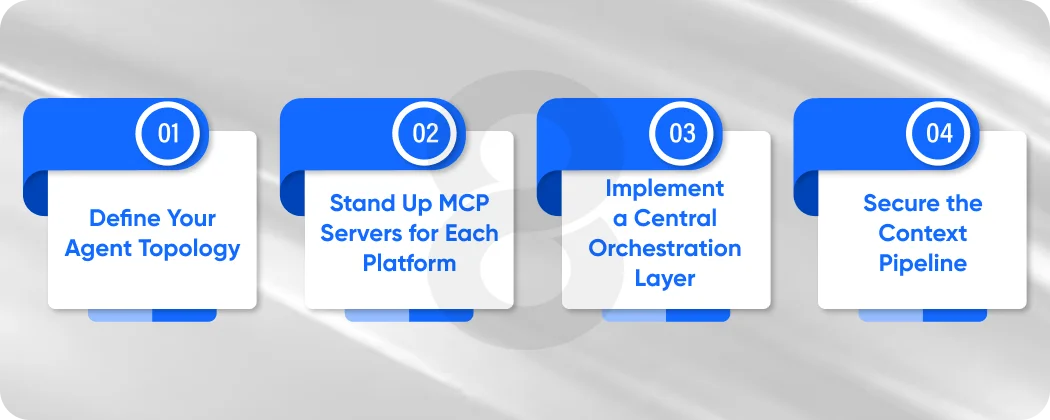
The application of MCP in Salesforce, Slack, and SAP needs a formal architecture. Enterprise AI teams are supposed to think about it in the following way:
Step 1: Define Your Agent Topology
Locate the owners of the systems. An effective multi-agent architecture has a defined ownership: a CRM agent has Salesforce context, an agent of communication has Slack, and an agent of ERP has SAP.
Just as good software design gives worries to modules, MCP enables these agents to ask domains of each other without tying them together directly, meaning that your AI architecture remains clean, maintainable, and scalable.
Step 2: Stand Up MCP Servers for Each Platform
Every integrated platform should have its own MCP server. These servers provide tools the AI calls as functions, resources the AI reads as data objects, and prompts that offer pre-written instructions for recurring tasks.
In the case of Salesforce, this could be such tools as get_opportunity, update_lead_stage, or run_flow. In the case of SAP, it may involve check_inventory, submit_purchase_order, or query_financial_ledger.
Step 3: Implement a Central Orchestration Layer
An agent in charge of context flow among specialized agents is commonly known as an AI orchestrator or planner. It determines which based agent in the MCP acts next, transfers the context, and integrates outputs into a sensible solution. Enterprise AI platforms, such as the custom AI development services of 8ration, come in highly useful at this point.
Step 4: Secure the Context Pipeline
Cross-platform AI processes and cross-platform development, in particular, cross-platform development that extends across web, mobile, and enterprise backends, present new security issues.
MCP implementations must incorporate server-level authentication, role-based access control, and comprehensive interaction logging for auditing purposes. This becomes critical when an agent context processes financial data from SAP and Salesforce customer records.
Read More: Agentic SOC – Transitioning from Human-Led Detection to Autonomous AI Threat Response
Why MCP Is the Future of Enterprise AI Integration
The enterprise AI landscape evolves rapidly. Organizations that prioritize immediate interoperability reap the greatest benefits. MCP has several structural benefits compared to other integration strategies:
- Reduced integration overhead: A single protocol substitutes dozens of point-to-point integrations.
- Composable agent design: This is possible even when there are new agents to be added to the workflow, without having to restructure the stack.
- Vendor-agnostic by design: MCP is integrated with providers of AI, not only Claude from Anthropic.
- Context persistence: Agents have stateful knowledge in long-run, multi-step processes.
- Observability: The natural audit trail of compliance and debugging is produced by standardized tool calls.
- B2B industry alignment: The structure of MCP is natural in the complex and multi-system environment of B2B enterprises.
- Cross-platform development ready: MCP-based AI agents operate on web, mobile app, and enterprise software levels without re-architecture.
With the MCP adoption by enterprise platforms, Salesforce via Agentforce, and increasing usage in the SAP and Atlassian ecosystems, organizations that do not plan interoperability will see an increasing technical debt load with the scale of AI workflows.
Final Thoughts!
Interoperability is not an option that is desirable in enterprise AI; it is the basis on which scalable intelligent automation is founded. The Model Context Protocol provides a uniform, extensible, and secure method of linking AI agents between the systems that your business already relies on.
With MCP connecting Salesforce, Slack, and SAP, enterprises can leave the experimental stages of AI experimentation behind and combine the workflows into a complete, multi-functional AI that brings quantifiable business value. The companies that have invested in this architecture now are getting in place to dominate an AI-based competitive environment.