




When operating in highly regulated sectors such as fintech, healthcare, and energy, businesses are under mounting pressure to make their AI development transparent, accountable, and compliant. Moreover, artificial intelligence can provide immense efficiency in operations and predictive value, yet without the proper governance, it may also bring a regulatory risk.
Therefore, that is where the decision trace protocol can be considered a game-changer. Furthermore, because of the way it allows organizations to create audit-ready AI agents that can ensure high quality in line with the industry requirements without losing their performance and innovation.
Moreover, in this guide, we will discuss the definition of the decision trace protocol, why it is important to regulated industries. Also, how your organization can adopt it to help your business achieve success.
Understanding the Decision Trace Protocol
The decision trace protocol is a framework that aims at establishing an auditable, transparent account of AI agent behavior. Consider it an AI black box in decision-making, where all actions, data input, and system responses are recorded to keep them accountable. In contrast to traditional logging, which logs generic events, a decision trace logs the entire context and justification of the AI decisions, and compliance reviews, audits, and regulatory reporting are effortless.
The important characteristics of the decision trace protocol are
- Full Decision Documentation: Record all AI activities with metadata that details the input information, the applied model, the decision rule, and the surrounding conditions
- Immutable Records: The logs are kept in formats that are not tampered with in order to ensure trace integrity during internal audits and regulatory review
- Transparency in AI Reasoning: Decision traces offer explainable mechanisms of how AI models arrived at certain decisions, solving the black box issues in the regulated industries
- Real-Time Monitoring: Organizations are able to identify anomalies, non-compliance, or dangerously risky conduct in the AI agents before it turns into regulatory challenges
Why Regulated Industries Need Audit-Ready AI Agents
Controllable industries, such as finance, healthcare, insurance, energy, and telecommunications, follow rigid frames of compliance. That is why it is no longer possible to build audit-ready AI agents as a luxury:
- Regulatory Compliance: The need for explanation, tracing, and accountability in automated decisions has become a requirement by the SEC, FDA, and the ISO standards.
- Risk Mitigation: Organizations without a transparent log of their AI decisions can face legal and financial risk to customers in case an AI malfunction affects their customers.
- Internal Governance: Audit-ready AI allows the management to track the behavior of the system, justify the decisions, and enforce the internal policies.
- Customer Trust: The openness of the AI procedures enhances customer trust and brand image, which is crucial in industries with high stakes.
Simply put, the decision trace protocol makes the AI agent responsible as a transparent entity so that businesses can safely innovate without regulation.
Read More: How to Build a “Digital Workforce” of Specialized AI Agents for Supply Chain Automation
Core Components of the Decision Trace Protocol
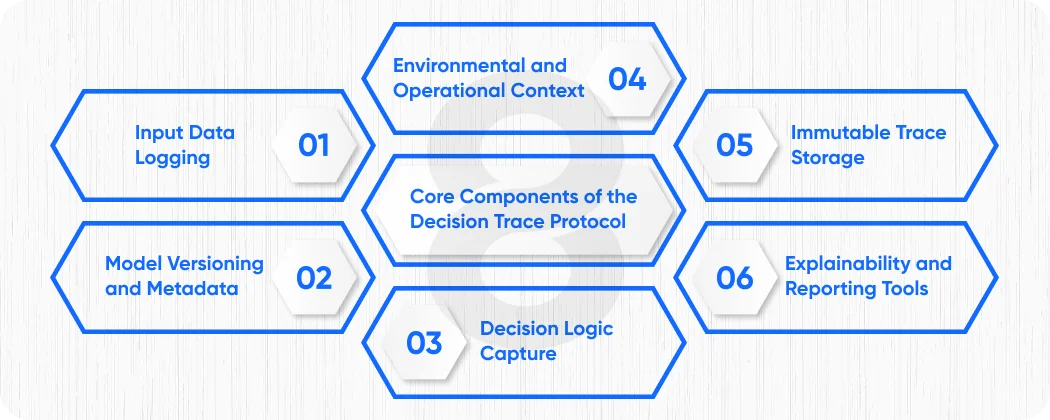
To create an AI agent that is audit-ready, there are a number of important elements that need to be incorporated. Each has a certain role in guaranteeing transparency, traceability, and compliance.
1. Input Data Logging
The initial step is to monitor all the data points that get into the AI system. Input data logging captures:
- Data origin (internally based system, externally based system, user-based system)
- Timestamp of data ingestion
- Transformations or preprocessing steps used.
This makes sure that any decision that was arrived at by an auditor can be traced to the input that caused the decision to be made.
2. Model Versioning and Metadata
The AI models change fast, and the decision trace protocol is focused on version control and metadata tracking:
- The choices are associated with a particular model.
- Metadata contains training information, hyperparameters, and updates.
- Helps prove that the AI agent deployed an approved model that had been tested.
3. Decision Logic Capture
In addition to inputs, the protocol demands the logic or rationale of every AI action:
- What algorithm or set of rules was used to make the decision?
- Probability scores or reference levels of confidence of results.
- Overrides or human interventions.
Furthermore, this provides a clear trail to the auditors who can determine the reasons as to why an AI made a certain decision.
4. Environmental and Operational Context
Making decisions is not a one-person activity. To introduce contextual information, which also brings an additional traceability level:
- Response times of system load, hardware status, or API response.
- Policy settings or regulatory environments that are present in the course of decision-making.
- The reasoning of the AI is influenced by external environmental conditions.
Moreover, this will make sure that auditors are able to test whether the decision-outsourcing factors came into play.
5. Immutable Trace Storage
The storage of all traces of decisions in a secure, tamper-proof storage is a critical part of the protocol:
- Trace immutability is best suited to blockchain or append-only databases.
- Sensitive data is secure due to encrypted storage.
- Enables auditing by regulators to have verifiable and unaltered records.
6. Explainability and Reporting Tools
Lastly, the AI agents that are audit-ready need visualization, reporting, and explainability tools:
- Summarizing AI decisions, risk level, and anomaly dashboards.
- Regulatory format automated reports.
- The tools to provide explainable AI results to stakeholders or auditors.
Read More: Agentic SOC – Transitioning from Human-Led Detection to Autonomous AI Threat Response
Implementing the Decision Trace Protocol: Step-by-Step
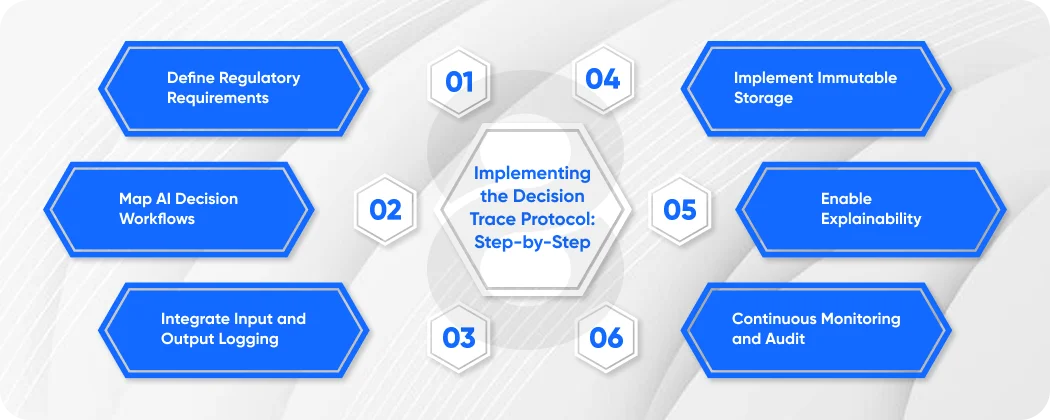
Integrating a decision trace protocol into a regulated industry can be perceived to be complicated. Yet an organized approach can make integration easy. Here’s a step-by-step guide:
Step 1: Define Regulatory Requirements
The first thing to do is to determine all the rules that apply to your industry. Identify AI audit and compliance requirements, and develop internal traceability, data retention, and approved model use policies to fully hold oneself accountable.
Step 2: Map AI Decision Workflows
Record every AI system and decision path.
Step 3: Integrate Input and Output Logging
Log each AI input, time and preprocessing information. Log results and version of model, confidence scores, rationale of decisions, and a full, comprehensive record of traceable AI activity to be audited.
Step 4: Implement Immutable Storage
Record every trace of decisions in non-readable systems like blockchain or append-only logs. Secure the encoding of sensitive data and remain within the regulations of GDPR, HIPAA, or other standards of the industry.
Step 5: Enable Explainability
Integrate explainable AI models such as SHAP, LIME, or counterfactual analysis. AI generates reasoning-based, automated, human-readable reports that clearly describe its thought process and provide auditors and other stakeholders with full transparency.
Step 6: Continuous Monitoring and Audit
Install real-time monitoring to identify anomalies or policy breaches in time. Organizations conduct regular audits to ensure the integrity of traces and protocols, and they keep models up to date with regulatory requirements and internal policies.
Best Practices for Audit-Ready AI Agents
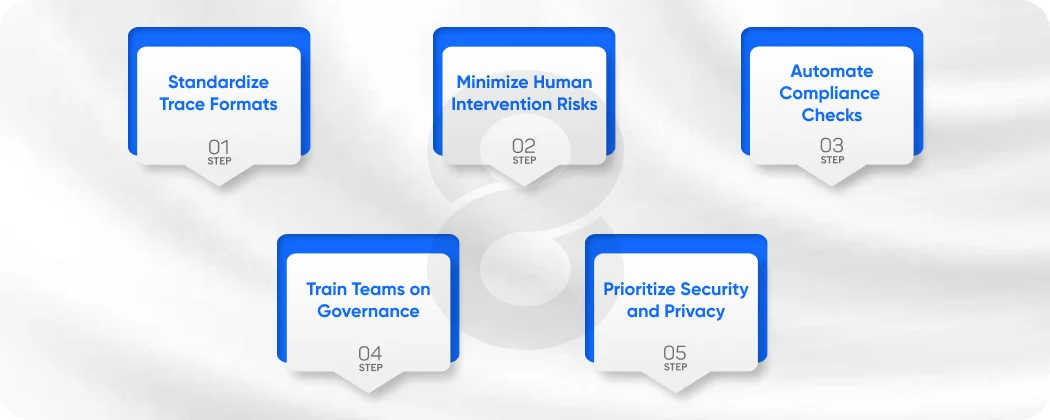
Adherence to best practices will keep your AI agents transparent, accountable, and compliant. By standardizing processes, reducing risks, and empowering teams, organizations can confidently roll out AI without compromising regulatory or security standards.
1. Standardize Trace Formats
Regular logging and metadata specifications provide auditors and teams with a chance to interpret AI choices promptly, provide clarity, and minimize errors. Also, it follows traceability in all AI operations in controlled settings.
2. Minimize Human Intervention Risks
Organizations must document all manual overrides and attach clear explanations. This approach prevents accountability gaps, improves audit readiness, and ensures AI decisions remain fully traceable while meeting both internal and regulatory requirements.
3. Automate Compliance Checks
4. Train Teams on Governance:
By training developers, data scientists, and auditors to interpret decision traces, organizations can foster a culture of responsibility, strengthen internal governance, and ensure unified AI management across the company.
5. Prioritize Security and Privacy
Implement strong cybersecurity, enforce access controls for authorized personnel, and protect the secrecy of sensitive data to safeguard AI logs without violating regulations or compromising organizational and customer information.
Read More: Why the Best Exercise Workout App are Moving to Agentic AI
Real-World Use Cases

1. Financial Services
AI is used by banks and investment firms in credit scoring, fraud detection, and automated trading. Using the decision trace protocol:
-
Record all credit decisions with their inputs, models, and rationales
-
Use explainable alerts from fraud detection models to inform regulators
-
Conduct internal audits efficiently, reducing compliance expenses
2. Healthcare
Healthcare providers can leverage custom AI development to ensure each diagnostic AI model meets FDA and HIPAA standards.
- Decision Trace allows tracing each recommendation to the clinical data.
- Assist in meeting AI standards of the FDA or HIPAA in clinical operations.
- Helps in promoting medical ethics and accountability by clarifying the AI-based reasoning to clinicians.
3. Energy and Utilities
Predictive maintenance, grid optimization, and automated load balancing are the areas where energy companies that use AI:
- Decision trace records are useful to show adherence to the environmental and safety standards.
- To confirm the operational safety, engineers are able to revise the historical decisions.
- Auditors will be able to make sure that AI action is undertaken in accordance with internal and regulatory policies.
Read More: 8 Industries Being Redefined by Computer Vision in 2026
Overcoming Implementation Challenges
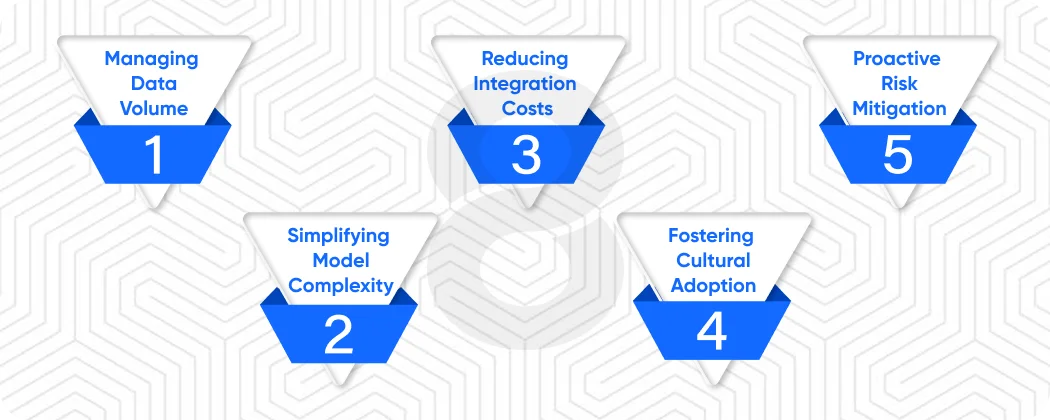
The adoption of the decision trace protocol may prove to be difficult, yet an appreciation of the common barriers that data volume, cultural acceptance, and adoption may pose can help organizations tackle the problem proactively and ensure that the results delivered by the auditing AI agents are productive, consistent, and tailored to the organization.
Managing Data Volume
Decisions by high-frequency AI create massive logs. An effective storage system, indexing, and data compression can help keep your audit-ready AI systems responsive, scalable, and readily available to audit and operational review.
Simplifying Model Complexity
The deep learning models are potent but tend to be opaque. The application of model-agnostic explainability tools facilitates teams to view AI reasoning transparently. Moreover, decision-making becomes transparent, understandable, and consistent with regulatory expectations.
Reducing Integration Costs
Trace logging may not be part of the legacy systems. Investment in middleware or system modifications is also a guarantee of smooth integration of Decision Trace to avoid disruption of operations and to facilitate audit-ready processes.
Fostering Cultural Adoption
Organizations must secure buy-in to make audits effective. Moreover, by training teams, promoting transparency, and presenting trace protocols as efficiency tools, they can motivate employees to embrace compliance rather than see it as an administrative burden.
Proactive Risk Mitigation
The early identification of difficulties, be it technical, operational, or even cultural, will allow organizations to employ the protocol of Decision Trace in a strategic manner and minimize the regulatory risk, making AI systems compliant, trustworthy, and reliable.
Read More: What Is Agentic AI? Definitions And Real-World Examples
Future Trends in Audit-Ready AI
The Decision Trace protocol is in agreement with larger tendencies in AI governance.
- Regulatory Convergence: Look to the world regulations to coordinate toward transparency and auditability.
- Explainable AI Evolution: Real-time explainability and reasoning tools are increasingly becoming sophisticated.
- Autonomous Auditing: The routine audit checks can be automated with the help of AI-generated compliance checks, which will involve less human work.
- Integration with Digital Twins: Simulations of digital twins, along with AI agents, have the potential to offer a more detailed context of decision traces.
Those companies that implement decision trace protocols at this point will be in a better position to survive the future regulatory environment, as they also keep innovating with AI.
Conclusion
The Decision Trace Protocol goes beyond compliance. It serves as a strategic platform for building audit-ready AI agents that operate safely and transparently in highly regulated industries. By capturing the entire decision context and storing it immutably, businesses can make AI decisions explainable and follow best practices. As a result, companies reduce risk, comply with regulators, and gain a competitive edge.
Furthermore, in a time when AI-based decisions are gaining more regulatory and operational implications than ever before. The implementation of a decision trace protocol is the key to every organization that intends to innovate in a responsible manner without losing trust, transparency, and accountability.