


Businesses no longer need to be traditional game studios to tap into the booming gaming market. With the right idea and a clear strategy, any company can build engaging game experiences that drive real growth and customer loyalty.
Imagine making your brand a two-way experience that engages billions of people around the world. Companies can use today’s ideas of game creation to build immersive worlds, branded casual games, or loyalty apps based on games.
Even little startups may discuss 2D game concepts on Android, a project of mobile game development, or strategy simulations to create long-term interaction.
Key Takeaways
- Gaming market is heading toward $260B in 2025, with mobile pulling in nearly half of that
- People connect with games on a deeper level than most traditional marketing ever achieves
- Before writing a single line of code, get clear on what you want, more customers, more revenue, or better retention
- You don’t need a big budget to start, simple casual or 2D mobile games can get the job done
- Adding points, badges, or leaderboards to what you already have can go a long way without building a game from scratch
- How you make money matters as much as the game itself, whether that’s ads, subscriptions, or in-app purchases
- Hayala proved it works, players stayed for 45+ minutes and 92% brought a friend along in the first week
- The hard parts are real, costs can spiral, keeping players around is tough, and the market is crowded
The market research projected that the overall video game industry will hit about $260 billion in revenue in 2025, with mobile gaming taking up almost half. To other firms toying with the game design and game dev concepts, this is an indicator of good ground to be innovative and profitable.
Why Businesses Should Invest in Game Development
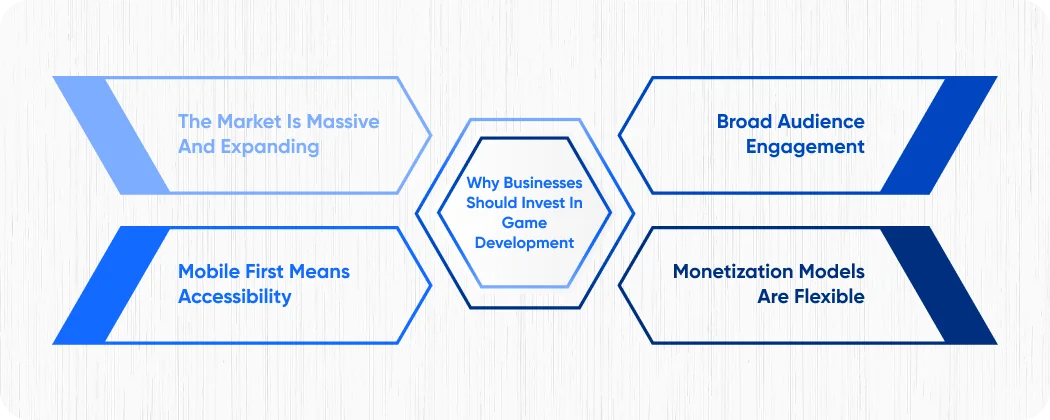
It is important to know why game creation is important before getting down to discussing particular concepts in connection with game development projects:
1. The Market Is Massive and Expanding
The video game media is still leading most of the other entertainment media. According to experts, the amount of money that is spent in the gaming industries around the world will have increased to over $205 billion by the year 2026, with mobile gaming taking up over fifty percent of that sum.
2. Mobile First Means Accessibility
Mobile games have become a tens-of-billions-of-dollars-per-year industry and control a leading portion of the gaming ecosystem. This renders the development of mobile games as a particularly appealing entry point for most businesses.
3. Broad Audience Engagement
Gaming cuts across the demographic lines. Games have the potential to establish strong emotional connections with consumers, unlike many other time-honored methods of marketing, generate repeat interaction, and establish community loyalty.
4. Monetization Models Are Flexible
The range of possibilities of how a game development can pay off has never been more varied, as the number of free-to-play models with in-app purchases has grown, along with subscription and advertising revenue.
How to Approach Game Development Strategically
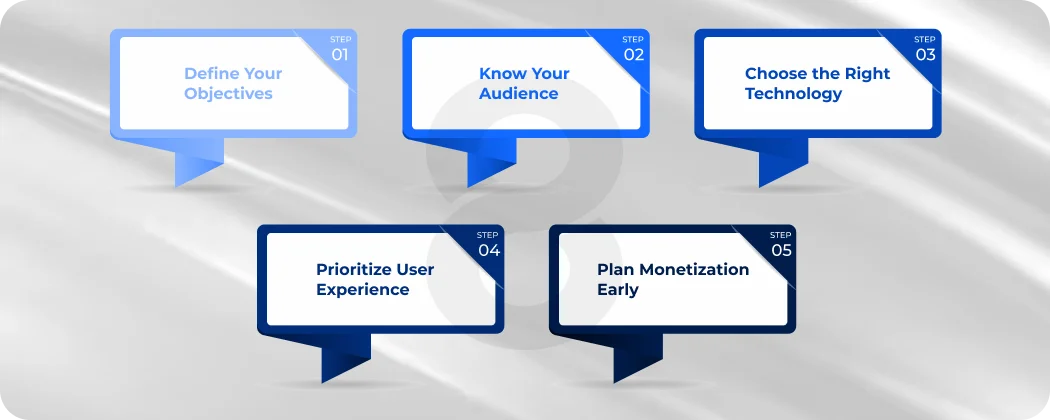
The gaming market does not involve coding and launching a product. Visionary businesses begin with an organized plan:
1. Define Your Objectives
Is it a game to create brand awareness, immediate revenue, customer loyalty, education, gamification of services, or both? This solution will define your architecture and technology stack.
2. Know Your Audience
The research on market segmentation and player behavior can be used to determine what type of games will make your target audience respond, whether they are casual mobile users or more serious gaming groups.
3. Choose the Right Technology
Choose between game engines such as Unity and Unreal Engine or create unique creative systems based on whether you are planning 2D games on Android, a complex 3D interactive world, or an AR/VR hybrid.
4. Prioritize User Experience
Development is as relevant as design. The best game development concepts have to be easy to control, have interesting stories, and have positive value to keep a player.
5. Plan Monetization Early
Available monetization models vary and include microtransactions, advertisements, premium models, and subscriptions, and each of these models can have an impact on the design and lifecycle of your game.
Read More: Game Programming Patterns – A Detailed Guide
Top Ideas for Game Development That Businesses Should Explore
Underneath are highly effective and scalable game development ideas depending on various business objectives.
 Branded Casual Mobile Games
Some of the most successful ideas for developing a game commercially are casual games. They are normally easy, enjoyable, and easy-to-get experiences that can introduce players to your brand without necessarily providing entertainment value. For example:
- A three-match puzzle game with thematic levels of the brand
- Unlimited runners with company mascots
- Industry-related trivia games and quizzes
The games are ideal in businesses that are new to the arena of games, as they are comparatively cheap and extensive.
 Educational or Training Games
In the case of an organization in education, healthcare, or enterprise learning, game-creating concepts may involve interactive training simulation, which can make learning more interesting. These games can:
- Enhance the growth of employees
- Reduce training costs
- Increase internal involvement
Education games based on simulation and quizzes assist in building trust in the brand and providing real value.
 Loyalty and Gamified Customer Apps
The other conversion-driven concept is to apply gamification to your customer app. Instead of being a game on its own, this strategy employs game-based structures like points, challenges, rewards, and leaderboards to engage and become loyal.
Examples include:
- Reward schemes for frequent shoppers
- Health brand fitness issues
- Badges of achievement for using services
These concepts of game development projects will assist in strengthening customer relationships and enhancing the lifetime value.
 2D Game Ideas for Android
Android has seen the greatest usage in the mobile operating system globally, and it is a good business game platform. Some lucrative 2D game development ideas for Android include:
- Stages of increasing difficulty
- Retro-style arcade games
- Children’s educational games
These enhance your brand presence on a handset that consumers are carrying all the time.
 3D Game Development Project Ideas
In case your company has a bigger budget and would like to establish a sense of immersion, 3D game development project ideas include:
- Branded environment open-world exploration games
- RPGs that are driven by stories but centered on your story world
- Interactive field tours with the help of game-based software
The 3D worlds are more immersive and need more expertise in design and development.
 Gamified Sales Experiences
Companies can develop gamified sales processes in which consumers get incentives when they finish some assignments linked to product findings or buying activities.
Examples include:
- Spin-to-win discounts
- Online treasure hunts with real-life prizes
- Interactive catalog quests
These are commercialized game concepts, which incorporate fun with business.
 Augmented Reality (AR) Experiences
The AR provides the potential for developing exciting games that brands interested in combining the real world with the digital experience can do. AR games can:
- Foster practical investigation
- Enable social interactions
- Develop new promotion strategies
This can be AR scavenger hunts or product visualizers involving the transformation of real environments into a game level.
 Multiplayer Social Game Concepts
Communities and long-term interactions are promoted by online multiplayer experiences. Viral growth and user retention can be motivated by the use of tactics such as cooperative goals, guild systems, and competitive leaderboards.
With the world of global gaming still evolving, social games are the favored engagement platform.
 Hyper-Casual Viral Game Concepts
Hyper-casual games present businesses with a risk-free opportunity to enter mobile game development with easy gameplay such as tapping, swiping, and timing challenges.
Such lightweight experiences enable the rapid experimentation of concepts to develop a game and use ad-based monetization to grow in scale and validate the market.
- Minimal one-touch gaming interface
- Rapid development and introduction process
- Slow maintenance and production costs
- Ad-driven revenue models
- Social sharing has high viral potential.
 Simulation and Strategy Business Games
Strategy and simulation games involve the user in an immersive game experience, such as city building, management of resources, or industry-specific difficulties.
The ideas presented in these game development projects are analytics, AI mechanics, and realistic systems, which explains their suitability for brands that want to engage their customers more profoundly with the 3D or 2D game development solutions.
- Virtual simulations focusing on the industry
- Mechanics that are data- and AI-based
- Increased participation and duration of the session
Technology Stack and Tools to Consider
The choice of the appropriate tools and engines will or will not make your game project successful. Examples of common technologies used to develop games are:
- Cross-platform 2D and 3D game development in Unity
- High-end AAA-style experience with Unreal Engine
- Godot is to develop lightweight and open-source games
- Specialized structures of niche or extremely specialized games
User retention and monetization will be enhanced by integrating analytics SDKs, ad networks, and cloud services.
Read More: How Much Does It Cost to Make a Video Game
Creating Addictive Social Gameplay: The Hayala Approach
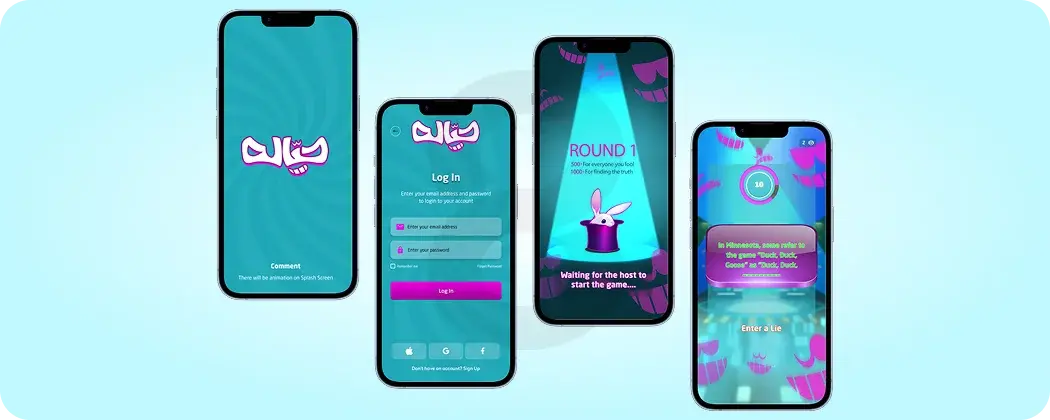
As our team, 8ration, discussed new concepts regarding the creation of the game, we collaborated with the developers of Hayala Arabic Game, which is a social quiz app that allows making knowledge not only fun but also socially shareable.
It was aimed at creating a mobile experience that was not just about trivia but one that would transform the witty answers into fun and competitive games that users would like and share.
With a successful launch, Hayala was able to achieve excellent engagement:
- In terms of time spent on each session, players had an average of 45+ minutes, indicating that they were immersed in the gameplay.
- 92% of players invited at least one friend during the first week, driving organic growth.
- Questions that were disseminated on social networks brought 100K+ impressions per month.
- Players were also heavily invested in the community, as 500+ user-created questions were made within the first month.
Combining intelligent gameplay with social competition and player-created content, this project underscores the idea of how a careful approach to the implementation of concepts of game development will lead to quantifiable business results, retention, and a player community.
Monetization Models You Should Know
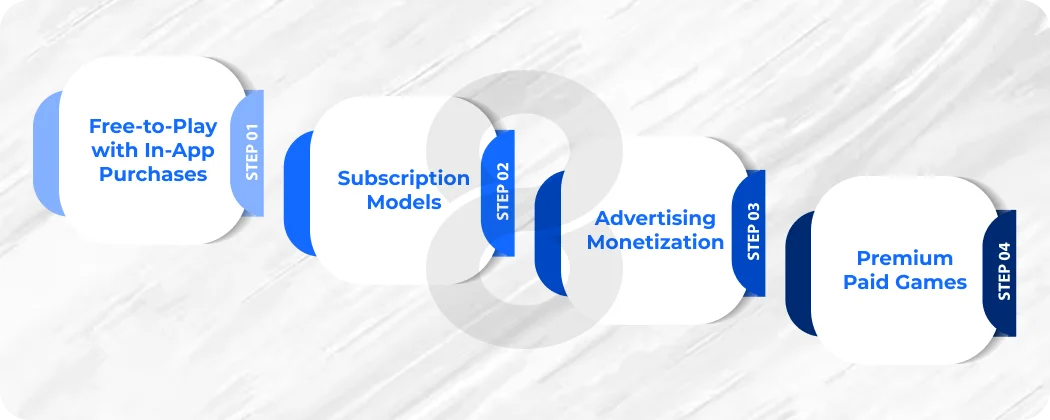
The game monetization strategy should be chosen as much as the good ideas to develop the game when making your game plan. A properly integrated revenue model guarantees sustainable growth, a balanced user experience, and profitability in the long run.
1. Free-to-Play with In-App Purchases
This model enables users to obtain the game at no initial expense and earn revenue based on optional in-app purchases like skins, power-ups, subscriptions, or upgrades of virtual money.
2. Subscription Models
The subscription models offer recurring revenue, such as through offering players exclusive content, premium features, ad-free experiences, early access, or bonus rewards in exchange for a weekly, monthly, or annual membership fee.
3. Advertising Monetization
Advertising monetization outperforms interstitial placements and rewarded video ads in gameplay, allowing a business to earn revenue without asking users to pay. Instead, it invites users to engage with ads that appear seamlessly as the game progresses.
4. Premium Paid Games
Premium paid games involve users making an upfront purchase of the game, so they usually target niche markets that like quality, immersive, or narrative experiences with no advertising, microtransactions, or recurring payment models.
In the end, the most appropriate monetization model must be based on target audience behavior, market positioning, and overall business goals and achieve revenue growth without negatively impacting the quality of gameplay or brand credibility in the long run.
Challenges Businesses May Face in Game Development
Despite good concepts towards the development of the game, businesses can face challenges that include:
- The sophisticated titles are highly expensive to develop
- Assurance of player retention in the long run
- Striking a balance between monetization and the reduction of user experience
- Creating a presence amongst similar apps
These risks are reduced by careful planning, quality assurance, and user testing.
Read More: How Long Does it Take to Make a Video Game
Final Thoughts!
Development of games is no longer restricted to the usual studios. Companies in any sector have the opportunity to utilize the concepts of creating games to win the interest of viewers, motivate them to engage, and convert more.
Opportunity can be scaled and even profitable, both in the case of casual mobile games and in the case of immersive 3D experiences.
As the gaming industry in the world is making billions of dollars, particularly via mobile types, brands have the opportunity to find new sources of revenue and more robust connections with customers. Select a strategic idea, match it with your objectives, and establish a strong digital contact point.