


Most manufacturing conversations still start in the wrong place. People jump straight into automation, Industry 4.0, smart factories, predictive systems, all the phrases that sound impressive in presentations but rarely reflect what is actually happening inside most manufacturing businesses. Because when you step away from the slides and look at the operations closely, the issue is usually not the absence of technology.
The real issue is fragmentation. Different systems doing different things, none of them fully aligned, and teams constantly compensating for that gap manually. That is where friction builds quietly. It shows up in delays that nobody can fully explain, repeated manual work that should not exist anymore, reporting that never feels fully reliable, and teams spending more time fixing processes than improving them.
And that is exactly the point where manufacturing software solutions stop being a “nice-to-have upgrade” and start becoming a structural requirement for the business. Because at some stage, you are no longer optimizing anything. You are just trying to prevent things from breaking under pressure.
That is the uncomfortable truth most companies realize a little later than they should.
What Is Actually Driving Demand for Manufacturing Software Solutions Right Now
The demand is not coming from trends. It is coming from pressure that keeps increasing. Manufacturers today are dealing with tighter profit margins, more volatile supply chains, higher customer expectations, and faster delivery cycles that do not leave room for inefficiency. At the same time, internal operations are becoming more complex, not less.
So naturally, businesses start looking at manufacturing software solutions as a way to stabilize operations. But here is where things go wrong for a lot of companies. They assume adding software automatically fixes inefficiencies. It does not. If anything, the wrong system adds another layer of complexity that teams now have to manage.
What actually creates value is alignment. When the system reflects how your business actually operates, not how a generic platform assumes it should operate. That is where software development becomes strategic instead of purely technical. It stops being about building features and starts becoming about solving operational bottlenecks that already exist.
The Real Reason Custom Development Is Becoming the Better Choice
Off-the-shelf platforms are designed to look good in controlled environments. They are structured, predictable, and easy to understand when everything is hypothetical. But manufacturing environments are not controlled environments. They are full of exceptions, dependencies, and workflows that rarely follow a perfect path.
That is why more businesses are shifting toward custom solutions for manufacturing software development. Because instead of forcing your operations to adapt to a system, you build the system around your operations and then improve it from there. That shift is more important than most teams initially realize.
Custom development allows businesses to:
- Remove redundant steps that slow down daily operations
- Integrate directly with existing machinery and internal systems
- Build workflows that reflect real-world processes instead of assumptions
- Scale operations without replacing core systems every few years
This becomes even more critical when companies invest in enterprise app development to support internal operations that span multiple departments and workflows. Because once multiple teams depend on the same system, flexibility stops being optional.
Read More: How to Choose the Right Supply Chain Management Software Solutions (Complete Guide)
Where Most Manufacturing Systems Quietly Fail
Most manufacturing environments did not start with a single unified system. They evolved and different tools were added over time to solve specific problems, and while each decision made sense individually, the overall system rarely ends up cohesive.
That leads to:
- Production data not syncing properly with inventory systems
- Reports that reflect past data instead of real-time conditions
- Manual tracking where automation should already exist
- Teams relying on workarounds instead of proper workflows
This is not a technology limitation. It is a system design issue. And this is exactly why properly built manufacturing software solutions tend to outperform patchwork systems over time. Because they are designed to reduce friction, not manage it.
Read More: Pricing Models for Software Services: Fixed vs. Hourly Rates Explained
How Smart Manufacturing Actually Works in Practice
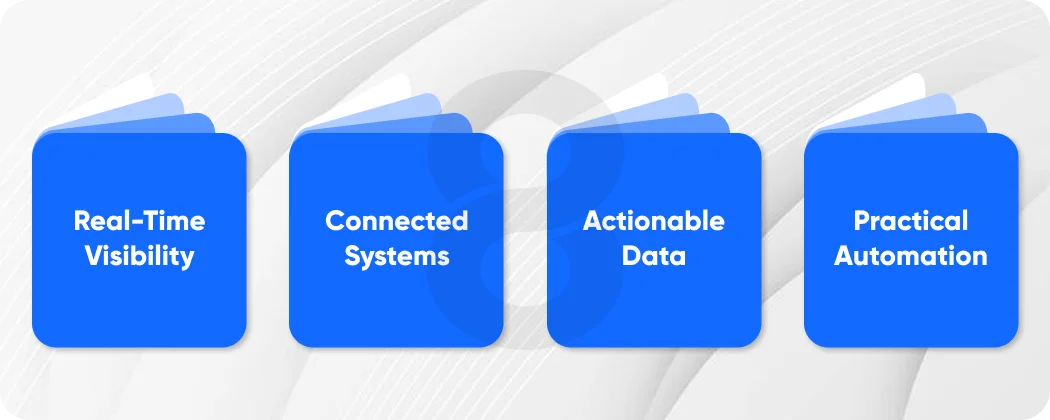
Smart manufacturing sounds complex, but in reality, it comes down to a few core principles working together properly.
Real-Time Visibility
Operations should not depend on delayed reports. Teams need live insights into production, inventory, and performance.
Connected Systems
Every critical function should communicate seamlessly without manual intervention.
Actionable Data
Collecting data is easy. Turning it into something useful is where most systems fail.
Practical Automation
Automation should simplify processes, not complicate them further.
This is where AI development starts becoming genuinely useful, not because it sounds advanced, but because it reduces unnecessary decision-making pressure.
Read More: What is a Proof of Concept in Software Development
AI in Manufacturing Without the Hype
AI is often overcomplicated in manufacturing discussions. But when applied correctly, it is actually very practical. With proper AI integration, businesses can:
- Predict equipment failures before they cause downtime
- Adjust production schedules based on real demand
- Improve quality control with less manual oversight
- Identify inefficiencies that are not immediately visible
This is not about replacing human decision-making. It is about supporting it with better data and faster insights. That is usually when it starts delivering real value.
Why Mobile and Web Systems Matter More Than Expected
Manufacturing operations are no longer tied to static systems. Teams need access to information where the work actually happens. With mobile app development, businesses can:
- Provide real-time updates to on-ground teams
- Improve response time for operational issues
- Enable better coordination across departments
With web development, companies can:
- Centralize operational data into accessible dashboards
- Reduce dependency on physical locations
- Improve system usability across devices
This combination creates operational flexibility without adding unnecessary layers.
Read More: How to Hire a Software Development Team: A Step-by-Step Guide
Where Ecommerce Starts Connecting With Manufacturing
Manufacturing and sales are no longer separate functions. With ecommerce app development, businesses can:
- Connect production directly to order demand
- Improve inventory accuracy across channels
- Reduce delays in order fulfillment
This becomes critical as businesses expand into digital-first sales models where production speed directly affects customer experience.
Read More: Top 10 eCommerce Solution Providers for the B2B Industry
What Manufacturing Software Solutions Actually Improve
Let’s keep this practical. When implemented correctly, manufacturing software solutions improve:
- Operational clarity across teams
- Speed of decision-making
- Efficiency by reducing repetitive work
- Scalability without system breakdown
That is the real impact. Not dashboards. Not features. Actual operational improvement.
Read More: Intellectual Property in Software: How to Protect Your App Idea Before You Build
Custom vs Off-the-Shelf Systems
Factor |
Custom Systems |
Off-the-Shelf Systems |
| Workflow Fit | Matches real operations | Requires adjustments |
| Integration | Flexible and direct | Often limited |
| Scalability | Built for growth | Needs replacement |
| Cost | Higher upfront, better ROI | Hidden long-term costs |
| Usability | Designed for teams | Generic experience |
Before You Build Anything, Think About This
Most mistakes happen before development even starts. Before investing in manufacturing software solutions, ask:
- Where is time being lost consistently
- Which workflows feel unnecessarily complex
- What data is missing or delayed
- Which systems fail to connect properly
If these are unclear, no system will fix the problem. It will just sit on top of it.
Conversion Section: Fixing Systems Before They Slow You Down Further
If your operations still rely on disconnected systems, manual tracking, or delayed reporting, the problem is already affecting performance. You just might not see the full impact yet. The difference between average operations and high-performing ones is not better machines. It is better systems supporting everything behind them.
The right manufacturing software solutions reduce delays, improve coordination, and remove unnecessary friction from daily operations. If the goal is to scale, improve efficiency, and reduce operational stress, this is not something to postpone. It is something to fix properly.
Where These Systems Create Real Impact
Area |
Improvement |
Why It Matters |
| Production | Faster workflows | Reduces delays |
| Maintenance | Predictive insights | Avoids downtime |
| Inventory | Accurate tracking | Improves planning |
| Quality | Consistency | Reduces defects |
| Operations | Better coordination | Improves efficiency |
Common Mistakes That Quietly Kill These Projects
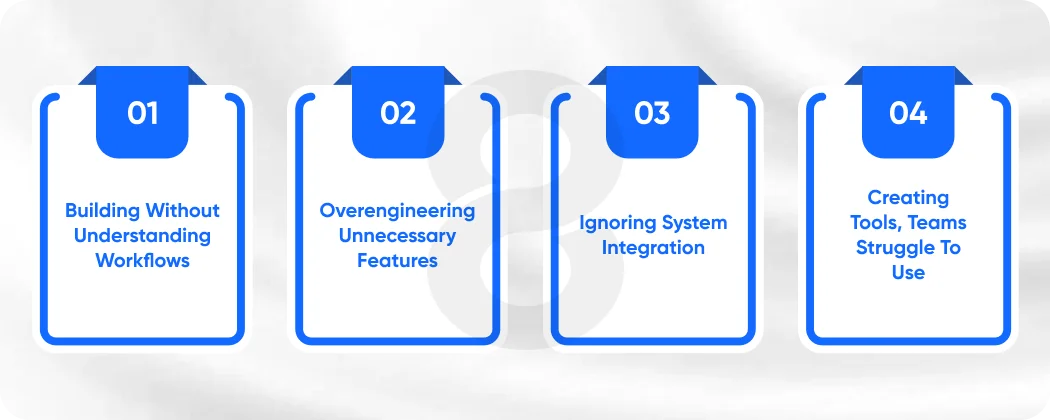
Even strong ideas fail with weak execution. Common issues include:
- Building without understanding workflows
- Overengineering unnecessary features
- Ignoring system integration
- Creating tools, teams struggle to use
And the biggest one: Building something that looks impressive but changes nothing operationally.
Final Thoughts
Manufacturing is evolving, but not in the way most people assume. It is not about replacing everything with new technology. It is about fixing what is already broken beneath the surface.
Manufacturing software solutions are not valuable because they are advanced. They are valuable because they simplify operations, improve visibility, and make systems actually work together. And once that happens, everything else improves naturally. Because the best systems are not the ones that look impressive. They are the ones who quietly make everything work better.