



In today’s auto and product distribution world, a dealership that doesn’t have the proper technology is similar to a vehicle without a GPS. You may get there, but on the whole you’ll likely be spending more time and money than needed. In today’s day and age, a dealer management system is the backbone of any successful dealership. Providing a seamless integration of the sales, inventory, financing, customer management, and reporting processes all within one digital platform.
If you’re an automotive dealership or equipment distributor or are a multi-location franchise and you just made the greatest decision that changed your business for the better, you picked the right dealer software. The big question then is, should you buy a ready-made solution or build your own solution that will fulfill your needs?
The global Dealer Management System (DMS) market is expected to reach nearly $16.5 billion by 2030, growing at a CAGR of around 10.7% due to increasing dealership digitization and cloud adoption.
This blog will take you through the basics of building a dealer management system from scratch, what the most important features are, the development process, the technology stack and what makes a good dealer management system great versus the best dealer management software in the market today.
What is a Dealer Management System?
A Dealer Management System (DMS) is a single software solution that encompasses all the functions of a dealership. A dealer management system brings all of this together in one, easy-to-access platform, from tracking vehicle inventory and processing sales transactions to managing customer relationships and creating financial reports.
It’s like the “central nervous system” of your dealership. Without it, departments work in isolation: sales does not communicate with finance, inventory is not integrated with showroom floor, and customer information is in spreadsheets and on sticky notes. A complete dealer management software solution allows the various departments to synchronize and make better decisions in no time.
The DMS market is expanding rapidly. Here’s why. Modern dealer management software is seen to be a positive influence on the profitability, customer satisfaction, and operational efficiency of dealerships. The need for the optimum dealer management system is more robust than ever.
Why Build a Custom Dealer Management System?
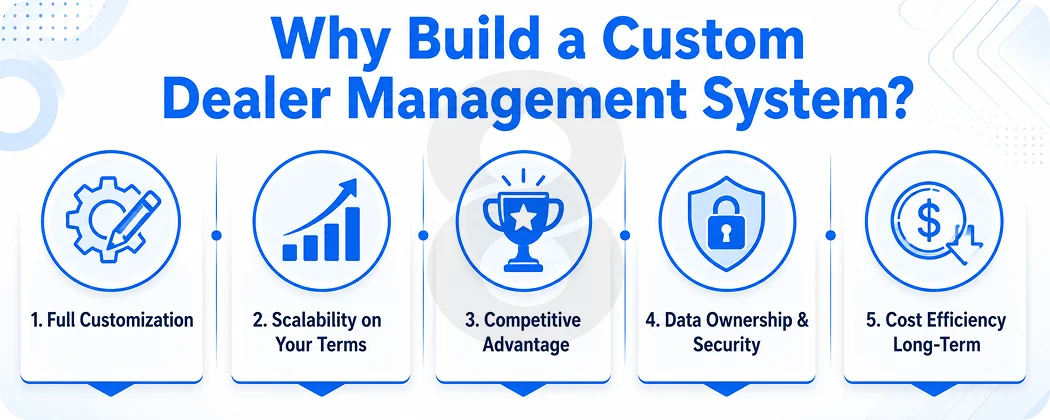
There are a few vendor companies that sell dealer management software products out-of-the-box, but a custom-built dealer management system has unique benefits that the off-the-shelf variety can’t beat.
Full Customization
Each dealer’s business is unique. A custom dealer management system works around your particular workflow and never the other way round. You don’t have to bend over backwards to make your business processes work in software.
Scalability on Your Terms
Your custom dealer management software scales with your dealership, meaning that you can add locations or new vehicle lines, or even a new service department, without having to pay extra for licensing upgrades or per-user fees that eat into profits.
Competitive Advantage
Developing your own best dealer management software will allow you to have your own unique features and integrations that your competitors cannot find. By creating your own best dealer management software, you can add your own unique features and integrations that you competitors cannot find.
Data Ownership & Security
It is now more important than ever! Your customer information, financial information, and stock levels are fully yours and not on a third party’s server with unknown data policies.
Cost Efficiency Long-Term
Most people overlook long-term cost efficiency. The dealer management system carries a higher initial cost, but it eliminates subscription fees paid to dealer management software providers, making it significantly more affordable within three to five years.
Read More: Pricing Models for Software Services: Fixed vs. Hourly Rates Explained
Core Features of a Modern Dealer Management System
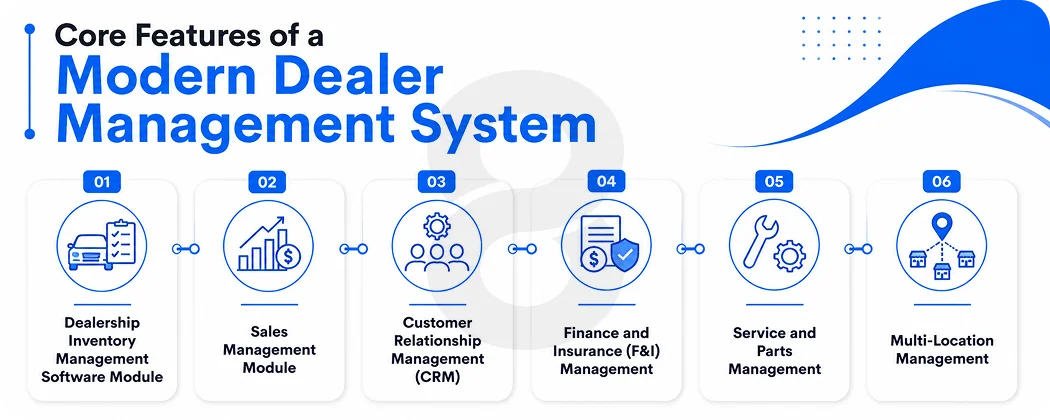
You must know what makes the best dealer management system before you begin construction. The following are the key modules in any good dealer management software:
Dealership Inventory Management Software Module
It is the core of the system. Your dealership inventory management software should be able to track all your items, including vehicles, equipment, and products, in real time. With VIN tracking, stock aging reports, tracking at multiple lots, pricing management, and automated low stock alerts. A good dealer inventory management software will remove the guessing aspect and ensure your sales team always has the correct and most up-to-date information about your stock on hand.
Sales Management Module
This deals with the complete sales process from lead to delivery. This includes deal structuring, trade in valuation, financing and lease calculations, digital contract creation and sales performance dashboards. The top dealer management software streamlines sales, enhances transparency, and boosts profitability.
Customer Relationship Management (CRM)
One of the most important features in today’s dealer management software is Customer Relationship Management (CRM). Your CRM module should be able to track every interaction with the customer, from initial inquiry to follow-up service, along with contact management, communication history, automated follow-up reminders, service scheduling, and customer satisfaction tracking. A good dealer management software company will distinguish itself from the best ones by the strength of its CRM.
Finance and Insurance (F&I) Management
It is responsible for the financial backbone of your dealership. This module is for the management of loan and lease processing, tracking of insurance products, compliance documentation, lender integration, and reporting of profit on F&I products. No dealer management system is complete without a powerful F&I system.
Service and Parts Management
They ensure your service department is running smoothly. This involves work order management, scheduling of techs, tracking stock levels, warranty claim process and tracking service history per vehicle. This is still as important as the dealership inventory management software part for dealerships that have an active service department.
Multi-Location Management
The ideal dealer management system will give a dealer the autonomy they require to effectively run multiple locations, but also enable them to have centralized control.
The Technology Stack for Building a Dealer Management System
When developing dealer management software, it’s essential to select the most appropriate technology. A modern stack would look something like this:
- React.js or Vue.js is a great option for the Frontend. They have fast, responsive interfaces that are display-friendly on both desktop and mobile. Essential as your sales team and service advisors will need access to the dealer management system from anywhere on the lot.
- The backend can be implemented using either Node.js (Express) or Python (Django) for the API layer of your dealer management software. Both frameworks handle large volumes of transactions efficiently and integrate seamlessly with third-party services.
- PostgreSQL is perfect for structured dealership data found in the Database, such as inventory, customer profiles, financial transactions, etc. For data that is accessed often, you can add Redis on top of it, to ensure your dealer inventory management software module remains super fast.
- AWS or Google Cloud offers the dependability and scalability that enterprise level dealer management software requires for Cloud Infrastructure. Auto-scaling maintains the performance of your system, even when sales are busy.
- Integrations should include your dealer management system and integrating with OEM data feeds, lender portal, credit bureau APIs, accounting software such as QuickBooks and marketing software. These integrations are the kind that can truly make a difference between a dealer management system and a standalone database.
Another market report predicts the DMS industry will grow from $7.2 billion in 2024 to $15.2 billion by 2030, driven by rising demand for integrated CRM, inventory, sales, and service automation solutions.
Read More: What is a Proof of Concept in Software Development
Step-by-Step Process to Build a Dealer Management System
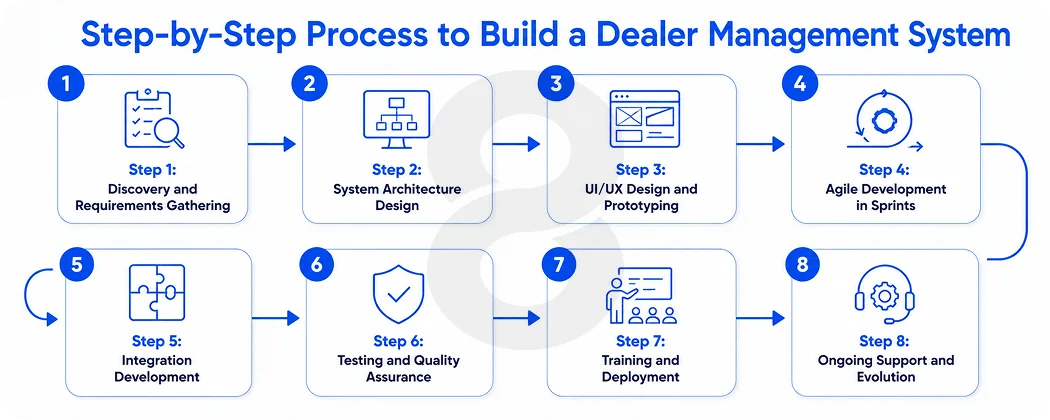
Creating the best dealer management software for your business is a step-by-step process. Follow these steps to learn how it works:
Step 1: Discovery and Requirements Gathering
This is where it all starts. Your development team must thoroughly grasp how your dealership works, how it can improve, and what you want to accomplish before you write one line of code. This includes mapping out all workflows, from when a lead enters your system to when a deal gets funded and every feature that your dealer management system should have. This is the number one reason that the project fails to succeed.
Step 2: System Architecture Design
It is the fundamental technical decisions with regard to the structure of your dealer management system. This encompasses design of the database schema, API architecture, user role and permission design, and integration planning. The key to developing scalable dealer management software is getting the architecture right from the outset.
Step 3: UI/UX Design and Prototyping
This is about how people will engage with your dealer management system daily. Great dealer management software is not only capable, but it’s also user-friendly. Wireframes and clickable prototypes are created and tested by real dealership personnel before development, which helps the product to be seamlessly integrated into their workflows.
Step 4: Agile Development in Sprints
The team develops the software in two-week sprints, delivering the dealership a working and testable piece at the end of each sprint: the inventory management module first, then sales, CRM, finance, and so on. The team repeats this process until the project is complete, giving the dealership the opportunity to provide real feedback throughout construction.
Step 5: Integration Development
In this step it integrates your dealer management software with the external systems that your dealership relies on, OEM inventory feeds, lender APIs, accounting platforms and manufacturer incentive systems. It’s these integrations that make a good dealer management system an irreplaceable business tool.
Step 6: Testing and Quality Assurance
This guarantee that all features of your dealer management software function perfectly before they’re used by a live deal. This covers functional testing, load testing, security scanning for vulnerabilities and user acceptance testing with actual dealership personnel.
Step 7: Training and Deployment
Extensive training (as opposed to a one-size-fits-all approach) guarantees the best adoption rate. The deployment will be phased to reduce the impact on current dealership activities.
Step 8: Ongoing Support and Evolution
Ongoing support keeps you up-to-date with your dealer management software. The market evolves, rules are updated and your dealership expands. There is no such thing as a complete dealer management system; it evolves as per the feedback received from users and business needs.
Read More: How to Hire a Software Development Team: A Step-by-Step Guide
What Separates the Best Dealer Management Software from the Rest
Not all dealer management software companies provide the same good quality. Let’s take a look at the most important features of a dealer management system in the market:
The best dealer management software is designed for the end user, your sales staff, finance managers, and service advisors. It’s quick, easy, and makes it much easier to accomplish regular tasks. It works in tandem with the tools your dealership already uses and provides real-time data views to inform smarter decision-making across your organization. But most importantly, the top dealer management software provides responsive support and a development team with a clear understanding of the dealership business.
Final Thoughts
Constructing a dealer management system is a huge investment, yet it is one of the high-yield investments that the modern-day dealership can make. The key dealer management software does more than just digitalize your operations; it revolutionizes them, making your business quicker, more profitable, and more customer-centric.
When assessing dealer management software companies or considering a full custom build. It is important to have a clear understanding of your dealership’s operational requirements and to select a solution or development partner that will place your dealership’s success at the top of its agenda.
The most features a brochure has aren’t necessarily the best dealer management system. It is the one that your team is using every day, and it is helping them to work better, faster and easier. Your dealership will have the competitive base it needs to last for years to come if you invest the proper dealer management software.