



Most founders treat the platform question as an IT decision and hand it to whoever on the team sounds the most technical. That is a mistake. The platform you pick sets your monthly overhead. It decides how long a simple promotion takes to launch and whether somebody with a developer title needs to stay on call for the next five years.
People have been arguing Magento vs Shopify for well over the years. Shopify grew into the biggest hosted commerce platform on the market. Magento, which Adobe has maintained since 2018, still runs some of the most complicated stores anywhere online. Neither product is bad. Plenty of businesses have picked the wrong one anyway.
There is also more money riding on the choice than there used to be. Statista’s retail ecommerce tracking puts global online sales at $6.9 trillion for 2026, so whatever platform sits under your store now carries a bigger slice of your revenue than it would have even five years ago.
What follows digs into the things that actually decide this question. Costs first, since that is what most people came for, then usability, SEO, security, and B2B. Real numbers throughout, because vendor pages will never volunteer them.
What Is the Difference Between Magento and Shopify?
Put the feature charts down for a minute. One structural difference sits underneath nearly every other gap between these platforms, and it comes down to ownership. A Shopify store is something you rent. Buy into Magento and the whole thing, code and all, belongs to you.
Renting means Shopify carries the boring weight. Servers, patches, the CDN, version updates, none of it ever crosses your desk, and you can run a store for a decade without opening a single config file. The bill for that convenience is freedom. Checkout works the way Shopify decided it should, and nobody gets direct database access.
Owning is a different life altogether. Magento Open Source hands over the entire codebase for free, which sounds generous until you realize hosting and security just became your problems too.
Adobe Commerce takes some of that weight off through cloud hosting, deeper B2B tooling, and support from Adobe itself. You still manage the codebase either way and that single fact ends up steering budgets and hiring decisions for years.
Founders tend to underweight this decision. Teams that do custom ecommerce store development for a living usually work backwards, from the business model to the platform. Getting that order wrong is how stores end up replatforming eighteen months after launch.
Read More: eCommerce App Development Guide: Everything You Need to Know
Magento vs Shopify at a Glance
Here is the short version before we get into the details.
| Factor | Magento | Shopify |
|---|---|---|
| Type | Open-source, Self-hosted (Adobe Commerce for Enterprise) | Hosted SaaS Platform |
| Starting Cost | Free Download, Plus Hosting & Development Costs | From $39/Month, Shopify Plus from Around $2,300/Month |
| Ease of Use | Steep Learning Curve, Built for Experienced Users | Beginner-friendly, Can Launch in Days |
| Customization | Nearly Unlimited with Full Code Access | Theme & App-based, Greater Flexibility on Shopify Plus |
| Maintenance | Your Responsibility (Patches, PCI Compliance & Upgrades) | Managed Entirely by Shopify |
| B2B Features | Advanced Native B2B Module in Adobe Commerce | Native B2B Features Available on Paid Plans |
| Best For | Complex Catalogs, Custom Business Logic & Enterprise B2B | Fast Launches, Lean Teams & Predictable Operating Costs |
Magento vs Shopify: Pricing and Total Cost of Ownership
Sticker prices are misleading on both sides, so let us do this properly.
What Shopify actually costs
Shopify’s standard plans run from $39 per month on Basic up to $399 per month on Advanced, with Shopify Plus starting around $2,300 per month for enterprise merchants.
Add payment processing fees, plus whatever apps you bolt on, and a typical growing store lands somewhere between a few hundred and a few thousand dollars a month. The upside is predictability. You know roughly what next quarter costs.
Magento is free until it isn’t
Magento works the other way around. Downloading it is free. Running it never is. Hosting might cost a small store $30 a month; a busy one can burn through several hundred. Development is where the real money goes, though.
Very little in Magento works out of the box, and even installing an extension can mean paying a developer for the afternoon. Adobe Commerce sits on top of all this with licensing tied to your revenue, starting somewhere in the tens of thousands of dollars a year.
The number that should drive your decision
The pattern that emerges from real projects is simple. Shopify front-loads almost nothing and charges you steadily forever. Magento front-loads heavily and can become cost-efficient at scale, if you have the volume and the team to justify it. Total cost of ownership, not the monthly fee, is the number that should drive your decision.
Is Shopify Easier to Use Than Magento?
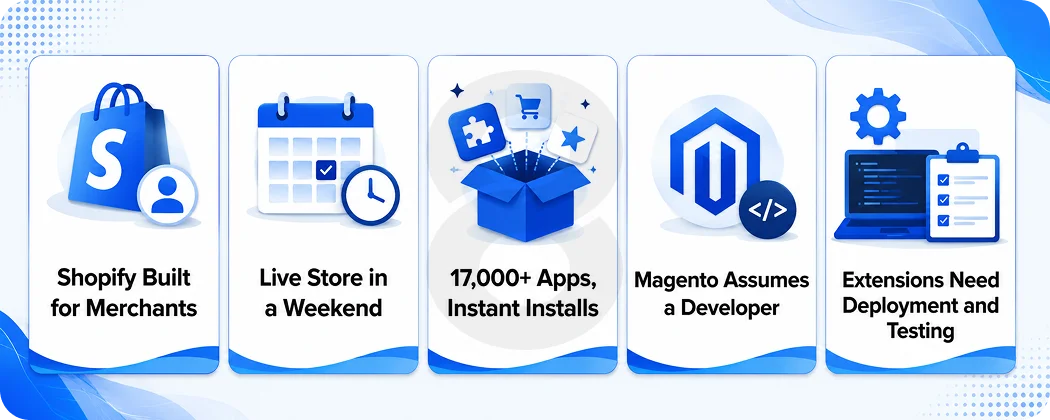
No contest. Shopify takes this category walking backwards. The admin panel feels like it was built by people who sat and watched real merchants struggle with software. Swapping a theme takes minutes and zero documentation. Same story for adding products or building a discount code.
The App Store sits north of 17,000 apps these days, and most of them run about two minutes after you hit install. A determined founder can genuinely sign up on Friday and be selling by Sunday night.
Magento’s admin panel is genuinely powerful, and genuinely intimidating. It assumes a trained user. Installing an extension usually involves deployment, code merging, and testing rather than a one-click install.
Nobody at Adobe considers that a bug. Magento was built on the assumption that a developer is nearby, and for the businesses it targets, one usually is.
The practical question to ask yourself is who will actually operate this store. If the answer is a marketing manager or the founder, Shopify saves you real money in avoided frustration. If you already have technical staff, Magento’s complexity stops being a tax and starts being a tool.
Read More: How to Hire a Shopify Expert Developer for Headless Commerce
Magento vs Shopify: Customization and Flexibility
After all of that, a fair question comes up. Why does anyone still pick Magento? One word answers it… control.
Where Magento has no ceiling
When you hold the full codebase, the ceiling disappears. The frontend can be rebuilt, the checkout rewritten, the database reshaped, whatever the business calls for, and a custom module can ship functionality that exists literally nowhere else. One installation happily runs several storefronts too, each with a catalog and price list of its own.
Performance has caught up as well, since most new builds now go out on the Hyvä frontend instead of the tired default theme, and load times improve dramatically for it. High-volume merchants with odd checkout flows or tangled pricing rules stay on Magento for exactly these reasons. No SaaS box was ever going to hold what they need.
How far Shopify has closed the gap
Checkout extensibility on Plus, the Shopify Flow automation engine, and the Hydrogen framework for headless storefronts give developers far more room than they had five years ago. For most B2C brands, that room is enough. For some, it never will be, and teams offering dedicated Magento development services exist precisely for those cases.
Which is Better for SEO Magento or Shopify?
Less than the marketing on either side suggests, and more than beginners assume.
Shopify handles the basics for you
Sitemaps generate themselves. SSL is just there. Themes come mobile-ready, most modern templates carry structured data already, and a global CDN moves your pages around the world without you lifting a finger. You give up some control, like fixed URL structures with directory prefixes you cannot remove, but you also cannot accidentally break your own crawlability.
Magento hands you the whole toolbox
URL structure, redirects, canonical tags, server response times, every technical lever sits under your control. The catch is that control cuts both ways. A well-optimized Magento store on properly tuned hosting can be extremely fast. Leave one sitting on cheap shared hosting, though, and it crawls, and Google keeps score.
The honest truth about rankings is less dramatic than either camp wants you to believe. Content and the quality of the build itself matter far more than the logo sitting in your footer. Stores rank well on both platforms every single day. What actually changes between them is how much work decent technical SEO asks of you.
Read More: Best Scalable Ecommerce Technology Stack for Enterprise
Magento vs Shopify: Security and Maintenance
This is the section that surprises first-time Magento owners. On Shopify, security is somebody else’s job. PCI compliance, SSL certificates, server patches, and platform upgrades all happen invisibly as part of your subscription. In eight years of running a Shopify store, you might never think about any of it.
Run Magento Open Source and every one of those jobs becomes yours. Adobe ships security patches on a regular cycle, and skipping them is genuinely dangerous as unpatched Magento stores have a long history of getting hit with card-skimming malware.
PCI compliance falls to you too. So do SSL, backups, and version upgrades, and a major upgrade can swell into a project all by itself. A clock also runs quietly in the background here, because older versions eventually lose support, and when yours does, you upgrade on Adobe’s schedule whether the timing suits you or not.
None of this makes Magento insecure. Properly maintained, it is trusted by enterprises everywhere. It just means your budget needs a permanent line for maintenance, either through in-house staff or a support retainer. Stores that skip this line pay for it later, usually at the worst possible time.
B2B and Scalability Changed the Debate in 2026
For years, the B2B conversation had one answer. Wholesale meant Magento, full stop. That is no longer automatically true.
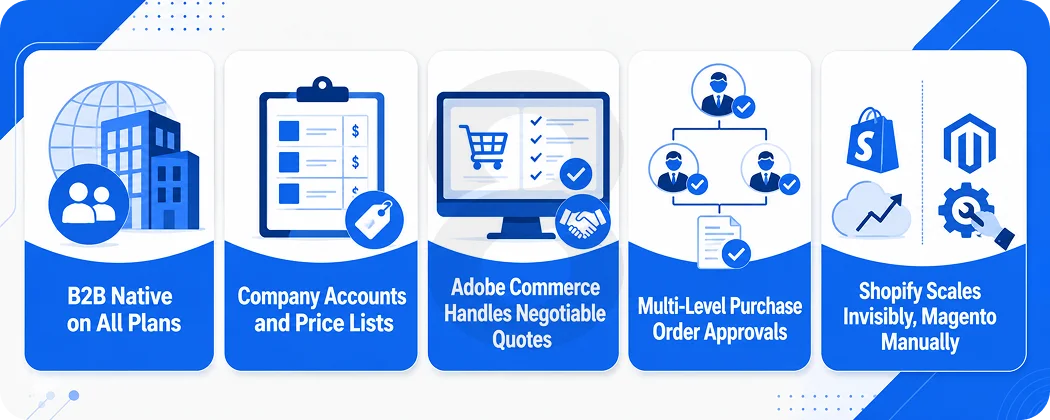
In April, Shopify rolled foundational B2B features out to every paid plan. Company accounts, custom price lists, net payment terms, and quick-order lists now ship natively, with catalog limits that scale by plan and unlimited catalogs on Plus. For a brand adding a modest wholesale channel to a retail business, that covers most of what is needed.
Its native B2B module includes negotiable quotes, shared catalogs with account-specific pricing, company hierarchies with role-based permissions, and purchase order workflows with multi-level approval rules. Manufacturers and distributors with complicated buying processes will still find more of their requirements met out of the box, and the rest can be built.
Scalability follows the same logic as everything else. Shopify scales invisibly, absorbing traffic spikes without you noticing. Magento scales with your infrastructure spend and your team’s skill, which offers a higher ceiling for complex operations at a higher operational price.
And once a store gets big enough, it stops living alone anyway. ERP, CRM, and inventory systems all want to talk to it, and the quality of that system integration work decides whether the whole operation hums or grinds.
Read More: Top 10 eCommerce Solution Providers for the B2B Industry
How to Choose Between Magento and Shopify
Forget which platform is better. Ask which platform is better for the specific store you are about to run.
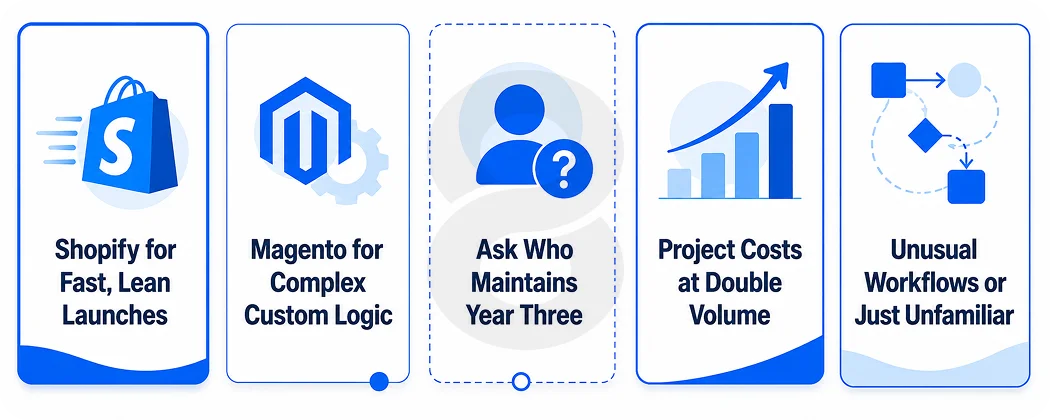
Shopify makes sense when
- You want to launch in weeks, with a small team and no dedicated developers.
- Predictable monthly costs matter more to you than total control.
- Your catalog and checkout are fairly standard, even at high volume.
- You would rather spend your budget on marketing than on infrastructure.
Magento makes sense when
- Your catalog is large or complicated, with configurable products and custom attributes everywhere.
- Your pricing, fulfillment, or checkout follows rules no app store can accommodate.
- You run serious B2B operations with quotes, approvals, and negotiated pricing.
- You have, or plan to hire, real technical capacity to own the stack.
Questions worth answering before you commit
Sit down and answer three things honestly.
- Who is maintaining this store in year three?
- If volume doubled tomorrow, what would the full monthly bill look like?
- And are your workflows actually unusual, or do they only feel that way from the inside?
Answer those straight and the magento vs shopify question mostly answers itself.
When Should You Migrate From Magento to Shopify?
Lately the traffic has mostly moved in one direction. Merchants leave Magento for Shopify when the maintenance bills climb one time too many, or when hiring an experienced Magento developer starts taking months.
Shipping a feature in days instead of sprints does not hurt either. BuiltWith’s platform usage data backs this up, with Shopify’s install base growing year after year while Magento’s has been shrinking for a long time.
Some brands travel the opposite direction, though. They bump into the limits of Shopify’s data model, or they watch app subscriptions pile up every time one more piece of custom logic is needed, and at some point the math says owning the codebase beats renting workarounds forever.
Either way, do not kid yourself about the effort involved. A replatform is a proper project. Products, customers, and orders usually transfer without drama, which lulls teams into relaxing too early.
The dangerous work hides in the URL redirects, plus rebuilding custom features and rewiring integrations behind the scenes. Botch the redirect map and years of organic rankings can vanish over one weekend. Treat that part like it matters… because it does.
Read More: How to Hire Magento Developers: 5 Red Flags to Avoid in 2026
How 8ration Builds on Magento and Shopify

eCommerce is one of 8ration’s core practice areas. The team works on both sides of this comparison rather than championing one platform, which keeps its recommendations tied to the client’s situation instead of a partner agreement.
Magento work at the agency usually means one of four things. A new build, version upgrade, performance tuning, or custom module for a store that has outgrown what standard extensions can do. Shopify store development runs alongside that, covering theme customization and app integrations for merchants who live on the hosted side.
The practice also extends to WooCommerce development and BigCommerce projects for businesses whose needs point elsewhere, along with broader ecommerce software development for retail companies that involves inventory systems, payment integrations, and connections to back-office tools. Platform migrations, including the SEO redirect planning mentioned above, round out the ecommerce work.