Clutch lists more than 93,000 web development companies. Roughly forty of them show up in every “top 10” article you find, and a surprising number of those articles were written by the company sitting at position one.
That matters when you are spending real money. A mid-sized web application runs into six figures, and picking wrong costs you the budget plus six months you cannot get back.
So the rule here was simple. No web app development company made it in on the strength of its own marketing. Hourly rate, minimum project size, and review count. If a firm has not published it somewhere you can check, it is not below. Every entry also names who the company is wrong for, which is the line most rankings skip.
An agency that lives on funded fintech work will misprice a $30K internal dashboard and neither side enjoys finding that out in month two. Ratings and review counts are from the recent Clutch web developers directory.
How We Selected These Web App Development Companies
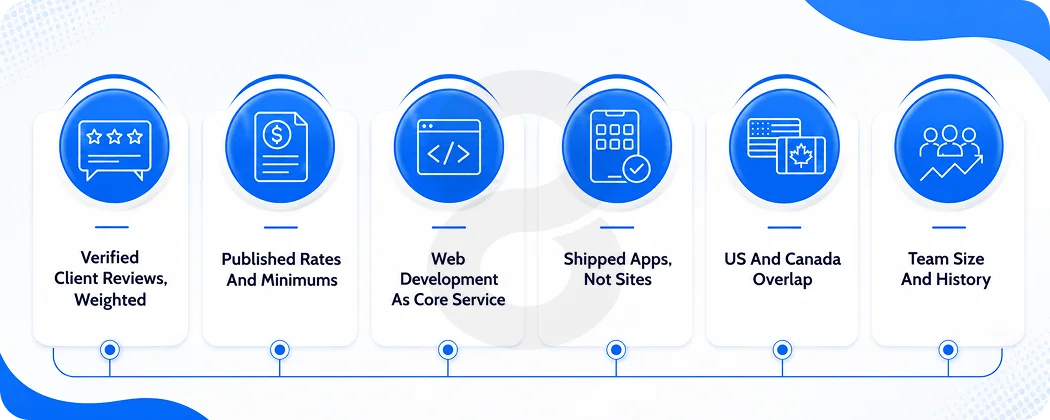
Every company here came from the Clutch web developers directory, chosen because it verifies business registration and collects client feedback through interviews instead of open submission forms. Here is what carried weight in the scoring.
- Verified client reviews, with volume weighted alongside the score
- Published minimum project size and hourly rate, so buyers can self-filter before a call
- Web development as a meaningful share of the service mix rather than a side offering
- Evidence of shipped applications with logins and stored data, not brochure sites
- Time zone and language coverage for clients based in the US and Canada
- Team size, operating history, and whether the firm subcontracts
One thing is worth stating plainly. This is a fit ranking, not a quality score. Position 11 is not worse than position 4. It serves a different budget and a different kind of project. Read the “consider someone else if” line under each entry before you read the number next to the name.
Quick Comparison of the Top Web App Development Companies
The table below pulls the numbers that usually decide a shortlist. Hourly rates and minimum project sizes come from each firm’s own Clutch listing, so they are what the company publishes rather than what a salesperson quotes.
| Company | Headquarters | Team | Starts At | Hourly Rate | Clutch Rating |
|---|---|---|---|---|---|
| 8ration | New York, NY | 350+ | Quote based | Quote based | Verified profile |
| Geniusee | Warsaw, Poland | 250-999 | $50,000 | $25-$49 | 5.0 (71 reviews) |
| Lounge Lizard | New York, NY | 50-249 | $25,000 | Undisclosed | 4.8 (43 reviews) |
| Wolfpack Digital | Cluj-Napoca, Romania | 50-249 | $10,000 | $50-$99 | 5.0 (76 reviews) |
| AllianceTek | Malvern, PA | 50-249 | Undisclosed | $25-$49 | 4.9 (41 reviews) |
| Imaginovation | Raleigh, NC | 10-49 | $10,000 | $50-$99 | 4.9 (16 reviews) |
| xfive | Krakow, Poland | 50-249 | $25,000 | $50-$99 | 4.9 (60 reviews) |
| Twin Sun | Nashville, TN | 10-49 | $25,000 | $150-$199 | 5.0 (21 reviews) |
| Rootstrap | Beverly Hills, CA | 250-999 | $50,000 | $50-$99 | 4.8 (44 reviews) |
| Lizard Global | Amsterdam, Netherlands | 50-249 | $10,000 | $50-$99 | 5.0 (70 reviews) |
| Somnio Software | Montevideo, Uruguay | 50-249 | $10,000 | $50-$99 | 5.0 (46 reviews) |
| Aalpha Information Systems | Bengaluru, India | 50-249 | $1,000 | Under $25 | 4.9 (215 reviews) |
12 Best Web App Development Companies
Each profile follows the same shape so you can compare across them without rereading. Snapshot data first, then what the firm actually builds, then the honest limitation. Nobody here is right for every project.
 8ration
- Headquarters: New York, with offices in Toronto, Dubai, Kuwait City, and Karachi
- Team: 350+ engineers, designers, and QA specialists
- Starts at: Quote based, with a public web app cost calculator
- Certifications: ISO 9001, ISO 27001, MBE
- Track record: 150+ projects delivered across 15+ industries
- Clutch rating: 4.9 (14 reviews)
- Best for: Custom applications that need real backend engineering plus North American overlap hours
Ask what 8ration actually ships and the answer is custom web applications, the kind that have to hold state and survive real users.
Done Right Away connects homeowners with verified plumbers and repair professionals. On the other hand, Trailer4Rent is the harder problem: peer to peer trailer rentals across Canada, which means listing management, availability calendars, and payments moving between two people who have never met. Family Plan looks quieter from the outside, shared scheduling and document storage for households, though the sync problem underneath it is not.
Pricing is unusual for this market. A public cost calculator sits on the site, so you can get a number without booking a call and sitting through a pitch first. Coverage is the other thing worth noting. Five offices across five time zones means a client in New York and Dubai both get hours that overlap with the team. It sounds like a small detail until you have spent a project waiting overnight for answers.
- What they build: customer portals, two-sided marketplaces and booking systems, internal dashboards, plus applications with AI components layered in
- Consider someone else if: you want a $5,000 brochure site. Wrong agency, and the quote will tell you so.
 Geniusee
- Headquarters: Warsaw, Poland
- Team: 250-1K people
- Starts at: $50K
- Hourly rate: $25 to $49
- Clutch rating: 5.0 (71 reviews)
- Best for: Funded startups and scale-ups that need a full product team
Custom software is the largest service line here, with web development, mobile, AI, cloud, and DevOps around it. All 23 of the firm’s web development reviews on Clutch sit at five stars, which is unusual at that volume. One shipped project was an online tutoring platform covering single sign-on, tutor registration, lesson booking, and virtual classrooms.
Geniusee also publishes three fixed price tiers at $30,000, $60,000, and $90,000. Very few agencies in this market put numbers on a public page.
- Consider someone else if: your budget sits under $50K. That floor is enforced.
 Lounge Lizard
- Headquarters: New York, NY
- Team: 50-249 people
- Starts at: $25K
- Hourly rate: Undisclosed
- Clutch rating: 4.8 (43 reviews)
- Best for: Companies that want one team to handle design and development
Design and development get equal billing at Lounge Lizard. It is rarer than it sounds, isn’t it? Plenty of agencies claim both and are quietly better at one. Around 95% of reviewers point to the creative work, and responsiveness comes up almost as often. Past clients sit in financial services, education, manufacturing, and eCommerce, with most projects billing somewhere between $10,000 and $49,000. That is a low floor for a New York agency.
- Consider someone else if: you need heavy backend engineering. The strength here sits in the front half of the build.
 Wolfpack Digital
- Headquarters: Cluj-Napoca, Romania
- Team: 50-249 people
- Starts at: $10K
- Hourly rate: $50 to $99
- Clutch rating: 5.0 (76 reviews)
- Best for: US and European clients who want overlap hours without US pricing
Seventeen of eighteen web development reviews are five stars, and clients repeatedly mention delivery ahead of schedule and under budget. The team covers six time zones including EST and PST, which is the practical reason US buyers pick Wolfpack Digital over a cheaper option further east. Projects have shipped for clients in nineteen countries, weighted toward the US, Romania, and Ireland.
- Consider someone else if: your process depends on on-site workshops in the US.
 AllianceTek
- Headquarters: Malvern, PA
- Team: 50-249 people
- Starts at: Undisclosed
- Hourly rate: $25 to $49
- Clutch rating: 4.9 (41 reviews)
- Best for: Mid-market companies replacing aging internal systems
Half of AllianceTek’s work is web development, with AI and mobile splitting the rest. Every reviewer praises project management, and the case history skews toward document capture, event management, marketplace platforms, and fuel management systems. That is unglamorous software, which is the point for companies with an operational problem instead of a consumer product. Rates sit at near-offshore levels with a Pennsylvania address.
- Consider someone else if: you want a design-led consumer product with a distinctive interface.
 Imaginovation
- Headquarters: Raleigh, NC
- Team: 10-49 people
- Starts at: $10K
- Hourly rate: $50 to $99
- Clutch rating: 4.9 (16 reviews)
- Best for: Founders who want senior attention on a smaller build
The service mix spreads evenly across web, AI, custom software, and mobile. Eight of nine web development reviews are five stars, with reviewers citing communication quality and attention to detail. The team is small, which cuts both ways. You get senior people in the room and less bench depth when something needs to scale quickly. Imaginovation covers multiple industries, including education, healthcare, and real estate.
- Consider someone else if: you need forty engineers staffed next quarter.
 xfive
xfive
- Headquarters: Krakow, Poland
- Team: 50-249 people
- Starts at: $25K
- Hourly rate: $50 to $99
- Clutch rating: 4.9 (60 reviews)
- Best for: Buyers who want the number agreed before they sign anything
xfive puts its prices on a public page, which almost nobody in this market does. Websites start at $22,800. An MVP runs $54,000. A full web app is $102,000. The reviews hold up alongside that: forty-two of forty-four for web development are five stars.
One shipped project was a video platform for a media company covering upload, organization, and package sales, with backend tooling for building timelines. Consulting and IT strategy make up the other 40% of the business.
- Consider someone else if: your scope is genuinely undefined. Fixed pricing rewards clarity and punishes discovery.
 Twin Sun
- Headquarters: Nashville, TN
- Team: 10-49 people
- Starts at: $25K
- Hourly rate: $150 to $199
- Clutch rating: 5.0 (21 reviews)
- Best for: US companies that want domestic engineers and will pay for them
Twin Sun is the most expensive firm on this list per hour, and the reviews suggest clients feel they get what they pay for. All ten web development reviews are five stars. Several reviewers describe the team working as staff augmentation under the client’s own project management, adapting to whatever tooling and cadence the customer already uses. Work spans construction, health tech, financial services, and marketing.
- Consider someone else if: your budget maths only works below $100 an hour.
 Rootstrap
- Headquarters: Beverly Hills, CA
- Team: 250-999 people
- Starts at: $50K
- Hourly rate: $50 to $99
- Clutch rating: 4.8 (44 reviews)
- Best for: Companies that need product strategy before anyone writes code
AI and custom software are the largest service lines of Rootstrap, with web development and big data consulting alongside. Web projects here run larger than most on this list, averaging between $200,000 and $999,000. One representative engagement was a product roadmap and offline prototype for a freelancer marketplace, which tells you something useful. Rootstrap sells thinking as much as hours. Nonprofit and healthcare clients mention budget discipline specifically.
- Consider someone else if: you already know exactly what to build and simply want it built.
 Lizard Global
- Headquarters: Amsterdam, Netherlands
- Team: 50-249 people
- Starts at: $10K
- Hourly rate: $50 to $99
- Clutch rating: 5.0 (70 reviews)
- Best for: European companies wanting design and engineering under one roof
Web, mobile, and AI each get real billing at Lizard Global. Delivery is what reviewers keep coming back to, around 89% of them, with two thirds also praising the design work. Eighteen industries in the portfolio, manufacturing through to real estate. Ask who has actually built in your sector. One caveat surfaces in the reviews themselves: some clients flag pricing as high, though the same reviews call it justified by the output.
- Consider someone else if: you are optimizing purely for cost.
 Somnio Software
- Headquarters: Montevideo, Uruguay
- Team: 50-249 people
- Starts at: $10K
- Hourly rate: $50 to $99
- Clutch rating: 5.0 (46 reviews)
- Best for: North American clients who want same-day overlap from Latin America
All ten web development reviews of Somnio Software are five stars. Mobile is the bigger line of business, with Flutter appearing repeatedly, but the web work includes a full front and back end build for a financial services platform. The time zone argument is the real draw for US buyers, since Montevideo runs one to three hours ahead of the US East Coast depending on the season. Sectors include telecom, financial services, healthcare, and education.
- Consider someone else if: you need deep enterprise compliance credentials on day one.
 Aalpha Information Systems
- Headquarters: Bengaluru, India
- Team: 50-249 people
- Starts at: $1K
- Hourly rate: Under $25
- Clutch rating: 4.9 (215 reviews)
- Best for: Budget-constrained builds with a clearly specified scope
Aalpha carries 215 reviews, more than any other firm here, with 80 of 91 web development reviews at five stars. Web development accounts for 45% of the business. Typical projects fall between $10,000 and $49,000, and the $1,000 floor makes this the only realistic option on the list for a very small first build. The trade is overlap. India Standard Time gives you a handful of shared hours with the US East Coast and almost none with the West.
- Consider someone else if: your project needs daily synchronous collaboration with a US team.
What Does a Web App Development Company Do?
A web app development company owns the whole build. Screens are the smallest part of it. The work runs from an idea nobody has drawn yet, through design and engineering, out to the far end where someone patches a dependency two years after launch. What they hand over is software people log into to do a job: a booking system, a customer portal, the internal dashboard your ops team lives in.
Website versus web application
A website presents information. A web application lets users change it. That single distinction explains why one quote comes back at $8K and another at $180K for what sounded like the same brief.
The moment your product needs accounts, permissions, stored records, payments, or anything that updates live, you are commissioning software. Websites are mostly a content and presentation problem. Applications add database design, authentication, business logic, and a security surface someone has to defend.
Services you should expect from a serious partner
Any firm worth shortlisting covers the full cycle rather than one slice of it. Expect discovery and requirements work, interface design, frontend and backend development, API integration, quality assurance and testing, deployment, and a written maintenance arrangement. Agencies that only handle one part of that will subcontract the rest, and subcontracting is where accountability leaks.
Stronger firms also offer software consulting before development starts. When scope is still fuzzy, that is money well spent, and it is usually cheaper than discovering the gap in month four.
Read More: How to Build a Web App From Scratch: A Step-by-Step Guide for 2026
How Much Does Web App Development Cost in 2026?
$15K buys a simple internal tool. $250K buys an enterprise platform with compliance work attached. The spread says less about agencies than about how much the phrase ‘web app’ is being asked to cover. Most projects cost between $40K to $120K and take three to six months.
| Application Tier | Typical Range | Timeline | Team Size |
|---|---|---|---|
| Internal tool or MVP | $15,000 to $40,000 | 6 to 12 weeks | 2 to 4 people |
| Mid-complexity custom app | $40,000 to $120,000 | 3 to 6 months | 4 to 7 people |
| Marketplace or SaaS platform | $120,000 to $250,000 | 6 to 10 months | 6 to 12 people |
| Enterprise or regulated platform | $250,000 and above | 9 to 18 months | 10+ people |
Rates moved in 2026, and not in your favor. Senior engineering costs climbed globally on demand for cloud, security, and AI skills. The US Bureau of Labor Statistics puts the median wage for web developers and digital designers at $95,380, with computer occupations overall at $105,990. That sets a hard floor under any US agency’s hourly rate, and it is why the $25 to $49 tier only exists offshore.
What pushes the number up
- Third party integrations. Every payment gateway and CRM connection is a small project with its own failure modes.
- Compliance. Healthcare and finance want audit trails and documentation nobody reads.
- Anything real time. Live chat and collaborative editing need infrastructure a normal request-response app never touches.
- Custom design. Component libraries are cheap because someone else already solved the hard parts.
- Data migration from a legacy system
The last one is the most commonly underestimated. Moving fifteen years of messy records into a clean schema is often a bigger job than building the interface that displays them.
Pricing models and where each one breaks
Fixed price works when scope is genuinely locked. It breaks the moment requirements shift, because every change becomes a negotiation instead of a decision.
Time and materials suits evolving products and lets you reprioritize each sprint. It breaks when nobody on your side is watching the burn rate.
A dedicated team fits long-running products with a continuous roadmap. It breaks if you only have three months of work, since you are paying for capacity you cannot fill.
How to Choose the Right Web App Development Company
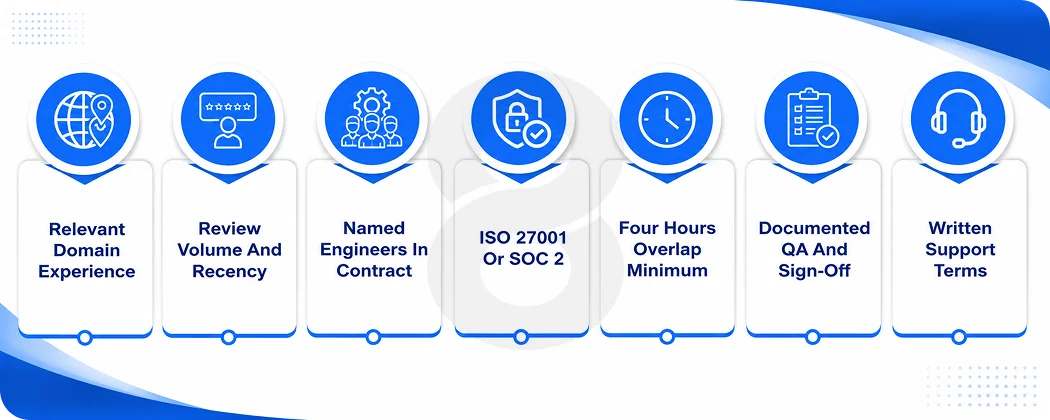
Once you have a shortlist, selection stops being about rankings and starts being about evidence. The criteria below are the ones that correlate with projects landing on time.
Relevant domain experience
A team that has shipped in your industry knows where the compliance and integration landmines sit. They have already argued with a payment processor and waited out a HIPAA review. That experience shows up later as fewer surprises in month four.
How many reviews, and how recent
Ninety reviews at 4.8 beats four at 5.0, and it is not close. Check the dates as well. A firm with fifty reviews and nothing from the past year has either stopped selling or stopped delivering, and you want to know which one.
A named delivery team
The engineers should appear in the contract by name. Agencies rotate people, and the senior developer who showed up to the pitch has a habit of becoming a junior three weeks after signing. Get the names written down, along with a clause covering replacements.
Security posture
ISO 27001 or SOC 2 if they hold one, and a straight answer on the OWASP Top 10 either way. Certification says more about process than code quality. It still means an outside auditor walked through how the team works, which most agencies this size cannot claim.
Time zone overlap
Under four shared hours a day, every decision costs you a night. It reads like a scheduling detail until you are three sprints in and waiting until tomorrow morning for an answer that would take ninety seconds on a call.
Documented QA
Test coverage, and a name attached to release sign-off. Worth asking what gives in their process when a deadline slips, because QA is the first thing most agencies quietly drop when they fall behind.
Written support terms
Six months after launch is exactly when you find out whether these exist. Get response times, patching cadence, and the annual cost into the contract before you sign. That conversation never happens afterwards.
Read More: What to Ask Before You Sign a Web App Design Contract (Most Clients Skip These)
Questions to ask before you sign
- Who is writing this code and how long have they done it?
- Who else touches it and are they on your payroll?
- How do you handle scope changes mid-project?
- What does your discovery phase produce, and do I own the output?
- Which parts of the stack will I be locked into afterwards?
- What is your average client retention, in years?
- Who owns the code and the repository at the end?
- What does your support arrangement cover, and what does it cost annually?
- Can I speak to a client whose project went badly?
That last question is the most revealing one on the list. Every agency has a project that went sideways. The ones worth hiring will talk about it.
Startups and enterprises need different partners
Startups want someone who will ship a narrow first version and push back on scope. Enterprises want a paper trail: compliance documentation, contracts procurement will sign off on, and an engineer willing to touch the legacy system everyone else avoids.
Few firms do both well, and the case history gives it away. Ten enterprise logos mean little if the work behind them was microsites. Check the size of each client and what shipped.
Red Flags to Watch For
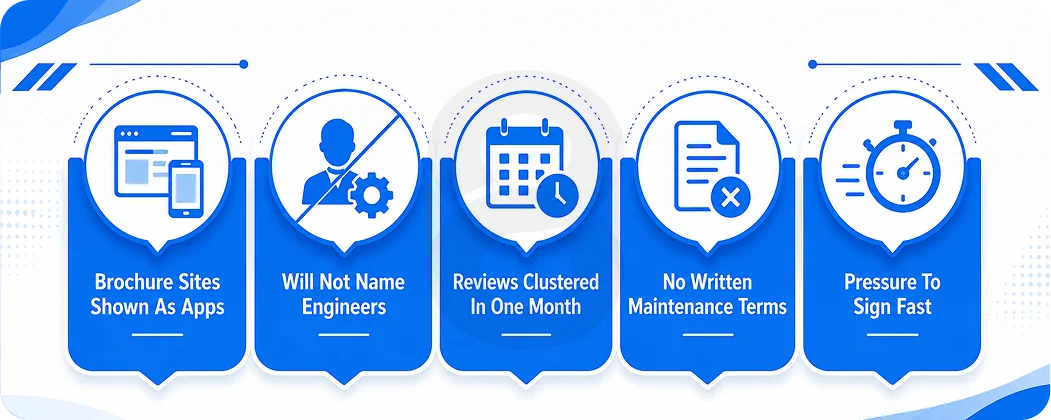
Most bad engagements were visible during the sales process. These are the signals worth walking away from.
- A fixed quote handed over before any discovery work. Nobody can price an application they have not scoped.
- A portfolio of brochure sites presented as applications. Click through and check whether anything has a working login.
- Refusal to name the engineers, or vague answers when you ask about subcontracting.
- Reviews clustered into a single month. That pattern usually signals a review campaign rather than a track record.
- No written maintenance terms. Applications need patching, and the cost should be known before launch.
- Pressure to sign before you have finished comparing.
One more thing worth saying out loud. Directory position is not neutral evidence. Clutch discloses that it may earn a fee for some placements, which means the top of any directory page is partly a commercial arrangement. Use directories to assemble a shortlist, then verify independently.
Read More: Examples of Web-Based Applications: Real Business Use Cases and How to Build Your Own
What 8ration Builds for Web App Clients
8ration’s web portfolio spans service marketplaces, rental platforms, patient access, insurance, and agriculture. Cinnamon supports patients navigating pharma-sponsored access programs, where real time assistance and careful data handling both matter.
Munitora handles herd and livestock management for farmers. Integrale Safe USA takes insurance coverage, which is miserable to compare at the best of times, and makes it legible to people who do not sell policies for a living.
Stack choices tend to follow whatever the client already runs. It is the reason React, Angular, and Vue all turn up in the portfolio with Node.js, Python, Laravel, .NET, or Java behind them. The ISO 9001 and ISO 27001 audits are worth asking about since plenty of agencies this size hold neither.
If your project sits earlier than a build, software consulting and staff augmentation are both available as standalone engagements. There is also industry-specific work in fintech, healthcare, and eCommerce, alongside broader custom software development.