




At some point the AI debate just stopped. Not because everyone figured it out. The money moved, the job titles changed, and the argument kind of died on its own.
Every product roadmap has an AI section now. Every app has something marketed as a feature. And an uncomfortable number of those features get tapped exactly once, maybe twice, then never again.
That’s the question worth actually sitting with. Not whether AI matters for business. But why so much of it ends up in products that real users quietly ignore.
What AI Apps for Business Actually Do in 2026
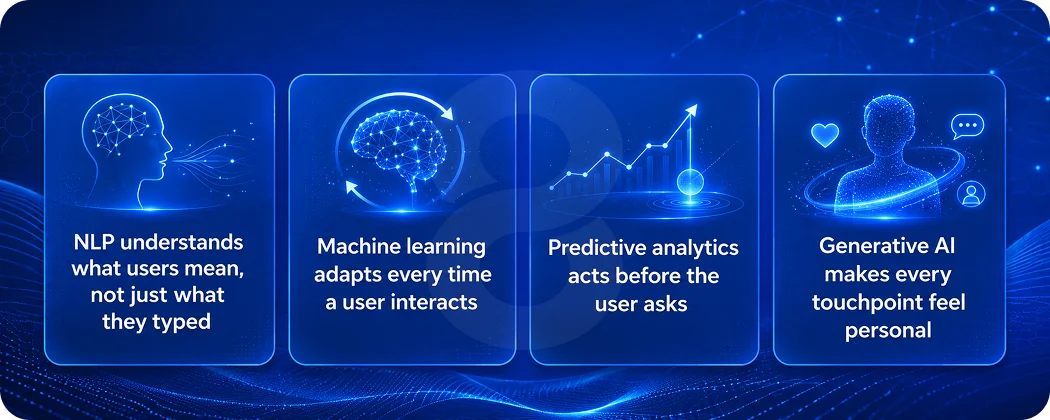
Let’s start somewhere concrete. AI apps for business in 2026 aren’t chatbot wrappers and they’re not demos. They’re products where machine learning and predictive models run inside the core logic. The Intelligence isn’t a feature you tap. It’s in routing and timing of what gets shown and when.
Not long ago, calling an app AI powered usually just meant connecting to a third-party API and adding a text box somewhere in the settings. That was considered enough.
The technologies doing the actual work
Natural language processing handles intent. A user who types “something for a dinner party under $50” doesn’t get a filtered list of products at that price point. They get results that interpret the context of what they said. That’s NLP doing what keyword-based search systems can’t.
Machine learning models watch user behavior and adapt over time. They track where users lose interest and what behavior shows up just before a conversion event look like before and after a conversion event. A product built on machine learning doesn’t stay static and actually improves with use.
Predictive analytics gives the app a sense of what’s coming. It can calculate churn risk and surface the most likely next action for any individual user before they’ve explicitly asked for it. The difference between a product that reacts to user behavior and one that anticipates it is where the real retention numbers live.
Generative AI handles content and conversation. It’s what makes an onboarding flow feel like it was written for you specifically and what makes an in-app assistant sound like a person rather than a knowledge base.
According to the Stanford AI Index, tracked across Statista’s global AI market data, generative AI adoption more than doubled in two years. That’s one of the fastest enterprise technology adoption curves on record. The businesses that treated this as experimental are now treating it as infrastructure.
Why architecture matters more than feature selection
There are two ways to add AI to a mobile product. The first is connecting an LLM API to an existing app and calling it AI powered. That can help at the margins. The second is building what some people are calling an AI native architecture, where data model user experience are designed from the start to work together.
The companies pulling ahead are building AI into the foundation, not layering it onto the surface. When software is architected with intelligence from day one, the product compounds. The model learns from real usage. The product improves with the model. The business metrics improve with the product.
That compounding effect is what separates a genuinely AI powered mobile product from an app that has a chatbot.
| Capability | Traditional App | AI Powered App |
|---|---|---|
| Personalization | Rule-based category filters | ML-driven dynamic recommendations |
| Customer support | Static FAQ or ticketing | Conversational AI with intent detection |
| Onboarding | Fixed linear flow | Adaptive flow based on behavior signals |
| Search | Keyword matching | Intent-based NLP search |
| Analytics | Descriptive (what happened) | Predictive (what will happen) |
| Notifications | Scheduled or broadcast | Triggered by predicted user state |
The Business Cases That Are Actually Working Right Now
Enough with the “10 ways AI transforms your business” lists. Most of those are generated by the same AI they’re writing about. Here’s what’s showing up in real usage data and real operational numbers across industries in 2026.
eCommerce: where the conversion data is clearest
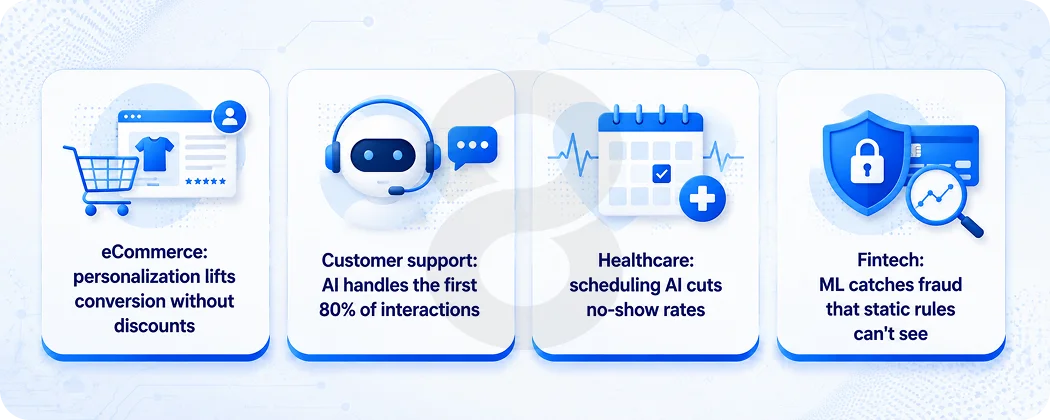
AI apps for business in ecommerce have the clearest signal because the outcome metrics are simple. Did the user buy? Did they come back? The system isn’t just tracking what you bought. It’s watching what you almost bought.
That’s the difference between “you bought shoes, here are more shoes” and a recommendation that actually lands. They’re pulling signals from timing and session behavior to surface what the user is most likely to want at that specific moment.
Businesses building AI into their ecommerce platform are finding that real-time personalization outperforms discount campaigns in driving repeat purchases. When the app already shows you exactly what you want, the motivation to buy doesn’t need a promo code attached to it.
Customer support: where cost reduction shows up fast
This is the business case with the clearest financial story. Based on Forrester’s 2026 research, companies using AI in customer service operations have seen a 20% reduction in operational costs.
At scale, that’s a meaningful number. A support flow that used to require five agents at peak hours can now handle the majority of volume through conversational AI, with human agents handling complex escalations.
The systems that actually work aren’t basic FAQ bots. They’ve been trained on real conversations and developed a sense of when a user is frustrated enough that a human needs to take over. Nobody taught them that rule explicitly. They learned it.
Industry estimates put savings from this kind of AI in customer service at up to $80 billion annually. That moves when you stop asking chatbots to answer FAQs and start asking them to handle the first 80 percent of every support interaction.
Healthcare: the quieter story with real production data
The healthcare numbers don’t get as much attention, but they’re arguably more meaningful. Scheduling systems that read patient history and predict who’s likely to miss an appointment have cut no show rates at clinics that deployed them.
Triage tools that match symptoms to the right level of care have reduced unnecessary emergency visits. None of these are pilots. They’re running in real health systems, and those systems are expanding them because the results held up.
Fintech: where machine learning does what rules can’t
Traditional fraud detection runs on static rules. ML based systems run on individual behavior patterns. A machine learning fraud detection layer flags transactions not because they break a generic rule, but because they look nothing like that specific user’s history. False positive rates drop. Actual detection rates improve.
For AI apps for business operating in fintech, this kind of ML powered risk layer has moved from competitive advantage to table stakes. Banks and payment apps that haven’t built it in are sitting with more exposure, not less.
| Business Type | Key AI Features | Primary Business Outcome |
|---|---|---|
| eCommerce | Personalization, dynamic pricing, visual search | Higher conversion and average order value |
| Fintech | Fraud detection, credit scoring, spending insights | Lower risk exposure and higher user trust |
| Healthcare | Symptom triage, scheduling optimization | Fewer no-shows and better care routing |
| SaaS / B2B | Churn prediction, smart onboarding, usage analytics | Higher retention and faster time to value |
| Logistics | Route optimization, demand forecasting | Lower operational costs and fewer delays |
| Retail | Inventory prediction, in-store navigation, voice search | Fewer stockouts and better in-app UX |
What Breaks When AI Gets Built Without a Plan
Most companies find this out the hard way, and it’s usually not the model that fails. It’s the decisions made before the model was trained.
McKinsey found that while 88% of organizations used AI in at least one business function, most of them remained stuck at the pilot stage.
They ran an experiment with promising early results and then couldn’t scale. The gap between a working prototype and enterprise-wide deployment is where most AI projects stall, and it’s almost never a model problem.
The cold start problem
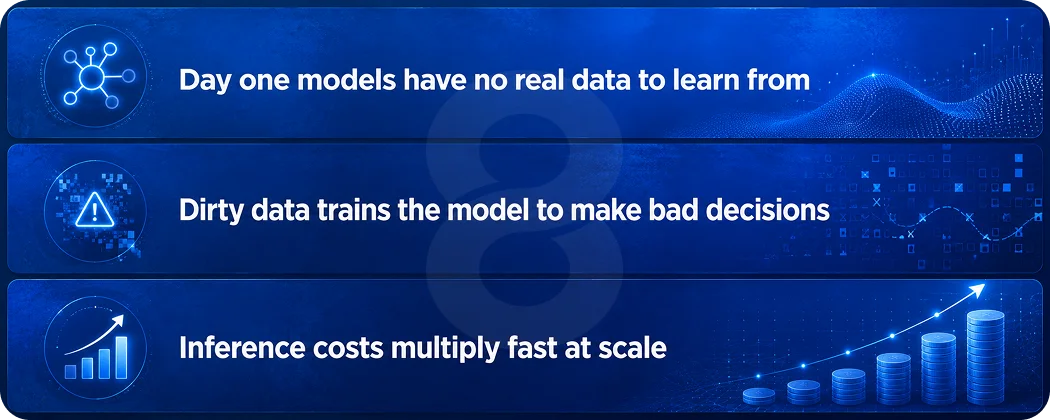
Any AI feature that learns from behavior needs behavior to learn from. A recommendation engine on day one is essentially a random sorter with better branding. That’s manageable, but the early product experience can seriously hurt retention if the team hasn’t planned for it.
The fix requires foresight. You seed the model with curated data before launch and build in manual override logic for early user cohorts. That means defining what good enough looks like before you hit different volume thresholds.
Most teams don’t have that conversation until they’re already in production. Then it’s an expensive and disruptive retrofit.
Data quality problems that only surface later
The model learns from whatever you feed it. Messy data doesn’t stay in the data layer. It moves into the model’s behavior and eventually into your product. A broken UI component announces itself. A biased model doesn’t. It just keeps making decisions that feel confident until something obviously wrong finally breaks through.
Investing in clean, structured data infrastructure before model development is not optional. It’s the work that determines whether your AI feature behaves intelligently or just confidently wrong.
Infrastructure costs you didn’t budget for
Research from experts shows AI workloads increase cloud compute costs by 60 to 70 percent when they hit real scale. Most product teams don’t include that in the original estimate. Real-time inference is expensive.
At prototype scale, the cost of running ML inference feels like a rounding error. At 100K daily active users it stops being that. It becomes a line item someone in finance wants to talk about. Most teams find this out after they’ve already committed to an architecture.
The fix most enterprises are moving toward is keeping some inference on-device rather than routing every request to the cloud. It reduces latency and it cuts the bill. The trade-off is model complexity. You can’t run everything on a phone. Knowing where that line sits before you start building is a lot cheaper than finding it after you’ve shipped.
Read More: AI and Machine Learning: How a Modern App Development Firm Stays Ahead
The Numbers Worth Knowing Before You Start
The numbers here are worth knowing before someone in a meeting asks why this budget exists. McKinsey found 88% of organizations were using AI in at least one business function last year. That’s not early adoption anymore. It’s the majority, which means the companies not doing this are increasingly the outliers in the room.
Gartner’s projection is the one that stops people. Task-specific AI agents are expected to show up in 40% of enterprise applications by end of this year. Under 5% had them twelve months ago. That’s not a technology maturing at a normal pace. That’s an entire category of software changing what it does in a single year.
Statista tracks the global AI market toward a projected $1.675 trillion by 2031. AI app downloads grew 148% year over year. The AI app sector generated $18.5 billion in revenue in 2025, with over 1.1 billion people now actively using AI apps globally.
AI apps for business are no longer a category where early adoption gives you a meaningful advantage. They’re becoming the category where late adoption creates a meaningful disadvantage. That’s a subtle but important shift in how to frame the investment case internally.
What it costs to actually start
A focused first AI feature, say a churn prediction model or a recommendation engine integrated into an existing product, can go from scoped requirement to production in four to six weeks for a basic version. Enterprise-scale builds with multiple models, real-time inference, and deep system integrations typically take three to six months.
The cost spread is wide because the scope spread is wide. A team that knows exactly which behavior metric they want to move, has clean historical data, and is building on a solid existing foundation will spend a fraction of what a team starting from a vague mandate to “become more AI” will spend.
The mistake that kills AI mobile budgets isn’t the technology cost. It’s committing to broad scope before validating narrow scope. Every successful AI mobile product that exists today started with a narrower version of itself.
Read More: 10 Best Open-Source Large Language Models for Your Next Venture
Industries Where AI Returns Come Fast
Not every vertical moves at the same speed. The categories with the cleanest data, most predictable user behaviors, and well-defined business metrics tend to see measurable returns fastest. That’s worth knowing when you’re choosing where to start.
Consumer apps and subscription businesses
RevenueCat’s 2026 benchmark data has an interesting finding here. AI powered subscription apps generate 41% more revenue per customer but churn 30% faster than their non-AI counterparts. That sounds contradictory until you look at it carefully.
Higher revenue per user means the personalization is working. Higher churn means the retention loop wasn’t built deeply enough into the product experience.
The apps that keep both numbers moving in the right direction use AI to personalize not just the content feed but the habit-forming moments: the first week experience, the notification timing, the re-engagement trigger. When those decisions are driven by machine learning rather than manually tuned rules, churn starts to look different on the six-month graph.
B2B SaaS and enterprise tools
AI apps for business in the B2B space have had a quieter impact than in consumer categories, but a very real one. Intelligent onboarding that adapts to how a new user actually moves through a product, rather than walking everyone through an identical linear tutorial, cuts time to value significantly.
When a user reaches their “this actually works for me” moment faster, retention improves without any change to the core product functionality.
Churn prediction in SaaS products has moved from nice-to-have to standard expectation. Models that watch for engagement patterns predicting cancellation and trigger targeted interventions before the user has decided to leave are producing measurable improvements in net revenue retention for the teams that have implemented them correctly.
Retail and physical-world businesses
Brick-and-mortar retail is building AI into mobile in ways that go beyond the obvious loyalty app. Demand forecasting models that predict inventory needs at the store level based on local events, weather patterns, and purchase history have meaningfully reduced both stockouts and overstock situations for the retailers running them.
In-store navigation apps that use ML to route customers to items based on purchase probability rather than just product category are increasing basket size in measurable ways.
Read More: 50+ AI App Ideas Generating Millions in Revenue
How 8ration Builds AI Powered Mobile Products
8ration works across the full stack of digital product development, from custom AI systems to enterprise software for clients across healthcare, fintech, retail, and logistics. The approach is deliberately narrow at the start.
Every project begins with a scoped problem, not a broad AI vision. The team identifies one behavior metric or one cost line that needs to move, and builds the AI capability that addresses exactly that problem. Once something is working in production and the model has real data to learn from, the scope expands from there.
You don’t have to piece together different vendors for different parts of the build. 8ration handles everything from the AI infrastructure and model development to the mobile app and the data pipeline that keeps everything learning after launch.
If you already have a product and want to add intelligence to it, the work doesn’t start with model development. It starts with a data audit, because the model is only as good as what you feed it.
Teams that need to move fast without building out a whole function can bring in specialized AI engineers through staff augmentation. It delivers the same capability without the overhead of a permanent hire or a full agency engagement.
The end goal stays the same regardless of where you’re starting from. The product ships against a defined metric and gets measurably better the longer it runs.