



Framework choice looks like an engineering decision. Sit with it a while and it starts to look more like a hiring decision, because whatever you pick determines the résumés that land on your desk for the next five years. The maintenance bill runs on roughly the same clock. Then there is the cost nobody writes into a proposal: the hours each sprint that go into arguing about where things belong instead of building them.
Spend enough time on developer forums and you will come away convinced Angular is finished. Then you go and look at what it is actually running. The Google Cloud Console. Chunks of the Microsoft 365 admin experience. Banking platforms at Deutsche Bank. Fare search at Delta. The number people usually quote is somewhere around 51,700 companies with it in production, which is an odd size for a framework to be. Too large for niche. Small enough that the obituaries keep getting written anyway.
So this guide takes the question seriously. What Angular development actually involves in 2026, and what version 22 changed about that. What a build costs and how long it takes. Where it beats React and Vue on a business decision, and the cases where it loses to both. I have tried to keep the answer honest in the third of those, since that is the section most guides quietly skip.
What Is Angular Web Development?
Angular is Google’s open-source framework for making web applications. It is written in TypeScript and ships on a fixed six month cycle. That is worth noting early because that cadence shapes a lot of what follows. When someone says Angular web development, they usually mean a single-page application built on it, with server-side rendering added on top.
Now the thing that catches buyers out. Angular and AngularJS are two different products that happen to share a brand. Google stopped supporting AngularJS in 2021. Nothing has been patched since. So when a vendor’s site advertises “AngularJS development,” that is either a decade-old skill set or sloppy copywriting, and it is worth finding out which before you go further.
How Angular differs from a library like React
React gives you a rendering layer and leaves routing, forms, HTTP, and state management to you. Angular ships all of it. That sounds like a small distinction until you have four teams on the same codebase and every one of them picked a different data-fetching library.
The practical effect is governance. An engineer who joins your Angular project on Monday can read any file in it by Wednesday, because the shape is the same everywhere. That predictability is worth more to a large organisation than the flexibility it gives up.
Who Angular is built for
Teams of ten or more engineers. Products with a five-year horizon rather than a five-month one. Regulated sectors where an auditor eventually asks how a form validates.
There is also a hiring pattern worth knowing. Companies with Java or .NET backends adopt Angular faster than anyone else, because dependency injection and strict typing already match how their engineers think. If your backend team lives in Spring or ASP.NET, Angular will read as familiar rather than foreign.
Read More: Java App Development: The Complete Guide from Basics to Deployment
Angular in 2026: What Changed in Version 22
Search this topic and most of what comes back describes an Angular that no longer exists. NgModules everywhere. Zone.js doing the change detection. RxJS reached for instinct. A new Angular project looks nothing like that now.
It matters more than it sounds like it should, because that stale picture is what a lot of vendors are still selling against and what a lot of proposals still quietly assume.
Angular 22 is the latest addition. Call it the release where the signal-based model stopped being the thing everyone said was coming.
Signals replaced the old change detection model
Older Angular used Zone.js to patch browser APIs and re-check the whole component tree whenever anything might have changed. It worked, and it got slow on dense screens.
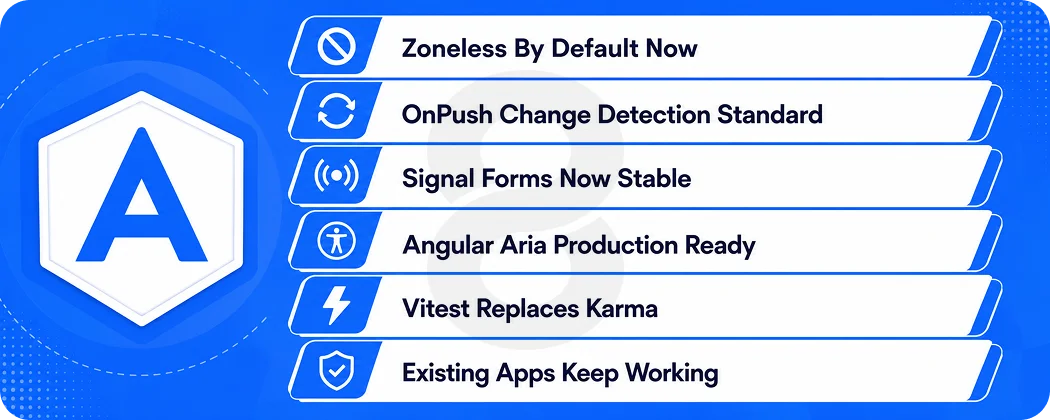
Spin up a new project today and it comes out zoneless, with OnPush set as the change detection strategy on every new component. The updates are fine-grained now.
Change a value and only the parts of the view that actually depend on it will re-render, which sounds like an implementation detail until you put it in front of a trading dashboard or an admin table carrying a few thousand rows. Then it is something your users feel, not something you have to open a profiler to prove.
Signal Forms and Angular Aria went stable
Signal Forms are the new forms API, and they replace a lot of the FormGroup and valueChanges subscription plumbing that made Angular forms verbose. Validation reruns automatically when a signal changes. There is no subscribe and unsubscribe bookkeeping to get wrong.
Angular Aria also reached production status. It gives you accessible component patterns where keyboard navigation, focus management, and ARIA semantics are handled by the directive while you supply the styling. If you have ADA exposure or a WCAG requirement in your contracts, that shifts a recurring cost from your budget to the framework.
What your existing Angular app has to do about it
Less than you fear. Zone.js support is retained for existing applications, RxJS keeps working, and signals interoperate with observables through toSignal and toObservable. Nothing forces a rewrite.
The sensible sequence is to upgrade the framework first so you stay inside the support window, then adopt the new APIs deliberately over a few sprints, starting with new features rather than a big-bang migration of working code.
| Version | Released | Active Support Ends | LTS Ends | Status |
|---|---|---|---|---|
| Angular 22 | June 2026 | December 2026 | December 2027 | Current Stable |
| Angular 21 | November 2025 | May 2026 | May 2027 | Long Term Support |
| Angular 20 | May 2025 | November 2025 | November 2026 | Long Term Support |
| Angular 19 | November 2024 | May 2025 | Ended May 2026 | End Of Life |
| Angular 18 And Older | Various | Ended | Ended | End Of Life, No Patches |
Support dates follow Angular’s published policy of six months active support plus twelve months of long-term support.
Why Businesses Still Choose Angular for Web Development
Benchmarks are the wrong argument to have. Any mainstream framework will be fast enough with a team that knows what it is doing, and the ones that are not fast enough usually have a people problem dressed up as a technology problem. The real question is what your codebase looks like once the engineers who wrote it have left, because they will.
Predictable releases and a named owner
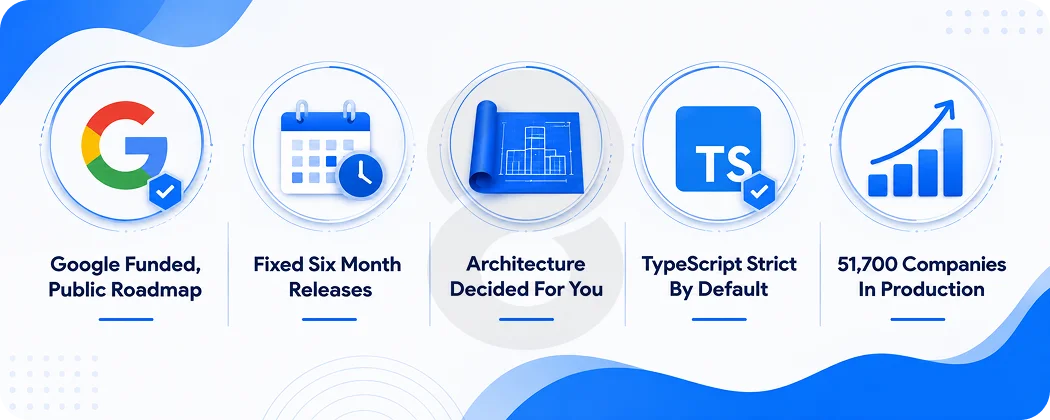
Google funds Angular, publishes a roadmap, and has hit its May and November release schedule for years. For a CFO signing off on a five-year platform, that predictability outweighs a lot of technical arguments. You can plan upgrade windows into a budget before the release exists.
Structure that survives team turnover
Angular decides the architecture so your team does not have to keep relitigating it. Module boundaries, dependency injection, and file layout are conventions rather than opinions. When a senior engineer leaves, the codebase does not leave with them.
Enterprise adoption you can point to in a board meeting
Angular runs the Google Cloud Console and Google Search Ads, admin surfaces in Microsoft 365, Deutsche Bank client platforms, Forbes, PayPal, Upwork, and Delta’s fare search. Roughly 51,700 companies are tracked as Angular adopters, and among companies that use a component framework at all, Angular holds close to half the category.
That last number is worth separating from the noise. Angular’s share of all websites is tiny, because most websites do not use a framework. Among organisations that deliberately chose a structured front end, it is a leader.
TypeScript discipline as a compliance asset
Angular has been TypeScript first since day one, with strict typing and ahead-of-time compilation catching a category of defects before anything reaches staging. In finance and healthcare, that is not a developer preference. It is part of how you answer an audit question about change control.
Read More: AI and Machine Learning: How a Modern App Development Firm Stays Ahead
Angular, Server Side Rendering, and AI Search Visibility
Here is the problem almost nobody puts in an Angular pitch deck, and it is now the single most expensive rendering mistake a business can make.
Your Angular application can rank on page one of Google and be completely absent from ChatGPT, Claude, and Perplexity answers. Same site, same content, two entirely different outcomes.
Why AI crawlers see an empty page
Googlebot renders JavaScript. It queues your page, runs it through a headless Chromium, and indexes what comes out. AI crawlers do not do this. GPTBot, OAI-SearchBot, ClaudeBot, PerplexityBot, and Bytespider fetch the raw HTML your server returns and move on.
Research from Vercel and MERJ analysing hundreds of millions of crawler fetches found no evidence of JavaScript execution across the major AI crawlers. They will download your JavaScript files, roughly 11.5% of ChatGPT fetches and about 24% of Claude fetches, and never run them. Google Gemini is the exception, since it borrows Googlebot’s rendering infrastructure.
So if your Angular app ships an empty div and a script tag, that empty div is your entire presence in the answer engines your buyers increasingly ask first.
What this costs a business
Think about which content sits behind client-side rendering on a typical B2B product site. Pricing tiers. Feature comparisons. Integration lists. FAQ answers. Case study detail. Every one of those is the exact content an AI assistant would quote when someone asks which vendor to shortlist.
You do not see this in analytics as a drop. You see it as absence, which is much harder to notice and much harder to attribute.
How Angular SSR fixes it
The good news is that Angular’s rendering options have caught up. You have full SSR, static prerendering for routes that never change, incremental hydration so only the pieces a user actually touches become interactive, and event replay to catch the clicks that land while hydration is still running.
The part worth writing down is what has to be sitting in the server-delivered HTML before any of that runs. Your body copy. Title and meta description. JSON-LD. Internal links as real anchor tags rather than click handlers. Canonical and hreflang. Anything on that list that only appears after hydration exists for Google and for nobody else.
The check you can run in ten minutes
Open a key page, view the page source, and search for a sentence you know is on that page. If the sentence is not in the raw HTML, neither is your AI visibility. Repeat for your pricing page and your top three service pages.
One thing to skip: llms.txt is not the fix. Adoption sits around 10% of domains studied, and most published files receive essentially no crawler requests. Fix the rendering first.
How Angular Fits Into AI Assisted Development
Framework choice now affects how well your AI coding tools perform, which is a sentence nobody would have written three years ago. Angular has invested harder in this than most of its competitors, and it changes the economics of a build in a way worth understanding before you sign anything.
The Angular MCP server
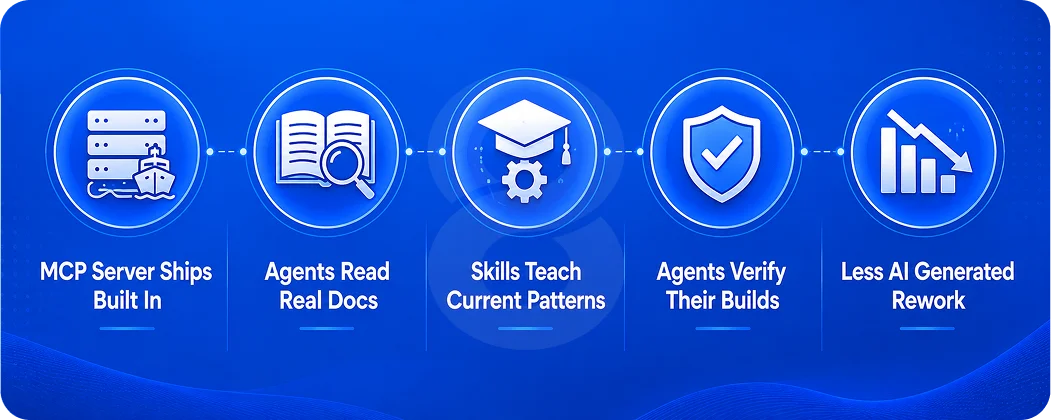
The Angular CLI ships with a Model Context Protocol server built in. Coding agents connect to it and get real tools instead of guesses: a best-practices reference, documentation search, current code examples, workspace analysis, build and test execution, and a migration tool that plans and applies an OnPush and zoneless conversion.
Chain it with a browser automation server and the agent can check its own work rather than reporting that something works when it does not compile.
Angular Agent Skills
Skills are a compact instruction layer that teaches a coding assistant current Angular patterns. Without them, assistants confidently produce 2019-era NgModule code that a senior developer then has to unpick. With them, generated code matches the version you are actually on.
Why a budget holder should care about this
Three reasons, all financial. Less rework from AI-generated code that compiles but uses dead APIs. Faster onboarding for developers who are new to your codebase. And migration work that a supervised agent can genuinely execute, which turns a version upgrade from a project into a task.
Read More: 10 Web Application Frameworks: Selecting the Best Tech for Your ROI
What Businesses Build With Angular
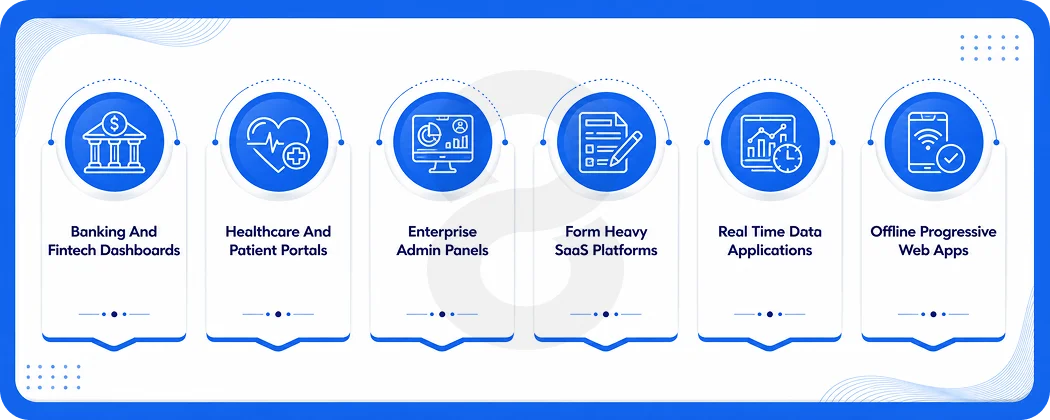
Angular shows up most often in applications where a user spends hours a day inside the interface rather than seconds. Dense data, complex permissions, long forms, and real-time updates are its natural territory.
Banking and fintech platforms
Trading dashboards, loan origination systems, and customer portals. Signal-based change detection handles live data updates without the whole-tree re-checks that used to make these screens sluggish, and the prescriptive architecture suits fintech platforms where an auditor will eventually read your code.
Healthcare portals and patient systems
Patient intake, scheduling, and clinician-facing records. Angular Aria matters here more than anywhere else, because accessibility is a legal requirement rather than a nice-to-have for most healthcare software buyers in the US.
Enterprise admin panels and internal tooling
The unglamorous work that keeps companies running. These systems live for a decade and get maintained by five different teams, which is exactly the scenario Angular’s structure is designed for.
SaaS products with heavy forms and permissions
Signal Forms took a lot of the pain out of multi-step, conditionally validated forms, which is most of what a serious SaaS application actually is once you get past the marketing site.
Real-time data applications
Logistics tracking, fleet monitoring, live pricing. Delta uses Angular for airfare search where results update as the user adjusts filters. Give it a decent API layer to work against and the front end stops being the thing holding everything up.
Progressive web apps
Service worker support is built in, so Angular is a reasonable starting point when the app has to keep working without a connection. Field service crews and warehouse floors are where this comes up most.
Read More: Custom Web App Design for SaaS Startups: Our Process Explained
Angular vs React vs Vue: A Decision Maker’s Comparison
Nobody wins this one outright. What you get instead is a set of conditions, and the useful version of the comparison is closer to a list of if-then statements than a scoreboard. Be wary of anyone who answers it with a single name, because that answer usually describes who they have sitting on the bench.
| Factor | Angular | React | Vue |
|---|---|---|---|
| Developer Usage (Stack Overflow 2025) | 18.2% | 44.7% | 17.6% |
| What It Is | Complete Framework | UI Library | Progressive Framework |
| Default Language | TypeScript | JavaScript Or TypeScript | JavaScript Or TypeScript |
| Time To Productive | 3 To 6 Months | 1 To 3 Months | 1 To 2 Months |
| Architecture Decisions | Prescribed By Framework | Made By Your Team | Flexible |
| Best Fit Team Size | 10+ Engineers | Any Size | Small To Mid |
| Common Industries | Finance, Healthcare, Government | Consumer, Startups, Media | SMB, Agencies, Asia Pacific |
| Five Year Maintenance | Scheduled, Predictable | Depends On Chosen Libraries | Moderate |
Usage figures come from the recent Stack Overflow Developer Survey, which polled more than 49K developers.
Where Angular wins
Large internal platforms with ten or more engineers. Regulated industries where prescriptive architecture is an asset in an audit. Products with a five-year-plus horizon. Teams coming from Java or .NET backgrounds. Applications where forms and permissions are the bulk of the work.
Where React or Vue wins
Speed to MVP. A wider hiring pool, since React job demand runs roughly two to one against Angular across the major boards. Consumer products where the design changes every quarter. Vue is often the pragmatic pick for smaller teams and is particularly strong in Asia Pacific markets. If your priority is content heavy pages with excellent search performance, Next.js deserves a look before either.
The talent trade-off nobody mentions
Angular’s smaller talent pool is usually framed as a pure negative. It is also less competitive. Enterprise Angular roles see lower churn than React roles, partly because the engineers who take them are not the ones chasing whatever launched last month.
There is a second data point worth knowing. Angular still accounts for a meaningful share of new enterprise projects, a number that is invisible in aggregate developer surveys because those surveys skew toward independent developers and startups.
Read More: React vs Angular: Which Framework Should You Choose for Your Next Web App?
Angular Web Development Cost and Timeline
Cost questions get vague answers because the honest answer depends on scope. What follows are the market rates you can verify and the planning bands most agencies work within, so you can sanity-check a proposal rather than accept it on faith.
What Angular developers cost
Most Angular salaries land somewhere between $109K and $134K in the US. Meanwhile, top earners get close to $146K and senior leads get well above that. Freelance is messier. Experienced developers quote anywhere from about $61 to $128 an hour, and where a given person falls in that spread has as much to do with what they specialise in as with how long they have been doing it.
Offshore and nearshore teams reduce that materially. The saving is real, and so is the coordination overhead, so build a few hours a week of overlap time into the plan rather than pretending it is free.
Cost by project scope
These are planning bands for a full build including design, development, QA, and deployment. Treat them as a starting point for a conversation.
| Project Type | Typical Scope | Timeline | Cost Range |
|---|---|---|---|
| MVP Or Internal Tool | Single Workflow, Basic Auth, One Integration | 8 To 12 Weeks | $25,000 To $50,000 |
| Mid Size Business App | Multiple Roles, Dashboards, 3 To 5 Integrations | 4 To 6 Months | $50,000 To $120,000 |
| SaaS Platform | Multi Tenant, Billing, Admin, Reporting | 6 To 9 Months | $120,000 To $250,000 |
| Enterprise Platform | Complex Permissions, Legacy Systems, Compliance | 9 To 18 Months | $250,000 And Above |
| AngularJS Migration | Rewrite Of An End Of Life Codebase | 3 To 8 Months | $40,000 To $150,000 |
What drives the number up
Integration count is the biggest lever, well ahead of screen count. Compliance requirements add QA and documentation time. Real-time features change the backend architecture. A design system built from scratch adds weeks before a single feature ships.
What people forget to budget
Two major upgrades a year. Accessibility audits if you are in healthcare, education, or government. SSR infrastructure, which costs more to run than static hosting. And ongoing support, usually 15% to 20% of build cost annually.
Planning for Angular Version Support and Upgrades
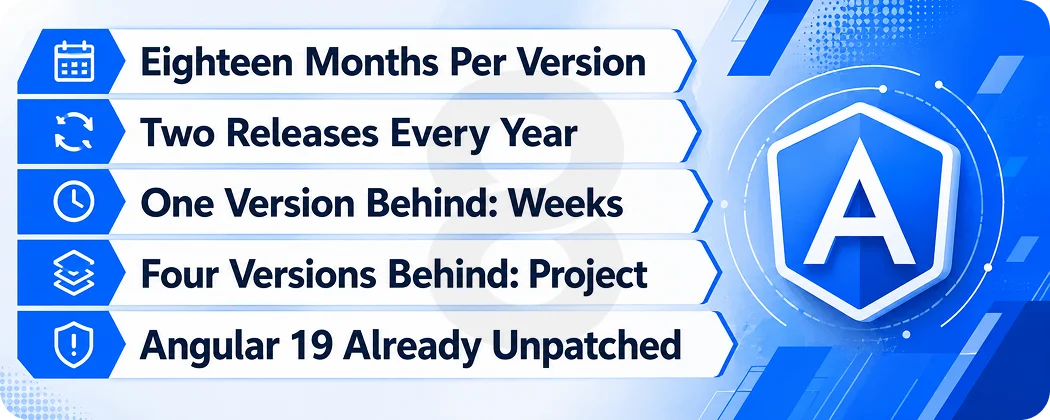
Version support is a budget line, not a footnote, and it is the item most often missing from proposals we review. Angular’s release cadence is public and fixed, so there is no excuse for being surprised by it.
The 18 month clock
Every major version gets six months of active support followed by twelve months of long-term support. Two majors ship each year, in May and November. Skip four in a row and you are running unpatched code in production.
One version behind versus four
A single-version upgrade on an enterprise application typically takes one to two weeks, most of it automated through ng update and the CLI migration schematics. Fall four versions behind and the automatic migrations start conflicting with each other, at which point a routine maintenance task becomes a quarter-long project with its own budget and its own risk register.
Budgeting two weeks of engineering time twice a year is dramatically cheaper than budgeting one rewrite every three years. Most organisations discover this the expensive way.
Read More: Angular Current Version vs. Legacy Builds: A Guide for CTOs Planning Their Next Hire
If you are already stuck on an old version
You have options. The CLI handles most breaking changes automatically. The MCP migration tooling can plan and apply the zoneless conversion under supervision. And commercial extended support exists for end-of-life versions if you need a bridge while you plan the real upgrade. What you should not do is nothing.
How to Hire Angular Developers
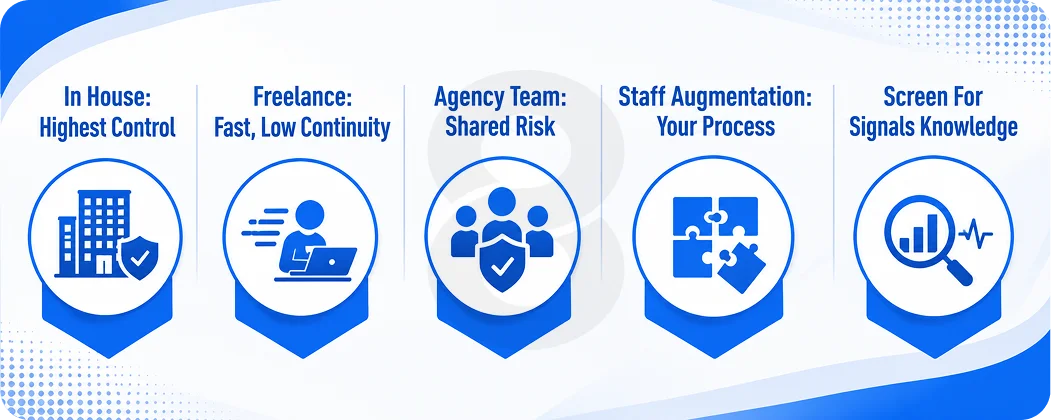
There are three ways to staff an Angular project and each fails differently. The right answer depends less on budget than on how long the work lasts and how much of it you expect after launch.
Building an in house team
Highest control, highest cost, slowest to start. Expect two to four months to hire a mid-level Angular developer in a competitive US market, plus onboarding. This makes sense when the application is core to your business and will be maintained indefinitely.
Freelance and contract developers
Fast to start and flexible on scope. The failure mode is continuity: freelancers finish, move on, and take the context with them. Works well for a defined piece of work with clear boundaries. Works badly as your only engineering capacity.
A dedicated agency team
You get a team rather than an individual, including QA and design, with the vendor absorbing turnover risk. It costs more than freelance and less than in-house once you count benefits and recruiting fees. Staff augmentation sits in between, where the agency supplies engineers who work inside your process and reporting lines.
What to screen for in 2026
Ask candidates and vendors about signals and zoneless change detection, SSR and hydration strategy, Signal Forms, testing with Vitest, and where they still reach for RxJS. Someone whose Angular knowledge stops at version 15 will write code your team spends the next year rewriting, and they will interview well while doing it.
elementor-template id=”10282″]
When Angular Is the Wrong Choice
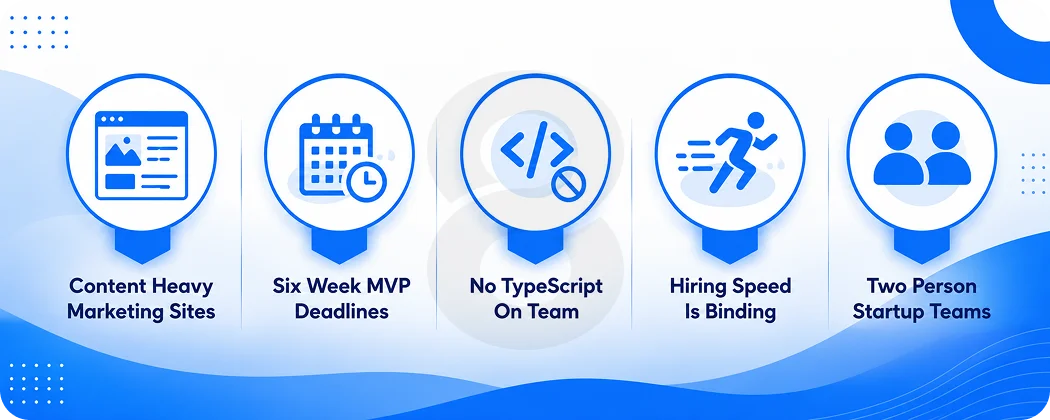
An agency telling you to use Angular for everything is telling you about its bench, not your project. Here are the cases where something else fits better.
Content-heavy marketing sites do not need it. A static site generator will be faster, cheaper, and easier to hand to a marketing team. Two-person startups racing to a demo in six weeks will lose time to Angular’s learning curve that they cannot afford, and React or Vue gets them there sooner.
Third case, and probably the most common one: a team with no TypeScript background and a date they cannot move. Angular takes TypeScript fluency as a given. Three months of ramp-up is what teams in that position tend to report, and it is not a worst case.
Hiring speed can settle it on its own. The React talent pool is roughly two and a half times the size of Angular’s, and when you need four engineers by March that fact will beat any architectural argument you can make. Angular is not the problem in any of this. It is just built for a particular kind of project, and these are not it.
Read More: Node JS App Development: The Complete Hiring Guide
How to Choose an Angular Development Company
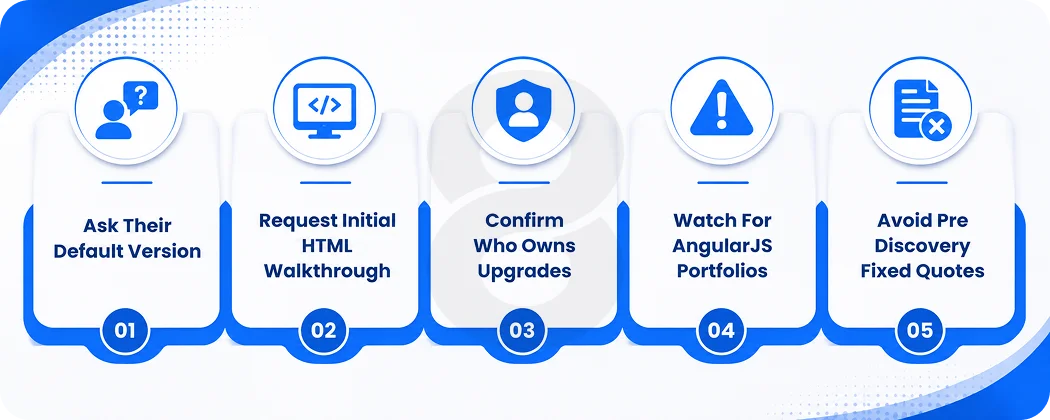
Most vendor evaluations focus on portfolio screenshots, which tell you almost nothing about whether a team can maintain your application in year four. These questions are more useful.
Questions that separate specialists from generalists
- Which version do you start new builds on? Anything below 21 and you want to hear a good reason, because there usually is not one.
- What goes into the initial HTML on a default project of yours? Ask them to walk through it rather than confirm they do SSR, since everyone says they do SSR.
- What is your approach to migrating an existing app to zoneless change detection?
- Who owns version upgrades after launch, and is that in the contract or billed separately?
- How do you test, and what is your coverage expectation on a project this size?
- Show me a codebase you maintained for more than two years and tell me what you would do differently.
Red flags
A portfolio where every Angular project is actually AngularJS. No clear answer on version strategy. A fixed-price quote offered before any discovery has happened, which almost always means the scope will be defended rather than delivered. And a proposal that never mentions rendering strategy at all, which tells you the AI visibility problem is going to be yours to discover later.
What a proper engagement looks like
Discovery and requirements first. Then architecture and API contracts, then a build that arrives in increments you can actually review. QA with accessibility inside it rather than bolted on at the end. Deployment with monitoring. And a support agreement that names an upgrade cadence instead of gesturing at one.
Six stages. If a proposal is short one, that is a question worth asking before you sign anything. Plenty of consulting engagements cover only the first two, and that is a sensible way to find out what a vendor is like before you hand them the whole build.
Read More: Best Web App Development Companies Worldwide
Building Angular Applications With 8ration

8ration builds web applications with Angular for clients across fintech, healthcare, logistics, and on-demand services. The Angular development practice covers new builds, AngularJS migrations, version upgrades, and adding SSR to applications that were originally shipped client-rendered.
On the engineering side, the team works across the surrounding stack rather than the front end alone, including Node.js backends, custom API design, and software testing as a separate discipline rather than an afterthought at the end of a sprint. For teams that need capacity inside their own process rather than an outsourced project, staff augmentation is available with engineers who work in your repos and your standups.
If you are weighing Angular against React or Vue for a specific product, that conversation is usually more useful than a proposal. 8ration will tell you when the answer is a different framework.