



A digital asset management system helps your business store, organize, find, approve, and share digital files from one central place. But that’s only the first step. When your brand assets move between marketing teams, designers, agencies, sales teams, ecommerce platforms, and external partners, you need more than storage. You need proof.
A marketing team uploads a product video. A designer edits it. An agency downloads it. Sales uses an older version in a pitch deck. Someone posts it after the licence expires.
Nobody planned the mess. It just happened.
That’s the everyday problem with digital assets. Files move too fast. Teams work across too many tools. AI content adds another layer of confusion. And once a file leaves your internal folder, you often lose track of who used it, when they changed it, and whether they had the right to use it at all.
A digital asset management system fixes much of that. It gives your business one place to store, organize, search, approve, and distribute images, videos, documents, audio files, design files, and brand assets. Adobe defines a DAM system as software that manages digital files across their full lifecycle, from creation and distribution to reuse and retirement.
But the next problem is trust. Your business needs to prove that an asset is original, track who owns it, and confirm that no one changed the file after approval. Usage rights also need to stay clear when partners, agencies, creators, and regional teams all touch the same asset. That’s where blockchain starts to make sense.
Why Digital Asset Management System Matters More in 2026
Content volume has exploded. Brands now need product photos, short videos, ads, landing page visuals, app graphics, pitch decks, social posts, creator content, AI generated content, and regional campaign variations. The numbers show why businesses are taking DAM more seriously.
The global digital content creation market was valued at $32.28 billion in 2024 and is projected to reach $69.80 billion by 2030, according to Grand View Research. The same report places the 2025 market value at $36.38 billion.
More content means more files. More files mean more mistakes. Teams waste time searching. Designers recreate assets that already exist. Sales teams use old logos. Ecommerce teams upload the wrong product image. Legal teams struggle to confirm whether an image is licensed for a region or campaign. That’s why modern DAM platforms focus on centralized asset repository, AI powered search, metadata tagging, workflow automation, approval workflows, brand asset management, and secure external sharing.
Canto’s 2026 DAM guide also lists features such as AI auto tagging, smart metadata, duplicate detection, version control, approval workflows, brand portals, permissions, rights tracking, and audit trails as major DAM capabilities. A normal DAM gives you control inside the system. A blockchain powered DAM extends that control beyond the system.
Read More: Digital Wallet Solutions: Complete Guide for Startups in 2026
Traditional DAM vs Blockchain Powered DAM
A traditional DAM answers one question. Where is the right file? A blockchain powered DAM answers a bigger question. Can we prove what happened to this file?
Area |
Traditional DAM |
Blockchain powered DAM |
| Storage | Stores files in cloud or private servers | Stores files off chain and records verified asset data on chain |
| Search | Uses folders, tags, filters, and metadata | Adds verified ownership, history, and asset status |
| Version control | Tracks versions inside the DAM | Creates tamper evident history for approved versions |
| Rights control | Uses permissions and expiry dates | Adds smart contracts for licences, usage rules, and royalties |
| Audit trail | Records internal activity | Creates an immutable audit trail that is harder to alter |
| Partner access | Uses portals and shared links | Adds proof of access, transfer, approval, and usage |
| Trust layer | Depends on platform records | Uses blockchain records for stronger verification |
IBM describes blockchain as a shared, immutable digital ledger for recording transactions and tracking assets across a business network. It also says blockchain can create a single source of truth and resist tampering because data is stored across multiple computers.
For DAM, that asset does not need to be a cryptocurrency. It can be a video, logo, product render, contract, training file, 3D model, or licensed image. The asset itself can stay in your cloud system. The blockchain records the proof.
Read More: Best Crypto Apps to Kickstart Your Blockchain Venture
What a Blockchain Powered DAM Actually Does
A blockchain powered digital asset management system combines a normal DAM platform with a blockchain record layer. Here’s the simple version. Your DAM stores and manages the actual file. Your blockchain layer records key events about that file.
That can include:
- Who created the asset
- When it entered the system
- Who approved it
- Which version became final
- What licence applies
- Which team can use it
- Which partner downloaded it
- When usage rights expire
- Whether the file hash changed
- Which campaign used it
The file can live in AWS, Azure, Google Cloud, IPFS, private servers, or a hybrid system. The blockchain should not store heavy media files because that gets expensive and slow. It should store proofs, hashes, permissions, ownership records, rights data, and transaction events. That’s the clean architecture. Use DAM for usability. Use blockchain for trust.
Read More: Blockchain for the Enterprise: Quantifying ROI and Strategic Success in 2026
Why Blockchain Makes Digital Asset Management System Stronger
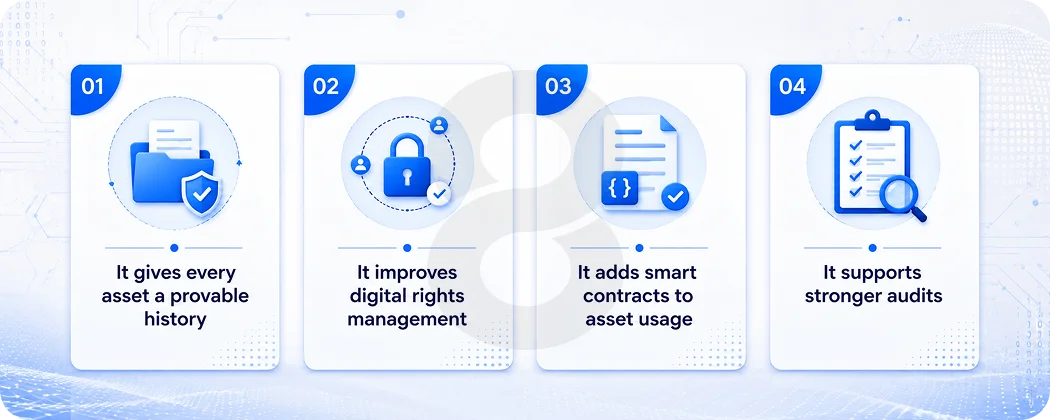
It gives every asset a provable history
Digital files are easy to copy. That’s the beauty and the danger. A brand image can move from a designer’s desktop to Slack, then to an agency folder, then to a freelancer, then to a social post. By the time a problem appears, nobody knows which version was approved or who changed it.
Blockchain creates content provenance. It records the origin and history of an asset in a way that gives teams stronger proof. The Content Authenticity Initiative explains that Content Credentials use C2PA standards and cryptographic methods to make content tamper evident. If someone changes the content or attached data after signing, the system can show that changes were made.
That matters for AI generated content, newsrooms, ecommerce, media companies, education platforms, legal teams, and regulated industries.
It improves digital rights management
Rights problems are expensive and embarrassing. A stock image licence expires. A music clip gets used outside the approved region. A creator signs off for Instagram usage, but the same content appears in paid ads. A product visual appears on a marketplace before launch. Normal DAM platforms can manage permissions and expiry dates. Blockchain makes rights records more traceable.
WIPO says blockchain can support IP rights management by recording creatorship, provenance, rights registration, distribution tracking, digital rights management, licences, exclusive distribution networks, and real time payments through smart contracts.
For a business, that means a DAM can become more than a file library. It becomes a rights control system.
It adds smart contracts to asset usage
Smart contracts can automate what happens when an asset is used. IBM defines smart contracts as digital contracts stored on a blockchain that execute automatically when preset terms are met. In a DAM, that can mean:
- A creator gets paid when a licensed video is used
- A partner loses access when a campaign ends
- A regional team can only download approved local versions
- A marketplace receives only product images approved for public release
- A paid media team gets blocked from using organic only assets
- A legal team receives alerts when usage passes a contract limit
You still need good legal agreements. Code does not replace legal review. But smart contracts help enforce agreed rules inside daily workflows.
It supports stronger audits
Audits get painful when evidence lives across email, folders, project tools, and old spreadsheets. A blockchain enabled DAM gives legal, compliance, IT, and marketing teams a cleaner record. Who touched the file? Who approved it? Which version went live? Which usage rights applied at the time?
IBM says blockchain can improve trust, security, and transparency by improving traceability across a business network. It also mentions immutable audit trails for regulatory compliance. That matters because security risk keeps rising. IBM’s 2025 Cost of a Data Breach Report puts the global average breach cost at $4.4 million. The same report says 97 percent of organizations that reported an AI related security incident lacked proper AI access controls.
A DAM cannot solve every security problem. But better asset governance reduces blind spots.
Read More: Top Blockchain Business Ideas Generating Massive ROI In 2026
Where Businesses Use Blockchain Powered DAM
Industry |
DAM problem |
Blockchain value |
| Ecommerce | Product images, videos, 3D models, marketplace files | Verified product media, approved versions, controlled partner access |
| Media and entertainment | Video files, scripts, music, licences, distribution rights | Content provenance, licence tracking, creator royalty logic |
| Fashion | Campaign assets, lookbooks, influencer content, regional usage | Ownership proof, usage limits, brand consistency |
| Healthcare | Patient education material, training videos, compliance documents | Approval records, audit history, controlled access |
| Education | Course videos, certificates, research files, student work | Proof of authorship, version history, verified credentials |
| Legal | Contracts, case files, evidence media, signed documents | Tamper-evident records, access logs, rights proof |
| Gaming and Web3 | 3D assets, skins, characters, collectibles | Asset tokenization, ownership tracking, NFT-based access |
| Real estate | Property videos, floor plans, virtual tours, legal files | Verified media history and document traceability |
If your business depends on content accuracy, ownership, rights, or public trust, blockchain powered DAM deserves attention.
Features Your Digital Asset Management System Should Include
A good DAM should be easy for humans and strict for systems. If your team hates using it, they’ll go back to Google Drive, Dropbox, WhatsApp, or email. Then the whole project fails.
Feature |
Why it matters |
| Centralized asset repository | Gives every team one place to find approved files |
| Metadata management | Makes assets searchable by campaign, owner, region, format, status, and licence |
| AI powered search | Helps users find files by visual similarity, object, face, topic, or context |
| Version control | Stops teams from using outdated files |
| Role based access control | Limits access by team, role, partner, region, or campaign |
| Digital rights management | Tracks licences, expiry dates, usage rules, and restrictions |
| Immutable audit trail | Records asset events in a tamper resistant way |
| Smart contracts | Automates usage rights, approvals, royalties, and access triggers |
| Brand portals | Gives partners and sales teams approved content without exposing the whole library |
| Content provenance | Shows where the asset came from and how it changed |
| Asset analytics | Tracks downloads, reuse, campaign use, and content performance |
| Cloud DAM implementation | Supports large asset libraries, remote teams, and high volume delivery |
Our digital asset management services already cover DAM development, multi format asset handling, metadata, tagging, secure storage, backup control, AI tagging, automated versioning, and asset delivery. That makes blockchain a natural extension when a business needs stronger ownership and verification.
Read More: 10 Profitable Blockchain Use Cases for Entrepreneurs
Blockchain DAM and AI Content Governance
AI has made content production faster. It has also made content trust harder. A designer can create ten ad concepts in minutes. A marketer can generate product lifestyle images without a studio. A video team can create AI assisted clips. That helps speed. But it also raises messy questions. Who created the asset? Which AI tool was used? Was the source material licensed? Was a real person’s likeness involved? Can we prove that this version was approved before publishing?
A blockchain powered DAM can record AI related metadata, approval history, and usage rights. It can also connect with Content Credentials and other provenance standards so your team can see where an asset came from. For many companies, AI governance will become a DAM problem. The files will sit inside the DAM. The proof should sit beside them.
That’s why AI powered search, automated metadata tagging, asset lifecycle management, and blockchain based provenance work well together.
How Blockchain Powered Digital Asset Management System Works
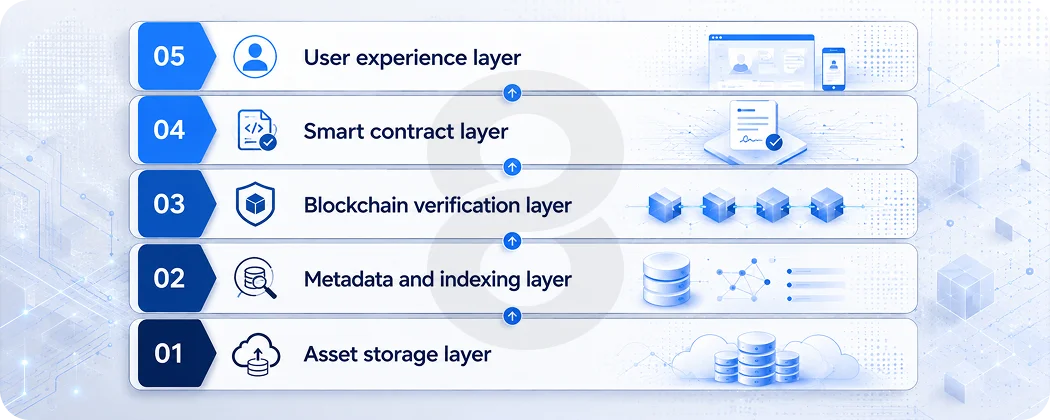
A practical blockchain DAM has five layers.
Asset storage layer
This is where the actual files live. For most businesses, this means cloud storage, private servers, or decentralized storage for selected assets. Large files stay off chain because storing them directly on blockchain is rarely practical.
Metadata and indexing layer
This layer stores details such as file name, format, creator, usage rights, campaign, region, tags, approval status, and version number. Strong metadata management decides whether users find the right file in seconds or waste half a day hunting for it.
Blockchain verification layer
This layer records hashes, ownership events, approvals, licence changes, access events, transfers, and usage logs. If a file changes, its hash changes. That gives the system a way to detect whether the approved file still matches the current file.
Smart contract layer
This layer handles rules. It can define who can use an asset, where they can use it, when access expires, and what happens after a licence condition is met.
User experience layer
This is the dashboard your team actually uses. It should feel simple. Search bar. Filters. Preview. Download. Share. Approve. Request rights. View history. Nothing confusing. The best blockchain systems hide the complexity. Users should not need to understand block confirmations to download an approved product image.
Implementation Roadmap for Businesses
Building a blockchain powered DAM starts with asset chaos, not code.
- Step 1: Audit your current asset library. Count file types, storage locations, teams, permissions, duplicated files, and licence risks.
- Step 2: Define your asset lifecycle. Map how assets move from request to creation, review, approval, publishing, reuse, archive, and retirement.
- Step 3: Choose what needs blockchain proof. You do not need to record everything on chain. Start with high value assets, licensed content, legal documents, AI generated media, partner files, and revenue linked assets.
- Step 4: Design your metadata model. Decide fields such as creator, owner, campaign, region, rights, expiry date, content type, approval status, hash, and distribution channel.
- Step 5: Build the DAM interface. Your team needs upload, search, preview, tagging, approval, sharing, access control, and reporting.
- Step 6: Add blockchain records and smart contracts. Connect asset events to verified records. Add licence rules where automation makes sense.
- Step 7: Integrate with your tools. Connect the DAM with CMS, ecommerce platforms, PIM, CRM, marketing automation, design tools, and analytics.
- Step 8: Train users and clean old habits. DAM adoption fails when people keep using side channels. Set rules, name owners, and make the new system easier than the old one.
How Much Does Blockchain DAM Development Cost
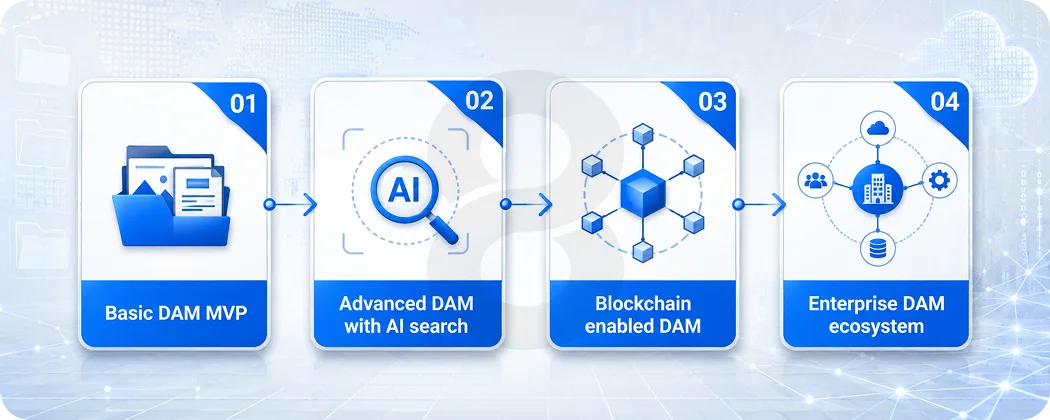
Costs depend on scale, integrations, security needs, and blockchain complexity. A small internal DAM costs far less than an enterprise platform with partner portals, AI tagging, smart contracts, audit dashboards, and ecommerce integrations.
Project type |
Estimated cost |
Best for |
| Basic DAM MVP | $25,000 to $60,000 | Startups and small teams that need upload, tagging, search, and access control |
| Advanced DAM with AI search | $60,000 to $140,000 | Growing brands with large content libraries and multiple teams |
| Blockchain enabled DAM | $100,000 to $250,000 | Businesses needing provenance, rights tracking, approvals, and audit trails |
| Enterprise DAM ecosystem | $250,000 plus | Large brands with partner portals, smart contracts, PIM, CMS, ecommerce, and compliance needs |
Do not build every feature at launch. Start with the assets that carry the highest risk or value. For example, product images, paid campaign videos, partner content, AI generated visuals, legal documents, and licensed creator files. That gives you a clear first version without turning the project into a monster.
Read More: How to Get a Crypto Wallet and Secure Your Digital Assets
Final Thoughts
A normal DAM helps your team find the right file. A blockchain powered DAM helps your business prove the right file, the right owner, the right version, the right licence, and the right usage history. That difference matters more now because content is faster, AI is everywhere, and brand assets move across more people than ever.
Businesses that depend on trust, rights, speed, and scale should start building that proof layer before the next content problem becomes a legal, security, or brand problem.