You know that Slack thread. Someone asks for “the final logo,” four people drop four files, and three of them are named final v2 REAL. By the time legal signs off, nobody is sure which version shipped to the printer, and the agency is invoicing for a re-export that should never have happened.
Multiply that across a few thousand brand assets, contracts, product photos, and signed licenses, and you start to understand why enterprise digital asset management software exists at all.
Here is the thing nobody tells you when you are knee deep in it. The folder mess is the symptom. The disease is that no two systems agree on what is true.
Marketing trusts the DAM. Finance trusts the contract PDF. Legal trusts the email chain. And when those three disagree, you lose a week reconciling instead of building. That week, repeated across a quarter, is a salary nobody budgeted for.
Blockchain walks into that fight with one stubborn promise. Write something once, and it stays written. Everyone reads the same record, nobody quietly edits history, and the file’s whole life is provable from first upload to final use.
Now set that next to a real asset library, the one already doing the unglamorous work of storage, search, and permissions, and the whole thing shifts. Five problems that felt permanent start to look like stuff you can actually fix.
None of it is magic, though. And anyone pitching it to you as magic should make you a little nervous. What follows is an honest walk through the five challenges that actually move when you combine a serious asset library with a ledger, plus the parts that stay hard no matter what the demo promised. Let’s go through them.
When No One Knows Which File is Real One
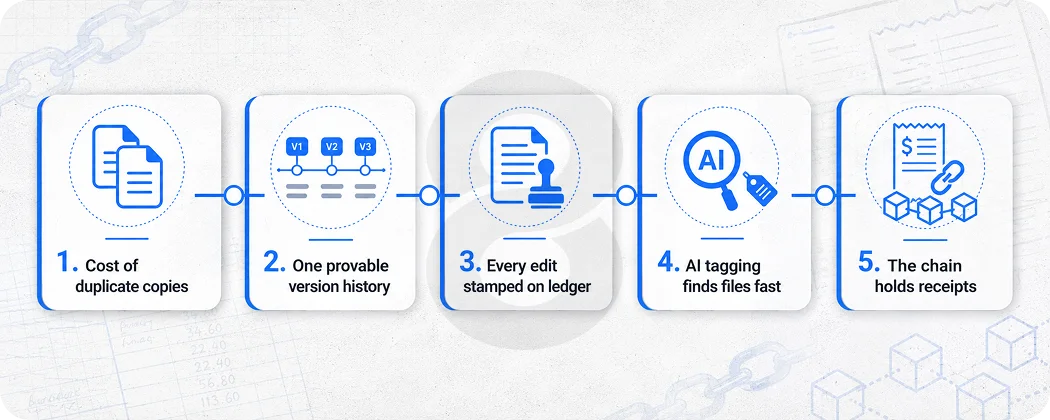
This is the boring crisis. Boring because it happens every single day, a crisis because it never stops costing you. Everybody keeps their own copies on their own drives. Filenames get changed, the metadata drifts, and before long version control is just folklore, something people half remember from a stand up three weeks back.
An enterprise digital asset management system already pulls all of that into one library and tracks versions, which beats a pile of shared folders any day. It still asks you to trust the database admin and the assumption that nobody with edit rights ever made a quiet mistake.
Put the version history on a distributed ledger and the question changes shape. Each edit, approval, and hand off gets stamped in a way that cannot be rewritten after the fact.
So when someone asks which file is real, the answer is not a vote and it is not the loudest person in the thread. It is a record. The provenance travels with the asset, from the first upload through every revision to the campaign that finally used it.
That single source of truth is what creative and operations teams have been begging for without quite naming it. No more screenshotting Slack to prove who approved what. No more digging through an inbox to find the version the client actually signed off on. The chain holds the receipts and the receipts do not change.
Where AI tagging fits
Finding the real file only matters if you can find it at all. A library with a hundred thousand assets and weak metadata is a junk drawer with a search bar. This is where automated tagging earns its place, reading images and documents and labeling them without a human typing keywords for hours.
The teams building AI models that flag unusual access patterns use the same underlying tech to tag assets accurately, so the provable version you trust is also the version you can locate in three seconds.
For companies running custom software built around their own approval flows, wiring tagging and provenance into existing tooling is where the value actually lands, not in the buzzword.
Proving You Actually Own the Asset
Ownership sounds simple until a contractor reuses a photo you only licensed for one region, or a former employee claims they made the thing, or a stock image turns up in a campaign with an expired license and a takedown notice attached.
Rights and licensing are messy because the proof usually lives in a separate contract that nobody reads until the moment there is a dispute, by which point the asset has already shipped to a million screens.
Blockchain handles this with tokenization. You attach a token to the asset that carries its license terms, its chain of ownership, and its usage rights, and that token cannot be forged or backdated.
This is the same mechanism powering the boom in tokenized real world assets, a market that analysts at Ark Invest project could surpass 11 trillion dollars by the end of the decade. The plumbing that proves who owns a tokenized bond is the exact plumbing that proves who owns a product render or a piece of brand video.
Inside a digital asset library, that means expiry dates enforce themselves instead of relying on someone to remember. A license that ends in March stops working in March, automatically, without a frantic email. The asset’s ownership history reads like a clean chain instead of a stack of PDFs in three different drives.
The financial services teams already living this shift lean on fintech platforms that move real money safely, and the rights logic that protects a payment can protect a brand asset just as well. The discipline is identical. Prove who owns it and make the proof impossible to fake.
Stopping Quiet Tampering and Leaks
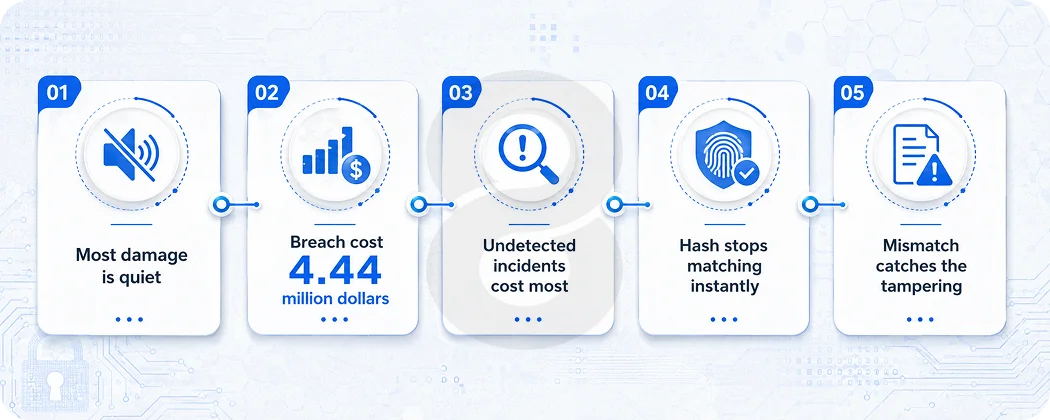
Most damage is quiet. Not a dramatic breach with a ransom note, just an asset swapped for a slightly altered version, a record edited to cover a mistake, a permission left open three months too long.
Traditional enterprise dam software leans on access control and encryption, which genuinely helps, but a privileged account can still rewrite history and clean up after itself. The log says everything is fine because the person who broke it also controlled the log.
IBM pegged the global average cost of a data breach at nearly five million dollars last year. It is usually the slow and quiet ones that cost the most. They sit there for months before anyone notices, and the damage just keeps stacking. By the time someone catches it, the altered asset is already out the door.
Tamper resistance is the whole reason a ledger earns its place here. Change a stored asset and its hash no longer matches the record on chain, so the tampering announces itself instead of hiding in plain sight. You do not have to catch the attacker in the act. The mismatch does the catching for you.
Role based permissions still matter and so does a sane offboarding process that actually removes access when people leave. Blockchain adds the one layer those controls cannot give you, which is a record of what happened that the attacker cannot quietly fix.
Security teams get a cleaner signal to work with, because the ledger tells them exactly what changed and when, down to the second. For organizations that want the underlying chain built carefully rather than bolted on, secure blockchain engineering is the difference between a system that resists tampering and one that just claims to.
The Audit That Used to Eat a Week
Ask anyone in a regulated industry about audit season and watch their face change. Healthcare, finance, and pharma all spend days pulling logs and praying the timestamps line up across four systems that were never designed to agree.
The work is real and the stakes are real, but most of the effort is just proving a negative, that nothing was altered and nothing went missing.
That is the exact job an immutable ledger does without being asked. Every access, every edit, every distribution event already sits in a chronological record that auditors can read directly, in order, with timestamps nobody can shift. The audit stops being a week long scramble and becomes a query you run in an afternoon.
Governance and compliance, which IBM lists among the core benefits of any serious digital asset management practice, get a foundation that does not depend on someone remembering to keep good notes through a busy quarter.
There is a quieter benefit too. When the trail is provable, internal disputes shrink. The argument over who approved the noncompliant asset ends the moment you point at the record. People behave a little better when they know the history cannot be edited, which is its own kind of control that no policy document ever delivered.
This is also where an enterprise digital asset management software setup earns its keep far beyond marketing. The same system that helps a creative team find a logo gives a compliance officer a defensible trail in front of a regulator.
Two very different people, one record, no contradiction between them. The teams running asset heavy operations across many sites often pair this with mobile apps their field crews actually use, so the audit trail captures what happens out in the world, on the loading dock and at the job site, not just the polished events back at headquarters.
Read More: Custom Digital Asset Management System Development
Getting It to Talk to Everything Else You Already Run
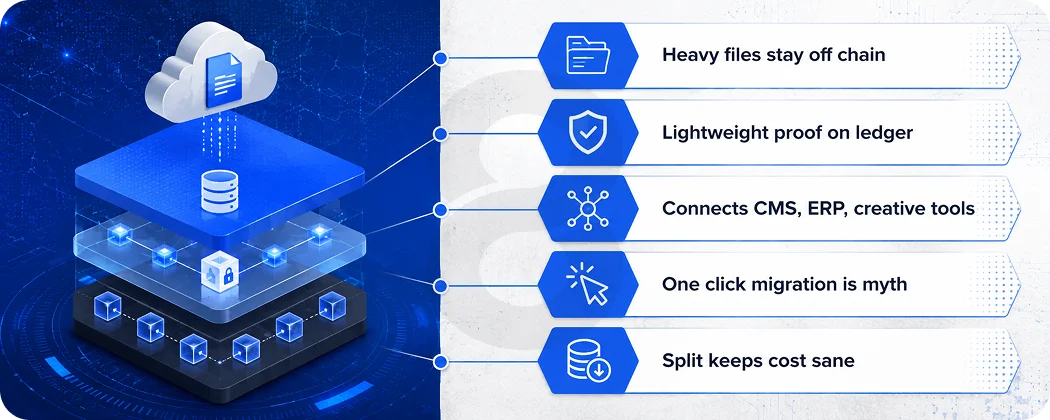
Here is the part that humbles every vendor demo. A blockchain ledger sitting on its own is a science project with a nice logo. Real companies already run CMS, ERP, creative suite, few marketing tools, and dozen homegrown scripts that one person understands and the new system has to fit into that mess without breaking the parts that currently work.
Interoperability is genuinely hard, and pretending otherwise is how pilots die. Different chains speak different protocols. Legacy systems were built in an era that never imagined any of this. A clumsy integration creates more silos than it removes, because now you have all the old systems plus a shiny new one that only two people know how to use.
The honest answer is that on chain records and off chain storage have to work together by design, with the heavy files living in scalable storage and the lightweight proof living on the ledger. Anyone who promises a one click migration across your whole stack has never actually done one.
There is also the question of volume. Asset libraries grow fast, and the rate at which companies generate content keeps climbing. The market reflects that pressure. The digital asset management market is expanding at a double digit growth rate for years to come precisely because the old way of managing files collapses under modern content velocity.
This is the difference between a tool that ranks well in a brochure and one that survives a year in production. Done right, the asset library becomes the connective tissue between teams instead of another login nobody remembers. Done wrong, it joins the graveyard of well intentioned pilots.
What Separates a Real Deployment From a Pilot That Dies
Plenty of companies have run a blockchain pilot. Far fewer have one in production a year later. The gap between those two outcomes has almost nothing to do with the technology and almost everything to do with the decisions made before a single line of code gets written.
The first decision is what actually goes on chain. Putting everything on a ledger is expensive and unnecessary. The teams that succeed anchor only the events that need to be provable. That single choice keeps costs sane and performance usable.
The second decision is the network type. A public chain, a private chain, and a permissioned network each fit different needs, and picking the wrong one bakes in years of friction.
A regulated enterprise rarely wants its asset history on a fully public chain, but a fully closed system can lose the trust benefits that justified the project. The right answer depends on who needs to verify what, and that question deserves deep thought rather than a default.
The third decision is the most human one… which is whether the people who will use this every day were in the room when it was designed. A flawless ledger that creative teams refuse to touch is a failed project.
Adoption is the metric that matters, not architecture diagrams. Good enterprise dam software succeeds when the daily users barely notice the blockchain is there and simply find that the version fights stopped and the searches started working.
Read More: Why Your Business Needs a Blockchain Powered Digital Asset Management System
How 8ration Approaches Enterprise Digital Asset Management in Blockchain
There is no single product that fixes all five challenges out of the box, and pretending otherwise is how companies end up paying for shelfware that sits unused. 8ration builds these the other way around.
Instead of shipping a fixed platform and hoping it fits, the team treats the asset library and the ledger as one custom system, shaped around how a specific company actually works rather than how a sales deck imagines it does.
So an 8ration engagement opens with the unglamorous questions. Where do your assets really live today, including the unofficial copies on personal drives. Who needs to prove ownership, and to whom, and how often. Which records have to survive an audit, and which can stay off chain to keep costs reasonable?
The answers decide what the team actually builds, whether that is a private chain, permissioned network, lighter setup where only the critical events get anchored, or AI tagging and rights logic layered onto the library a client already runs. The chain is a tool the team reaches for when it earns its place, not the starting point.
| Capability | Standard digital asset library | Blockchain backed asset library |
|---|---|---|
| Version history | Stored in a database an admin can edit | Anchored on a ledger no one can rewrite |
| Proof of ownership | Lives in a separate contract | Travels with the asset as a token |
| Tamper detection | Relies on logs and trust | Built in through hash mismatches |
| Audit readiness | Manual log pulling across systems | Queryable chronological record |
| Rights enforcement | Honor system | Self enforcing license terms |
| Findability | Manual tagging | AI tagging + provable record |
What 8ration is after with any enterprise digital asset management system is easy to say and hard to deliver. Solve version fights, ownership disputes, tamper risk, audit dread, and integration headache, without handing the client a fresh headache in return. That balance, more than any feature list, is the whole job.