


These days, companies don’t have to develop on two different applications. The need for cross-platform solutions has made a fundamental change to the approach companies are taking towards mobile development. One codebase, ship to both iOS and Android and get to market in half the time. That’s the deal.
The “hybrid apps feel clunky” argument has become increasingly moot as Flutter and React Native have grown up. Companies such as Google Pay, BMW and Shopify are using these frameworks in production and at scale. And as more and more businesses realize this, it’s not a question of if you should go hybrid. It’s only a matter of which company you’re comfortable with creating it.
This guide aims to list the best hybrid mobile app development companies around the world in 2026 by taking into account their cross-platform engineering depth, portfolio quality, client reviews and delivery track record. Not marketing pages. Actual evidence.
Hybrid Mobile App Development Industry at a Glance

But before we get into rankings, it’s good to grasp what’s really going on in the market today and why hybrid development continues to prevail.
Global Market Growth
The numbers speak volumes. The Business Research Company estimates the 2025 cross platform software market at $104.6 billion and forecasts the market will expand to $121 billion at a 15.7% CAGR in 2026. As for the frameworks that are favored, Flutter has secured a significant market share of about 46% of the users of cross-platform development tools around the world, followed by React Native at 35%, accounting for more than 80% of new production builds.
If using the right framework, code reuse is between 70–90% on iOS and Android, which means only a fraction of work is platform specific.
Why Businesses Prefer Hybrid Apps
The business case is quite simple. Lower upfront development costs and cheaper maintenance costs in the long run: one codebase. No double effort on two platforms. You launch faster. You update only once rather than twice. And you get to both iOS and Android users without doubling the budget.
That 30-50% cost savings could be the difference between shipping and stalling for startups. Shared codebases for enterprises result in fewer moving components and less tech debt over time. It’s virtually a handout on top of that that the device will have wider compatibility.
How We Ranked These Hybrid Mobile App Development Companies
All the companies in this list were evaluated on actual results, not presentations.
| Ranking Factor | Weight |
|---|---|
| Portfolio Quality | 20% |
| Technical Expertise | 20% |
| Client Reviews | 15% |
| Enterprise Clients | 15% |
| Years of Experience | 10% |
| Innovation & Tech Stack | 10% |
| Pricing Transparency | 5% |
| Post-launch Support | 5% |
Every company on this list was assessed against real-world deliverables, not slide decks.
Top Hybrid Mobile App Development Companies Globally
 8ration
8ration is a complete mobile product company that provides Flutter and React Native applications to startups, mid-market companies, and enterprises throughout various verticals. The team is capable of doing everything from strategy and UI/UX to backend integration, QA and post launch support. They have deployed apps for logistics, fintech, healthcare and ecommerce customers, and seen results. They also provide enterprise app development with serious microservices architectures.
- Headquarters: USA (with global delivery)
- Hourly Rate: $25–$60/hr
- Core Services: Flutter development, React Native development, cross-platform app strategy, UI/UX design, backend development, QA, enterprise mobile apps
- Industries Served: Healthcare, FinTech, E-commerce, Logistics, Real Estate, Education, Travel
- Rating: 4.9/5
 Intellectsoft
Intellectsoft is a software development company located in the USA, in operation for more than 10 years and proven for complex mobile solutions for enterprises. They provide cross-platform builds with strong integration options to existing ERP and CRM systems, making them an excellent choice for businesses requiring application and backend unification.
- Headquarters: Palo Alto, California, USA
- Hourly Rate: $50–$100/hr
- Core Services: Flutter, React Native, enterprise integrations, cloud-native mobile apps
- Industries Served: Healthcare, Finance, Manufacturing, Retail
- Rating: 4.8/5
 Andersen
With more than 3,500 engineers on its team, Andersen is a Warsaw-based software powerhouse. They have developed production-ready hybrid mobile applications for banks, healthcare services providers and SaaS solutions, in Europe as well as in North America. They have a QA-first development process and agile structure for reliable large-scale deliveries.
- Headquarters: Warsaw, Poland
- Hourly Rate: $40–$80/hr
- Core Services: React Native, Flutter, QA engineering, UI/UX, cloud integration
- Industries Served: FinTech, Healthcare, SaaS, Logistics
- Rating: 4.8/5
 Netguru
Netguru is a Polish digital product studio, famous for clean design and quick iteration. Their hybrid mobile work spans fintech, healthcare and retail products focused on UX research, even before the first line of code is written. Their services are ideal for startups and growing companies that need user-tested and refined applications.
- Headquarters: Poznań, Poland
- Hourly Rate: $50–$90/hr
- Core Services: React Native, product design, UX research, rapid prototyping
- Industries Served: FinTech, Healthcare, Education, Retail
- Rating: 4.7/5
 EPAM Systems
EPAM is an international engineering consultancy that takes care of mission-critical hybrid applications for large enterprises. Their delivery teams of React Native and Flutter operate within intricate ecosystems, spanning financial institutions such as banks and insurers to healthcare networks where security and scalability are paramount. It is not a startup’s first call, but who you want for enterprise grade builds.
- Headquarters: Newtown, Pennsylvania, USA
- Hourly Rate: $75–$150/hr
- Core Services: React Native, Flutter, enterprise architecture, security engineering
- Industries Served: Banking, Insurance, Healthcare, Government
- Rating: 4.7/5
 Vinova
Vinova is the only Asia-Pacific hybrid app specialist to be Bureau Veritas certified to ISO 9001 and ISO 27001 standards. They have experience in creating cross-platform application solutions for top-tier MNCs and government bodies in Southeast Asia, have deep expertise in ERP integrations, and Salesforce attachments.
- Headquarters: Singapore
- Hourly Rate: $30–$65/hr
- Core Services: React Native, Flutter, ERP/CRM integration, government apps, compliance-heavy builds
- Industries Served: GovTech, Logistics, Healthcare, Maritime
- Rating: 4.8/5
 Zco Corporation
One of the older names in the cross-platform development scene, Zco has built a reputation for producing complex and production-ready apps. Their hybrid solutions portfolio includes healthcare management tools, enterprise productivity apps and logistics platforms, and they have been working on hybrid solutions since it was not a no-brainer.
- Headquarters: Nashua, New Hampshire, USA
- Hourly Rate: $45–$90/hr
- Core Services: Flutter, React Native, enterprise mobile, IoT-connected apps
- Industries Served: Healthcare, Logistics, Enterprise SaaS
- Rating: 4.6/5
 Plavno
Plavno is a mobile-first agency that enables the development of scalable hybrid applications based on an agile and domain focused team structure. They’re often leaner and faster compared to the larger consultancies, making them a great option for growth-stage companies that require agility and speed without losing quality.
- Headquarters: Ukraine (distributed team)
- Hourly Rate: $30–$60/hr
- Core Services: Flutter, React Native, custom API development, performance optimization
- Industries Served: E-commerce, Retail, Healthcare
- Rating: 4.7/5
 Techanic Infotech
Techanic Infotech specializes in Flutter, React Native and custom hybrid frameworks and has a niche in startups and SaaS companies. They are nimble in their work and deliver on time and their fintech and logistics portfolios demonstrate great architecture choices and not just functional demos.
- Headquarters: India
- Hourly Rate: $20–$50/hr
- Core Services: Flutter, React Native, SaaS platforms, fintech apps
- Industries Served: FinTech, SaaS, Logistics, Travel
- Rating: 4.7/5
 RipenApps
RipenApps has successfully established a wide reputation in the world as a mobile development partner for startups as well as enterprises. They are experienced in developing consumer-facing platforms with a high user base and enterprise tools with the demand for backend support due to their proficiency in Flutter and React native. Their clients’ satisfaction ratings on Clutch and GoodFirms are always high.
- Headquarters: India / USA (distributed)
- Hourly Rate: $25–$55/hr
- Core Services: Flutter, React Native, mobile strategy consulting, UI/UX design
- Industries Served: Healthcare, FinTech, E-commerce, Education
- Rating: 4.8/5
Comparison Table of the Best Hybrid Mobile App Development Companies
| Company | Country | Best For | Technologies | Min. Project | Rating |
|---|---|---|---|---|---|
| 8ration | USA | Full-cycle cross-platform builds | Flutter, React Native, .NET | $5,000+ | 4.9/5 |
| Intellectsoft | USA | Enterprise ERP-connected apps | Flutter, React Native | $25,000+ | 4.8/5 |
| Andersen | Poland | Large-scale QA-driven delivery | Flutter, React Native | $20,000+ | 4.8/5 |
| Netguru | Poland | Startup products, UX-first design | React Native | $15,000+ | 4.7/5 |
| EPAM Systems | USA | Mission-critical enterprise apps | Flutter, React Native | $50,000+ | 4.7/5 |
| Vinova | Singapore | Asia-Pacific, government apps | React Native, Flutter | $10,000+ | 4.8/5 |
| Zco Corporation | USA | Complex production-ready apps | Flutter, React Native | $15,000+ | 4.6/5 |
| Plavno | Ukraine | Scalable startup builds | Flutter, React Native | $10,000+ | 4.7/5 |
| Techanic Infotech | India | Affordable SaaS and fintech | Flutter, React Native | $5,000+ | 4.7/5 |
| RipenApps | India/USA | Consumer apps at scale | Flutter, React Native | $5,000+ | 4.8/5 |
What Makes a Great Hybrid Mobile App Development Company?
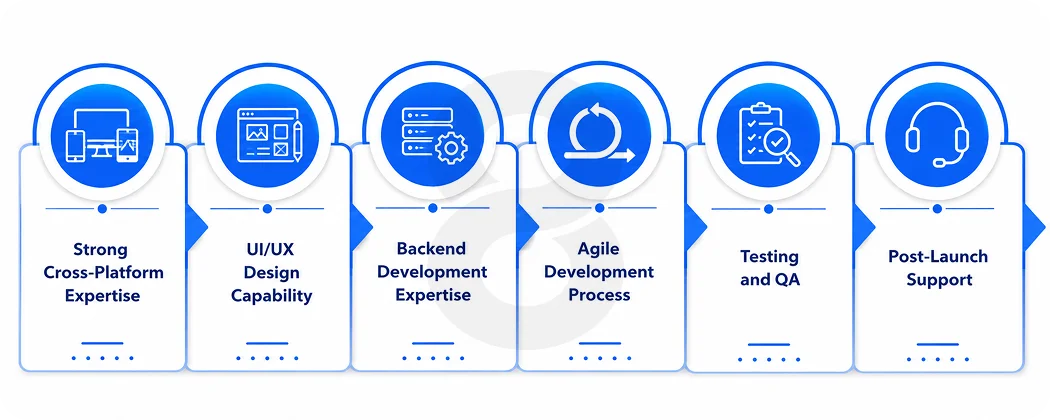
Plenty of agencies claim cross-platform expertise. Here’s what actually separates the good ones.
Strong Cross-Platform Expertise
They should have shipped real apps in Flutter, React Native, Ionic, and .NET MAUI, not just built proofs-of-concept. Request links to the App Store and Play Store. Download apps by yourself. When it feels janky, or the UI inconsistencies are apparent, that’s telling you something.
UI/UX Design Capability
An app that mimics a webpage inside an app is no hybrid app; it’s a thumbs down from users. The best companies have their own design teams that are familiar with the conventions of both platforms: iOS and Android. Great UX is not cosmetic; it is that which extends the usage of your product beyond day one.
Backend Development Expertise
Mobile applications are only as good as the APIs that provide data to them. Look for companies with Node.js, Laravel, .NET, Java, or Python backend experience. If their mobile team can’t discuss database architecture or API performance, you’ll feel that gap the moment your app hits scale.
Agile Development Process
Sprint based delivery is the key to an honest project. You can see working software every 2 weeks, not 6 months when there is a big reveal and it doesn’t look the way you talked about it in the kickoff. In addition, scope changes do not derail the entire project, as they always do in mobile development, and that is another aspect of being agile.
Testing and QA
Automated testing, manual testing, and performance testing are three distinct types of testing, and all three are important. A company that only has manual QA will not find regressions. If a company doesn’t have manual testing, they simply will not be able to register any edge cases that automation cannot handle. You want both, and testing on actual devices.
Post-Launch Support
Not many of the apps fail on the spot. They go stale over time as bugs get in, Operating System updates mess things up, and nobody’s looking. Ensure that your contract has maintenance, monitoring and a clear SLA for critical fixes.
Read More: Hybrid App Development: Costs, Benefits & Best Practices
Hybrid App Development Technologies These Companies Use
| Framework | Best For | Advantages | Limitations |
|---|---|---|---|
| Flutter | Pixel-perfect UI, gaming, fintech | Fast rendering, single codebase, strong performance | Dart learning curve, larger app size |
| React Native | JavaScript teams, social apps | Huge ecosystem, JS talent pool, hot reloading | Some platform-specific bridging needed |
| Ionic | Web dev teams, lightweight apps | HTML/CSS/JS, fast builds, browser preview | Lower performance than Flutter/RN for complex UIs |
| .NET MAUI | Microsoft-stack enterprises | C# shared codebase, desktop + mobile | Smaller ecosystem, fewer community resources |
| Kotlin Multiplatform | Sharing business logic, not UI | Native UI per platform, strong type safety | More complex setup, emerging adoption |
Flutter and React Native collectively power over 80% of new cross-platform production builds. The others serve specific niches well but don’t match the ecosystem depth of the top two.
Read More: Flutter vs React Native: Which Is Better for Business Apps
Industries That Benefit Most from Hybrid Mobile App Development
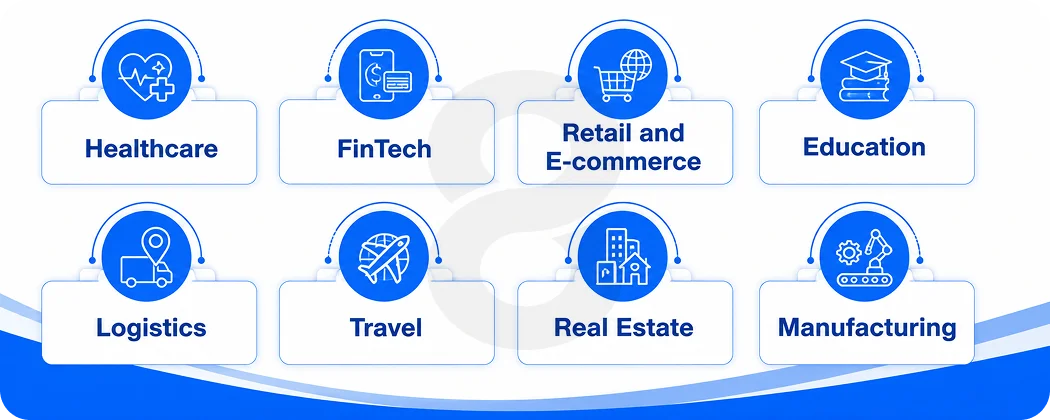
Healthcare
HIPAA-compliant patient portals, telemedicine apps, and health monitoring tools benefit from hybrid development because the codebase stays consistent across iOS and Android, which matters when you’re dealing with sensitive data and regulatory requirements.
FinTech
Payment apps, investment platforms, and digital wallets need fast, secure, and consistent interfaces across devices. React Native powers apps like the Facebook mobile banking interface; Flutter handles fintech apps at Google scale.
Retail
Product browsing, cart management, push notifications, and payment flows work well in hybrid frameworks. Shopify rebuilt parts of its merchant mobile experience in React Native and has been public about the productivity gains from sharing most of its code across platforms.
Education
E-learning platforms need to run across a wide range of devices including older Android phones. Hybrid development’s broad device compatibility makes it ideal for reaching students regardless of what hardware they’re using.
Logistics
Route management, real-time tracking, inventory scanning, and driver dashboards are all practical hybrid app use cases. The shared codebase means field teams on both iOS and Android scanners get the same experience.
Travel
Discovery apps, booking tools, itinerary management, and offline map functionality are well served by hybrid frameworks, especially when global reach means accommodating many device types.
Real Estate
Property listing apps, virtual tours, mortgage calculators, and agent dashboards are relatively stable in terms of UI complexity, which makes hybrid an efficient choice without sacrificing quality.
Manufacturing
Shop floor apps, equipment monitoring dashboards, and work order management systems often run on a mix of iOS tablets and Android devices. One codebase keeps maintenance overhead manageable.
How to Choose the Right Hybrid Mobile App Development Company
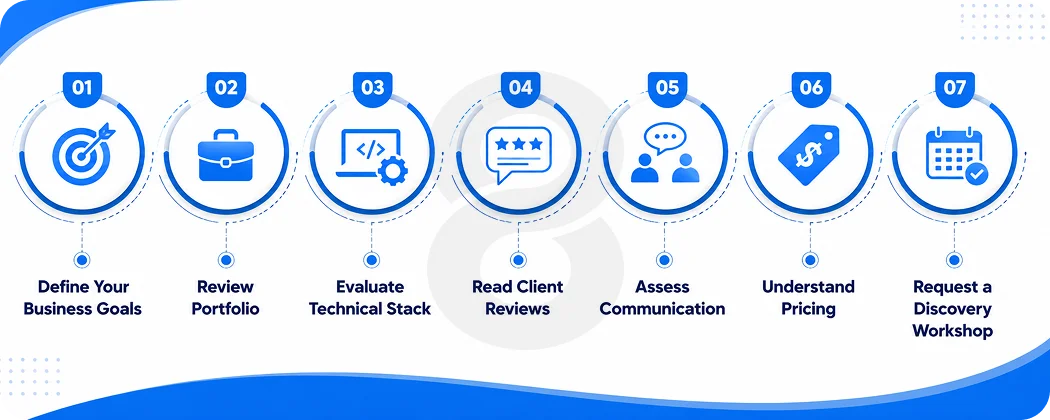
Define Your Business Goals
Before you contact a single agency, write down what success looks like. Not just “an app,” but specific outcomes. User acquisition targets, retention benchmarks, revenue milestones. Companies that understand your goals will ask better questions in the first call.
Review Portfolio
Look at shipped apps, not case study PDFs. Download the apps from the stores. Note load times, animation smoothness, and whether the UI feels native. This tells you more than any deck.
Evaluate Technical Stack
Ask which frameworks they use and why. A company that recommends Flutter for every project without asking about your team’s JavaScript background isn’t thinking about your specific situation. The right answer depends on your goals, your timeline, and what you’re building.
Read Client Reviews
Clutch, GoodFirms, and Google reviews show patterns over time. One bad review means little. Five reviews mentioning missed deadlines means something. Look for what keeps coming up, both good and bad.
Assess Communication
Your first interaction with their team tells you a lot. Do they ask good questions? Do they respond quickly? Moreover, do they admit uncertainty or oversell everything? The quality of communication during sales usually predicts what it’ll be like mid-project.
Understand Pricing
Ask for a detailed breakdown, not a round number. Understand what’s included in the quote and what triggers additional costs. Scope changes, additional platforms, backend work. Know the model before you sign.
Request a Discovery Workshop
Any serious development company will offer a discovery phase before writing a line of code. This is where requirements get defined, architecture gets decided, and edge cases get surfaced. Skipping this to save money upfront usually costs more later.
Read More: 20 Best Mobile App Development Companies
Hybrid App Development Cost in 2026
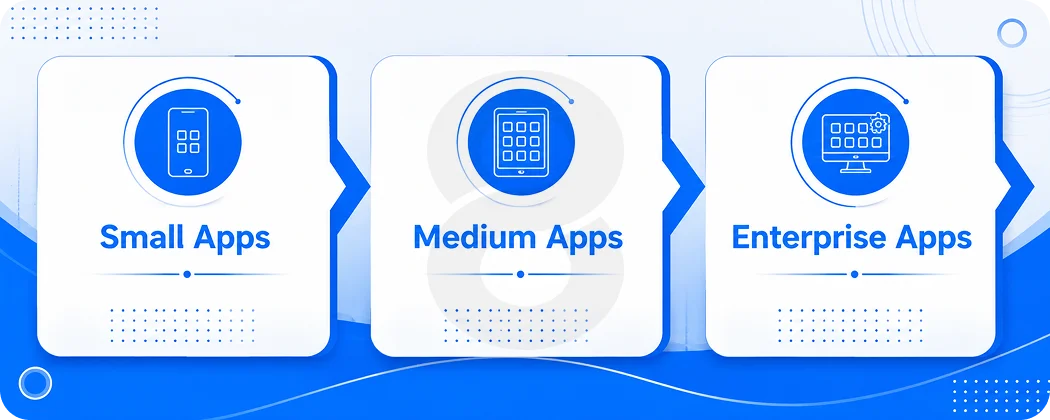
Small Apps
Basic functionality: user auth, a few screens, simple backend. You’re looking at $10,000–$30,000 and typically 2–4 months to delivery.
Medium Apps
Multiple user roles, third-party integrations, payment processing, custom notifications. Budget $30,000–$80,000 and 4–6 months.
Enterprise Apps
Complex workflows, ERP/CRM sync, offline functionality, multi-region deployment, strict security requirements. $80,000–$250,000+ and 6–12 months minimum.
| App Type | Estimated Cost | Timeline |
|---|---|---|
| Simple / MVP | $10,000–$30,000 | 2–4 months |
| Medium Complexity | $30,000–$80,000 | 4–6 months |
| Enterprise Grade | $80,000–$250,000+ | 6–12+ months |
Common Mistakes Businesses Make When Hiring Hybrid App Development Companies
Choosing based only on price
The cheapest quote often reflects the least experienced team or the most optimistic scope interpretation. Price is one data point, not the only one.
Ignoring scalability
An app that works for 500 users but breaks at 50,000 isn’t a finished product. Ask how the architecture handles load before you commit.
Poor requirement documentation
“We want something like Airbnb” is not a spec. Vague briefs produce vague builds. Get your requirements written down before you engage anyone.
No maintenance agreement
Apps require ongoing care. OS updates, security patches, API deprecations. If there’s no maintenance plan in your contract, you’ll be paying emergency rates the first time something breaks post-launch.
No NDA
Protecting your idea and your user data starts with a non-disclosure agreement before any discussion of architecture or features.
Weak communication
Working across time zones with a team that doesn’t communicate proactively is a slow-motion disaster. Establish meeting cadence, reporting frequency, and escalation paths upfront.
Technology mismatch
Choosing React Native when your product roadmap includes heavy animations and custom rendering will cost you later. Make sure the framework fits the product, not just the agency’s preferences.
Read More: Mobile App Development Team: Hiring Tips for Businesses
Hybrid vs Native Development Companies
| Feature | Hybrid | Native |
|---|---|---|
| Cost | 30–50% lower | Higher (separate codebases) |
| Speed to Market | Faster (single codebase) | Slower (two builds) |
| Performance | Near-native (Flutter/RN) | Maximum native performance |
| Maintenance | One codebase to maintain | Two separate codebases |
| UX | Platform-consistent with good design | Fully native platform feel |
| Scalability | Strong with right architecture | Excellent per platform |
| Offline Functionality | Good | Excellent |
For most businesses, hybrid is the smarter starting point. You get to market faster, at lower cost, with acceptable performance. Native makes sense when you’re building something where hardware-level performance is the product, like a camera app or a demanding mobile game.
Read More: Native App vs Hybrid App Development: A Business Owner’s Decision Guide
8ration: Cross-Platform Mobile Development Done Right
8ration is a full-service mobile development company with deep expertise in React Native and Flutter app development, building cross-platform products that serve startups and enterprises across healthcare, logistics, fintech, and e-commerce. Their engineering teams work end-to-end: strategy, design, development, QA, deployment, and post-launch support.
What separates 8ration’s approach is architecture thinking from the start. They don’t just write code that works today. They build modular, maintainable codebases that support the product as it grows. Their microservices infrastructure has supported applications handling over 10,000 simultaneous users, and their UI work consistently passes platform-specific quality bars on both iOS and Android.
For businesses that need cross-platform developers without the overhead of a large consultancy, 8ration offers flexible engagement models: dedicated teams, augmented staffing, and fixed-scope project delivery.
Final Thoughts!
Picking the right hybrid mobile app development company matters more than picking the right framework. The best teams bring architecture thinking, real design capability, backend depth, and the kind of communication that keeps projects on track when scope inevitably evolves.
Flutter and React Native have made hybrid development a legitimate first choice for enterprises, not just a budget option for startups. The companies on this list prove that a single codebase can deliver serious applications across industries.
Compare partners based on what your business actually needs: industry experience, technical expertise, and long-term support, not just the lowest hourly rate. The cheapest option rarely ships the best product.